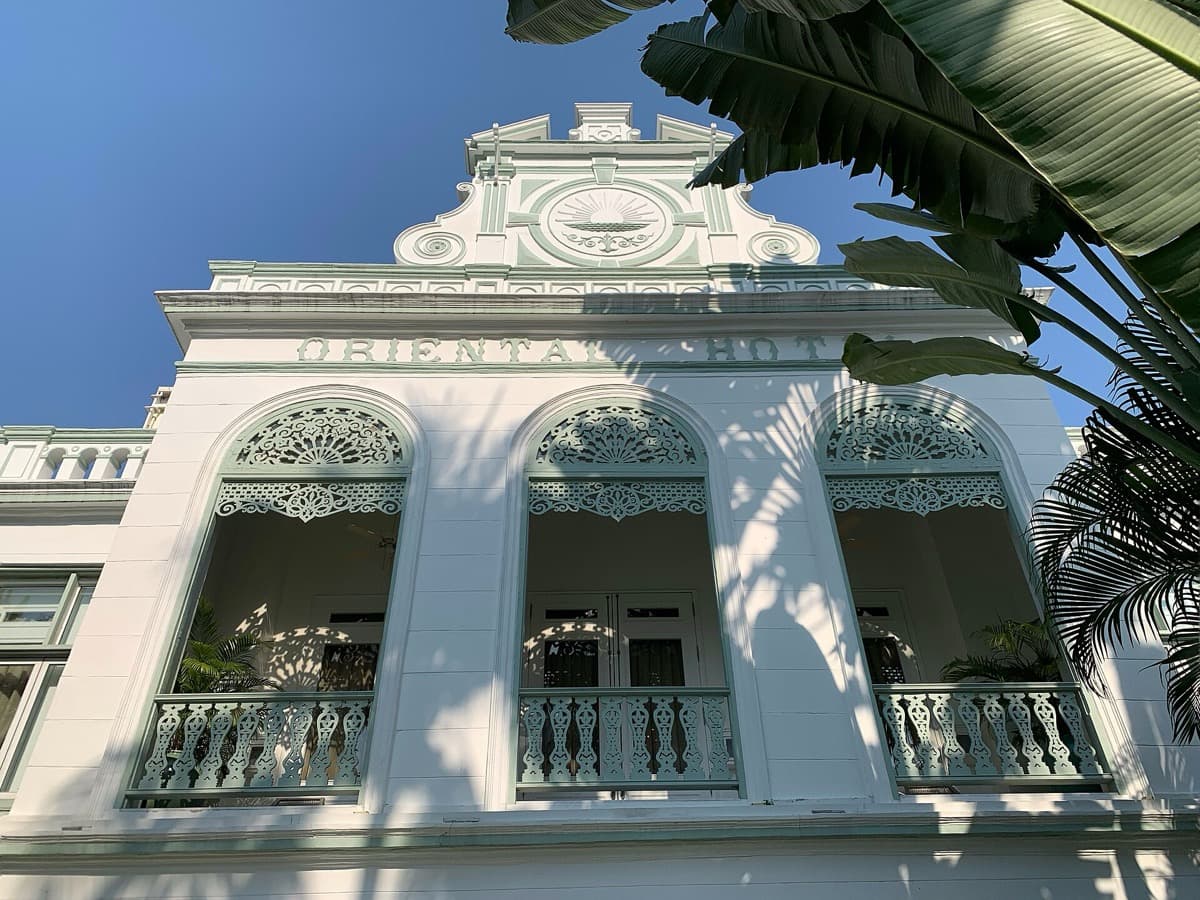
The Mandarin Oriental, known for most of its life simply as The Oriental, sits at the water's edge in Bang Rak where the Chao Phraya river bends past the old foreign quarter. According to the Wikipedia record, it is recognized as the first hotel built in Thailand and the oldest hotel in Bangkok. That fact does most of the work of explaining the building. A hotel is a piece of infrastructure for arrival, and this one was engineered, over several rebuilds, to be the place the foreign world came ashore. To read the Oriental correctly, you have to read it as a machine for landing travelers on a riverbank, positioned exactly where the money and the traffic already were.
A hotel built on a burned foundation
The site has a longer working life than the current establishment lets on. An earlier hotel stood here and burned in 1865. Danish sea captains opened its replacement, and the hotel dates its official establishment to 1876. That founding year is the number that matters, because it is what makes the Oriental the oldest hotel in Bangkok. It also places the hotel's origin only about a decade after Charoen Krung, the first road in Siam built by modern methods, was laid down the spine of this quarter. The road opened in 1864. The hotel opened in 1876. The sequence is not a coincidence. Once a paved land route existed alongside the river, a permanent building for housing arriving foreigners became worth constructing, and the riverbank at Bang Rak was the natural place to put it.
The Danish thread that shaped the riverbank
Hear a stop from this walk
The East Asiatic Building
The single name to carry through this stop is Hans Niels Andersen. He founded the Danish East Asiatic Company in 1884, and its Renaissance Revival headquarters, the East Asiatic Building, still stands next door on the same stretch of bank. Andersen bought the hotel property in 1881 and developed it into a proper luxury hotel, with a new building opening in 1887. That means one Danish businessman built both the great trading house and the grand hotel on adjacent plots of the same riverfront. The engineering lesson here is about clustering. Commerce and lodging were placed side by side, on the water, so that the man arriving to do business and the room he slept in were a short walk apart. The river was the through-line. If the road opened the door and the trading house handled the money, the Oriental gave the foreign world a place to sleep, and then a place to be seen.
Why the position on the Chao Phraya is the whole point
Look at where the hotel faces. It presents itself to the Chao Phraya, not to the street behind it. For generations of Western travelers, the river was the way into Bangkok, and this was the arrival point. That single orientation is what made Bang Rak the foreign quarter rather than any other bend in the river. A hotel that fronts the water advertises itself to everyone coming upstream by boat, and it collects them at the exact moment they need a room. The design decision to build toward the river, rather than toward the land city forming behind it, is the reason the Oriental became an address and not merely a building. You can still admire the hotel from Oriental Avenue and the riverside, and the water frontage is where the logic of the place becomes obvious. The interior is for guests and patrons.
The Authors' Wing and the stories the hotel keeps
The Oriental is famous for the writers it collected, and it curates that lineage deliberately. Its Authors' Wing honors literary guests, with spaces named for W. Somerset Maugham, along with Noel Coward, Graham Greene, and others. By hotel lore, Maugham first came to Bangkok in the 1920s and nearly died of malaria here. There is a quieter story about Joseph Conrad, once a ship's officer on this river, who by the hotel's own tradition drank at the bar but could never afford to stay the night. The honest way to treat these, and the way the hotel itself treats them, is as cherished stories rather than settled fact. They are worth knowing because they explain the second function the hotel performed. Once it was the place foreigners arrived, it became the place they were recorded, and the literary names attached to it are the marketing residue of a century of being the address where Bangkok was written about.
Reading the building in the argument of the quarter
Stand on the riverside and hold the paradox that runs through all of Bang Rak. This strip of cathedral, trading house, and grand hotel was built in the very decades when European empires were absorbing the rest of Southeast Asia, yet Siam alone was never colonized. The Oriental is a European kind of building, built by Danish interests, catering to Western travelers, and it sits on ground the kingdom never surrendered. The hotel is not a colonial imposition. It is what a sovereign kingdom allowed onto its riverbank because it had decided, on its own terms, to open a controlled door to the West. The customs house a little further downstream, where every ship paid its duties, is the reminder that the kingdom priced this encounter. The hotel is the comfort at one end of that transaction; the customs gate is the toll at the other. Both belong to the same negotiated arrangement.
The Oriental is the fifth stop on Roamer's self-guided audio walk through this quarter, and it is best understood in sequence, after the road, the post office, the cathedral, and the trading house have set up the argument. If you want to walk the full riverside line for yourself, start with the other Bangkok walking tours or head straight to Bangkok to open the Bang Rak route. Come in the late afternoon, when the low sun lights the river frontage, and let the water reframe the building as you approach it.
Sources
- Mandarin Oriental, Bangkok (Wikipedia): the hotel's 1876 founding, its status as the oldest in Bangkok, the 1865 fire, the Danish sea captains, and the Authors' Wing literary lineage.
- East Asiatic Building (Wikipedia): Hans Niels Andersen and the 1884 founding of the Danish East Asiatic Company whose headquarters stands beside the hotel.
- Charoen Krung (Wikipedia): the 1864 opening of the first modern road in Siam that anchors the Bang Rak quarter the hotel helped define.
- Roamer tour "The First Road" (bangkok-charoenkrung): the fact-audited stop text for the Oriental Hotel and its place in the riverside sequence through Bang Rak.
Ready to experience it?
Bang Rak (Charoen Krung): The First Road
90 min · 2.5 km · easy
More from Bangkok
Explore more at your own pace.
Bangkok Travel Guide 2026: Days, Transport, Season, Safety, and Budget
Bangkok in Layers: A Capital Founded as a Copy, Still Open for Business
Charoen Krung Road: How Siam's First Modern Street Built a Colonial-Looking Quarter That Was Never a Colony
The Emerald Buddha and the Palace: How Bangkok Was Built to Replace a City That Burned
The Golden Buddha of Wat Traimit: The Statue That Hid Its Own Gold for Two Centuries