Wat Arun, the Temple of Dawn, is the one stop on Bangkok's founding walk that refuses to fit the story around it. Rise a tower on the wrong bank of the Chao Phraya, cover it not in gold but in the broken porcelain that trading ships dumped as ballast, and you have a monument that belongs to an older capital than the one that displaced it. Standing on the west bank looking up at the great prang, the single thing worth understanding is this: everything on the far shore was built to resurrect a lost city, and this temple was already here, watching, when that resurrection began.
A temple older than the capital that faces it
The city across the water is young by the standards of its own temples. Bangkok was founded in seventeen eighty-two, when the first king of the Chakri dynasty laid out a new royal island on a bend of the river. Wat Arun predates that founding. It already stood in the Ayutthaya era, before Bangkok existed as a capital at all.
Its modern identity begins with a king most visitors have never heard of. When Ayutthaya fell to the Burmese in seventeen sixty-seven, the general who rallied the shattered kingdom, King Taksin, made nearby Thonburi his capital rather than the ruined old city. Thonburi sits on this west bank, and Taksin renamed the temple standing here Wat Chaeng. That means the tower you are looking at served the capital that came immediately before Bangkok. For roughly fifteen years, between the fall of Ayutthaya and the founding of Bangkok in seventeen eighty-two, the center of the Thai world was here, on this side of the river, and this temple was part of it.
Then the capital moved. The Chakri kings crossed to the east bank and built their new royal island, the Grand Palace, the Emerald Buddha, the whole cosmological plan of concentric rings. Wat Arun did not move with them. It stayed on the Thonburi side, in what is now the Bangkok Yai district, a relic of the capital that lost its status the moment the new one was drawn. When you cross the river from Tha Tien Pier and look back, you are seeing the geography of a demotion. The winners took the far bank. This temple kept the losing one.
The tower, and why its height is honestly unknown
Hear a stop from this walk
Museum Siam: Decoding Thainess
The central prang is a Khmer-style tower meant to symbolize Mount Meru, the mountain that stands at the center of the cosmos in Hindu and Buddhist thought. It was not always this tall. The second Chakri king, Rama the Second, had the temple restored and began plans to raise the main pagoda. The work carried on into the reign of Rama the Third and was completed around the year eighteen fifty-one, after years of continued construction.
Here is a detail that most guidebooks quietly smooth over, and it is worth keeping because it is true. Nobody agrees on how tall the prang actually is. Published figures scatter across a wide range, from roughly sixty-seven metres to about eighty-six metres, depending on the source and on where the measurement starts and stops. If you want a single confident number, you will not find an honest one. What is beyond dispute is the effect. From the deck of the cross-river ferry, the tower reads as enormous, a spire of pale ceramic climbing far above the shophouse roofs of the west bank. Take the exact metre count as uncertain and trust your eyes instead.
The crockery of trade, pressed into a sacred skin
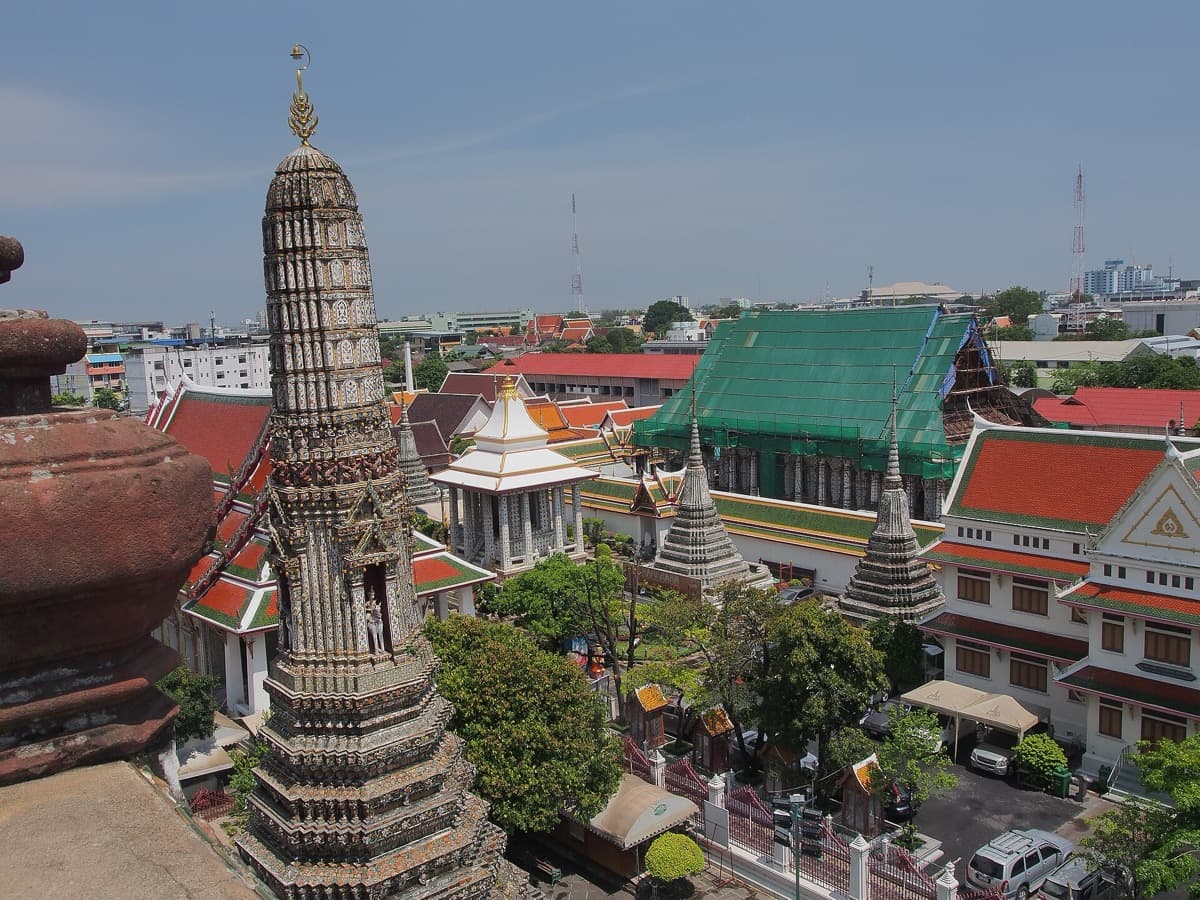
Come close, close enough to touch the base, and the surface dissolves into thousands of small fragments. The prang is encrusted in broken, colourful Chinese porcelain and in seashells. This is the detail that carries the meaning of the whole place.
These were not precious materials commissioned for a temple. The porcelain arrived as ballast. Trading junks sailing from China to the river needed weight in their holds to steady them at sea, and broken ceramic served the purpose cheaply. When the ships reached port, the ballast was unloaded and discarded. Someone gathered that discarded crockery, the debris of commerce, and pressed it piece by piece into lime plaster across the skin of a Buddhist tower. Flowers, plates, and cups, snapped and rearranged, became the ornament of a monument to Mount Meru.
Set that against the far bank. The royal temples of the new capital glitter in gold leaf and mirrored glass, the deliberate splendor of a dynasty proving its legitimacy. Wat Arun glitters too, but in a different currency. Its shine is the leftover of trade, the practical trash of ships turned into something sacred. One bank asserts royal restoration in gold. The other bank, the older one, wears the fragments of ordinary commerce and makes them holy. The tension of the whole royal island is visible here in a single glance across the water.
What the restoration revealed
The porcelain skin needs constant care, and the most recent major intervention ran from the year twenty thirteen to the year twenty seventeen. Restorers replaced a large number of broken tiles and refinished many surfaces with lime plaster, undoing cement patches from earlier, cruder repairs. As the work finished, photographs of the paler tower drew public criticism that it looked whitewashed compared to the darker temple people remembered. Thailand's Fine Arts Department answered that the lighter finish was closer to the temple's original appearance, and that the earlier grime was not the true face of the prang. The argument itself is telling. Even the color of this temple is contested, a place where authenticity is something people fight over rather than simply inherit.
Standing in front of it
Give yourself the walk up the steep flights of the lower terrace, where the porcelain detail is close enough to read individual patterns. Look for the flower forms and the fractured plate edges, and remember that each one crossed an ocean as dead weight in a ship's hold. Foreign entry runs around two hundred baht. The light matters: late afternoon, when the sun drops behind the tower and the river carries the glow, is when the Temple of Dawn earns its name in reverse, catching fire at dusk rather than sunrise.
This landmark is the pivot stop on the Rattanakosin founding walk, the moment the story crosses the river and complicates itself. To reach it on foot, with the full sequence of shrine, palace, royal field, and reclining Buddha leading you to the water and across it, walk the founding-island route among our Bangkok walking tours, or browse everything on offer in Bangkok. The temple reads best as the answer to a question the east bank spends the whole morning asking.
Sources
- Wat Arun, Wikipedia. origin in the Ayutthaya era, Taksin's renaming to Wat Chaeng, the prang raised under Rama the Second and Third and completed around eighteen fifty-one, ballast-porcelain decoration, and the twenty thirteen to twenty seventeen restoration and its whitewash controversy.
- Roamer, "The Royal Island" tour transcript (fact-audited, en.json). the Thonburi displacement narrative, Mount Meru symbolism, the sixty-seven to eighty-six metre height uncertainty, and the roughly two hundred baht foreign entry.
- The History of Wat Arun, Cittra Collective. background on the temple's construction phases and porcelain ornament.
- Wat Arun Bangkok, TripThaiTour. current visitor entrance fee, opening hours, and dress code.
Ready to experience it?
Rattanakosin: The Royal Island
120 min · 5.5 km · moderate
More from Bangkok
Explore more at your own pace.
Bangkok Travel Guide 2026: Days, Transport, Season, Safety, and Budget
Bangkok in Layers: A Capital Founded as a Copy, Still Open for Business
Charoen Krung Road: How Siam's First Modern Street Built a Colonial-Looking Quarter That Was Never a Colony
The Emerald Buddha and the Palace: How Bangkok Was Built to Replace a City That Burned
The Golden Buddha of Wat Traimit: The Statue That Hid Its Own Gold for Two Centuries