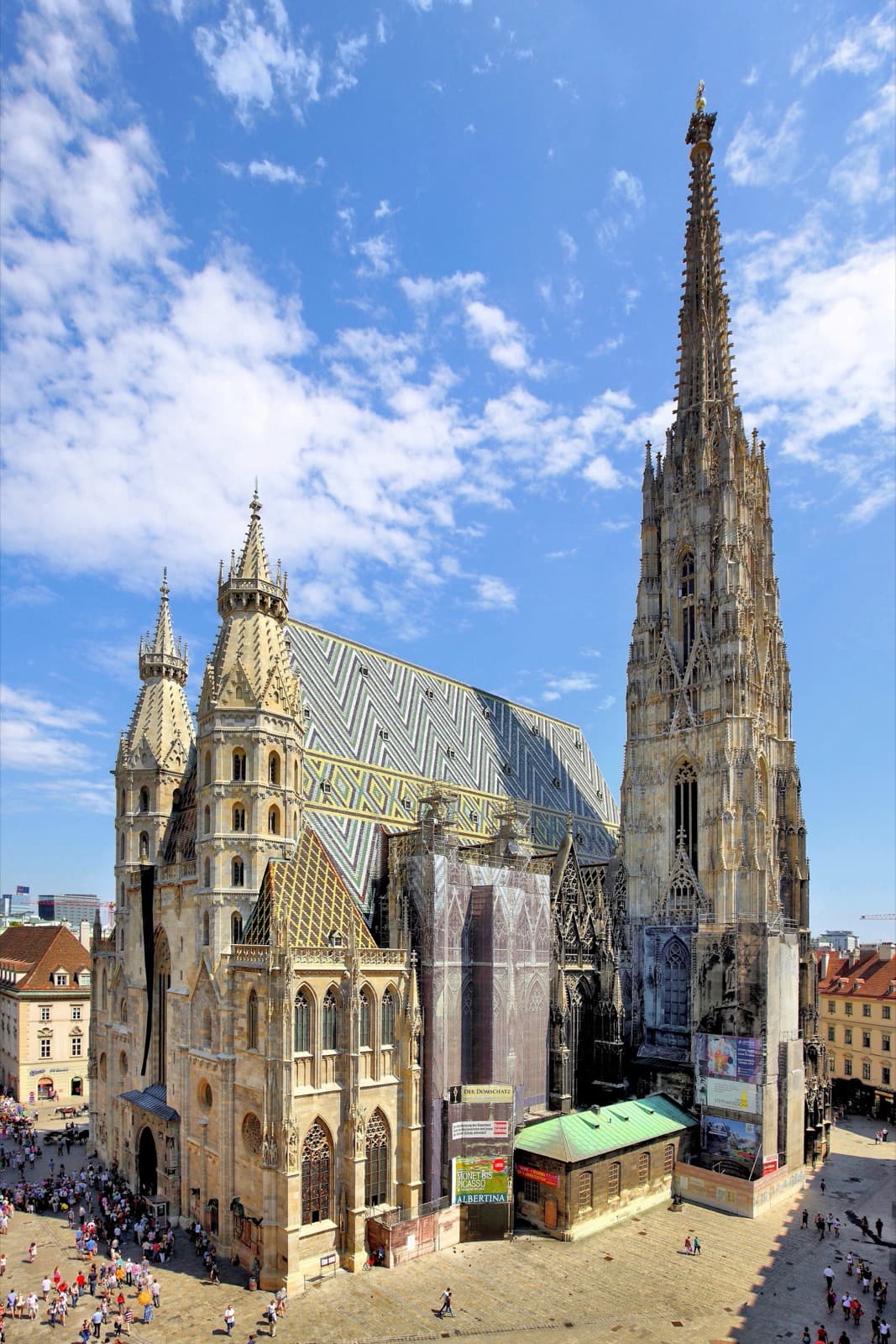
St. Stephen's Cathedral rises from Stephansplatz at the exact center of Vienna's old town, the Gothic mother church that the whole Innere Stadt still organizes itself around. Most visitors photograph it and move on, treating it as a skyline and a meeting point. The more rewarding way to stand in front of it is to read it deliberately, from the top of its great south tower down through its patterned roof to the dead stacked beneath the floor. Done that way, the cathedral stops being a single flat image and becomes what it actually is: a monument assembled in layers across centuries, its own deep history matching the layered city around it.
The Steffl and its sixty-five years
Begin with the spire, because the Viennese begin there. They call the great south tower the Steffl, an affectionate nickname for a structure that reaches one hundred and thirty-six meters, roughly four hundred and forty-six feet, into the sky above the square. That height is easy to state and hard to grasp until you tilt your head back and follow the stone as it narrows toward its point.
The tower was not raised quickly. It went up across roughly sixty-five years, from thirteen sixty-eight to fourteen thirty-three, which means generations of masons lived and died while it climbed. The Gothic story of the building begins earlier still. A choir was ordered in thirteen oh four, and Duke Rudolf the Fourth launched the major rebuilding from thirteen fifty-nine. When you look at the finished tower, you are looking at a project that outlasted the men who conceived it, a common truth of great Gothic churches and one worth holding in mind on a walk through a city that likes to present itself as finished and serene.
The roof that names its rulers
Hear a stop from this walk
Saint Stephen's Cathedral: The Steffl Over the City
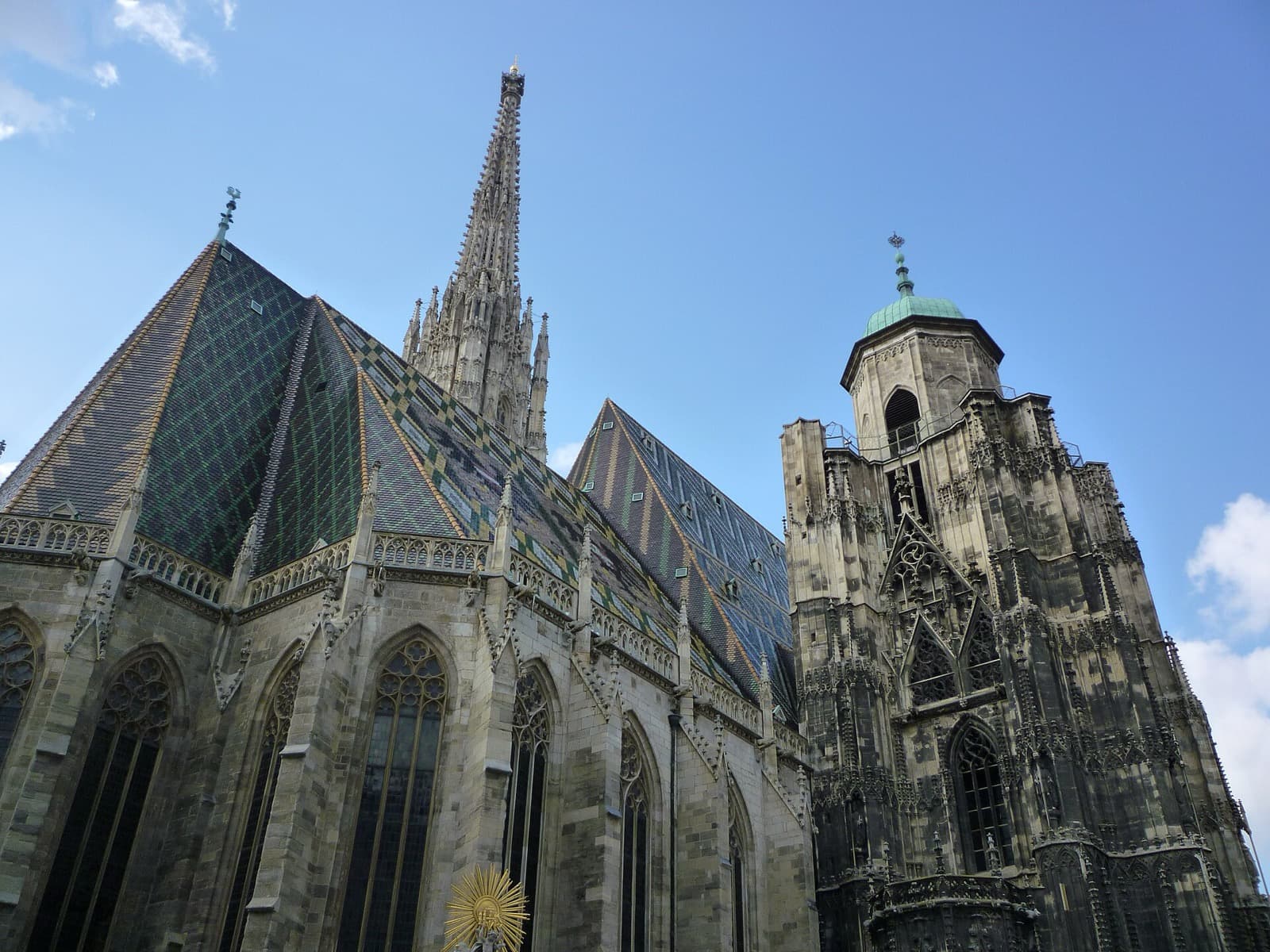
Now lower your eyes to the roof, which is the detail most people miss because they are busy with the spire. It is not plain tile. About two hundred and thirty thousand glazed tiles cover it, and over the choir on the south side they are arranged into a mosaic of the double-headed eagle, the emblem of the Habsburg empire that was governed from this city. This is not decoration for its own sake. It is a statement of ownership laid across the top of the building, legible to anyone who climbs high enough or knows to look. The church belongs to the faith, and the roof announces who rules.
That pairing, sacred building and imperial emblem, is the single idea most worth carrying away from this stop. Vienna's old town is a place where power and worship share the same stones, and the cathedral roof is the clearest illustration of it. The spire reaches toward heaven; the tiles just below spell out an earthly dynasty.
The Pummerin and the captured cannon
Cross to the north tower and the layers keep going. Here hangs the great Pummerin bell. The bell you would hear today was cast in nineteen fifty-one in Upper Austria, after the Second World War damaged its predecessor. That earlier bell, from seventeen oh five, carried a startling origin: it was made partly from the metal of nearly three hundred cannon captured from the Ottomans. A weapon of siege warfare recast as a church bell is history compressed into a single object, the sound of the city literally forged from the arms of its enemies.
The dead beneath the floor
Then go down, at least in imagination, because the cathedral keeps its dead. The catacombs beneath it hold the remains of over eleven thousand people. Standing on the free-to-enter nave floor, it is worth pausing on that number. The building is not only a place of worship and an imperial emblem; it is a vast ossuary, a lower layer of the church as real as the spire above.
You will hear colorful stories here, about carved marks and mysterious signs on the walls, guides and pamphlets offering legends as if they were record. Treat those as legend rather than documented history. What is certain, and what actually earns your attention, is the scale of the thing and the length of its making. The honest facts are more impressive than the invented ones.
Why this is the first stop
The cathedral is the marquee surface of Vienna, the image on the postcards, and it is also a monument with its own great depth, which is why it anchors a walk built entirely around depth. The Historic Centre of Vienna, the Innere Stadt, was inscribed as a UNESCO World Heritage site in two thousand one, its origins tracing back to the Roman camp of Vindobona and the medieval city of the twelfth century. St. Stephen's is the spiritual and civic anchor of that center. Its Gothic form, begun under the medieval dukes and completed over generations, made it the emblem the whole old town still arranges itself around.
That is the useful frame for a first-time visitor. Do not treat the cathedral as a checkbox to clear before finding the "real" old Vienna. It is the old Vienna, in miniature and stacked vertically: modern crowds on the square, the medieval Gothic shell, the Habsburg eagle on the roof, the Ottoman-metal bell, and eleven thousand dead below. If you can read one building this way, you can read the whole district this way, which is the entire premise of walking these streets.
Practical footing before you walk on
The nave is free to enter, so you can stand inside without a ticket. The south tower climb, the north tower lift to the Pummerin bell, the catacombs, and the treasury each require a separate paid ticket, so decide in advance what you actually want to see rather than paying at each door. This is a working church, not a museum set, so dress modestly and keep your voice low if you step inside. Early morning or late afternoon on a weekday is when Stephansplatz is calmest and the light is soft on the stone.
From here the old town opens outward, and every stop beyond the cathedral works the same downward logic: a fashionable street laid over a Roman ditch, an excavation left open in a palace square, the oldest surviving church on the edge of the vanished legionary camp. The self-guided Vienna walking tours collection includes the "Old Town: The Roman Fort Beneath the Imperial City" route, which starts here at St. Stephen's and reads the whole Innere Stadt from the imperial surface down to the Roman foundation of Vindobona. To plan the rest of your time in the city, see the Vienna city page. Start at the Steffl, look up, then look down, and the rest of the walk follows naturally.
Sources
- St. Stephen's Cathedral, Vienna (Wikipedia): tower height, construction dates from 1368 to 1433, the 1304 choir and Rudolf the Fourth's 1359 rebuilding, the glazed-tile roof and Habsburg eagle, and the catacombs.
- Pummerin (Wikipedia): the 1951 recasting in Upper Austria and the 1705 predecessor made partly from captured Ottoman cannon.
- UNESCO World Heritage List, Historic Centre of Vienna: the 2001 inscription of the Innere Stadt and its Roman and medieval origins.
- Roamer tour transcript, "Old Town: The Roman Fort Beneath the Imperial City": fact-audited narration for St. Stephen's Cathedral and the surrounding old-town stops.
Ready to experience it?
Old Town: The Roman Fort Beneath the Imperial City
100 min · 1.9 km · easy
More from Vienna
Explore more at your own pace.
One Day in Vienna: A Walkable Morning-to-Evening Itinerary
Vienna, a City Stacked on a City: Reading the Capital in Three Directions
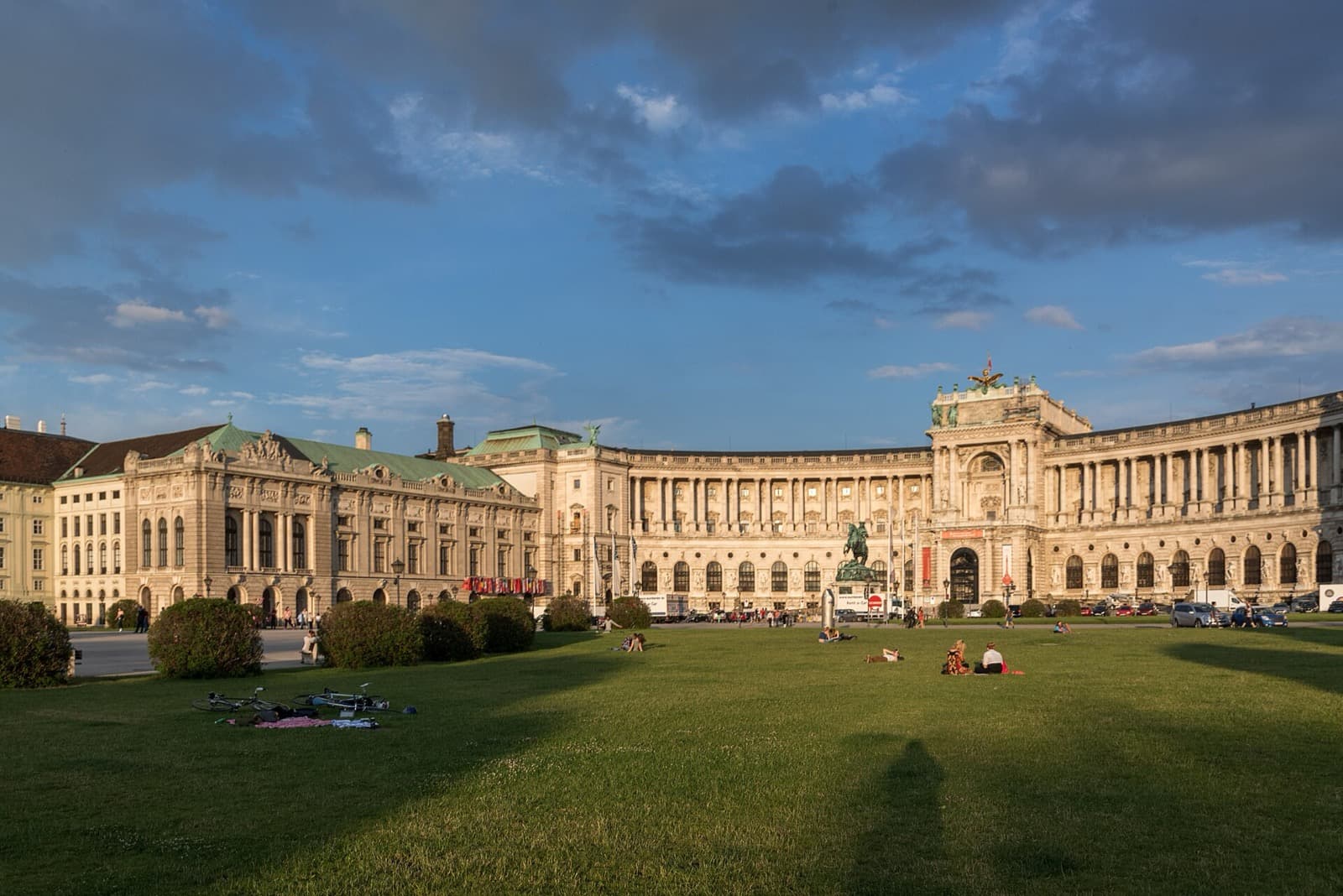
Heldenplatz and the Neue Burg: Why Vienna's Grandest Palace Wing Was Never Finished
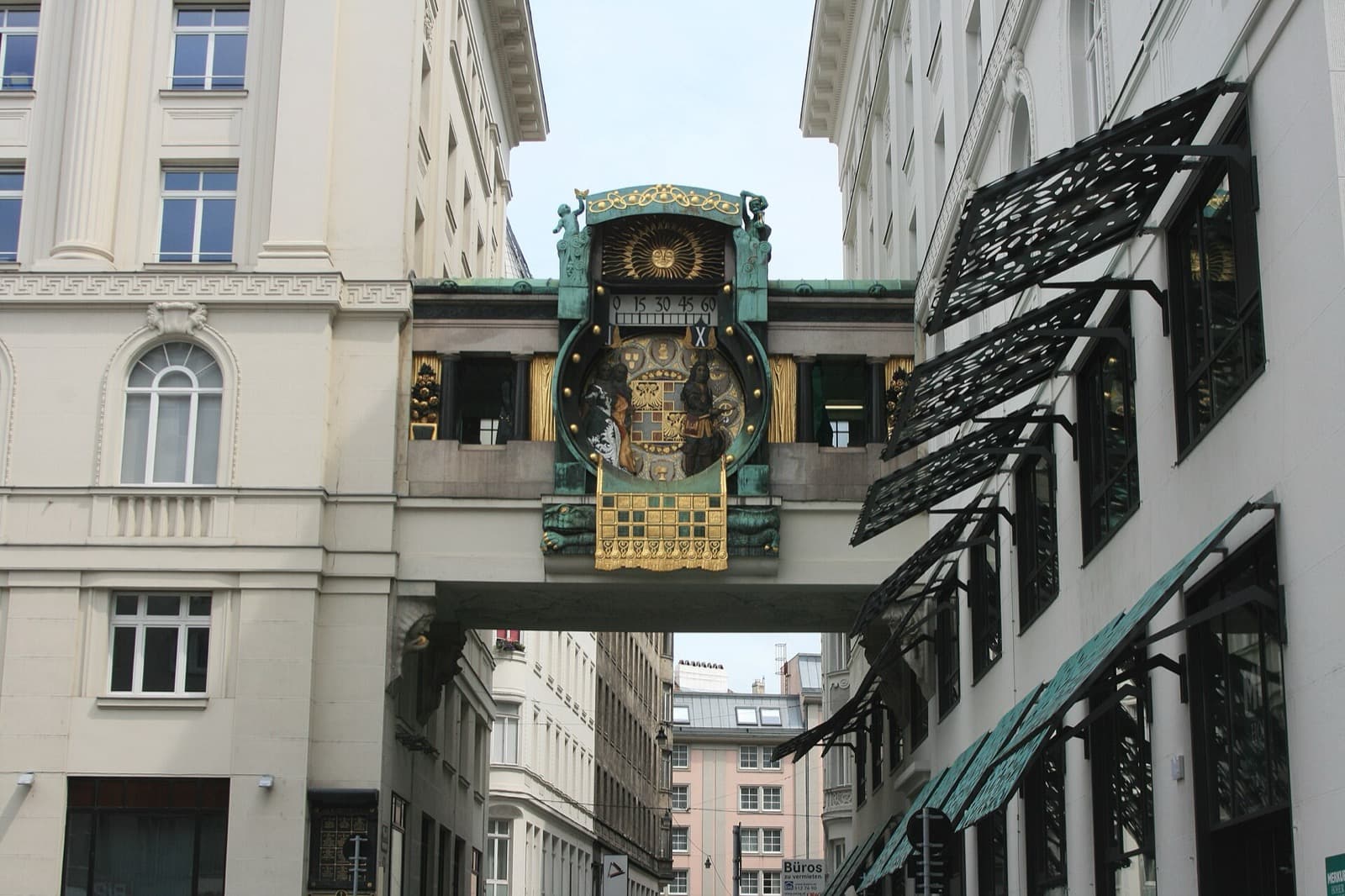
Hoher Markt and the Anker Clock: Where Roman Vienna Surfaces
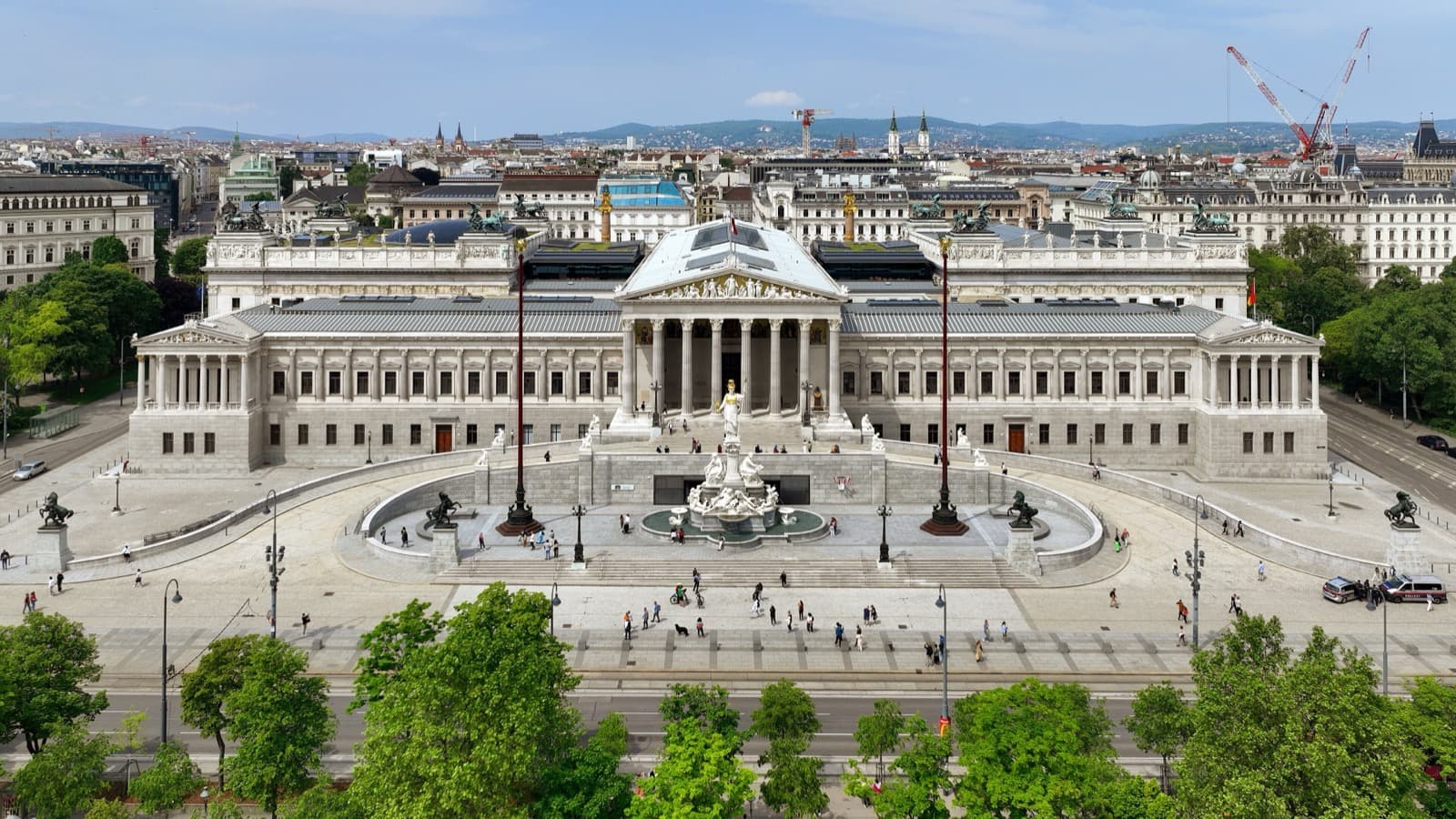
The Austrian Parliament: Why Vienna Built Its Legislature as a Greek Temple