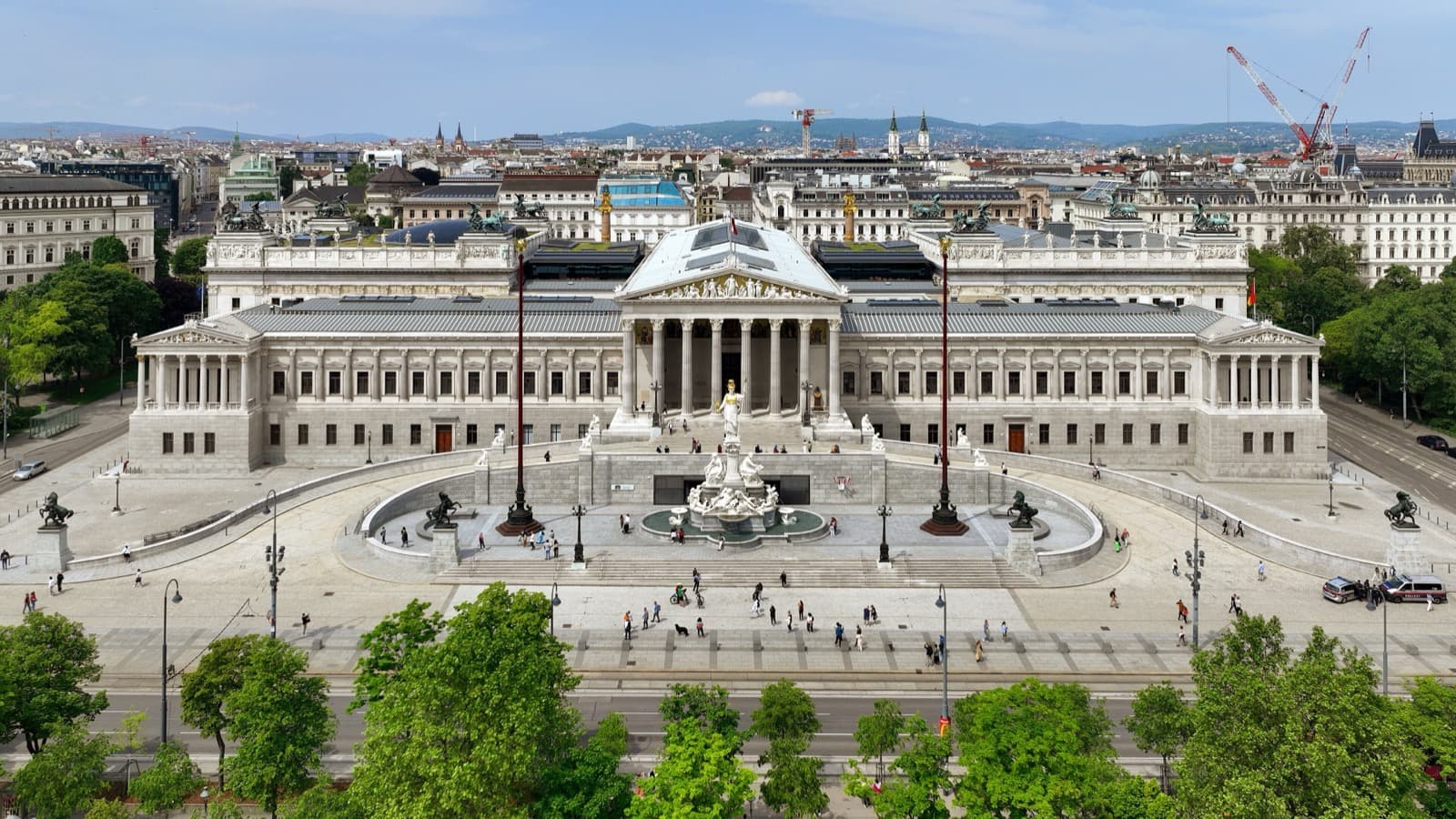
The Austrian Parliament makes the whole argument of the Ringstrasse in a single gesture: a modern empire chose to dress its legislature as an ancient Greek temple, so that the act of reasoned debate would carry the authority of Athens. That choice is not decoration. It is the key to reading Vienna's grand ring boulevard, where a nineteenth-century city replaced its medieval walls with a parade of monumental buildings and gave each one the costume of a different historical era. Stand in front of Theophil Hansen's columns and pediments and you are standing at the clearest sentence in a boulevard written in stone. Walk the rest of the Ring and you read the full paragraph.
Why a temple for a legislature
The building you approach on this stretch of the Ring was completed in 1883, designed by the Danish-born architect Theophil Hansen in a strict Greek Revival style. It was raised to house the two chambers of the Imperial Council, the Reichsrat, the legislature of the Austrian half of Austria-Hungary. Today it holds the National Council and Federal Council of the Republic of Austria, a continuity of function across two very different political worlds.
The question the building poses answers itself once you ask it. Why would a modern empire clothe its parliament in the architecture of the classical past? Because ancient Athens was remembered as the place where citizens gathered to debate and decide. By reaching for columns and pediments, Hansen made a claim that could be read without a caption: reasoned debate belongs to an old and noble tradition. The style is the argument.
In front of the building, the Pallas Athena Fountain completes the thought. Athena, goddess of wisdom, stands armoured on a tall pillar with a gilded helmet, a spear in her left hand, and a small figure of Nike, Victory, in her right. The fountain was created by the sculptor Carl Kundmann, working with others to Hansen's plans, and finished around 1902. Wisdom, placed at the door of the legislature, is the point made plain for every visitor who passes.
The scale is imperial. The Parliament covers more than 13,500 square metres and contains over one hundred rooms. Yet the message is simpler than the footprint. Where other buildings on the Ring speak for art or for public knowledge, this one speaks for reason, for wisdom, and for the ancient dignity of citizens deciding their own affairs.
The grammar of the boulevard
Hear a stop from this walk
Maria-Theresien-Platz: The Twin Imperial Museums
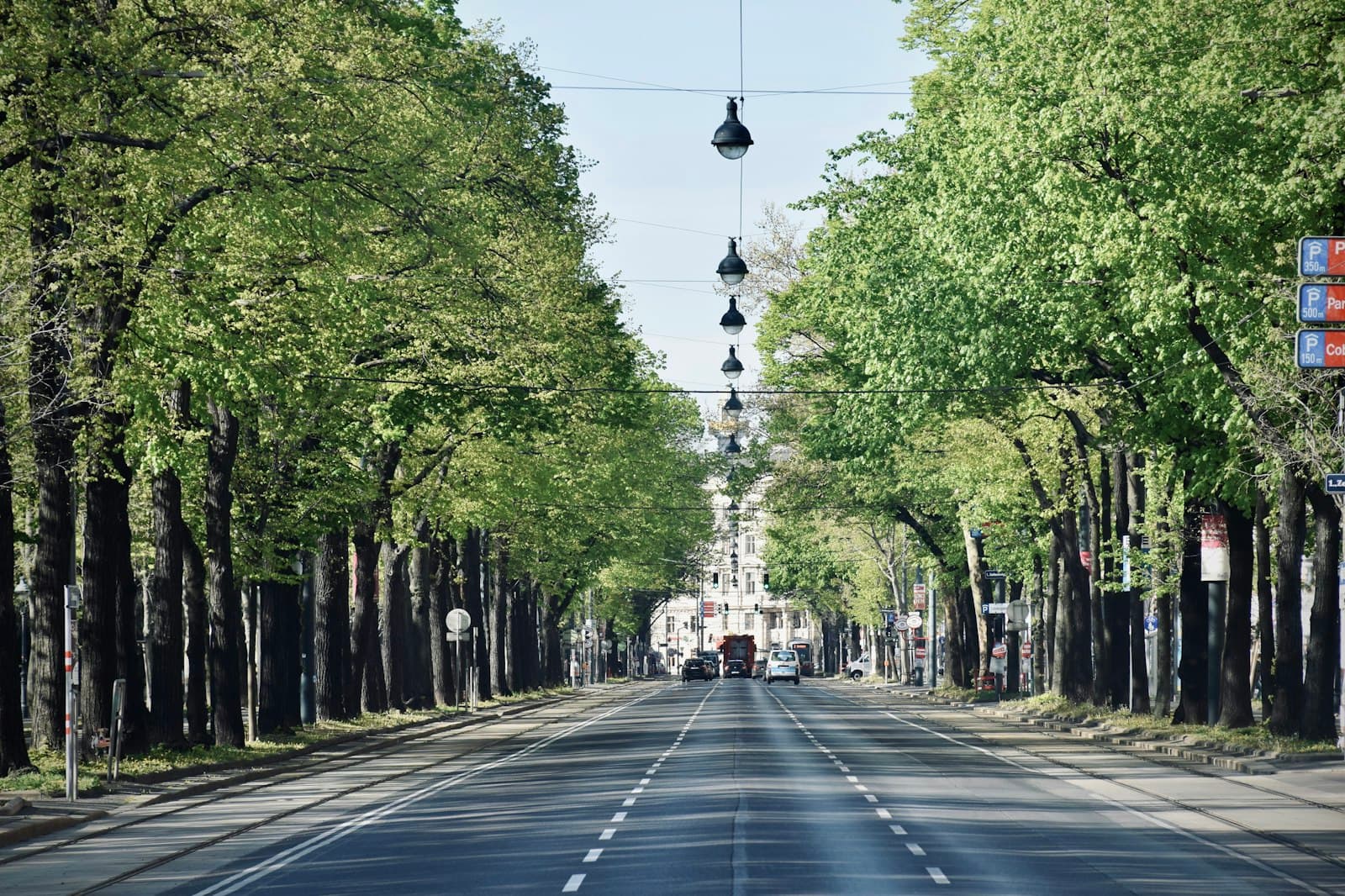
To understand why the temple matters, you need the story of the ground it stands on. For centuries a ring of medieval walls held Vienna in. On the twentieth of December 1857, the Emperor Franz Joseph signed an order that began with four famous words meaning "It is my will," commanding that the walls come down and a grand boulevard rise in their place. Demolition began in March 1858, and the first section of the new Ringstrasse opened on the first of May 1865. Along the curving avenue, a confident age raised a row of monumental public buildings.
Here is the part that turns the walk into a puzzle worth solving. Every one of these buildings was brand new, yet each wore the costume of a different, older era. That was not confusion. It was a deliberate grammar, each style an argument about what a democracy, a city, a university, or a theatre is supposed to be. The Parliament is the temple. Its neighbours each speak a different tongue.
Cross toward the Vienna City Hall and the register changes entirely. The Rathaus rises in soaring neo-Gothic, its central tower reaching 97.9 metres, crowned by an iron standard-bearer called the Rathausmann. Gothic recalled the proud, self-governing free cities of the Middle Ages, so where the Parliament argued for ancient democracy, the City Hall argued for medieval civic pride. There is a fine bit of cleverness in that tower: Franz Joseph required it not rise higher than the roughly 99-metre spires of the nearby Votivkirche, so the architect obeyed with the stonework, then set the iron figure on top to gain the extra height.
Facing the City Hall stands the Burgtheater, the Austrian national theatre, in rich neo-Baroque, all curves and gilding. Baroque is the language of spectacle, and here the boulevard's argument turns: this building makes its case for culture as its own reward. Look for a young hand on its ceremonial staircases, where ceiling frescoes were painted by a young Gustav Klimt with his brother Ernst Klimt and Franz von Matsch, work made in his mid-twenties, long before the golden shimmer that would make him famous.
What the ends of the walk say
The tour runs seven stops over roughly three and a half kilometres. It opens at the Vienna State Opera, the very first of the great Ringstrasse buildings to be finished, which opened in 1869 to public mockery before becoming one of the most beloved faces of the city. Nearby, Maria-Theresien-Platz sets two near-identical Renaissance Revival museums facing each other, the Kunsthistorisches Museum and the Naturhistorisches Museum, built to open the imperial Habsburg collections to the public.
The University of Vienna's main building, dressed in Italian Renaissance, dedicates itself to the mind. The institution was founded in 1365 by Duke Rudolf the Fourth and is the oldest university in the German-speaking world. Renaissance was the age of the rebirth of learning, so the style ties Vienna's scholars to that humanist tradition. Step into the arcaded courtyard, the Arkadenhof, and you find busts and memorials to the university's scholars looking down on the students who pass below.
The walk closes at the Votivkirche, a slender twin-spired neo-Gothic church. It exists because of a single moment: on the eighteenth of February 1853, the young Franz Joseph survived a stabbing when the blade was largely turned aside by his stiff uniform collar, and the church was raised as a votive offering of thanks. Its spires reach the very 99 metres the City Hall tower was forbidden to exceed. The Ring ends where it began, with the monarchy, but transformed, no longer a fortress guarding the city but a church giving thanks for a life spared.
Read the Parliament first and the rest of the boulevard falls into place. This is a city that traded its walls for a sentence in stone about what it wanted to be, and the temple to debate is where that sentence is clearest. When you want to plan the full route, or compare it with the old town and the Hofburg, start with the Vienna walking tours overview, then set out along the Ring and read the boulevard one building at a time.
Sources
- Austrian Parliament Building, Wikipedia: architect Theophil Hansen, Greek Revival style, 1883 completion, and function as the Reichsrat then the Republic's chambers.
- Architecture and History, Parliament of Austria official site: the Pallas Athena Fountain, building scale, and history of the legislature.
- Vienna City Hall, Wikipedia, and the City of Vienna Rathausmann page: the tower height, the iron standard-bearer, and the Votivkirche height constraint.
- Vienna State Opera and Votivkirche, Wikipedia: opening dates and the 1853 assassination attempt behind the votive church.
- Main building (University of Vienna), Wikipedia: the 1365 founding and the Arkadenhof courtyard.
Ready to experience it?
The Ringstrasse: The Grand Boulevard Built on the Walls
130 min · 3.6 km · moderate
More from Vienna
Explore more at your own pace.
One Day in Vienna: A Walkable Morning-to-Evening Itinerary
Vienna, a City Stacked on a City: Reading the Capital in Three Directions
Heldenplatz and the Neue Burg: Why Vienna's Grandest Palace Wing Was Never Finished
Hoher Markt and the Anker Clock: Where Roman Vienna Surfaces
St. Stephen's Cathedral: Reading Vienna's Steffl From Roof to Catacombs