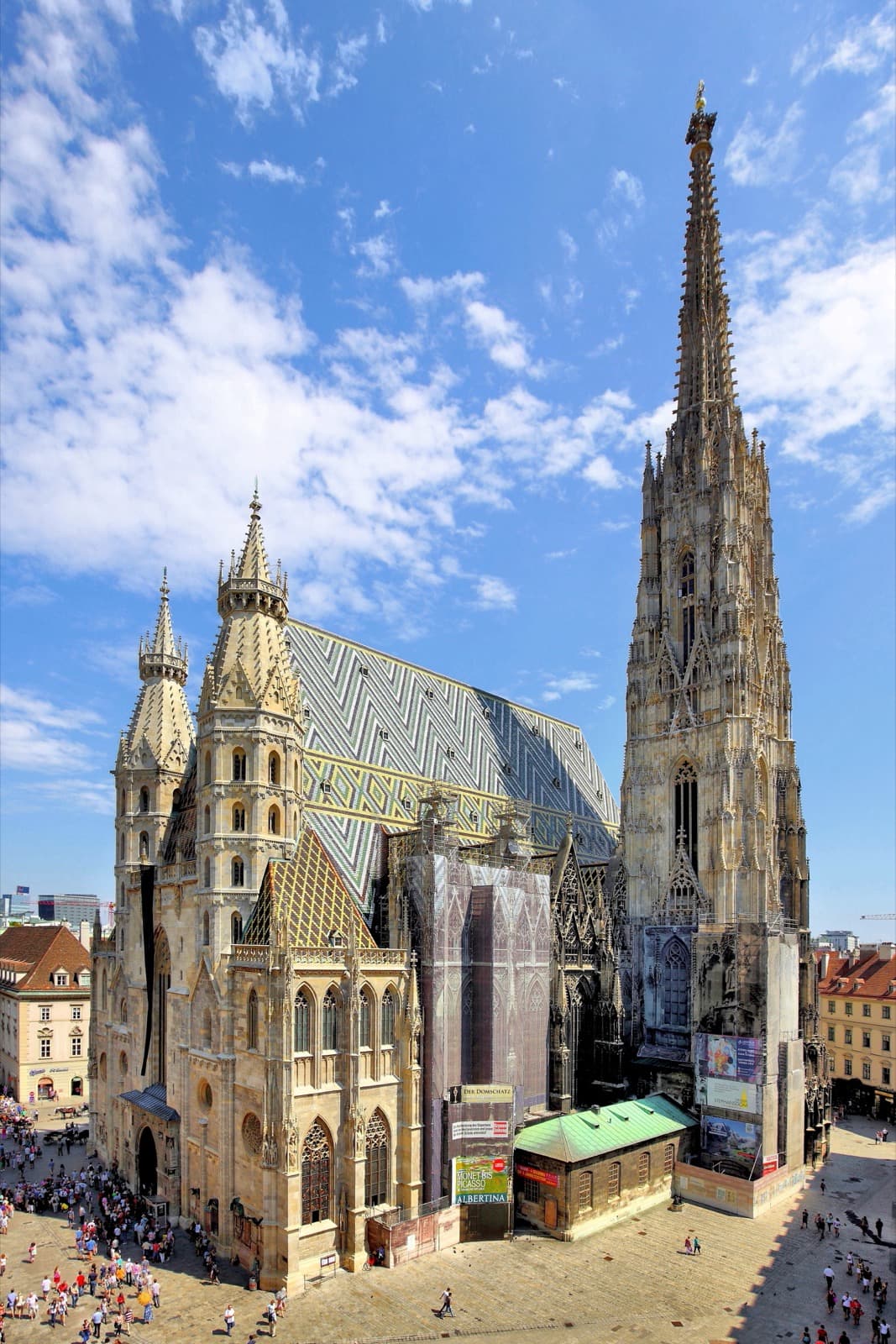
A downward reading of Vienna's Innere Stadt, from the Gothic cathedral and baroque promenade to the Roman legionary camp of Vindobona that still shapes where the streets run.
Start · Saint Stephen's Cathedral: The Steffl Over the City
DirectionsStops
- 1
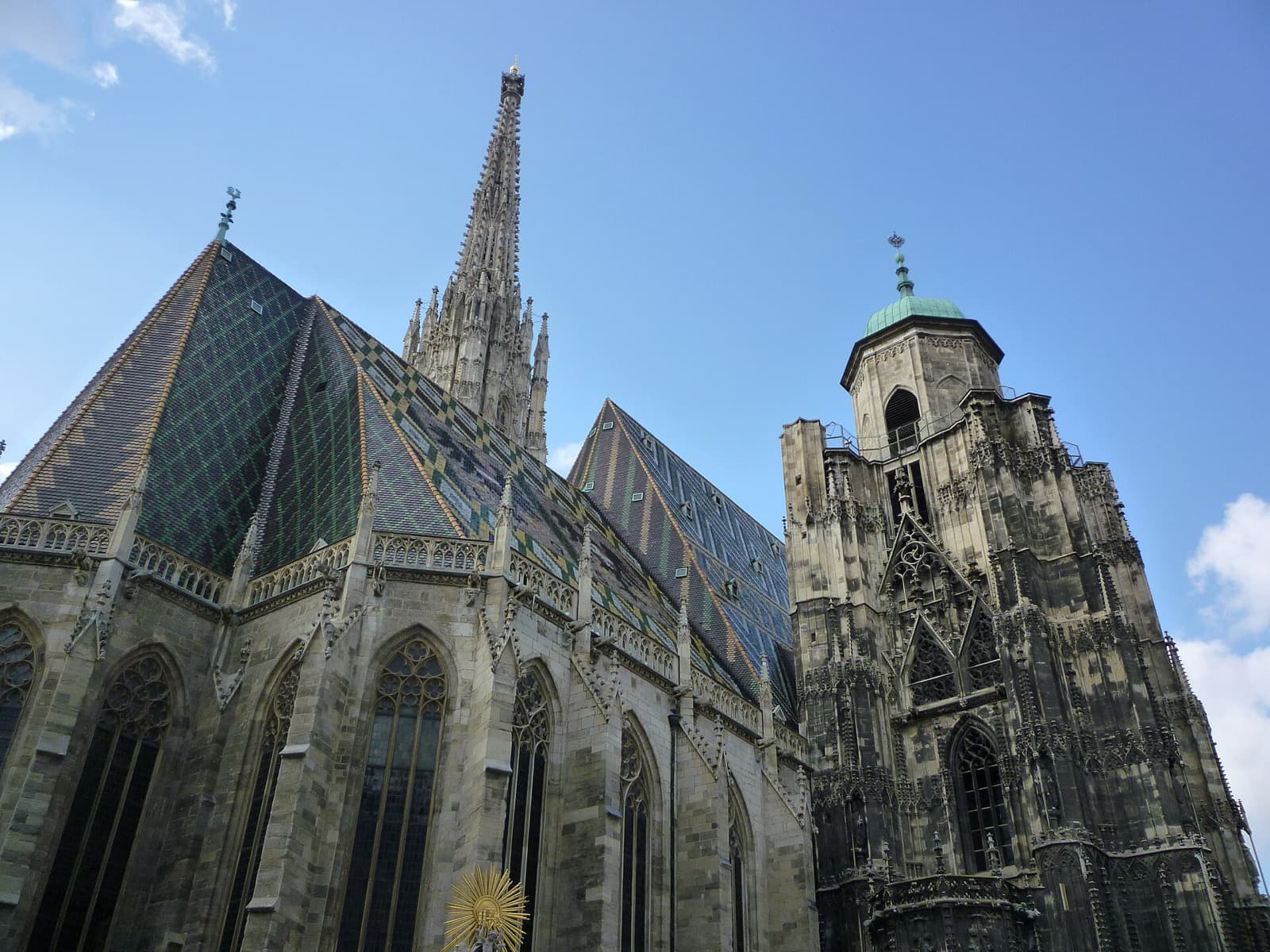
Saint Stephen's Cathedral: The Steffl Over the City
The Gothic mother church of Vienna, whose soaring south tower and eagle-patterned roof crown the old town, itself a monument with its own deep layers.
- 2
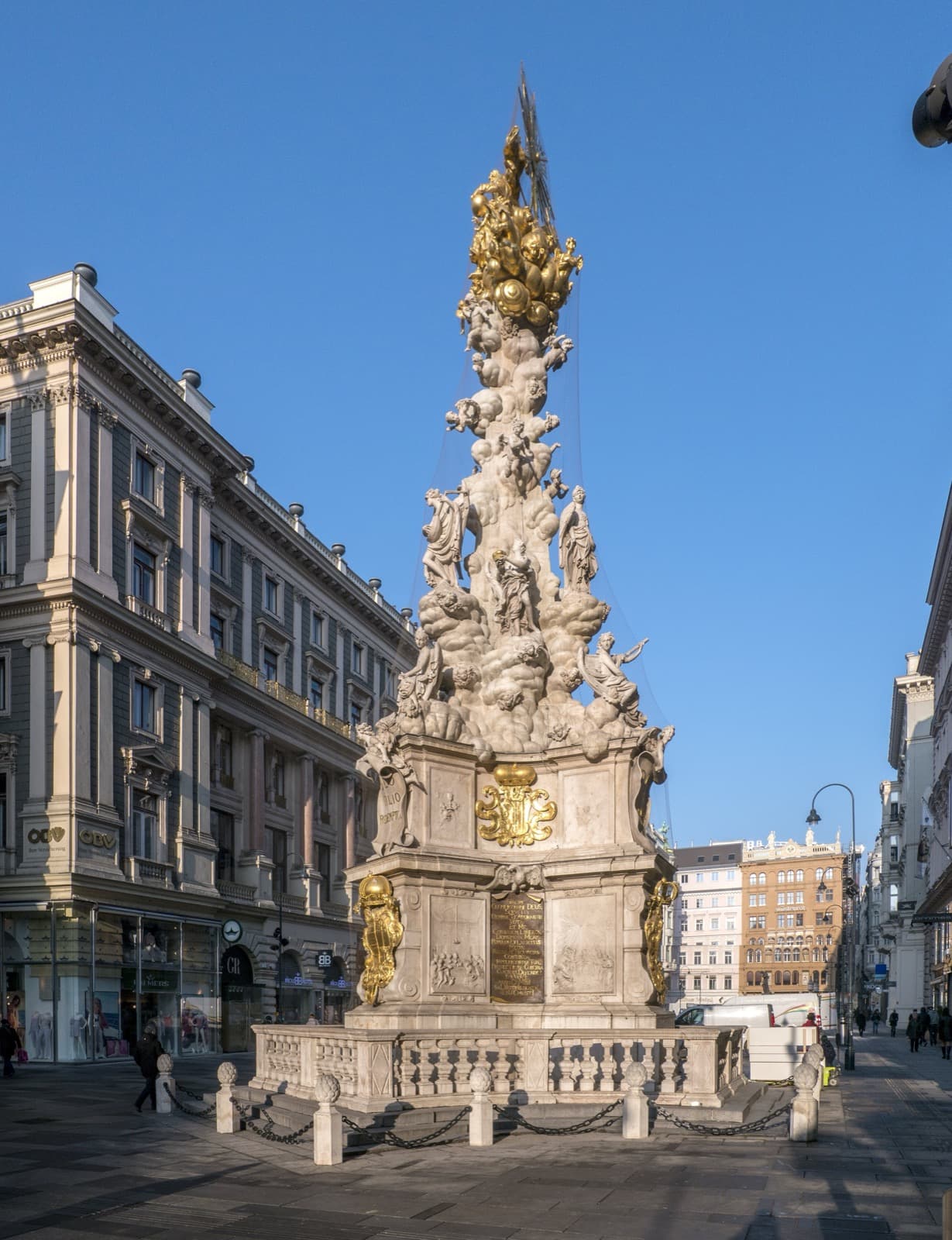
The Graben: The Ditch That Became a Promenade
Vienna's most famous promenade follows the line of Vindobona's outer defensive ditch, its baroque Plague Column standing directly over the old Roman edge.
- 3
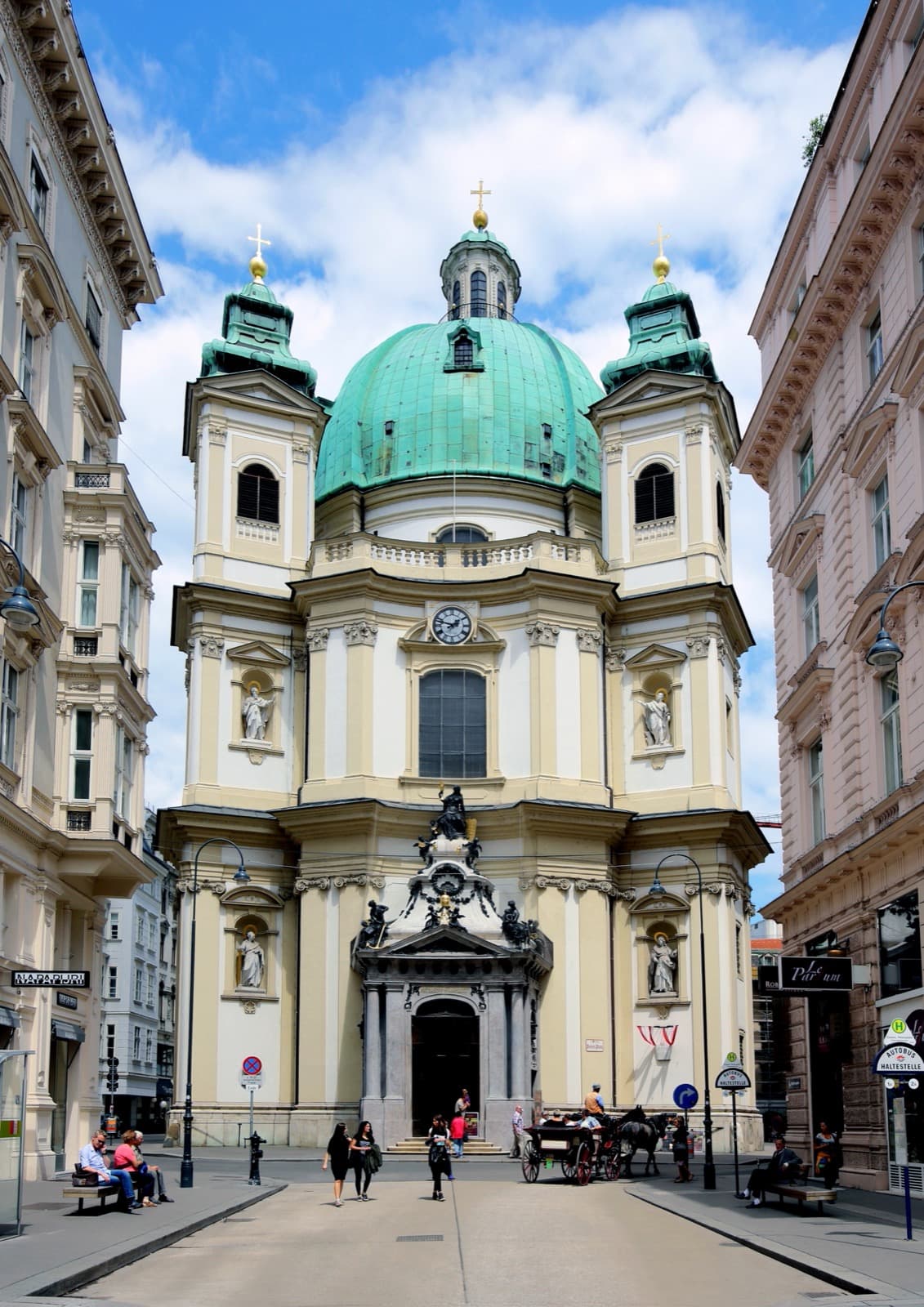
Peterskirche: Worship on One Spot
The green-domed baroque church just off the Graben, modeled in plan on Saint Peter's in Rome, on a site wrapped in legends of ancient worship.
- 4
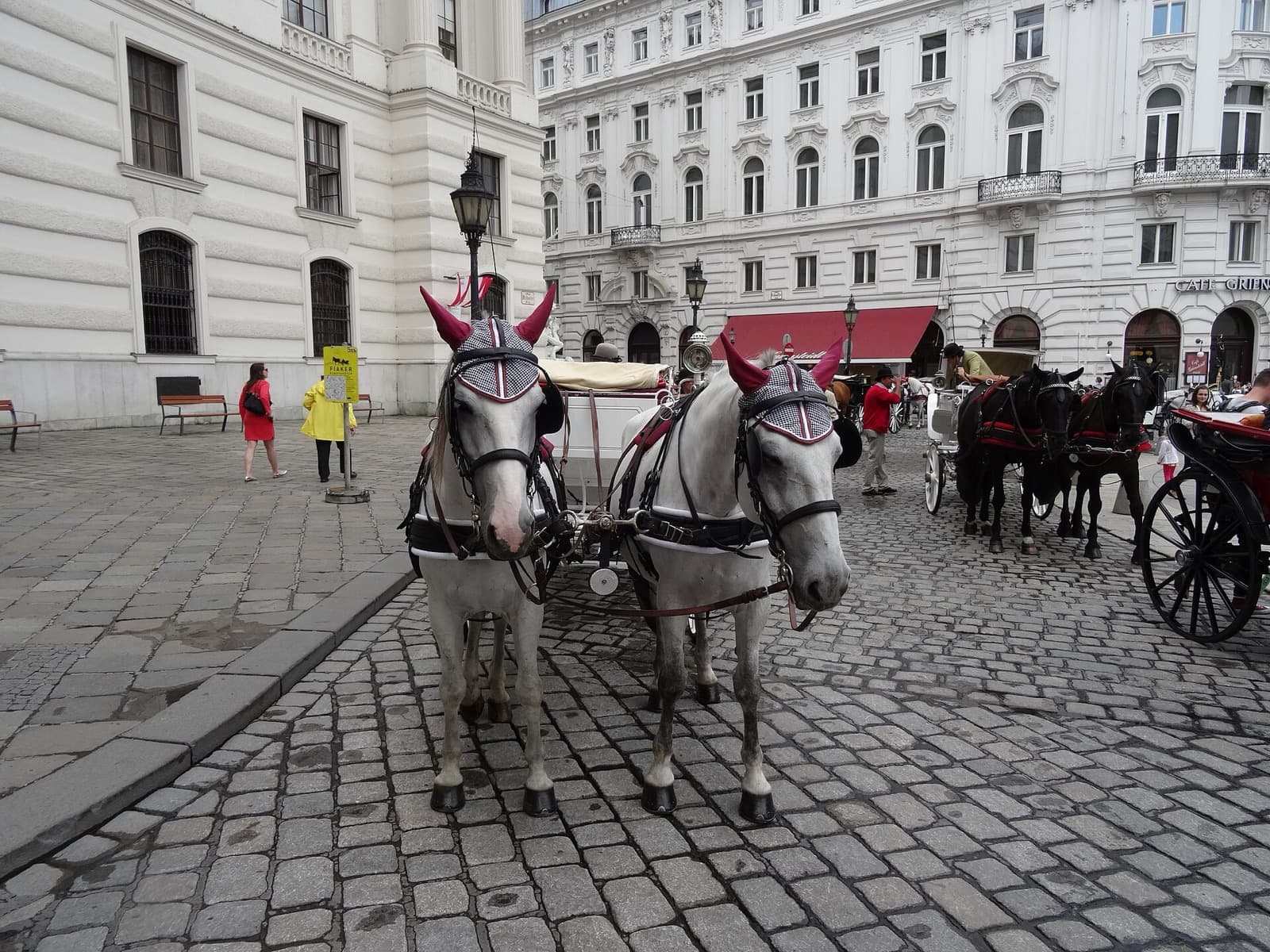
Michaelerplatz: The Layers in the Pavement
The square before the domed wing of the Imperial Palace, where an open excavation exposes the Roman layer beneath the modern stones, facing Adolf Loos's plain modernist house.
- 5
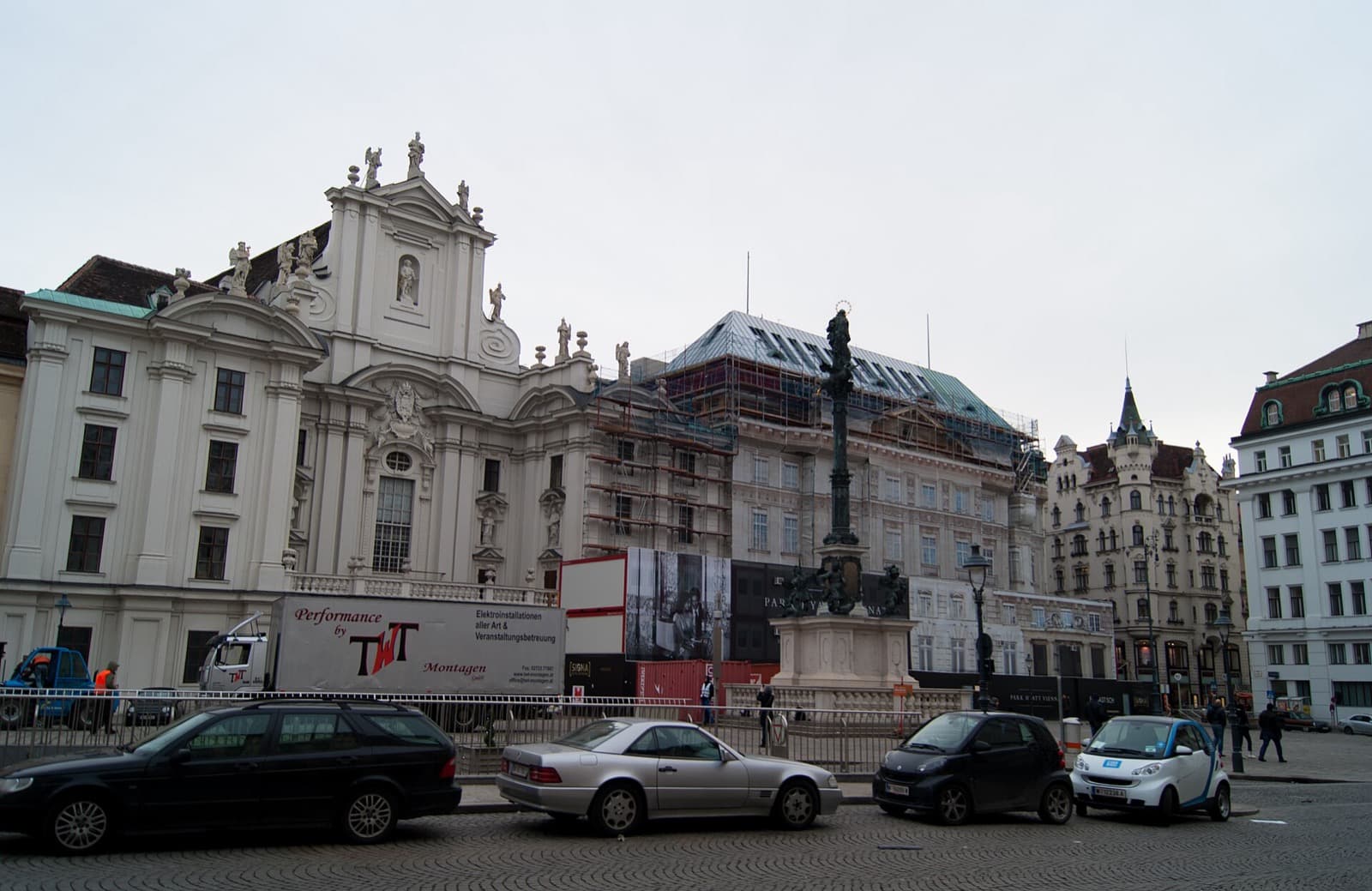
Am Hof: The Court and the Column
The largest square of the inner city, site of the twelfth-century ducal residence, crowned by a Marian column and the church from whose balcony the Holy Roman Empire was declared at an end.
- 6
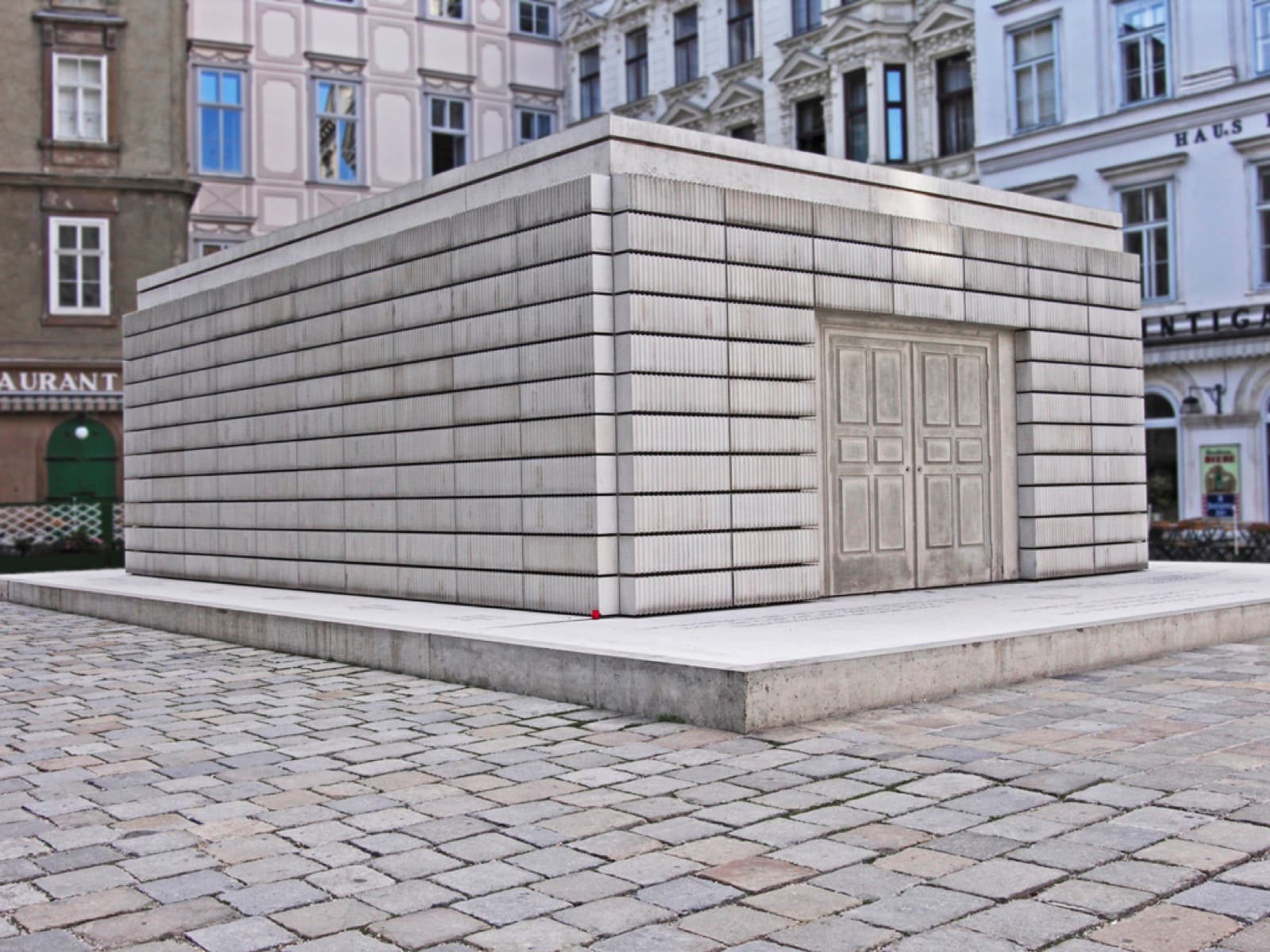
Judenplatz: The Erased Square and the Nameless Library
The quiet heart of medieval Jewish Vienna, where the excavated synagogue lies beneath the square and Rachel Whiteread's Holocaust Memorial stands above it.
- 7
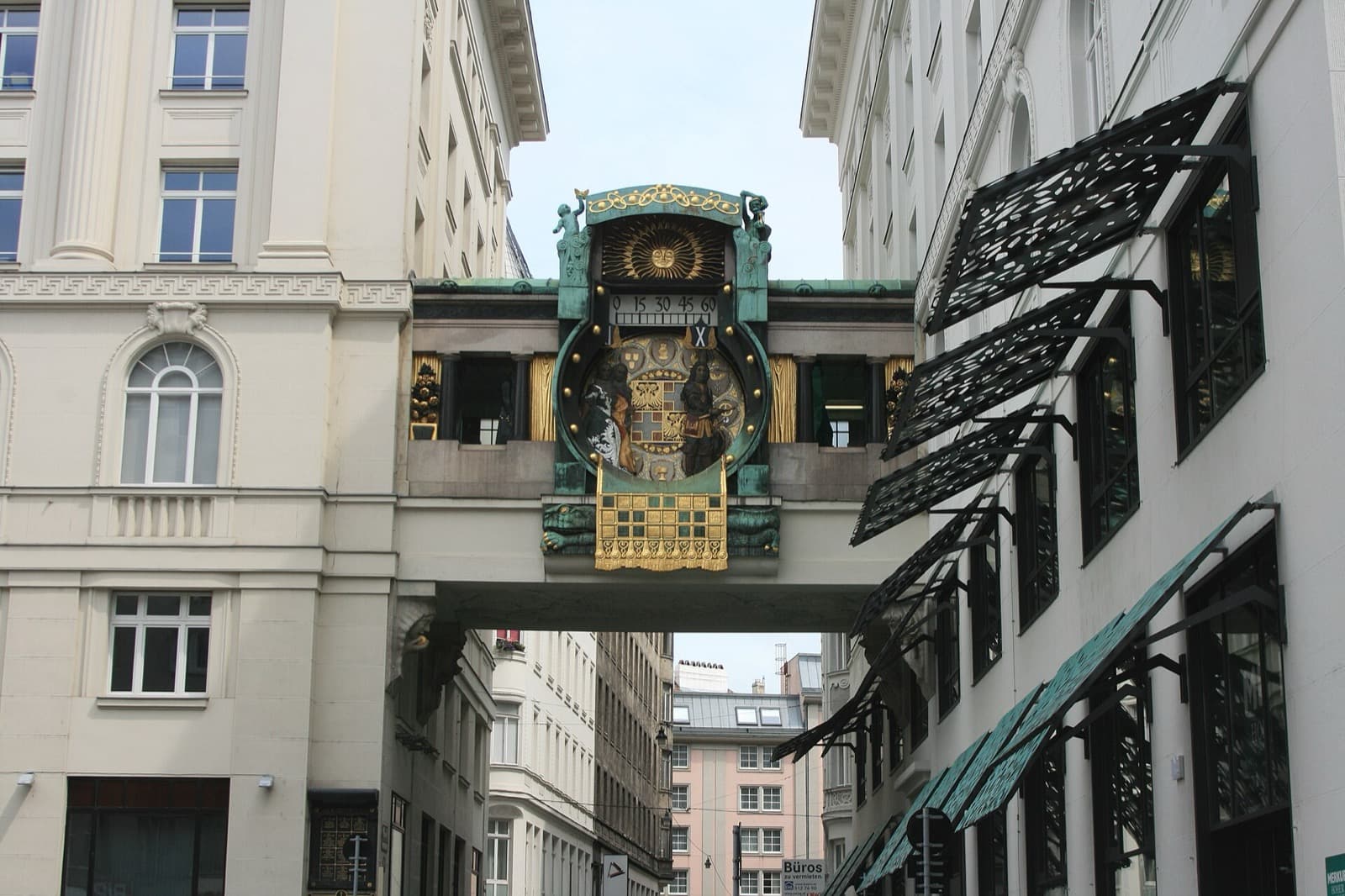
Hoher Markt: Vindobona Surfaces
The oldest square in Vienna, laid over the heart of the Roman legionary camp, where excavated officers' houses are displayed beneath the pavement and an Art Nouveau clock parades history at noon.
- 8
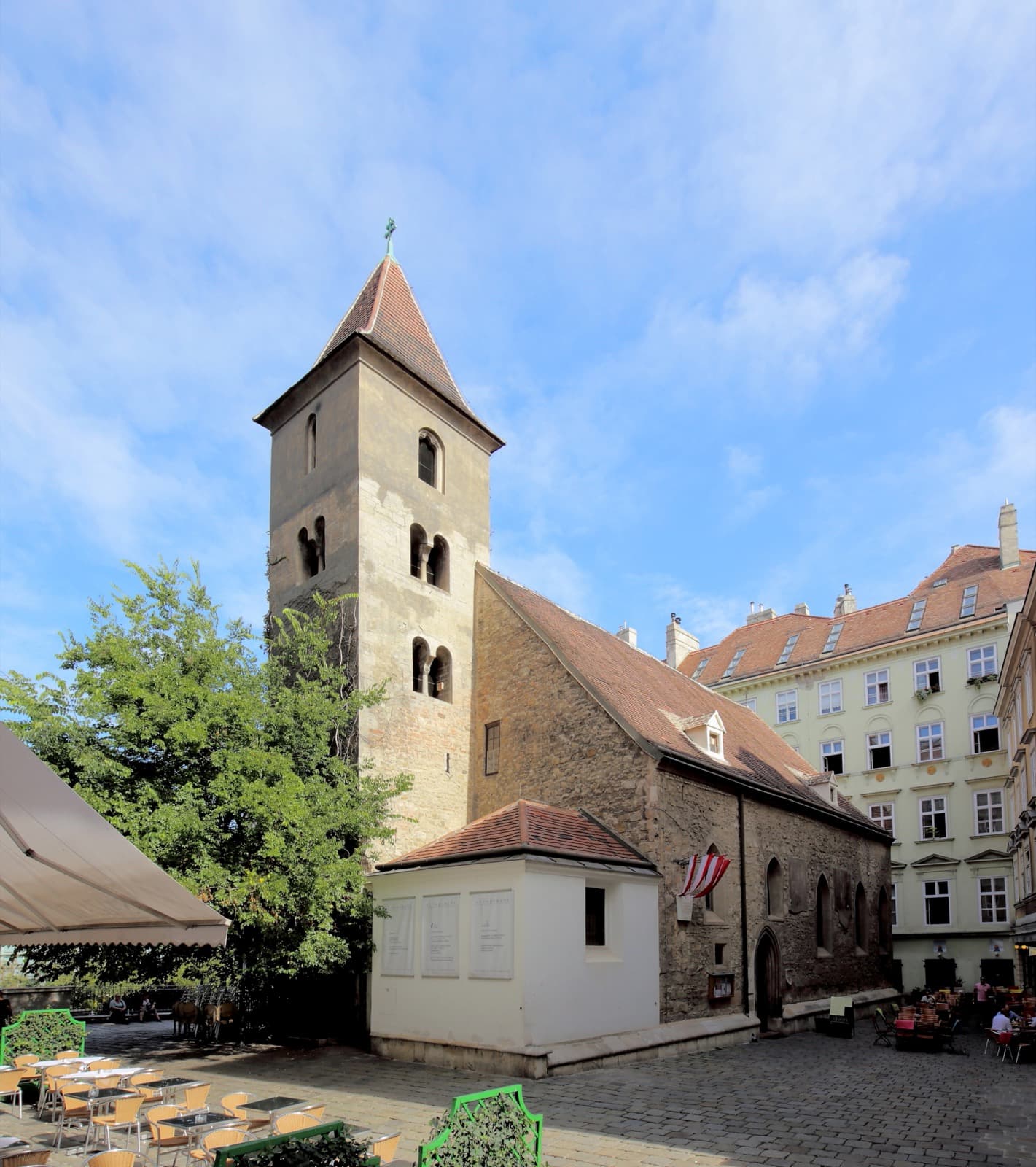
Ruprechtskirche: The Oldest Surviving Layer
The oldest still-standing church in Vienna, its Romanesque tower on a rise above the Danube Canal at the very edge of the old Roman camp.
Details
Best Time to Visit
Early morning or late afternoon on a weekday, when the Graben and the cathedral square are calmest and the light is soft on the facades. Aim to reach Hoher Markt shortly before noon so you can watch the full parade of figures on the Anker Clock, which only assembles at midday. Spring and autumn are the most comfortable seasons; summer middays bring strong sun and crowds, while winter adds the atmosphere of the season though with short daylight and cold in the exposed squares.
Pro Tips
- •The nave of Saint Stephen's is free to enter, but the south tower climb, the north tower lift to the Pummerin bell, the catacombs, and the treasury each need a separate paid ticket, so decide in advance what you want to see.
- •Time your arrival at Hoher Markt for just before noon: the Anker Clock's twelve figures parade in full only at midday, each to its own period music.
- •The excavation at Michaelerplatz and the Plague Column on the Graben are free to view in the open air, so you can appreciate the Roman and baroque layers without any ticket.
- •Wear comfortable shoes for cobbled lanes and pedestrian zones, and keep to the walking areas, since cyclists and horse-drawn Fiaker carriages share the old town streets.
- •For the buried medieval synagogue at Judenplatz you need a ticket to the Museum Judenplatz, while the square and the Whiteread memorial above it are free to see.
- •The old town is a tight cluster of lanes, so this route is easy to pause, reorder, or shorten; step into a working church only when you are ready to be quiet and are dressed modestly.
Safety & Precautions
- •Saint Stephen's and the other working churches on this walk, Peterskirche, the Kirche am Hof, and Ruprechtskirche, expect modest dress and quiet, and access to the cathedral's towers, catacombs, and treasury requires a paid ticket beyond the free entrance area.
- •The Judenplatz Holocaust Memorial and the Museum Judenplatz are places of memory and mourning; give them silence and respect, and do not treat the memorial or the buried synagogue as a photo backdrop.
- •Watch your footing on cobbled lanes and in the pedestrian zones, where cyclists and horse-drawn Fiaker carriages move through the same streets, and mind young children near them.
- •Keep ordinary big-city awareness of pickpockets on the crowded Graben, on Kaerntner Strasse, and around the cathedral; the currency is the euro, and many small churches keep limited opening hours, so check before relying on entry.
Travel advisory: Exercise Normal Precautions (Level 1).
Gallery
Related Reading
Go deeper on what you'll see, hear, and walk through.

Overview
Best Self-Guided Walking Tours in Vienna (2026)
3 min
Overview
One Day in Vienna: A Walkable Morning-to-Evening Itinerary
6 min
Overview
Vienna Travel Guide: Days, Transport, Timing, Safety, Budget
7 min
Thematic
Best History Walking Tours in Vienna (2026)
2 min
Thematic
Vienna, a City Stacked on a City: Reading the Capital in Three Directions
7 min
Companion
Hoher Markt and the Anker Clock: Where Roman Vienna Surfaces
7 min
Deep dive
St. Stephen's Cathedral: Reading Vienna's Steffl From Roof to Catacombs
7 min
Read
What to Eat in Vienna: Schnitzel, Sachertorte, and How to Order Like a Local
7 min
Read the walk
The full story of Old Town: The Roman Fort Beneath the Imperial City, in words. Prefer to listen? Play it narrated, from home or on location.
Introduction
This is a walk that reads Vienna, in Austria, from the top down. The Innere Stadt, the old town at the city's heart, is a city stacked on a city. Beneath the Gothic cathedral, the baroque promenade, and the imperial gates lie the walls of Vindobona, the Roman legionary camp planted near the Danube around the turn of the first century. Over eight stops and roughly two kilometres, a walk of about two to three hours at your own unhurried pace, this route peels the imperial surface back to the older city underneath. You set your own speed, linger where a layer breaks through the pavement, and skip whatever does not hold you. The surface here is dazzling and deliberately so, built to be looked at: promenades, columns, a green baroque dome. The deeper story is the one under the stones, the ditch that became a fashionable street, the camp that became a market square, the erased medieval Jewish quarter, the Roman street two floors down. Each place on this route is a spot where the lower layer surfaces. Several stops are working churches and one is a place of memory, so quiet and modest dress are part of the visit. Numbers, dates, and the difference between what is documented and what is only tradition are marked as you go, so you always know which is which. The old town is a tight cluster of lanes, easy to cross on foot and forgiving if you wander. When you arrive at Stephansplatz in front of Saint Stephen's Cathedral, begin with stop one.
1. Saint Stephen's Cathedral: The Steffl Over the City
Saint Stephen's Cathedral rises from Stephansplatz at the very centre of the old town, the Gothic mother church and the symbol of Vienna. The Viennese call its great south tower the Steffl, an affectionate nickname for a spire that reaches one hundred and thirty-six meters, about four hundred and forty-six feet, into the sky. That tower was built across roughly sixty-five years, from thirteen sixty-eight to fourteen thirty-three. The Gothic story begins earlier: a choir was ordered in thirteen oh four, and Duke Rudolf the Fourth launched the major rebuilding from thirteen fifty-nine. Look up and the roof itself tells you who ruled here. About two hundred and thirty thousand glazed tiles cover it, and over the choir on the south side they form a mosaic of the double-headed eagle, the emblem of the Habsburg empire governed from this city. In the north tower hangs the great Pummerin bell. The current bell was cast in nineteen fifty-one in Upper Austria after the Second World War, and its predecessor, from seventeen oh five, was made partly from the metal of nearly three hundred cannon captured from the Ottomans. Below your feet the cathedral keeps its dead: the catacombs hold the remains of over eleven thousand people. You will hear colourful stories here, about carved marks and mysterious signs on the walls. Treat those as legend rather than documented history. What is certain is the scale of the thing and its long making. This is a working church, so if you step inside, dress modestly and keep your voice low. It is the marquee surface of Vienna, and it is also a monument with its own great depth.
2. The Graben: The Ditch That Became a Promenade
The Graben is one of the grand promenades of Vienna, wide, bright, and lined with elegant facades. Its name is more honest than its finery: Graben means the ditch, or the trench. This street follows the line of the outer defensive ditch of the Roman fort of Vindobona, which ran before the southwestern wall along what is now the Graben. The Babenberg dukes filled that ditch in during the twelfth century, and the old military line quietly became a street, later the most fashionable walk in the city. So the baroque surface you see is laid directly over the Roman edge. At the center stands the Plague Column, in German the Pestsaeule, also called the Holy Trinity Column. In sixteen seventy-nine a plague struck the city. The Emperor Leopold the First, having left Vienna, vowed to raise a column of mercy if the epidemic ended, and a provisional wooden column went up that same year. The permanent monument took years and several hands: Matthias Rauchmiller, Johann Bernhard Fischer von Erlach, who shaped the base sculptures, and Paul Strudel among them. It was completed in sixteen ninety-three. The column climbs in layers, from suffering humanity at the base, up past angels, to the Trinity at the summit, a shape that reads almost like the strata this whole walk follows. The plague it commemorates was a real and grievous event, and the monument is a votive offering, not a spectacle. Stand here for a moment and hold two things at once: a fashionable promenade above, and the buried Roman defenses below.
3. Peterskirche: Worship on One Spot
Just off the Graben, a green dome rises above the rooftops: this is Peterskirche, the church of Saint Peter, one of the most Italian sights in Vienna. The church you see was begun around seventeen oh one under Gabriele Montani, continued from seventeen oh three by Johann Lukas von Hildebrandt, and consecrated in seventeen thirty-three. It was the first domed baroque church in the city, and its plan was inspired by Saint Peter's Basilica in Rome, an oval interior gathered under a broad dome. Inside, frescoes by Johann Michael Rottmayr fill the ceiling, and the high altar area was shaped by Antonio Galli Bibiena, with an altarpiece by Martino Altomonte. Now for the deeper claim, and here we have to be careful. A much-loved story says a church was founded on this very spot by Charlemagne around the year eight hundred. Record that as tradition, not fact: there is no evidence supporting it. What can be documented is a medieval church of Saint Peter here by eleven thirty-seven. The appeal of this stop is not any single date but the idea of continuity, worship returning again and again to one small patch of ground, told honestly as tradition rather than proof. Since nineteen seventy the church has been entrusted to Opus Dei, and it remains a working place of prayer, so keep your voice low and dress modestly if you step inside. Stand under that oval dome and you feel Rome quoted in the heart of Vienna, on a site whose oldest layers dissolve into legend.
4. Michaelerplatz: The Layers in the Pavement
Michaelerplatz opens before the great domed wing of the Hofburg, the Imperial Palace, reached from the Graben along a lane called Kohlmarkt, which means the coal market. In the center of this square the past is not hidden at all. An open archaeological excavation lies exposed in…
Full narration for this stop unlocks with the tour.
5. Am Hof: The Court and the Column
Am Hof is the largest square of the inner city, covering about nine thousand eight hundred and thirty square meters, and among its oldest public spaces. The name means at the court, and it earns it: this was the site of the twelfth-century residence of the ruling Babenberg…
Full narration for this stop unlocks with the tour.
6. Judenplatz: The Erased Square and the Nameless Library
Judenplatz is a quiet square, and its quiet is earned. This was the heart of medieval Jewish Vienna. Jews settled here from about eleven fifty, and by around fourteen hundred roughly eight hundred people lived in the quarter, with a synagogue, a hospital, a bathhouse, a school,…
Full narration for this stop unlocks with the tour.
7. Hoher Markt: Vindobona Surfaces
Hoher Markt is the oldest square in Vienna, and it sits directly over the heart of the Roman legionary camp of Vindobona, established near the turn of the first century as part of the province of Pannonia. This is the climax of the walk, the point where the Roman foundation does…
Full narration for this stop unlocks with the tour.
8. Ruprechtskirche: The Oldest Surviving Layer
Ruprechtskirche, the church of Saint Rupert, stands on a small rise above the Danube Canal, at the edge of the old Roman camp, and it makes a fitting close to a walk that reads Vienna downward. Traditionally it is held to be the oldest church in the city, and it is most…
Full narration for this stop unlocks with the tour.