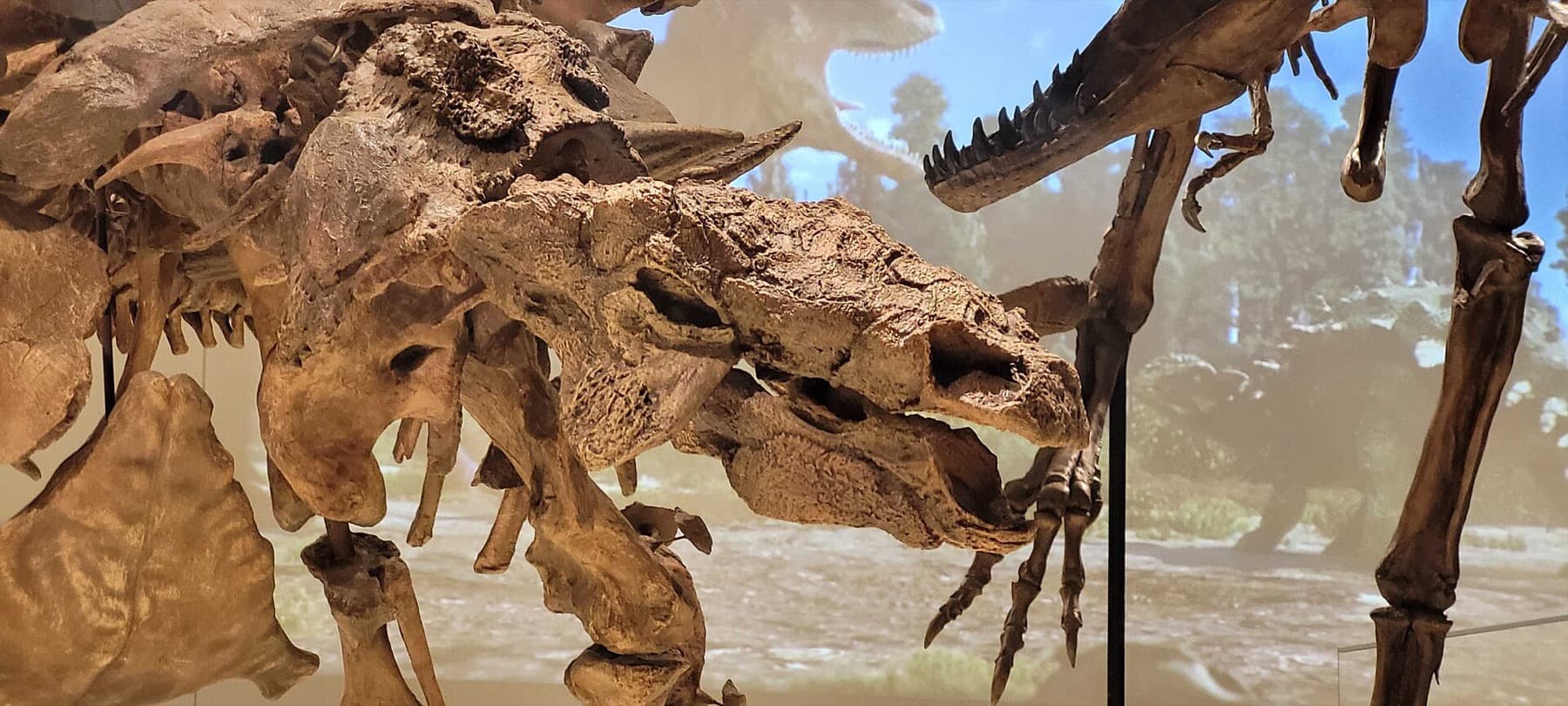
Zuul crurivastator is an armoured dinosaur found near Havre, Montana in 2014 and acquired by the Royal Ontario Museum in 2016. Its name means "destroyer of shins." It keeps much of its skin and armour, and it stands on Level 2 of the ROM, mounted in a fight scene with a Gorgosaurus.
On Level 2 of the Royal Ontario Museum, in the Age of Dinosaurs galleries, a low, wide animal covered in bony plates stands with its tail swung out toward a meat-eater. The meat-eater is Gorgosaurus libratus, a relative of T. rex. The armoured one is Zuul crurivastator, and the museum calls it one of the most complete and best-preserved dinosaurs ever found anywhere in the world.
Found by a loader in Montana
Zuul came out of the ground in 2014, near Havre in Hill County, Montana, from rocks of the Judith River Formation. The company digging there, Theropoda Expeditions, was clearing away overburden with a skid-steer loader in May when the machine uncovered a tail club. They nicknamed the skeleton "Sherman."
The rocks it lay in date to between about 76.2 and 75.2 million years ago. The company offered the specimen for sale, and the ROM acquired it in June 2016, with support from the Louise Hawley Stone Charitable Trust. Its catalogue number is ROM 75860, and it is the holotype: the single specimen that defines the species.
Where the name comes from
Hear a stop from this walk
Tank House Lane: Buildings for Waiting
Victoria Arbour and David Evans named and described the animal in 2017, in the journal Royal Society Open Science. The first half of the name comes from Zuul, the demon in the 1984 film Ghostbusters. The skull has a short, rounded snout and prominent horns behind the eyes, and the resemblance was too good to pass up.
The second half is the serious part. Crurivastator joins the Latin crus, the shank or lower leg, with vastator, destroyer. The authors render it as "destroyer of shins," a nod to the club at the end of the tail and what it could do to the legs of a predator walking on two feet.
Why this fossil is extraordinary
Most dinosaurs reach museums as bones. Zuul arrived with much more. The skull is complete, the tail club is complete, and the museum says the fossil kept most of its skin and bony armour across the entire back and flanks.
That matters because ankylosaur armour is not one shell. It is hundreds of separate bony plates and spikes, called osteoderms, set into the skin. In most skeletons they scatter after death and nobody can be sure where each one sat. On Zuul they are still in their original positions. Some even keep a dark film over them, the remains of the horny keratin sheath that covered the bone in life, and patches of small, non-bony scales survive between the plates on the tail.
How big was Zuul?
The skeleton is estimated at about 6 metres (20 feet) long. The skull is about 50 centimetres long, and the tail alone runs nearly 3 metres, stiffened toward the back and ending in the heavy bony club. Reporting at the time of the naming put its weight at roughly 2.5 tons.
Zuul vs Ankylosaurus
Zuul is not Ankylosaurus, though they are relatives. The naming study placed Zuul in a group of tail-clubbed ankylosaurs alongside Ankylosaurus, Anodontosaurus, Dyoplosaurus and Scolosaurus. Ankylosaurus itself lived later, between about 70 and 66 million years ago, and was bigger: estimates run from about 6 to 8 metres long and 4.8 to 8 tonnes. Zuul is older by roughly five to ten million years, and because so much of its skin and armour survived, it is the better guide to what this kind of animal looked like in the flesh.
The healed spikes
In December 2022, Victoria Arbour, Lindsay Zanno and David Evans published a study in Biology Letters titled "Palaeopathological evidence for intraspecific combat in ankylosaurid dinosaurs." They looked closely at the spikes along Zuul's sides.
Several spikes near the hips, on both sides of the body, are missing their tips. The bone and its horny sheath healed into a blunter shape, which means the animal survived the damage. Some of the injuries are fully healed and some only partly, which suggests more than one injury event. The damage is clustered on the flanks around the hips rather than spread randomly across the body.
The authors argue that this pattern fits blows from another ankylosaur's tail club better than attacks from a predator. Their reading is that tail clubs were used in fights between members of the same species, perhaps over territory, rank or mates. The study does not rule out using the club against a tyrannosaur. It suggests that combat with rivals was more likely the force that shaped the club.
What to look for in the gallery
Start at the tail. Follow the stiff rear section to the club and notice how it is built as one solid mass of bone, with no flex at the end.
Then walk to the hips and look along the flanks for the big spikes. Compare their tips from one side to the other. Some are pointed. Some are blunt and rounded where they broke and healed.
Look at the head for the short snout and the horns behind the eyes that gave Zuul its name. Then step back and take in the whole scene: an animal built as armour facing one built as teeth, and a reminder from those healed spikes that its hardest fights may have been with its own kind.
How this fits the Roamer guide
Roamer's audio guide to the Royal Ontario Museum includes a story for Zuul in the Age of Dinosaurs gallery on Level 2, alongside Gordo the Barosaurus, Parasaurolophus and the museum's T. rex. You can find it in the Royal Ontario Museum guide.
Cover photo: Montanoceratops, public domain (CC0), via Wikimedia Commons.

Ready to experience it?
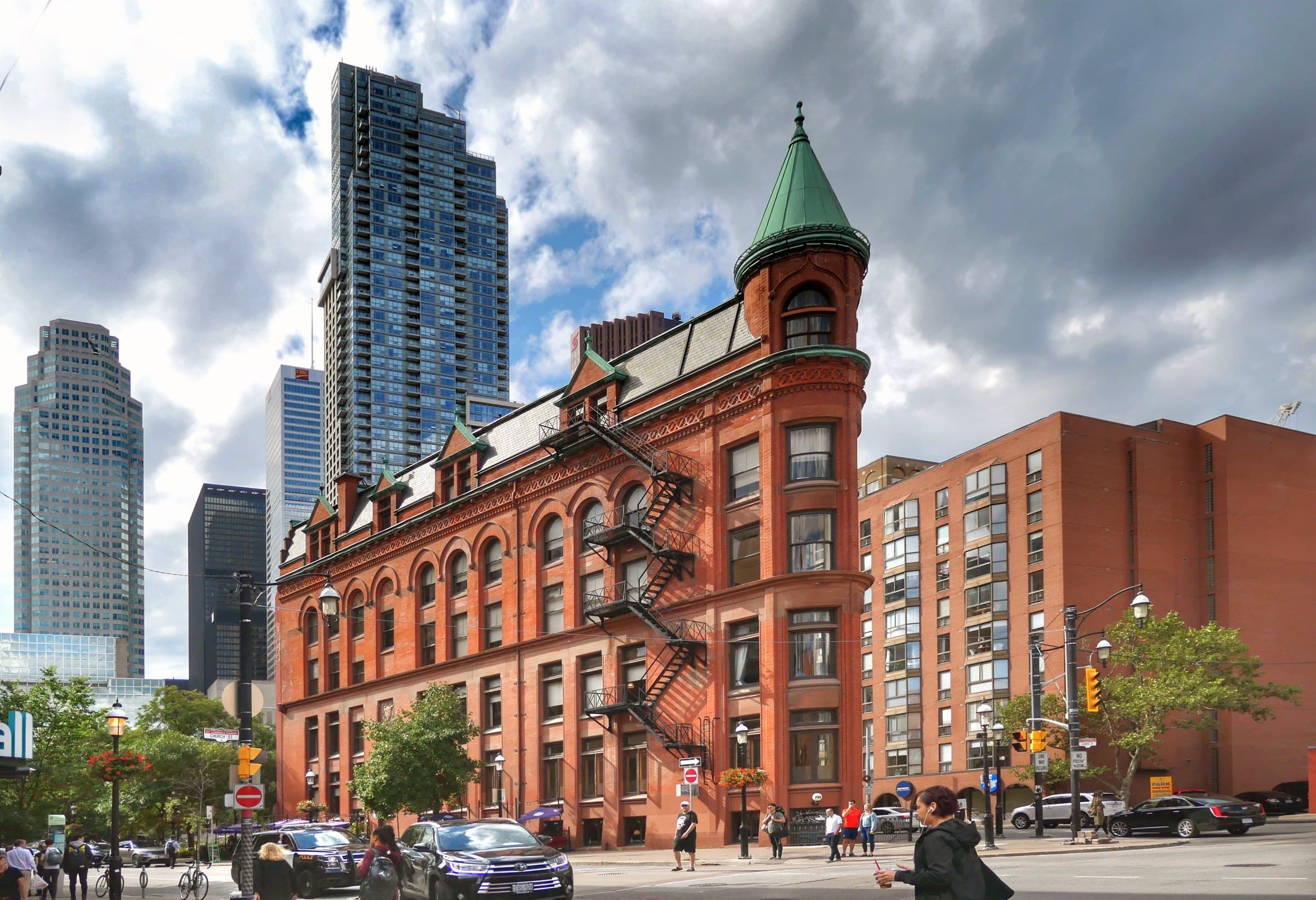
Old Town: St Lawrence Market to the Distillery District
110 min · 3.2 km · easy
More from Toronto
Explore more at your own pace.
Royal Ontario Museum: What to See, Floor by Floor
The ROM Crystal: Daniel Libeskind's Shard on Bloor Street
The ROM's Totem Poles: Crest Poles Built Into the Building
Garrison Creek: The Buried River Under Trinity Bellwoods
The White Squirrels of Trinity Bellwoods