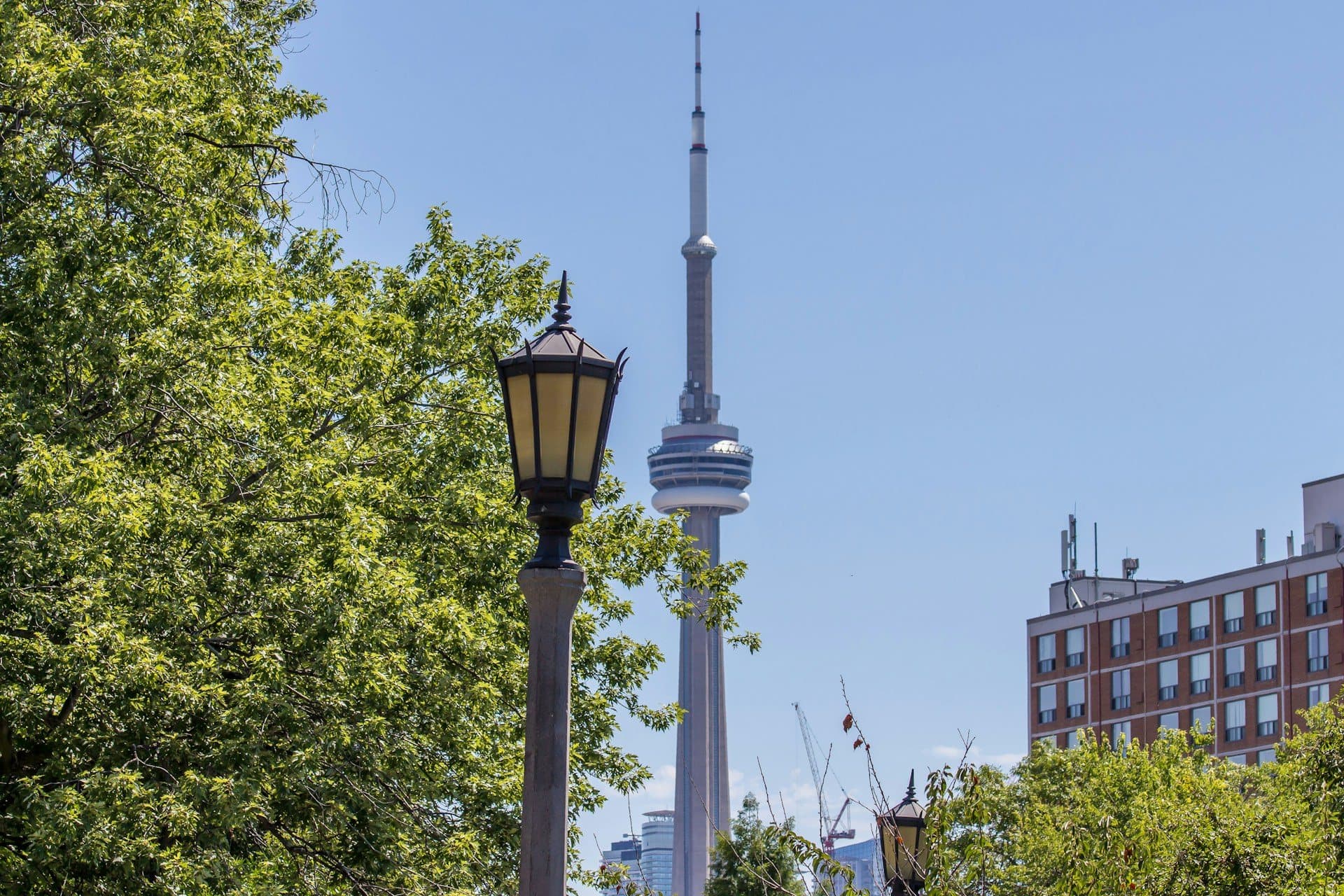
Stand on Bremner Boulevard and look up, and the CN Tower stops being a postcard. It becomes a single grey shaft of concrete tapering into the sky, with a doughnut-shaped pod near the top, a smaller pod above that and a thin mast on top. The first honest question is not how tall it is but why anyone built it. The answer is more practical than the view suggests.
A tower the skyline made necessary
The "CN" stands for Canadian National, the Crown corporation that ran the country's largest railway network. The tower's own history gives the reason it was built: the existing transmission towers were simply not high enough to broadcast radio and television signals over Toronto's tall new office buildings, which bounced the signals away from the people trying to receive them.
So the railway built higher than all of them. Canadian National employed more than 1,500 workers for 40 months. Construction crews moved onto the site on 6 February 1973, and by February 1974 the tower was already the tallest structure in Canada. Today it carries more than 17 Canadian television and FM radio stations and welcomes more than two million visitors a year.
That is the irony worth carrying with you on the walk. The tower that dominates the skyline exists because of the skyline. The glass towers came first, and this is the answer to the problem they caused.
How it was poured
Hear a stop from this walk
Jack Layton Ferry Terminal: The Islands Across the Bay
Look at the shape of the shaft. Its core is hexagonal, braced by three curved arms, and the taper gives it a low centre of gravity. The concrete was poured into a huge mould called a slipform, which climbed on a ring of hydraulic jacks as the concrete below it hardened, and grew smaller as it rose. That shrinking mould is what gives the shaft its curve.
The antenna went up by air. In March 1975 a giant Sikorsky helicopter called Olga lifted the 39 pieces of the antenna into place. The tower was finished on 2 April 1975 and opened to the public on 26 June 1976. In 1995 Canadian National sold it to the Canada Lands Company, a federal Crown corporation.
The height, and the record
The official height is 553.33 metres, or 1,815.5 feet. For more than thirty years it was the tallest free-standing structure in the world. The tower's own pages disagree on exactly when that record ended, so the safe statement is the one that matters: for a generation, nothing humans had built and left standing on its own was taller.
It still holds other titles. Its official awards page lists it as the tallest tower in the Western Hemisphere, with the hemisphere's highest observation platform at The Top, 447 metres up. The Main Observation Level is 346 metres up, and the elevators get there in 58 seconds. The glass floor on the Lower Observation Level gives a view 342 metres straight down. On a clear day the view reaches about 160 kilometres.
EdgeWalk
Around the rim of the main pod, 356 metres up, runs EdgeWalk, a ledge 1.5 metres wide. Participants walk the outside of the pod secured with a harness attached to an overhead trolley system. Guinness certified it on 8 November 2011 as the highest external walk on a building in the world. The whole experience takes about ninety minutes, about thirty of them on the ledge. From the ground you may see walkers in bright suits as dots on the rim on a clear day, though nothing guarantees it.
Visiting
The tower is ticketed, with timed entry, and on a clear day it is worth going up. Prices and hours change, so check the official site before you go. The long low roof at its foot is Ripley's Aquarium, also ticketed.
On the walk
The CN Tower is stop two of the CN Tower and the Waterfront walk, nine stops over about two and a half kilometres from Union Station to the Jack Layton Ferry Terminal, about 85 minutes at an easy pace. The stop works from the corner of Bremner Boulevard and Lower Simcoe Street, whether or not you go up. The next stop is the turntable in Roundhouse Park, where the same railway story continues at ground level: read John Street Roundhouse: The Best Survivor of the Steam Age. For every walk in the city, see the Toronto walking tours guide, or start from Toronto.
So look up one more time. The number, 553.33 metres, is the easy part. The better fact is that the railway built it because the city's new towers were in the way, and then it stood taller than anything on Earth for more than thirty years.
Ready to experience it?

CN Tower and the Waterfront: From the Railway Lands to the Lake
85 min · 2.4 km · easy
More from Toronto
Explore more at your own pace.

Royal Ontario Museum: What to See, Floor by Floor
The ROM Crystal: Daniel Libeskind's Shard on Bloor Street
The ROM's Totem Poles: Crest Poles Built Into the Building
Zuul: The ROM's Armoured Dinosaur, Skin and All
Garrison Creek: The Buried River Under Trinity Bellwoods