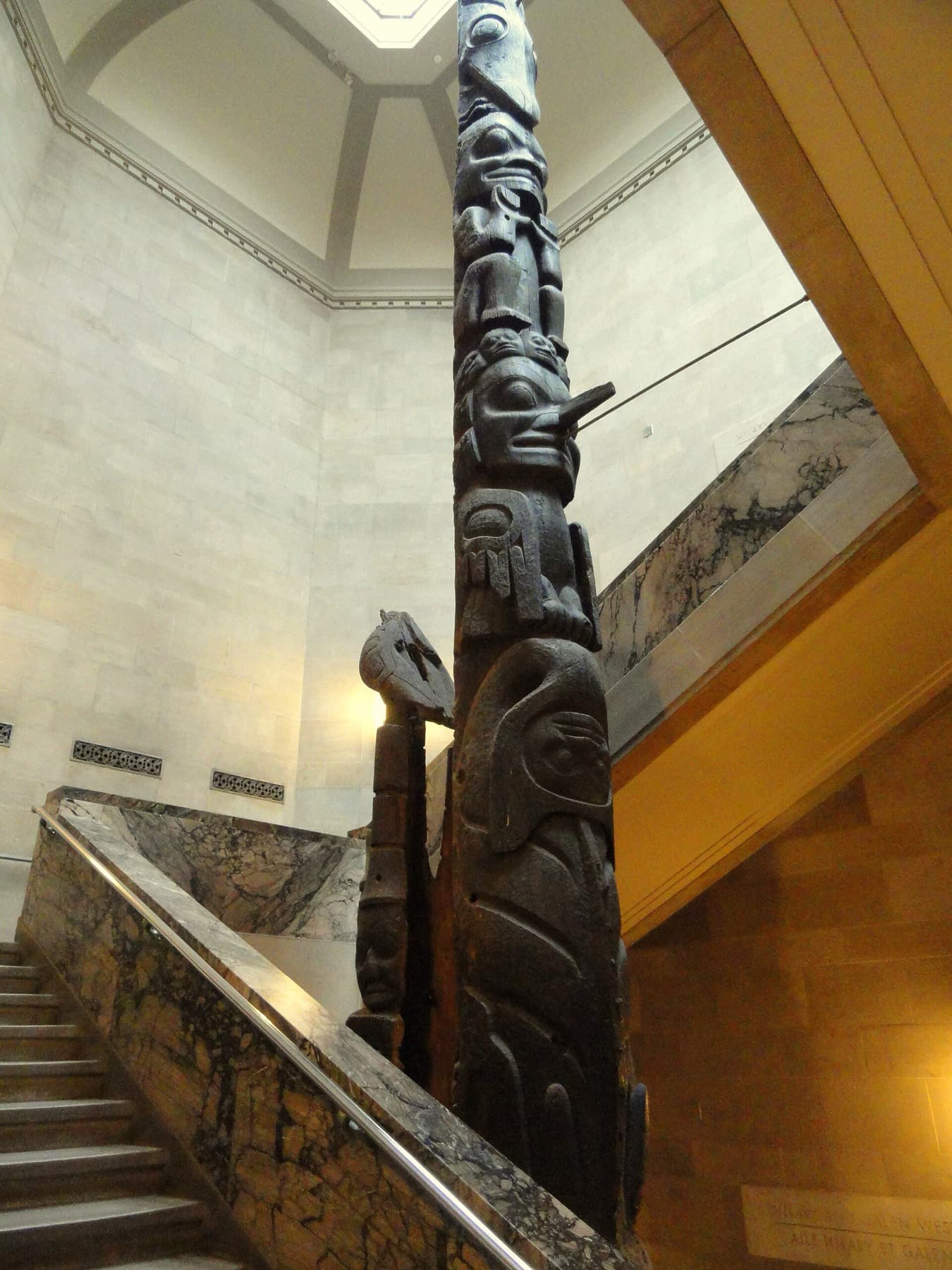
The Royal Ontario Museum holds four cedar crest poles, three Nisga'a and one Haida, standing just outside its First Peoples gallery where the staircase winds around them. They arrived in the 1920s and went on show in 1933. The tallest, the Pole of Sag̱aw̓een, rises about 25 metres.
Most people searching for the ROM's totem poles have already seen them, or seen a photo: tall red cedar columns of carved figures, rising up a stairwell with the museum's staircase turning around them. There are four. Three were carved by Nisga'a artists in the Nass River valley of British Columbia, and one by Haida artists. They stand just outside the Daphne Cockwell Gallery of First Peoples Art and Culture, on the main floor of the Weston Wing.
"Totem pole" is the common English name, and the museum's own page uses it. They are also often called crest poles, which says more about what they are. Each figure is a crest: a being that belongs to a family and records where that family came from and what it is entitled to.
A building made tall enough
The poles reached Toronto in the early 1920s. The Nisga'a poles were acquired by the anthropologist Marius Barbeau, and a 2016 article in the Daily Commercial News says the poles were bought under the instruction of Charles Currelly, the museum's first director, during the years of the Potlatch Ban, when many Indigenous ceremonies were illegal.
Then the museum had a problem. No room was tall enough. The poles could not go on display until the expansion of 1933, when the new building was constructed around them. The same article quotes J'net Ayayqwayaksheelth, then the museum's Indigenous outreach and learning co-ordinator, describing how the largest pole was brought in pieces and joined beneath the skylight before the staircase was wrapped around it. The article also notes that the poles were soaked in petroleum and wax for preservation, which destroyed much of the original paint, and that the paint had to be applied again.
The Pole of Sag̱aw̓een
Hear a stop from this walk
Tank House Lane: Buildings for Waiting
The tallest of the four is the Pole of Sag̱aw̓een, carved by Oyee to commemorate Chief Sag̱aw̓een of the Eagle tribe. At about 25 metres it is the tallest pole carved on the Nass River and the tallest known pole from the nineteenth century. It once stood in the village of Gitiks. Its thirteen figures run, from the top, from a detached Eagle down to Aitl and the Devil Fish at the base, with a Dragonfly, a Bullhead and a Halibut in between.
The Shaking Pole of Kw'ax̱suu
The Shaking Pole was carved by two artists, Oyee and Yarogwanows, and raised in the 1840s. It is 14 metres (45 feet) high and commemorates a woman, Chief Kw'axsuu. It stood on the beach along the Nass River, just past the village of Ank'idaa, the fifth in a row of poles there. Its name comes from the idea that grizzly bears would shake it as they climbed.
What makes it unusual is that it carries the crests of two tribes. Chief Kw'axsuu asked for both her mother's tribe, the Wolf, and her father's tribe, the Raven, to be included. The upper figures, among them the Prince of Grizzlies and Bear Mother, are Wolf crests. Lower down is Real Kingfisher, also called Submerged Person, a Raven crest. Two lineages share one trunk because the woman it honours belonged to both.
House 16: Strong House Pole
The Haida pole is known as House 16: Strong House Pole. It was carved from a single piece of cedar, hollowed out at the back, and its completion is estimated at about 1910. Its main figures are a sitting beaver, a killer whale missing its dorsal fin, and a sitting bear. It was raised as a memorial by a man named Nespalas for his brother, recorded as "Prince capsized himself." A carved horned owl once perched on top; it is no longer there. Charles F. Newcombe collected the pole for the museum in 1923.
How to read a crest pole
The figures are not gods, and the poles were not worshipped. Indigenous Foundations at the University of British Columbia notes that this is a common misunderstanding, and explains that most poles show crest beings marking a family's lineage and the rights and privileges it held. A memorial pole, like the three Nisga'a poles here, was usually raised to honour an important person after their death, usually by their successor.
So read a pole one figure at a time. Pick out one figure, find its name, and then ask whose crest it is. On the Shaking Pole, that question leads straight to a mother's family and a father's family. Climbing the staircase helps: each landing brings a different figure close to eye level.
Collection and return
These poles left their villages in a period when Canadian law suppressed the ceremonies they belonged to, and questions about how museums came to hold such poles are part of their story. The best known recent case involves a different pole. In 1929 Marius Barbeau took the Ni'isjoohl memorial pole from Ank'idaa to the National Museum of Scotland. After discussions with the Nisga'a Lisims Government, the museum agreed in December 2022 to return it, and it arrived home on Nisga'a territory on 29 September 2023. The Nisga'a call this rematriation, because Nisga'a society is matrilineal.
How this fits the Roamer guide
Roamer's audio guide to the Royal Ontario Museum tells the story of the poles in the First Peoples gallery and the stairwell beside it, starting with the Pole of Sag̱aw̓een and moving figure by figure up the stair. You can find it on the Royal Ontario Museum guide page.
Cover photo: Daderot, public domain (CC0), via Wikimedia Commons.
Ready to experience it?
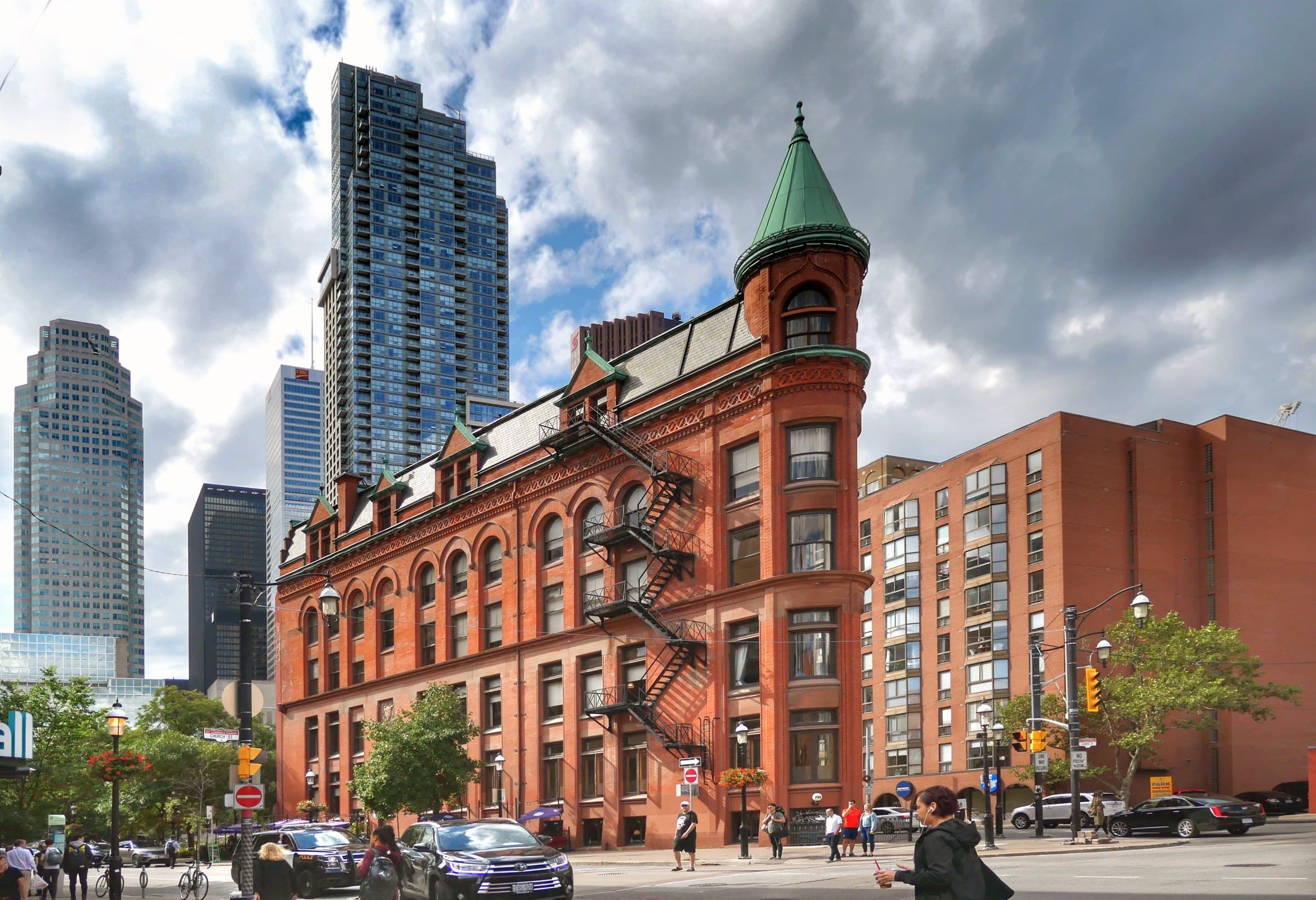
Old Town: St Lawrence Market to the Distillery District
110 min · 3.2 km · easy
More from Toronto
Explore more at your own pace.
Royal Ontario Museum: What to See, Floor by Floor
The ROM Crystal: Daniel Libeskind's Shard on Bloor Street
Zuul: The ROM's Armoured Dinosaur, Skin and All
Garrison Creek: The Buried River Under Trinity Bellwoods
The White Squirrels of Trinity Bellwoods