Edo's copy of Kyoto, and what was left after the battle: in the 1620s the priest Tenkai laid out Ueno's hill as Kyoto in miniature, the battle of 1868 burned most of it, and this walk reads what survived and what is only a trace, ending in the temple town of Yanaka, which came through 1923 and 1945 comparatively lightly. It runs eleven stops over about 2.5 kilometres in roughly ninety minutes, from the Saigo Takamori statue at the edge of Ueno Park to the Yuyake Dandan steps above Yanaka Ginza.
Kyoto in miniature
The plan was a copy, and you can still read it. Tenkai founded the temple of Kan'ei-ji here in 1625, on the northeast of the shogun's castle, the unlucky quarter, in the way that the temples of Mount Hiei guard the northeast of Kyoto. The landscape followed. Shinobazu Pond below the hill was treated as Lake Biwa, the great lake beside Hiei, and an island built in it stood for the sacred island of Chikubu-shima.
Kiyomizu Kannon-do, the second stop, is the clearest piece of the copy. Tenkai built it in 1631 in imitation of Kyoto's Kiyomizu-dera, a hall on a tall wooden stage over a slope. It was moved to its present spot in 1694 and escaped the fire of 1868, and it is a national Important Cultural Property. From the stage, a pine trained into a full circle frames the island hall below. Both the pine and the island hall are recent, the pine a 2012 re-creation of a tree shown in an Edo print and the hall rebuilt in 1958 after the air raids. What survives is the arrangement: Kyoto's stage, lake and island in one view.
The battle
Hear a stop from this walk
Yuyake Dandan: The Sunset Steps
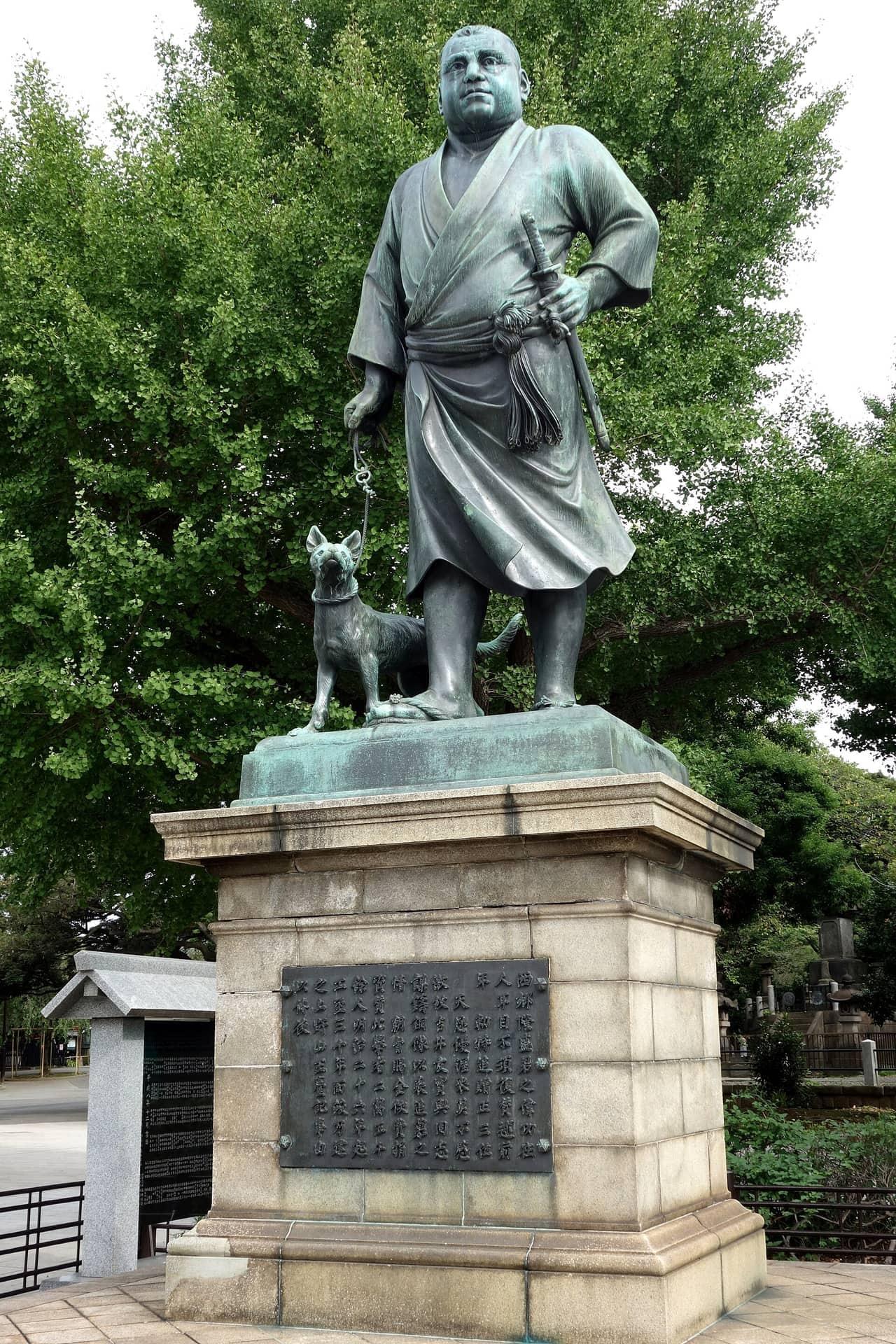
The statue at the start sets the scene. Saigo Takamori, unveiled in 1898, was a staff officer of the army sent against the shogunate in 1868 and is credited with arranging the surrender of Edo Castle without a fight. Ueno did not go so quietly. About two thousand loyalists of the shogun, the Shogitai, held the temple grounds, and on 4 July 1868 the new government's army attacked. By evening the defenders had fled and most of the temple was burning. A few steps from the statue stands their grave, a stone of 1881 that does not carry their name, because they were still rebels in the government's eyes.
What survived and what is a trace
From here the walk becomes a sorting exercise. Some things came through. Ueno Tosho-gu, the golden shrine to the first Tokugawa shogun, was founded in 1627 and rebuilt in 1651 on the model of Nikko; its approach is lined with stone and bronze lanterns given by lords from across the country. The shrine survived the battle, did not fall in 1923, and by its own account an incendiary bomb behind the golden hall in 1945 failed to go off.
Other things are only traces. The Ueno Daibutsu is a bronze face set into a stone wall, all that remains after earthquakes, a fire and the wartime metal drive took the rest; Kan'ei-ji set it into the wall in 1972. At the fountain plaza stood the temple's main hall, 32 metres high, dedicated in 1698 and burned in the battle. Nothing of the building is left, and the open ground is the evidence. Ueno became one of Japan's first public parks in 1873, and the Tokyo National Museum now stands on the site of the temple's main residence.
Across the road, Kuroda Memorial Hall of 1928 shows the next layer: a classical front with Ionic columns at the centre, faced in brown scratch tile over reinforced concrete, paid for by the painter Kuroda Seiki's will.
Into the temple town
At the Yanaka 6-chome corner the walk leaves the museum park for a neighbourhood where people live. Three old buildings stand close together, each kept a different way: Yoshidaya, a 1910 sake shop rebuilt as a museum annex; Kayaba Coffee, a 1916 house kept working as a cafe; and SCAI the Bathhouse, a 1951 bathhouse turned gallery. Tokyo's cemetery plan says the earthquake and the war hit this area comparatively lightly, which is why its lanes and wooden buildings keep the feel of the old downtown.
Two more traces of loss follow. In Yanaka Cemetery a fenced square of 49 granite stones is all that remains of Tenno-ji's five storey pagoda, rebuilt in zelkova wood in 1791. It survived the earthquake and the air raids and was destroyed by a fire set in it in 1957. Then, on Gotenzaka, the gate of Kyo-oji, built in 1836, still carries bullet holes. Arakawa City records that Shogitai survivors fled here from Ueno in 1868 and the new government's troops attacked the temple. The battle that emptied the hill left its smallest, closest mark in a wooden gate that still stands.
Walking it yourself
The route mixes park paths, a cemetery avenue and quiet residential lanes, so it suits a slow pace. Families come to tend graves in Yanaka Cemetery, and Kyo-oji is private and seen from the street. You can stop for coffee at the corner, step into the Tosho-gu grounds or skip them, and time the end for the Yuyake Dandan steps, named by neighbourhood contest in 1990 for the sunset glow. The tour is free to start and runs on your own schedule.
Start at stop 1 of Ueno and Yanaka: Edo's Kyoto and the Battle of 1868, and find more on the Tokyo city page. For one corner in depth, read about Kayaba Coffee.
Sources
- Arakawa City, Kyo-oji (https://www.city.arakawa.tokyo.jp/a022/shisetsuannai/jinja/nippori003.html): the gate built in 1836, the Shogitai who hid here after the Battle of Ueno in 1868, the government attack and the bullet holes that remain.
- Ueno Tosho-gu (https://www.uenotoshogu.com/): founded in 1627 to enshrine Tokugawa Ieyasu, its golden buildings spared by wars and earthquakes.
- Roamer tour research for the Ueno and Yanaka walk (audited transcript and fact dossier, drawing on Kan'ei-ji, Taito and Arakawa wards, the Tokyo National Museum and Tokyo's park and cemetery offices): Tenkai's plan, Kiyomizu Kannon-do, the Saigo statue and the Shogitai grave, the Daibutsu, the main hall site, Kuroda Memorial Hall, the 6-chome corner, the Yanaka pagoda site and the Yuyake Dandan.
Ready to experience it?
Ueno and Yanaka: Edo's Kyoto and the Battle of 1868
90 min · 2.5 km · easy
More from Tokyo
Explore more at your own pace.
Best Culture Walking Tours in Tokyo (2026)
Best History Walking Tours in Tokyo (2026)
Best Nature Walking Tours in Tokyo (2026)
Asakusa and Senso-ji: Why the Grand Buildings Are Young and the Survivors Are Small
Edo Castle, Gate by Gate: How the Shogun's Fortress Became a Garden Anyone Can Walk Into