Imperial Palace: Edo Castle, Gate by Gate
80 min · 2.9 km · easy
Built land, rebuilt twice: Tsukiji was filled from the sea for a temple after 1657 and became Tokyo's kitchen after 1923, keeping its shops when the fish market left in 2018; Ginza was rebuilt in brick after 1872 and again after 1923 and 1945, and keeps the names, Renga-dori and Sukiyabashi, where the things are gone. That is the line this walk follows. It covers eleven flat stops over about 2.1 kilometres in roughly seventy five minutes, from a temple in India's style to a bridge with no water under it.
Ground made from the sea
The name is the first clue. After the great fire of 1657 a temple that had burned in the city was given a stretch of shallow sea in exchange, and its followers, fishermen from Tsukuda island, filled it in. The new ground was called Tsukiji, built land, and the temple, Tsukiji Hongwanji, still stands on it. Everything on this walk stands on made ground.
The hall you see is not the old one. The temple burned again in the fire after the 1923 earthquake, and the main hall that replaced it was finished in 1934 to a design by the architect and historian Ito Chuta. Chuo City notes that he looked not to Japanese temple styles but to the architecture of India, where Buddhism began. Look for the central dome, the two side towers and walls that read as carved stone. They are reinforced concrete, built with fire and earthquake first in mind, and the hall is now a national Important Cultural Property.
The market that came and went
Hear a stop from this walk
Ninomaru Garden: An Edo Plan, Made in 1968
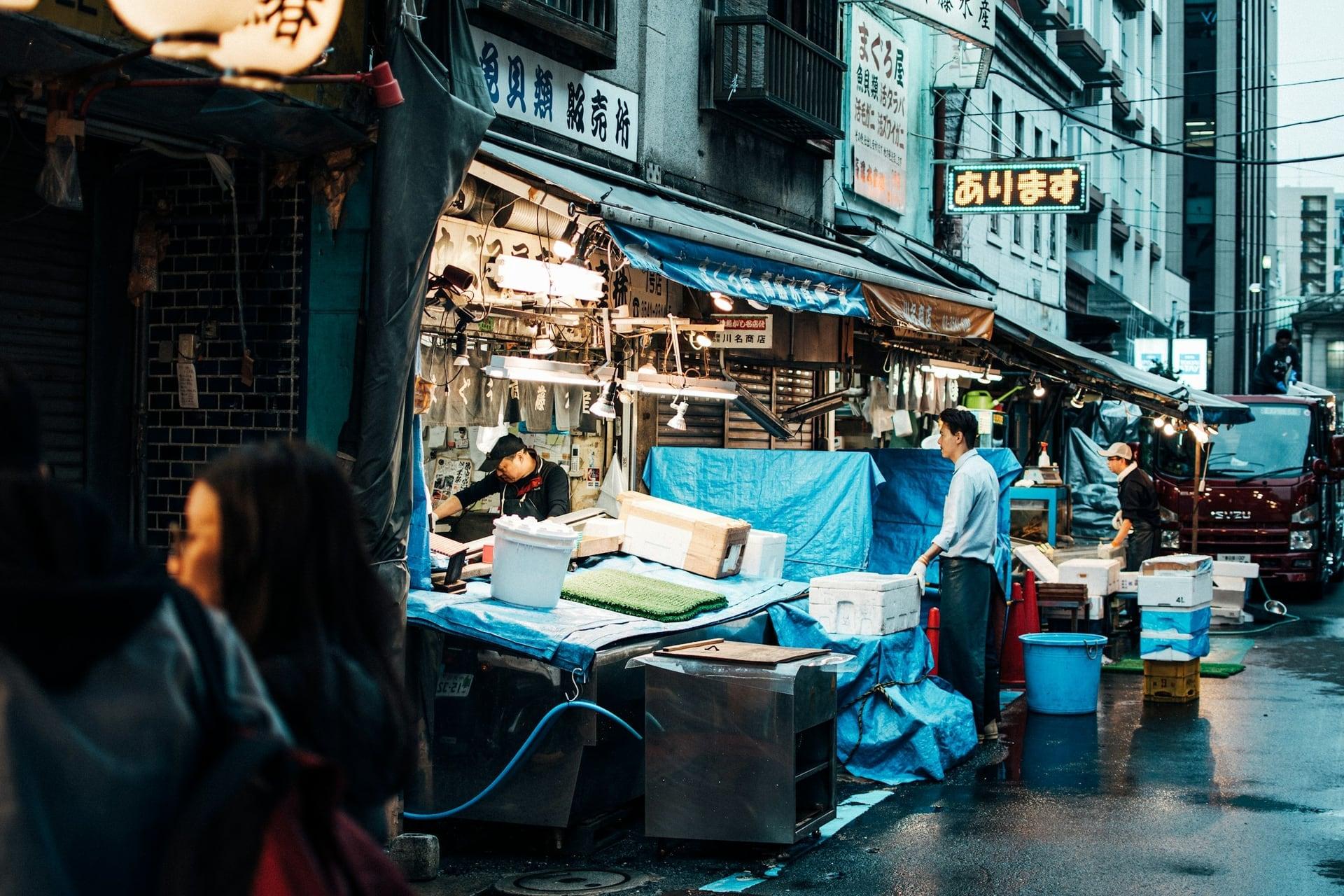
The same disaster that burned the temple sent the fish market here. The 1923 earthquake destroyed the old market at Nihonbashi, and Tokyo's central wholesale market opened at Tsukiji in 1935. Around it, on ground cleared when many of the temple's graves were moved out of the city, seafood traders set up shop, and a town of small shop houses grew up of its own accord. When the wholesale market moved to Toyosu in October 2018, the shops stayed. That is the Tsukiji Outer Market: the part of the famous market that Tokyo kept.
Read the layers as you go. Namiyoke Inari, the shrine of the waves, tells how a glowing statue drifted in while the landfill kept washing away, and the sea calmed once it was enshrined. Around its grounds stand memorial stones set up by the market's own trades. Tsukiji Uogashi, two low market buildings put up by Chuo City so the professional trade could stay, are named after bridges whose water is gone. Across Shin-Ohashi-dori, the site of the old inner market is behind hoardings, and the Tokyo Metropolitan Government reports that archaeologists digging there have found the base of a steel furnace thought to belong to the Meiji-era navy, the land's use before the market came.
A river of cars
Between the two districts the walk crosses the bed of the Tsukiji River. It was filled in and, in December 1962, the first route of Tokyo's Metropolitan Expressway opened along it. The bridges stayed and kept their names, Uneme-bashi and Mannenbashi, though they now cross traffic. The pattern is already clear before you reach Ginza: water becomes land, and names stay behind.
Ginza, rebuilt and rebuilt again
The Kabuki-za, on Harumi-dori, has been rebuilt four times on the same spot. The theater in front of you was designed jointly by Mitsubishi Jisho Sekkei and Kuma Kengo and completed in 2013, with 1,808 seats and a revolving stage 18.18 metres across. Its curved gables copy the fronts of the theaters before and after the war, while a tower rises behind. The old face, rebuilt in new materials, with the new city behind it.
At Ginza four-chome stands the clock tower everyone calls Wako. It was built for the Hattori watch store and finished in 1932, after the earthquake fire, to a design by Watanabe Jin, in granite curving round the corner. The building was officially renamed Seiko House Ginza in 2022, and nobody calls it that.
Names where the things are gone
Ginza's oldest layer survives only as words. After a fire in 1872 burned dozens of city blocks, the government declared a fireproof city and built the Ginza brick town, finished in 1877, with carriage roads, tree-lined pavements and gas lamps. Brick was costly, and in the end only about forty percent of the buildings were brick. No brick survives at the corner of Ginza Renga-dori, whose name means Ginza Brick Street.
The walk ends at Sukiyabashi, named for a bridge over the outer moat of Edo Castle. The moat here was filled in during the late 1950s. The water and the bridge are gone; the name stayed, on the crossing and on a small park. Ginza was bombed on 27 January 1945, and Chuo City keeps photographs of this crossing taken that day.
Walking it yourself
The market is a morning place, and the outer market closes with the wholesale market on Sundays, holidays and some Wednesdays, so plan around that if food is the point. Otherwise the route works at any hour, and you can stop to eat, skip the theater or linger in the back lanes as you like. The tour is free to start and fits your own schedule, with no group to follow.
Start at stop 1 of Tsukiji and Ginza: Built Land, Rebuilt City, and find more on the Tokyo city page. From Sukiyabashi, the Imperial Palace walk tells the castle whose moat once ran there.
Sources
- Chuo City, Tsukiji Hongwanji main hall (https://www.city.chuo.lg.jp/a0052/bunkakankou/rekishi/kunibunkazai/021021.html): rebuilt in 1934 after the post-earthquake fire, designed by Ito Chuta in the architectural style of India, a nationally designated Important Cultural Property.
- Tsukiji Outer Market (https://www.tsukiji.or.jp/english/): the Nihonbashi market destroyed in 1923 and moved to Tsukiji, operating from 1935, and the shops that stayed as the Outer Market when the wholesale market moved.
- Kabuki-za, building outline (https://www.kabuki-za.co.jp/guide/gaiyo.html): 1,808 seats, the 18.18 metre revolving stage, and the joint design by Mitsubishi Jisho Sekkei and Kengo Kuma and Associates.
- Roamer tour research for the Tsukiji and Ginza walk (audited transcript and fact dossier): the 1657 landfill and the name Tsukiji, Namiyoke Inari, Tsukiji Uogashi, the inner market excavation, the Tsukiji River expressway, Wako, the brick town and Sukiyabashi.
Ready to experience it?
Imperial Palace: Edo Castle, Gate by Gate
80 min · 2.9 km · easy
More from Tokyo
Explore more at your own pace.
Best Culture Walking Tours in Tokyo (2026)
Best History Walking Tours in Tokyo (2026)
Best Nature Walking Tours in Tokyo (2026)
Asakusa and Senso-ji: Why the Grand Buildings Are Young and the Survivors Are Small
Edo Castle, Gate by Gate: How the Shogun's Fortress Became a Garden Anyone Can Walk Into