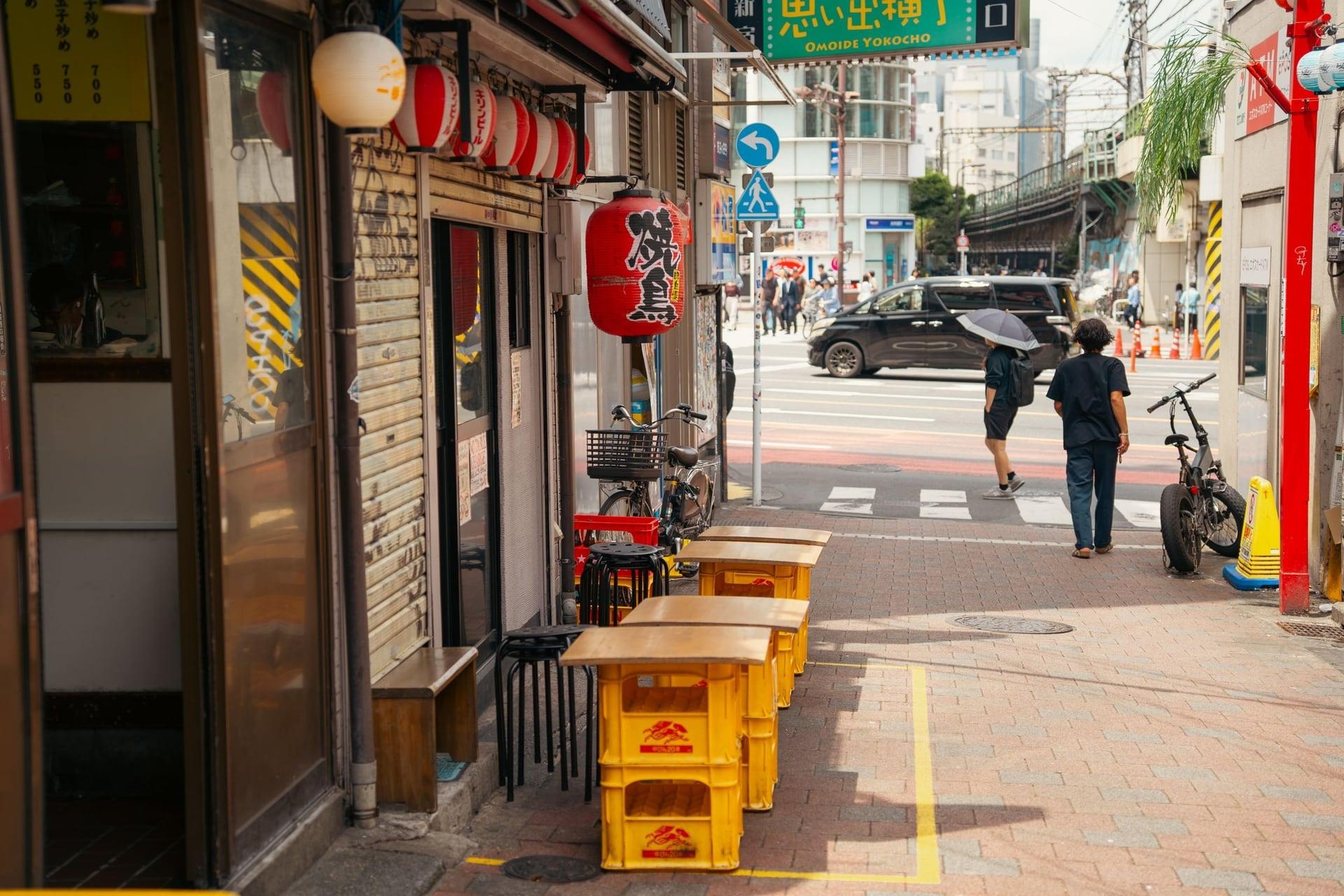
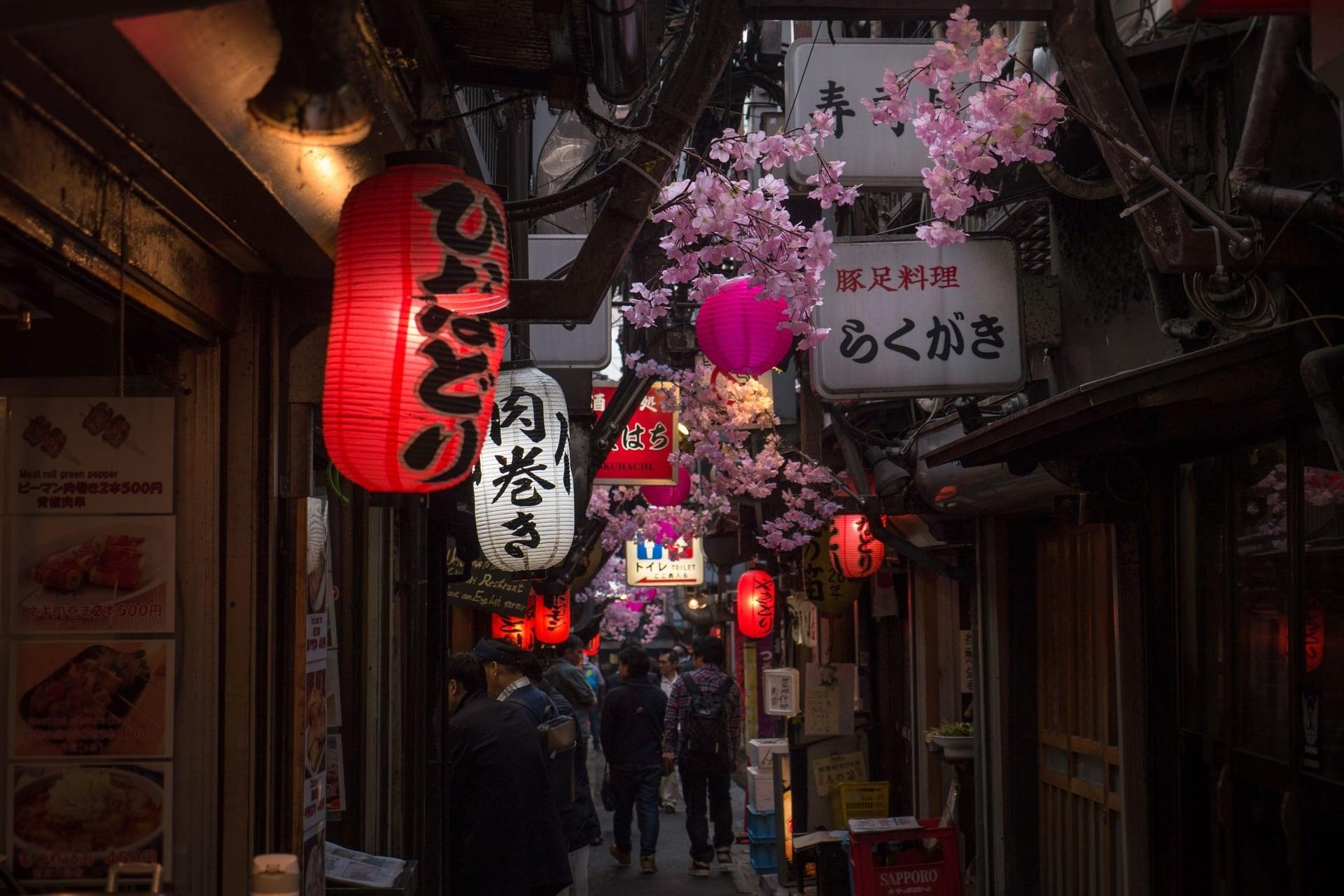
Omoide Yokocho is a menu and a floor plan fossilised by rationing. The narrow alley of grills beside Shinjuku's railway tracks began as a black market on burned ground after the war. Offal went on its grills because offal was the meat nobody controlled, and single wooden boards divided its stalls because that was all anyone had. Both survive: in the smoke, and in the shops that still share a wall with their neighbours.
Burned ground and reed screens
The alley's shopkeepers tell its history themselves, and they start at the end of the war. Around 1946, their association writes, the area by the West Exit was burned ground buried in rubble. Stalls sold clothes, shoes, soap and everyday goods in front of the station, and thirty or forty stands of reed screens sold oden, steamed sweet potatoes, boiled red beans, tempura and secondhand books. Then they burned down.
What replaced them was a market of street stalls, each divided from the next by a single wooden board: a black market of the controlled-economy years, called Lucky Street. That, the association says, is the forerunner of Omoide Yokocho. Shinjuku had a reason to draw a crowd. It was the transfer point for people coming in from the western suburbs, a terminal where people and goods moved, and the stalls set up where the people were.
Why the skewers are offal
Hear a stop from this walk
Shinjuku Gyoen's Shinjuku Gate: The Planned Garden
Now the menu. Around 1947, the association writes, the police were strict about controlled goods, and flour, the base of ramen and of sweet imagawayaki cakes, was one of them. Selling it was hard. What was not controlled was the offal of the cattle and pigs of the occupation forces. So stall after stall began grilling offal on skewers, motsu-yaki, and business boomed.
The association does the arithmetic for today: of about sixty restaurants in the alley, more than half are still yakitori or motsu-yaki shops. The smoke drifting out of the lane is the leftover of a rationing rule from the late 1940s. It is one of the few places in Tokyo where you can taste a piece of economic history, and order it with a beer.
Read the walls
The design is the other survivor. The association points to it directly: the single-board construction has been handed down from those days, and many shops still have walls joined to the shops next door. Walk the lane and look at the fronts. They are tiny, open, and pressed together, more like a row of market booths with roofs than a street of buildings. The lane itself is under three metres wide. A counter, a grill, a few stools, and the next shop begins.
The alley also shows what the city took away. In the Showa 30s, from the mid 1950s, the association recalls oddities like yakitori cabarets, where customers drank shochu over skewers served by dressed-up hostesses. Then, around 1959, plans for a subway extension and a new station building cleared about three hundred shops that had run all the way from the Koshu highway to the Ome highway, as illegal occupation of the ground. Only the stretch from today's Palette Building to the Ome highway remained. Today about eighty shops share about two thousand square metres. So Omoide Yokocho is not a frozen wartime market. It is the surviving fragment of a much longer one, rebuilt shop by shop on the old pattern.
Visiting
Many shops open from midday or late afternoon, and evening is when the grills are busiest. Walk the lane single file when it is crowded, and ask before you photograph inside a bar or the cooks at work: the association has its own strict rules on filming. On a self-guided walk you can stop for a skewer here and pick the route up again whenever you like.
Omoide Yokocho is stop 2 of Shinjuku: Backstreets, Kabukicho and Golden Gai, which carries on under the tracks to Kabukicho. Read the Shinjuku walk companion for the whole route, and see every walk on the Tokyo page.
Sources
- Shinjuku Nishiguchi shopping street association, history of Omoide Yokocho: the burned West Exit around 1946, the reed-screen stands and what they sold, the Lucky Street black market divided by single boards, Shinjuku as a transfer point, flour controlled and occupation offal not around 1947, more than half of about sixty restaurants still yakitori or motsu-yaki, the shared walls, the yakitori cabarets, the clearance of about 300 shops around 1959.
- Omoide Yokocho, official site: the shop directory, map and filming rules.
- Roamer's audited tour transcript for Shinjuku, stop 2, and its fact dossier (opened 8 November 2026): about eighty shops on about two thousand square metres, the lane under three metres wide.
Ready to experience it?
Shinjuku: Backstreets, Kabukicho and Golden Gai
75 min · 2.6 km · easy
More from Tokyo
Explore more at your own pace.
Best Culture Walking Tours in Tokyo (2026)
Best History Walking Tours in Tokyo (2026)
Best Nature Walking Tours in Tokyo (2026)
Asakusa and Senso-ji: Why the Grand Buildings Are Young and the Survivors Are Small
Edo Castle, Gate by Gate: How the Shogun's Fortress Became a Garden Anyone Can Walk Into