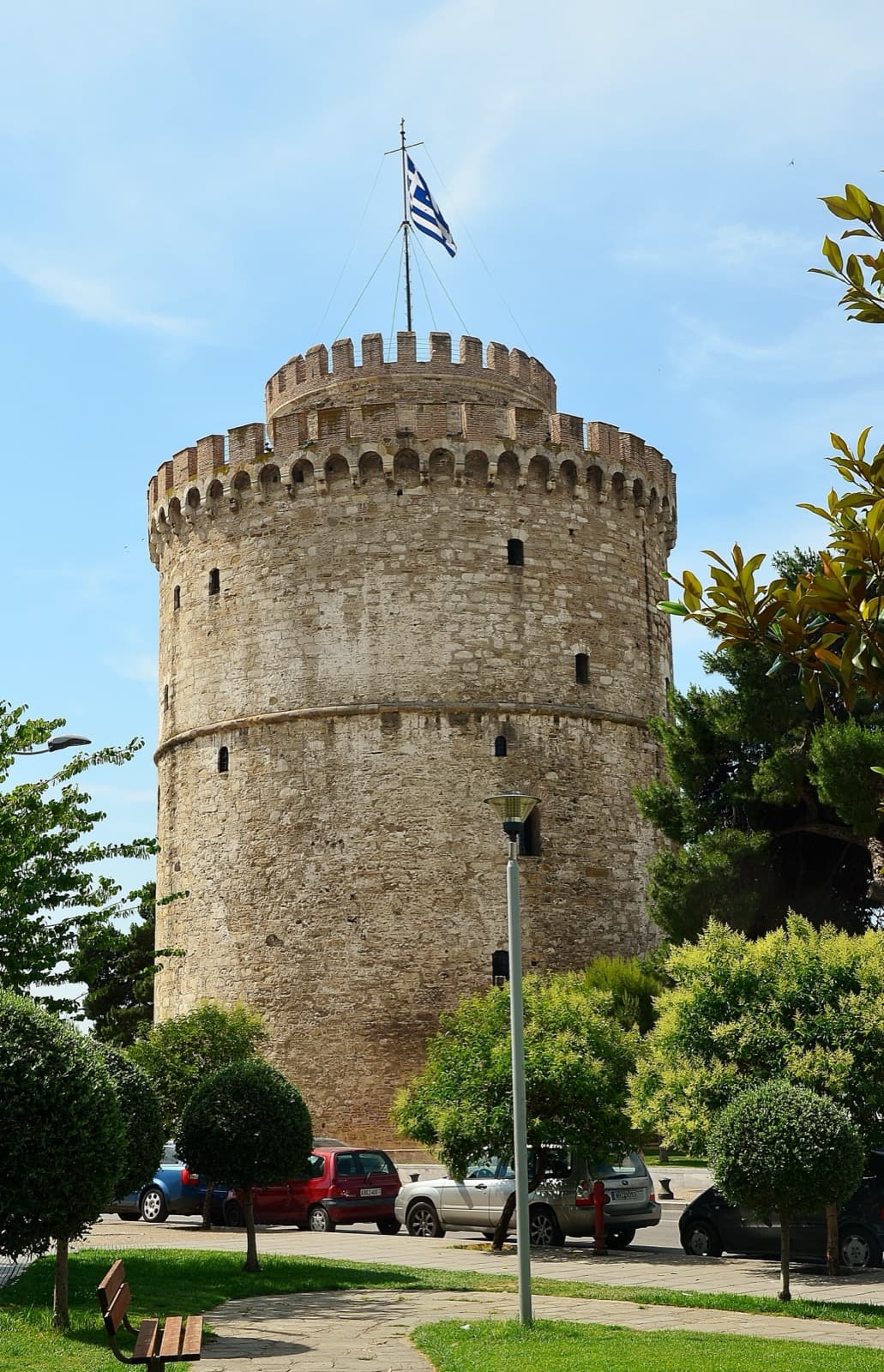
The White Tower of Thessaloniki looks like the calmest thing on the waterfront: a pale cylinder of stone at the edge of the sea, photographed a thousand times a day, the emblem printed on postcards and fridge magnets across northern Greece. Stand in front of it and the most useful thing to understand is that this serenity is recent and partly invented. The tower is a layered Ottoman survivor that once held prisoners and executions, carried a far darker name, and got its whitewash and its present identity through a story that is closer to legend than fact. It is a place that has changed its meaning several times, and it now stands at the end of one of the city's most important walks, where the living waterfront meets a history that is mostly invisible.
What you are actually looking at
The physical object is precise and satisfying. The tower is a cylindrical stone structure roughly thirty-four metres tall and about twenty-three metres across, with six floors stacked inside a single round shell. That squat, heavy proportion is the point. This was not built to be pretty. It was built to be strong, a defensive and controlling structure anchoring the southeastern corner of the city's old sea walls.
Thessaloniki was captured by the Ottomans under Sultan Murad the Second in fourteen thirty, and the tower as we know it belongs to the long Ottoman period that followed. For centuries after that, this was one of the great multi-faith ports of the Ottoman world, a city where Muslims, Christians, and a very large Sephardic Jewish population lived layered on top of one another. It is worth reading that era soberly rather than as a costume drama. The tower is a real piece of that machinery of empire, and its uses were not gentle.
The Tower of Blood
Hear a stop from this walk
Eleftherias Square: The Menorah in Flames
The version of this building that most visitors never hear about is the one that matters most for understanding it. During Ottoman rule the tower served as a prison and a place of execution. It was, for long stretches of its life, a place where people were held and killed, not a scenic landmark.
The nickname that stuck to it in that period tells you everything. After a massacre of imprisoned soldiers here in eighteen twenty-six, the tower was grimly remembered as the Tower of Blood. Hold that against the pale, friendly cylinder in front of you. The building did not change its shape. Only its reputation, and then its color, and then its meaning, shifted underneath it.
The name it carries now arrived around eighteen ninety. By tradition, a prisoner whitewashed the tower's walls in exchange for his freedom, and from that act the Tower of Blood became the White Tower. Whether or not the legend is literally true, the transformation it describes is real: a structure associated with confinement and death was, quite deliberately, painted over into something the city could live with. The whitewash is long gone from the stone today, but the name it created remains, which is a small monument to how places get their reputations rewritten.
From Ottoman edge to Greek emblem
Thessaloniki was incorporated into Greece in nineteen twelve, and in the century since, the tower has become something its builders would not recognize: the single most reproduced image of a Greek city, the shorthand for Thessaloniki itself. Today it is a museum of the city's history. You can pay admission, climb the internal ramp that spirals up through those six floors, and step out at the top onto a view that takes in the whole seafront and the bay.
That reinvention, from military prison to civic emblem to ticketed museum, is not unusual for old fortifications. What makes it worth pausing on here is how neatly it rhymes with the rest of the walk this tower closes. Thessaloniki is a city that has repeatedly rebuilt over its own difficult ground. A great fire in nineteen seventeen erased much of the lower town, and the elegant modern squares along the seafront rose over the ash of the older, denser quarters. The White Tower did the same trick on a smaller scale, turning a site of executions into a source of civic pride, quietly and thoroughly.
Why this is the right place to end
The White Tower is the final stop on the thessaloniki-ladadika-jewish walking route, and the reason is not just that it sits at a convenient point on the seafront. It is the horizon of the whole tour.
That route moves through the surviving skin of Jewish Thessaloniki, a Sephardic metropolis so central to the Jewish world that it was once called the Mother of Israel. Between the spring and summer of nineteen forty-three, the Nazi occupiers deported roughly ninety-six percent of that community to Auschwitz-Birkenau, and almost none returned. The walk asks you to read that absence into a lively Mediterranean waterfront that shows almost none of it: through the olive-oil warehouse quarter of Ladadika, the Modiano Market built over a destroyed synagogue, the Jewish Museum, the one synagogue that survived the war, and the seafront square where the persecution began.
By the time you reach the White Tower, the whole route is behind you, and in front of you is the open water. This is the same sea that carried the city's trade for centuries, and the same horizon those deportation trains turned their backs on. The tower's own history, a prison rebranded, a dark name whitewashed over, a fortification turned into an emblem, is a compact version of the larger pattern: a living city moving forward on ground that holds far more than it shows. Standing here, you get to let both things be true at once. The waterfront is genuinely lovely. What it sits on top of is genuinely heavy. Neither cancels the other.
If you want the full arc, the walk that leads here runs about four kilometres on mostly flat ground and takes roughly two hours at an unhurried pace. You can browse it and the rest of the city's routes among the Thessaloniki walking tours, then come stand at the tower yourself, with the record already in your head, and watch the sea do the remembering.
Sources
- White Tower of Thessaloniki, Wikipedia. Overview of the tower's Ottoman-period construction, its use as a prison and execution site, the eighteen twenty-six massacre and "Tower of Blood" nickname, the whitewashing legend, and its current role as a city-history museum.
- Roamer tour transcript, "The Mother of Israel: Jewish Thessaloniki and Its Absence." Fact-audited primary source for the tower's dimensions, its place in the wider Jewish Thessaloniki walk, and the framing of the seafront as a horizon of memory.
- Jewish Museum of Thessaloniki. Institutional record of the city's Sephardic history and the scale of the wartime deportations that give the walk its weight.
- History of Thessaloniki (Ottoman capture of 1430 under Murad the Second; incorporation into Greece in 1912), Wikipedia. Context for the political layers the tower has passed through.
Ready to experience it?
The Mother of Israel: Jewish Thessaloniki and Its Absence
95 min · 3.9 km · easy
More from Thessaloniki
Explore more at your own pace.
One Day in Thessaloniki: A Walkable Morning-to-Evening Itinerary
Thessaloniki: The City Read in Layers
The Ano Poli Timber Houses: How the Poorest Quarter Kept the Oldest City
The Jewish Museum of Thessaloniki: Reading a Vanished City
Agios Dimitrios: The Basilica That Holds Thessaloniki's Whole Memory