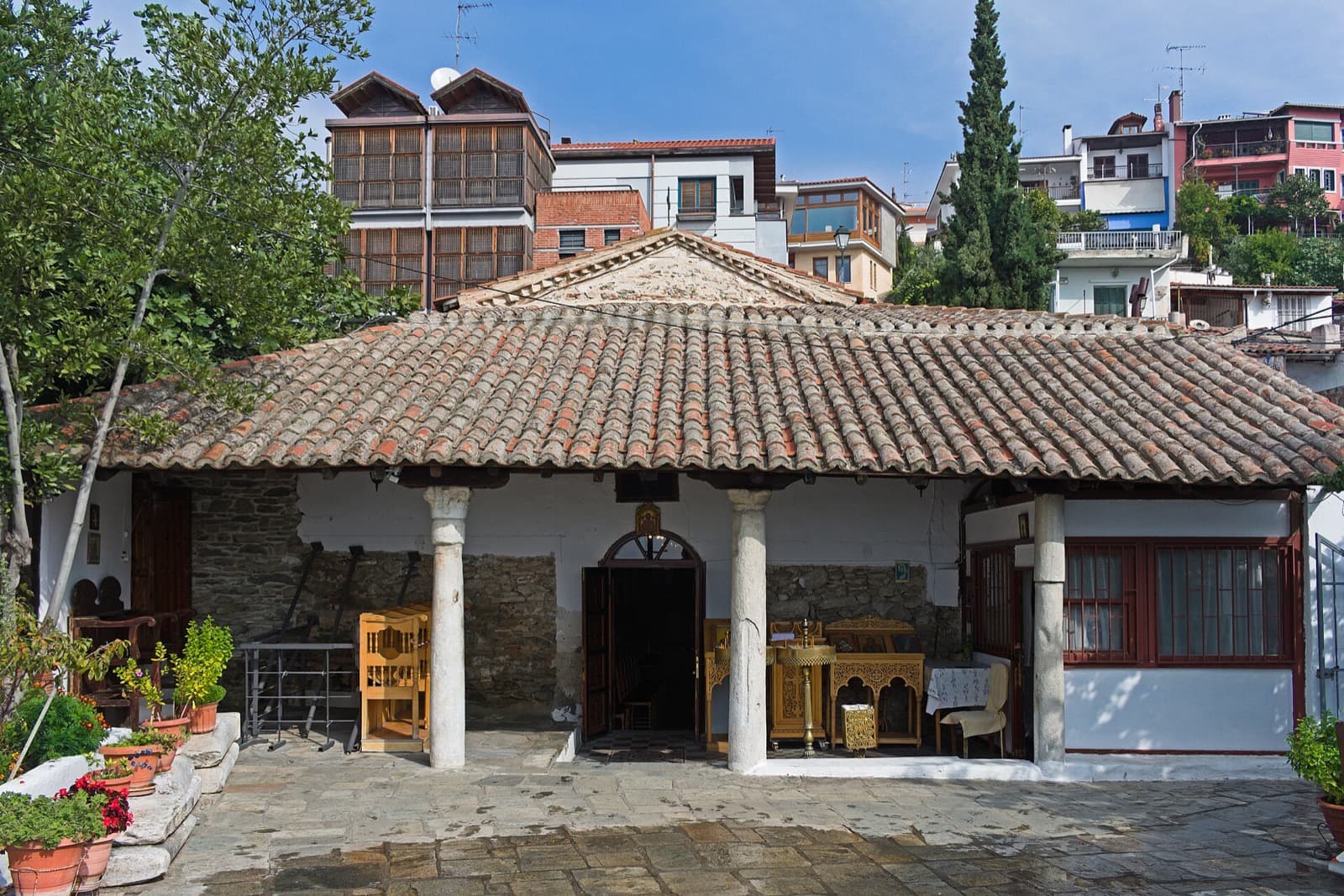
Agios Dimitrios is the basilica of Thessaloniki's patron saint, a vast five-aisled church raised over the Roman baths where Saint Demetrius was said to be held and martyred. It is the one building on this walk that stops being an argument about architecture and becomes an act of memory. The crypt beneath it marks a martyrdom. The mosaics inside it survived an empire's war on images. The stones around it were gutted by a fire that unhoused tens of thousands, and the community that lived beside it was almost entirely murdered within living memory. To stand in front of Agios Dimitrios is to stand in front of everything Thessaloniki has both kept and lost.
What you are looking at
The church you see is largely a seventh-century building, rebuilt between 629 and 634 after earlier fires, and its plan is unusual for a Greek church. It is a five-aisled basilica, wider than the three-aisled churches elsewhere in the city, with a transept that gives it a cross shape. The first church on this ground went up in the early fourth to fifth century, and the seventh-century rebuild kept much of that earlier structure inside it, so the building is itself layered, an older church folded into a newer one.
That length and breadth are not decoration. Agios Dimitrios was built to hold crowds, because Demetrius is not a saint the city admires from a distance. He is its protector, the figure Thessaloniki credited with its survival through sieges and centuries. A church this size is a measure of how much devotion needed a roof over it.
The mosaics that outlived the war on images
Hear a stop from this walk
Agios Dimitrios: the patron saint, the crypt, and the fire
Lift your eyes to the piers that separate the nave from the sanctuary. Six mosaic panels survive there from before the Byzantine Iconoclasm of 730, and understanding what that date means is the key to why they matter so much.
In the eighth and ninth centuries the Byzantine state tore itself apart over a single question: whether sacred images could be shown at all, or whether every icon was a forbidden idol. During the Iconoclast decades, mosaics and painted images across the empire were scraped, plastered over, and destroyed by imperial order. Very little figural work from before that campaign came through intact. The panels at Agios Dimitrios did. They show Saint Demetrius standing with the church officials who restored the building, and with children beside him, and they are among the oldest surviving images of the saint anywhere. They are not merely old. They are survivors of a deliberate erasure, which makes them among the rarest early Byzantine images you can look at in the flesh.
The crypt and the martyrdom
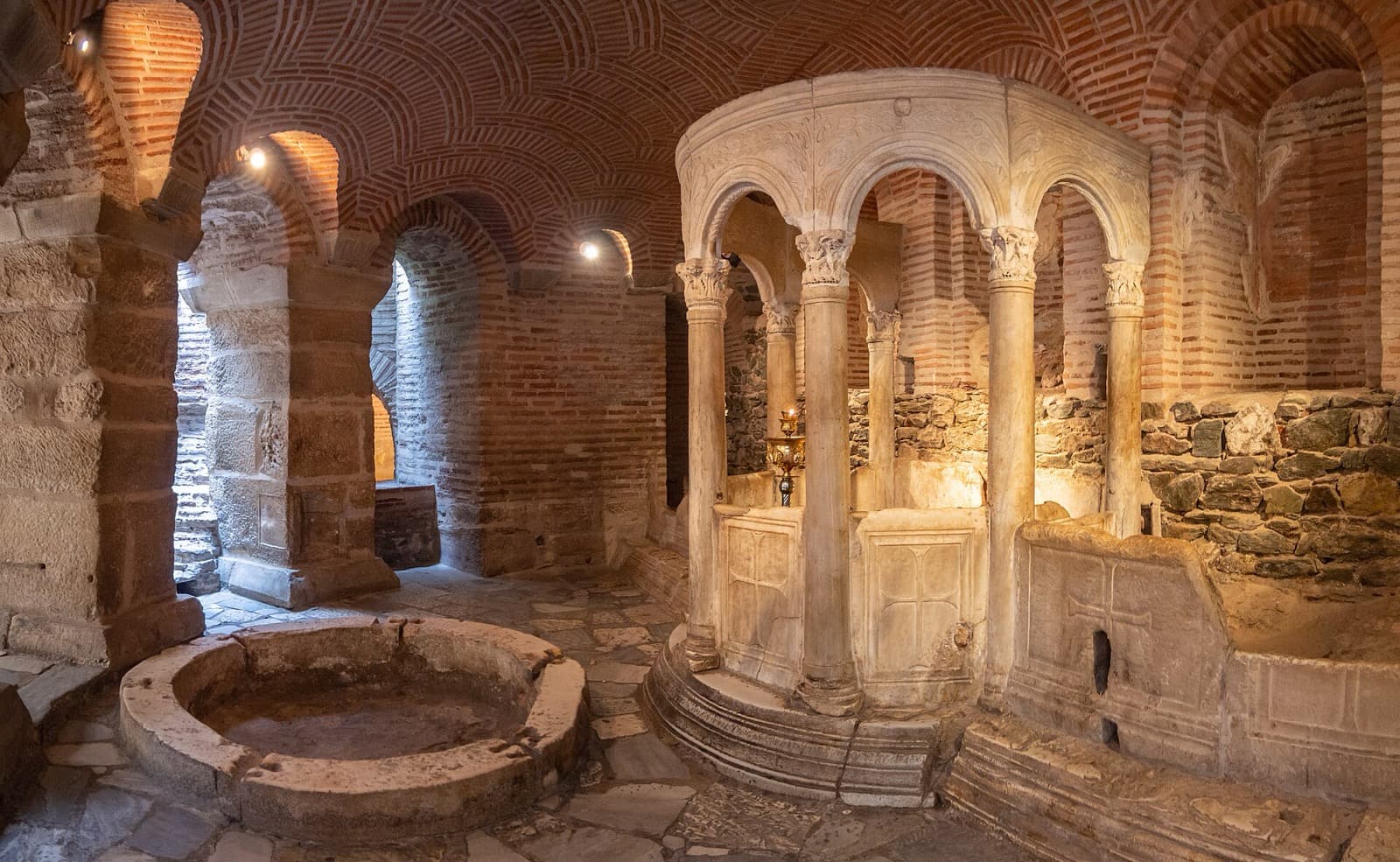
Go down into the crypt. It is free, and it holds the church's oldest and quietest layer. The crypt was built over a Roman bath complex, and by tradition this is the very place where Saint Demetrius was imprisoned and killed. Treat that as tradition rather than settled fact, the story the faithful have kept and defended across the centuries, not a claim archaeology can close. What the crypt does hold, physically, are the remains of the original silver-and-wood shrine that once stood over the site of the martyrdom. You are standing where Roman plumbing, Christian legend, and centuries of pilgrimage meet in the same dark room.
This vertical stacking, Roman baths at the bottom, a shrine above them, a basilica above that, is the same grammar written across the whole of central Thessaloniki. The city does not clear its past to build. It builds on top of it. Agios Dimitrios simply makes that habit literal, floor by floor.
The fire, and the city that burned with it
Now the modern layers arrive, and they arrive hard. The Great Fire of 1917 tore through the centre of Thessaloniki and gutted this church, destroying much of its mosaic in a single catastrophe. The fire left more than seventy thousand people homeless, roughly fifty-two thousand of them Jews, and it wiped out the central Jewish quarter that had stood in the burned zone. The French architect Ernest Hébrard was brought in to replan the ruined centre under the prime minister Eleftherios Venizelos, redrawing the streets you now walk. The church itself was rebuilt slowly across the middle of the twentieth century and reconsecrated in 1949.
That rebuild is why so much of what you see reads as restoration rather than original fabric. The bones are ancient. The surfaces, in many places, are recovery work, patient repair of a building that had been left a shell.
The layer that has to be named
There is one more layer, and it must be spoken plainly. For centuries Thessaloniki was a great Sephardic Jewish city, home to a community that had lived here since the expulsions from Spain. Between March and August of 1943, the German occupiers deported more than forty-five thousand Jews from this city to the death camp at Auschwitz-Birkenau. According to the United States Holocaust Memorial Museum, the pre-war Jewish community of about fifty thousand was almost entirely destroyed, roughly ninety-six percent murdered, with fewer than two thousand survivors. A community that had shaped the language, commerce, and rhythm of the city for centuries was nearly erased in a matter of months.
Agios Dimitrios does not commemorate that directly. It sits near it. The church that celebrates a protector saint stands a short distance from the memory of a people who were not protected, and holding both at once is the honest way to end here. The walk begins with a Roman hall that survived seventeen centuries of earthquakes and conquests. It ends by remembering what did not survive.
Walk it, don't just read it
The one thing to understand standing in front of Agios Dimitrios is that it is not a single building from a single time. It is a Roman bath, a martyr's crypt, a seventh-century basilica, a survivor of Iconoclasm, a casualty of fire, and a neighbour to catastrophe, all in one footprint. Reading about it flattens those layers. Walking through them, from the mosaics overhead down into the crypt, restores their order.
Agios Dimitrios is the final stop on the self-guided audio tour "The City in Layers," which threads one short axis through central Thessaloniki, from the Rotunda of Galerius to this basilica, teaching how each empire wrote over the last without fully erasing it. You can browse the full route and the city's other walks among the Thessaloniki walking tours, or start planning from the Thessaloniki city page. Six of the monuments on this route, including Agios Dimitrios, carry a shared distinction: they were inscribed together on the UNESCO World Heritage List in 1988. Go at your own pace, keep your voice low inside, and give the crypt the few extra minutes it asks for.
Sources
- Hagios Demetrios, Wikipedia. Confirms the five-aisled plan, the 629 to 634 rebuild, the six pre-730 mosaic panels, the crypt over Roman baths, the silver-and-wood shrine remains, and the 1949 reconsecration.
- Paleochristian and Byzantine Monuments of Thessalonika, UNESCO World Heritage List (site 456). Documents the 1988 inscription of the group of monuments that includes Agios Dimitrios.
- Salonika, United States Holocaust Memorial Museum Holocaust Encyclopedia. Source for the March to August 1943 deportations of more than forty-five thousand Jews and the near-total destruction of the city's roughly fifty-thousand-strong Jewish community.
- The Byzantine Legacy, Church of Hagios Demetrios in Thessaloniki. Detailed treatment of the mosaics, the martyrdom tradition, and the building's construction phases.
- Great Thessaloniki Fire of 1917, Wikipedia. Source for the more than seventy thousand left homeless, the roughly fifty-two thousand Jews affected, and the Hébrard replan under the Venizelos government.
Ready to experience it?
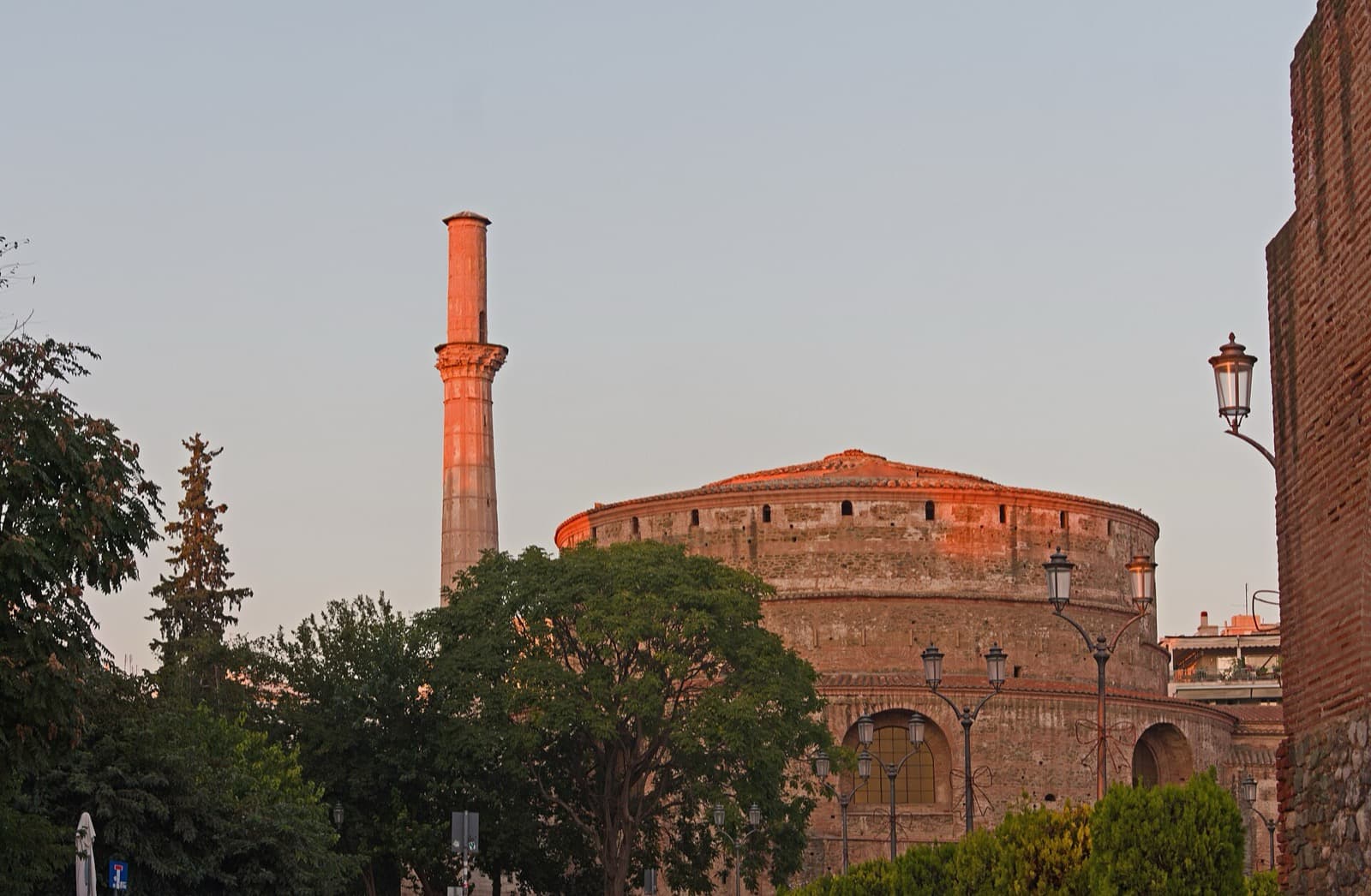
The Rotunda and Arch of Galerius: The City in Layers
90 min · 3.1 km · easy
More from Thessaloniki
Explore more at your own pace.
One Day in Thessaloniki: A Walkable Morning-to-Evening Itinerary
Thessaloniki: The City Read in Layers
The Ano Poli Timber Houses: How the Poorest Quarter Kept the Oldest City
The Jewish Museum of Thessaloniki: Reading a Vanished City
The Rotunda of Thessaloniki: How One Building Holds Four Empires