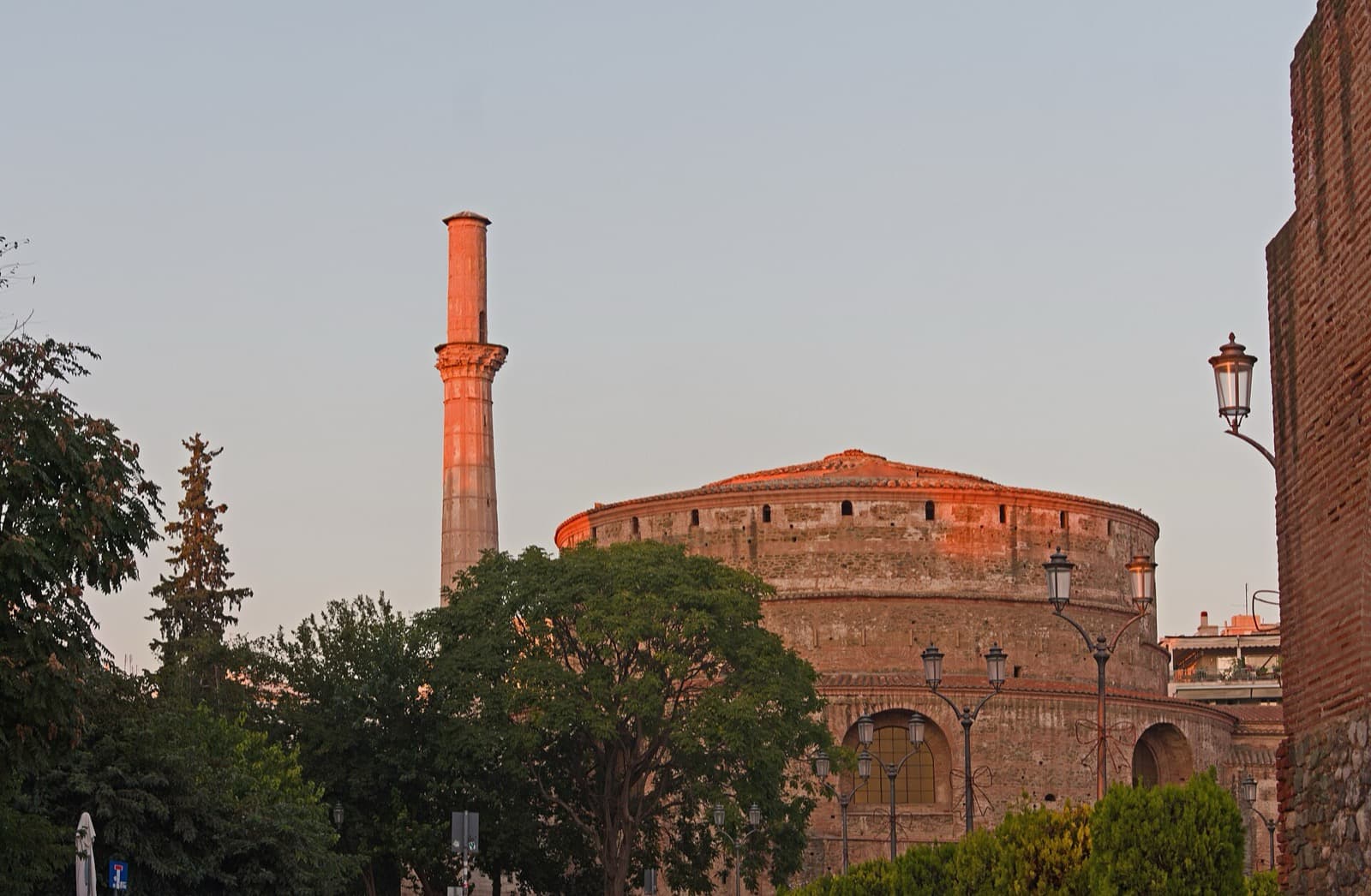
Stand under the Rotunda of Thessaloniki and you are standing inside four empires at once. This one brick cylinder was a Roman round hall, then an early-Christian church, then an Ottoman mosque with a minaret, and finally a monument that is a church again. Roman power, Christian triumph, Ottoman conversion, and Greek modernity are stacked inside a single structure, and once you learn to read that stacking here, you can read the rest of central Thessaloniki the same way. The building is a lesson in grammar: how each ruler wrote over the last without ever fully erasing it.
One cylinder, four lives
The Rotunda was raised around 306 A.D. on the orders of the tetrarch Galerius, and it is thought to have been intended as his mausoleum. The scale still startles: a diameter of about 24.5 metres, walls more than six metres thick, a height near 30 metres, a mass that has invited comparison with the Pantheon in Rome. Those thick walls are not decoration. They are why the building has ridden out earthquakes for roughly seventeen centuries while so much else around it fell.
Galerius, as it happens, was never laid to rest here. Late in the fourth century the round hall was converted into a Christian church dedicated to the Archangels, the Incorporeal Ones, a dedication it held for more than twelve hundred years. Its cupola was once entirely sheathed in mosaic, and the surviving late-fourth-century work is remarkable: a band of saints with hands raised in prayer before elaborate architectural fantasies, golden crosses among stylized flowers and acanthus, garlands of fruit. Look up to find them. The mosaics that matter in this building are overhead, not at eye level.
Then comes the layer that makes the Rotunda unmistakable from the street. In 1590 it became a mosque, and a minaret was added. That minaret still stands, one of very few left anywhere in the city, rising beside a Christian dome. The building served as a mosque until 1912, the year of the city's liberation. Today it is the Church of the Rotunda, also called Agios Georgios, Saint George, a monument under the ephorate of antiquities, opened to Orthodox worship for certain festivities. Roman hall, Christian church, Ottoman mosque, monument-church again. Raise your eyes to the dome, then out to the minaret, and you have read the city's grammar in a single glance.
Why the Rotunda is the way in
Hear a stop from this walk
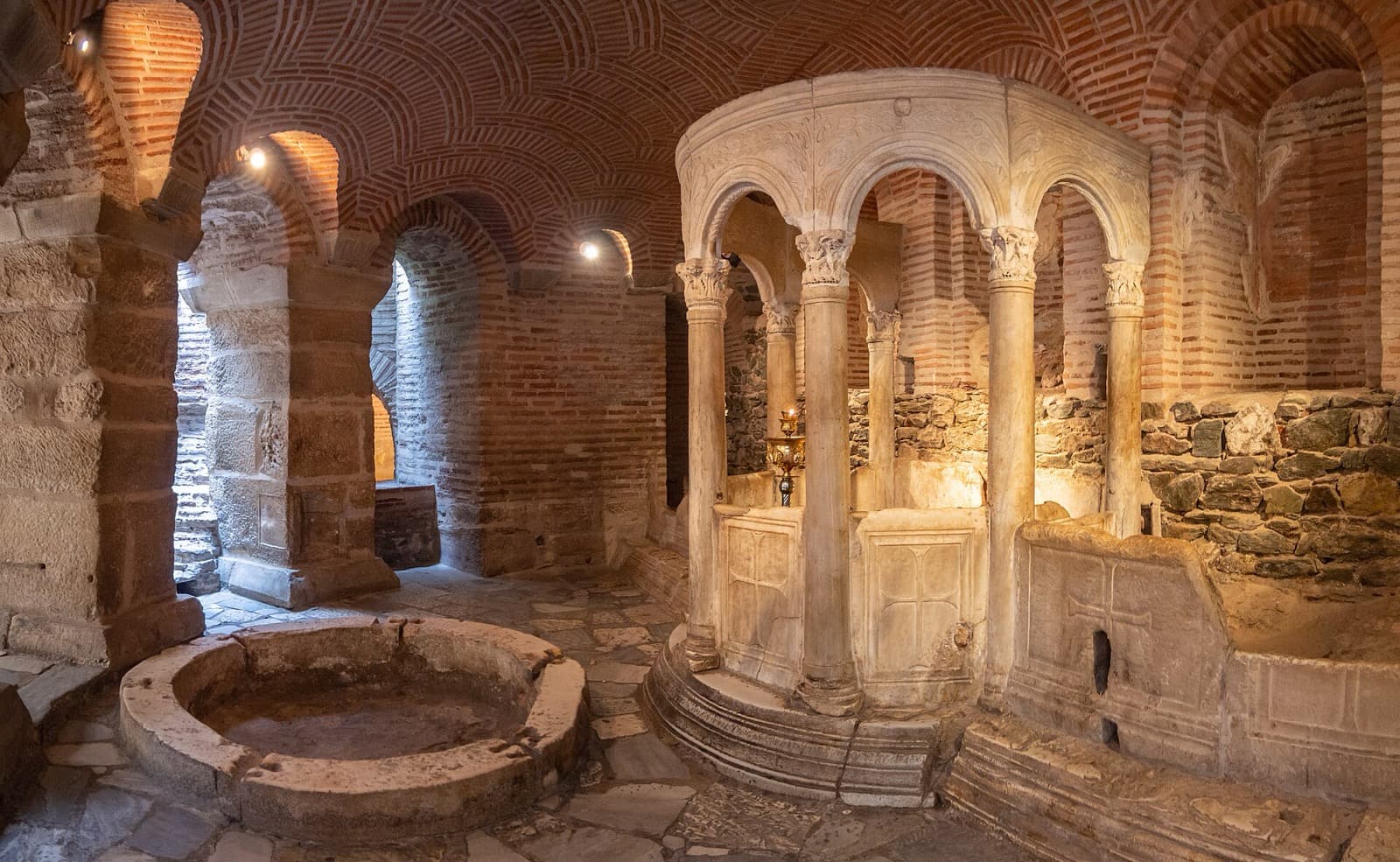
Agios Dimitrios: the patron saint, the crypt, and the fire
The Rotunda never stood alone. It was one element of an imperial complex Galerius built, and the pieces were bound together along one processional axis. A short walk away, straddling the old road, rises the Arch of Galerius, the triple gateway the city simply calls the Kamara, dedicated in 303 A.D. to celebrate the emperor's victory over the Sasanian Persians. It sits about 125 metres from the Rotunda and roughly 235 metres from the palace, so arch, round hall, and palace were threaded together on the Via Egnatia, the great Roman east-west road that ran clear across the Balkans. The emperor could pass beneath the arch, between his mausoleum and his throne. On this tour you follow the same line he did.
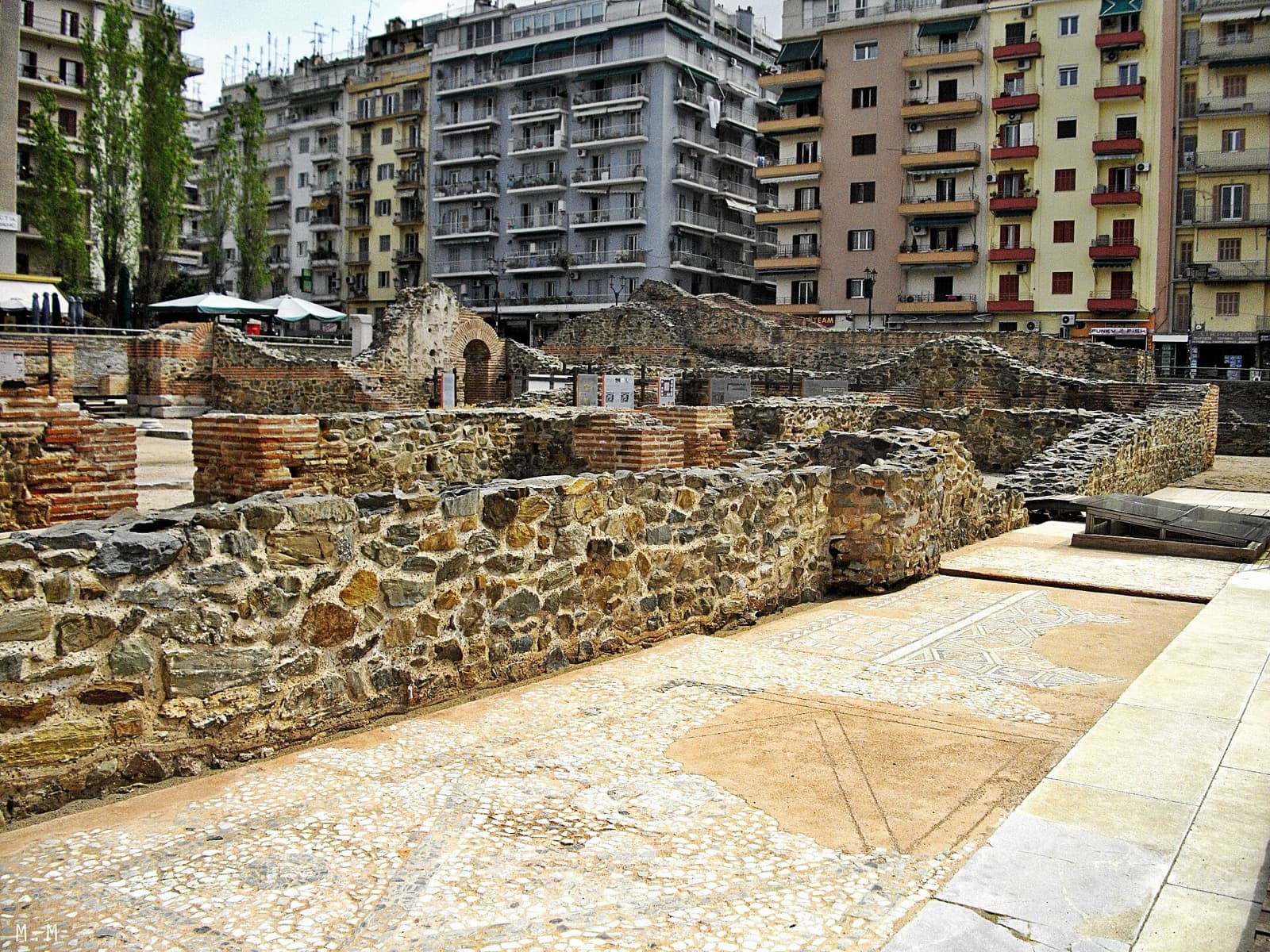
The palace itself lies underfoot a little farther on, its foundations exposed around an open square. Its finest surviving hall is the Octagon, an eight-sided room of about 875 square metres, read by prevailing research as the throne room, the very heart of imperial power in the city. And here the habit of overwriting appears early: that imperial audience hall was later put to use as a Christian church. The same instinct that turned a Roman mausoleum into a church, and a church into a mosque, is already at work in the fourth century. A building outlives its purpose and gets claimed for a new one rather than torn down. That is the pattern the Rotunda teaches, and the whole route rehearses it.
The pattern, written letter by letter
Once you carry the Rotunda's logic with you, later stops stop being a list of old churches and become variations on one argument. Agia Sophia, a domed Byzantine church named in conscious dialogue with Constantinople, spent nearly five centuries as the Ayasofya Camii mosque, from the Ottoman conquest of 1430 until 1912, while a ninth-century mosaic of the Ascension waited above through all of it. A few steps on, Panagia Acheiropoietos is the sharpest version of the whole idea. It is a fifth-century basilica, among the oldest churches anywhere still in continuous use, and it was the first church in the city converted to a mosque after 1430, claimed by Sultan Murad the Second in person. He left an inscription commemorating that conversion, and it still survives on the northern colonnade. Walk that row of columns and you can see both layers at once, in a single line of stone. The older layer was not destroyed. It was inscribed upon.
The Ottoman layer finally gets a building of its own at Bey Hamam, a double bathhouse built in 1444, the oldest Ottoman bath raised in the city after the conquest, in use as a public bath under the name Baths of Paradise until 1968. Then the route turns to the Roman Forum, the citizens' ground rather than the emperor's stage, found by accident in the 1960s when crews digging for a planned courthouse struck the ancient agora instead. It closes at Agios Dimitrios, the great basilica of the city's patron saint, which carries the modern layer most gravely: the fire of 1917 that left tens of thousands homeless and erased the central Jewish quarter, and the deportation of more than 45,000 Jews to Auschwitz-Birkenau between March and August of 1943. The walk that begins with survival ends by remembering what did not survive.
Walking it well
The full route is eight stops, about three kilometres of mostly level walking, roughly two hours at your own pace. Six of the monuments share a single distinction: they were inscribed together on the UNESCO World Heritage List in 1988. Go early. The open ruins at the palace and the forum are sun-baked with almost no shade, and the churches are calmest for worshippers in the morning. Ask at the first monument desk about a combined ticket for the UNESCO group, and dress modestly, since the churches are active places of worship. Begin under the Rotunda's dome, learn to see the minaret beside it, and the rest of the city will start to read itself. For the full route and neighboring walks, see our guide to Thessaloniki walking tours.
Sources
- Arch of Galerius and Rotunda, Wikipedia: construction date, dimensions, conversions, and the 1590 minaret.
- Paleochristian and Byzantine Monuments of Thessalonika, UNESCO World Heritage List (site 456): the 1988 inscription covering six of these monuments.
- Church of the Acheiropoietos, Wikipedia: fifth-century date and the surviving Ottoman conversion inscription by Murad the Second.
- Salonika, United States Holocaust Memorial Museum Encyclopedia: the 1943 deportations and the fate of the Sephardic Jewish community.
- Octagon, Galerius Palace, Hellenic Ministry of Culture: the palace complex and the reading of the Octagon as the throne room.
Ready to experience it?
The Rotunda and Arch of Galerius: The City in Layers
90 min · 3.1 km · easy
More from Thessaloniki
Explore more at your own pace.
One Day in Thessaloniki: A Walkable Morning-to-Evening Itinerary
Thessaloniki: The City Read in Layers
The Ano Poli Timber Houses: How the Poorest Quarter Kept the Oldest City
The Jewish Museum of Thessaloniki: Reading a Vanished City
Agios Dimitrios: The Basilica That Holds Thessaloniki's Whole Memory