The carvings of Teotihuacán's Temple of the Feathered Serpent survive because, about a century after the temple went up, the city built a plain platform straight against its face. That act of burial is the first lesson on the Teotihuacán walk, and the one you will meet all day: this was a city that kept its past by wrapping it. Stop one is not out in the open. It is in a narrow gap behind a smooth stepped platform, at the far side of the great walled square the Spanish named the Ciudadela.
What you see in the gap
Walk into the mouth of the gap and look along it. One side is plain. On the other, great stone heads jut out of the wall: serpents wrapped in carved feathers, and between them a second, blockier head whose meaning scholars still argue about. Along the slopes below them, the serpents' bodies ripple among carved shells.
The temple was built around AD 200. The archaeologist George Cowgill described it as the third largest pyramid in the city and unique for the massive reliefs and sculptures that once covered all its sides. Mexico's National Institute of Anthropology and History says it was built in seven tiers. What you see in the gap is a fragment of what once wrapped the whole building, on every face and every tier.
Notice the profile of each tier: a sloping base and, above it, a flat vertical panel framed like a picture. Archaeologists call it talud-tablero, and it is Teotihuacán's signature. You will see it on nearly every platform between here and the Pyramid of the Moon. The heads stand out best in the afternoon, when the sun falls on this face.
The platform that hid them
Hear a stop from this walk
Pyramid of the Moon: Seven Pyramids in One
The smooth platform in front of the temple came about a century later, built straight against its main face. It is the exact opposite of what it covers: plain tiers, painted only red, not one sculpture. Nobody knows why the city did it. It may have marked a change in who ruled or what they believed, or it may have been the start of an enlargement that was never finished.
The result is certain, though. By burying the carvings, the builders kept them. The most famous sculpture in Teotihuacán survives because the city hid it, and that is why you see it only in a slot between two buildings. The same habit shows up again at the Superimposed Buildings, under the Palace of Quetzalpapalotl and inside the Pyramid of the Moon, which turned out to hold six earlier pyramids.
What lay beneath
The temple's foundations held darker material. Excavations found the remains of some 137 people buried at ground level or in pits dug for the purpose, and Cowgill concluded that about two hundred people were sacrificed when the pyramid was built. Oxygen isotopes in their bones and teeth show that many had spent much of their lives outside Teotihuacán.
Below everything runs a tunnel. It was discovered on 2 October 2003, when a hole opened overnight during conservation work on the temple. Over more than twelve years of exploration, the team led by the archaeologist Sergio Gómez Chávez recovered thousands of objects. According to a 2026 INAH bulletin, radiocarbon dating shows the tunnel was used from the start of the common era and sealed around AD 250. The tunnel is not open to visitors, so what you stand above is a sealed passage you cannot see.
A crossroads, and a crowd
When you turn back toward the plaza, the setting makes sense. The Ciudadela is a raised square about four hundred metres across, ringed with small temples in the same profile, with a low altar in the middle. INAH estimates that the plaza could hold up to a hundred thousand people. Across the avenue, the flat ground of the Great Compound was probably the main market. At this crossroads, the city's most richly carved temple and its marketplace faced each other.
Take as long as you need in the gap. The rest of the walk climbs north from here, two kilometres up the avenue, at your own pace.
This is stop 1 of Teotihuacán: The Avenue That Climbs to the Moon, a self-guided walk on the Mexico City page.
Sources
- George L. Cowgill, Ritual Sacrifice and the Feathered Serpent Pyramid at Teotihuacán, FAMSI (2002): third largest pyramid, sculpture on all sides, the 137 individuals, about 200 sacrificed at construction, and the oxygen isotope results.
- INAH Boletín 110 (2026): the tunnel's discovery on 2 October 2003, the work led by Sergio Gómez Chávez and Julie Gazzola, thousands of objects, and closure around AD 250.
- The tour's fact dossier and INAH portal notes (research/mexico/tours/teotihuacan/): the date around AD 200, seven tiers, the later red platform, the Ciudadela's size and INAH's crowd estimate.
Mexico eSIM· 10% off with ROAMER10
Ready to experience it?
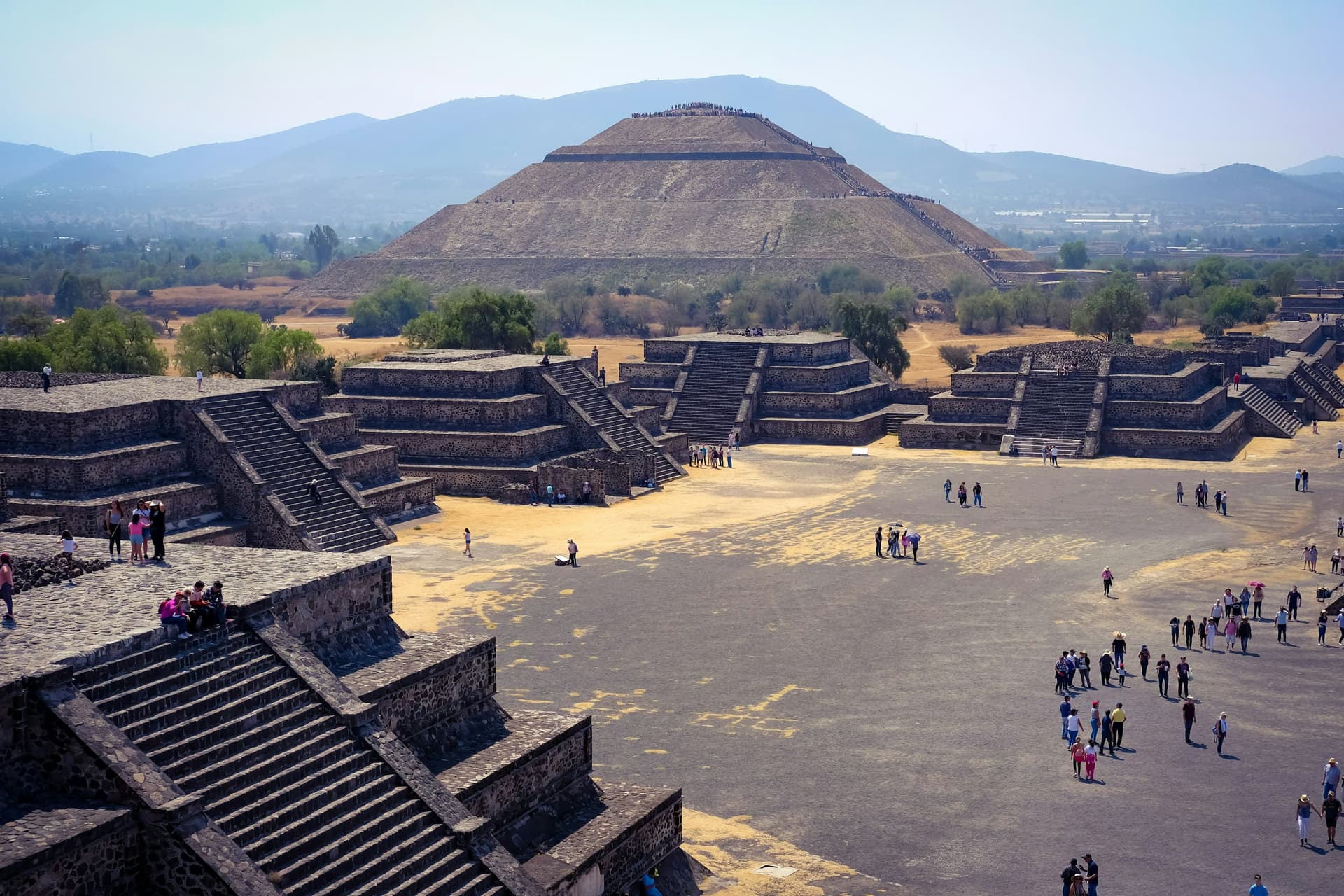
Teotihuacán: The Avenue That Climbs to the Moon
180 min · 2.3 km · moderate
More from Mexico City
Explore more at your own pace.
Basilica of Guadalupe: Three Churches, One Lakebed, and the Hill Above
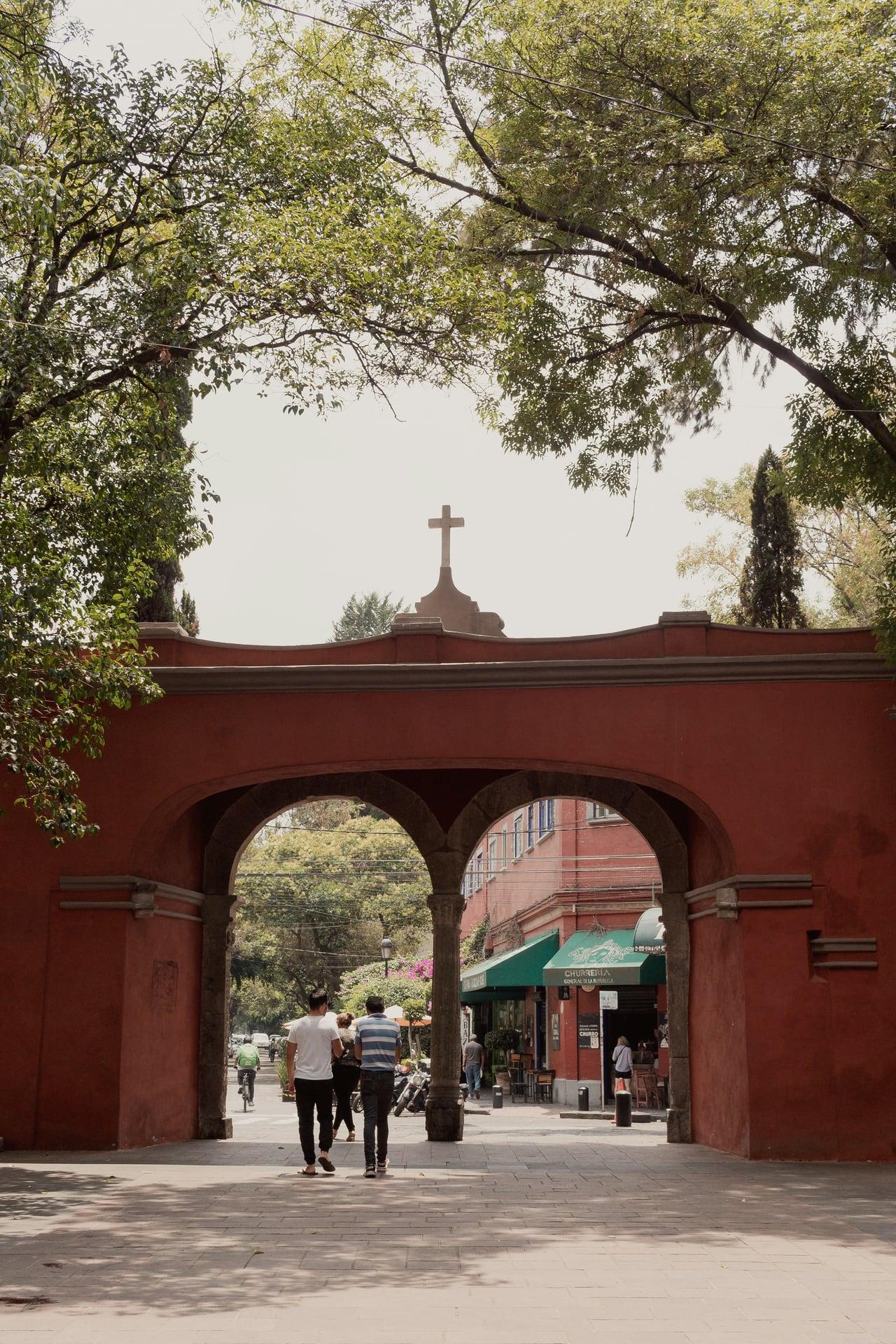
Coyoacán in Walls: Churchyards Torn Open, a Blue House Closed In
Paseo de la Reforma: Where Mexico Decides Who Gets a Statue
Capilla del Pocito: Red Stone, Tiled Domes and a Spring at the Basilica of Guadalupe
Casa del Risco: The Fountain of Broken China Hidden Behind a San Ángel Wall