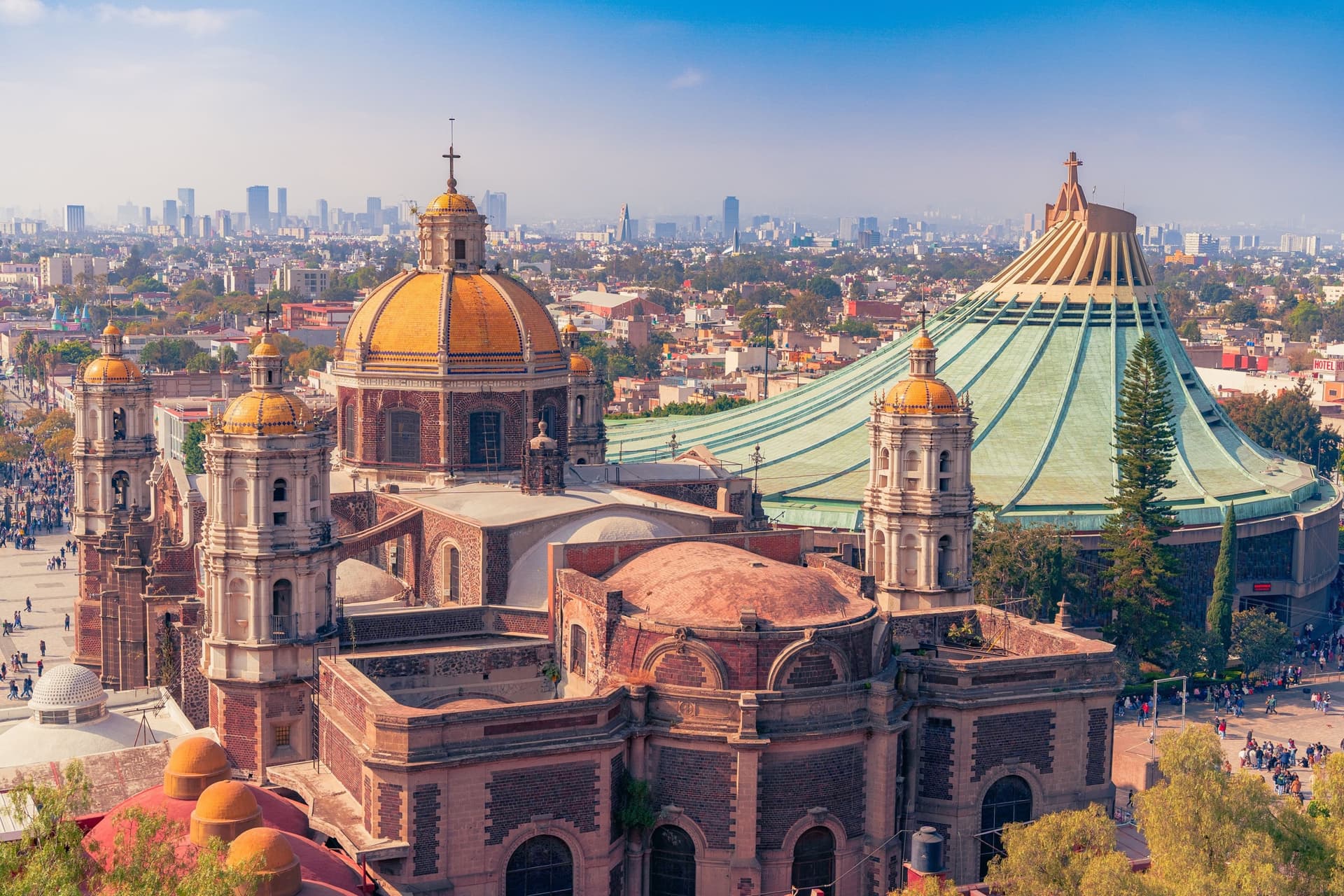
On the plaza, three centuries of churches show three answers to a lakebed that keeps pulling them down. On the hill, the chapels set the Church's account of December 1531 in stone. That is the shape of the Basilica of Guadalupe walk: ten stops over about 1.3 kilometres and roughly seventy-five minutes, from the old La Villa railway station in the north of Mexico City, up the pilgrims' avenue, across the great atrium and up Tepeyac to the summit chapel. The walk asks you to look at two things at once. One is the ground. The other is the story. You do not have to believe or doubt anything to follow either.
The ground under the shrine
The shrine stands on the soft shore of an old lake, long since drained. That is not a footnote. It is the reason the plaza looks the way it does, with three large churches from three centuries standing side by side instead of one church rebuilt on the same footprint.
Start with the oldest of the three big buildings on the plaza, the old basilica, now called the Templo Expiatorio a Cristo Rey. It was begun in 1695 and opened in 1709, and for 267 years it held the image that brings people here. Its architect was Pedro de Arrieta. It was rich Baroque work, remodelled in part in the plainer neoclassical style in the early 1800s. And it sank. The clay under it gave way so badly that it was closed for worship in 1976 and spent more than twenty years being lifted and given new foundations. For decades its eight original columns stood in cement splints. It reopened in stages from the year 2000.
Next door, the Capuchinas church is the second answer. Its first stone went in in 1782 and it opened in 1787, one of the few convents in Mexico begun and finished in the neoclassical style, according to a study from Mexico's national university. It was closed for sinking once, in 1800, and between 1976 and 1982 it was set on control piles: foundations built to keep a structure level as the ground settles.
The third answer is the round new basilica of 1976, designed by a team led by the architect Pedro Ramírez Vázquez. Its first stone was laid on 12 December 1974, and the image was carried across the atrium to it on 12 October 1976. It turned fifty in October 2026. Instead of fighting the clay, it was designed around it: a circular frame of reinforced concrete carries one sweeping copper roof, weathered green, with no columns inside, and beneath it stand 344 control piles.
Put the three side by side and you have a small history of engineering on bad ground. The Baroque church trusted its own weight. The neoclassical church was rescued with piles after the fact. The modern church was built on adjustable piles from the start. Stop five ends with a question worth carrying: if you had to build the next one here, what would you build?
The story on the hill
Hear a stop from this walk
Above the Two Basilicas: Three Answers to Soft Ground
Past the Capilla de Indios, the walk leaves the plaza and turns to the hill, and the subject changes. Here the buildings mark places in the Church's account of December 1531, when, in that account, the Virgin appeared to an Indigenous man, Juan Diego, and sent him to the bishop, Fray Juan de Zumárraga.
The account was written down in Nahuatl and first printed in 1649. The walk tells it the way the shrine tells it and keeps the line between tradition and record visible. The Capilla de Indios, from about 1649, stands where the Church says the first small chapel received the image on 26 December 1531. The Capilla del Pocito, built between 1777 and 1791 over a spring, marks the place tradition gives to the fourth meeting. The Capilla del Cerrito on the summit is where the account sets most of the story, ending with the roses Juan Diego carried down to the bishop.
Even the hill has its reminders of the lakebed. The Pocito was re-levelled in 1959, and Mexico's national institute of anthropology and history reported in 2024 that it was sinking again, with cracks and missing pieces of its red stone facing.
What to look at
This is a design walk as much as a pilgrimage route, so let your eyes do the work. On the Calzada de Guadalupe, the avenue laid out in the 1780s and finished in 1791, notice how the whole approach is built to end on the shrine. In the atrium, compare the old basilica's carved front with the cooler neoclassical face of Capuchinas: almost a century of changing taste in two neighbouring facades. At the Pocito, read the colours: porous red tezontle walls, pale grey stone around the doors and windows, star-shaped windows, and domes covered in blue-and-white glazed tile. An architect from the national institute has suggested the domes stand for the sky and the red base for the earth.
The last stop turns you around. From a terrace above the atrium you can pick out the three big buildings in one view: the stone basilica that had to be lifted, the nuns' church on its later piles, and the green roof built for the clay from day one.
Walking it your way
The shrine is a working one, with masses almost every hour and a dress code inside every church and chapel, so the walk is built to work from outside. Up to stop eight there are no steps, though the hill path is steep, and a step-free visit can end there; stops nine and ten are reached by stairs. Mexico City sits about 2,240 metres up, so the climb is best taken slowly. With the audio in your pocket you set the pace, linger where a building holds you, skip what does not, and leave whenever you like.
The walk is Basilica of Guadalupe: Churches on Soft Ground, a Story on the Hill, one of the self-guided walks on the Mexico City page.
Sources
- EWTN News: the old basilica's 300th anniversary and restoration: opening on 1 May 1709, architect Pedro de Arrieta, cement splints on the eight original columns since the 1960s, reopening in 2000 and the conservation plan from 2001.
- INAH Boletín 332 (2024) on the Capilla del Pocito: built 1777 to 1791 by Francisco Guerrero y Torres, the spring and the fourth apparition, the sky and earth reading, the current damage.
- Insigne y Nacional Basílica de Santa María de Guadalupe: 50th anniversary: the jubilee for the fifty years of the new basilica's dedication and the transfer of the image.
- The tour's own fact dossier (research/mexico/tours/cdmx-guadalupe/FACT-DOSSIER.md), which carries the Capuchinas, Capilla de Indios and new basilica sources.
Mexico eSIM· 10% off with ROAMER10
Ready to experience it?
Basilica of Guadalupe: Churches on Soft Ground, a Story on the Hill
75 min · 1.3 km · moderate
More from Mexico City
Explore more at your own pace.
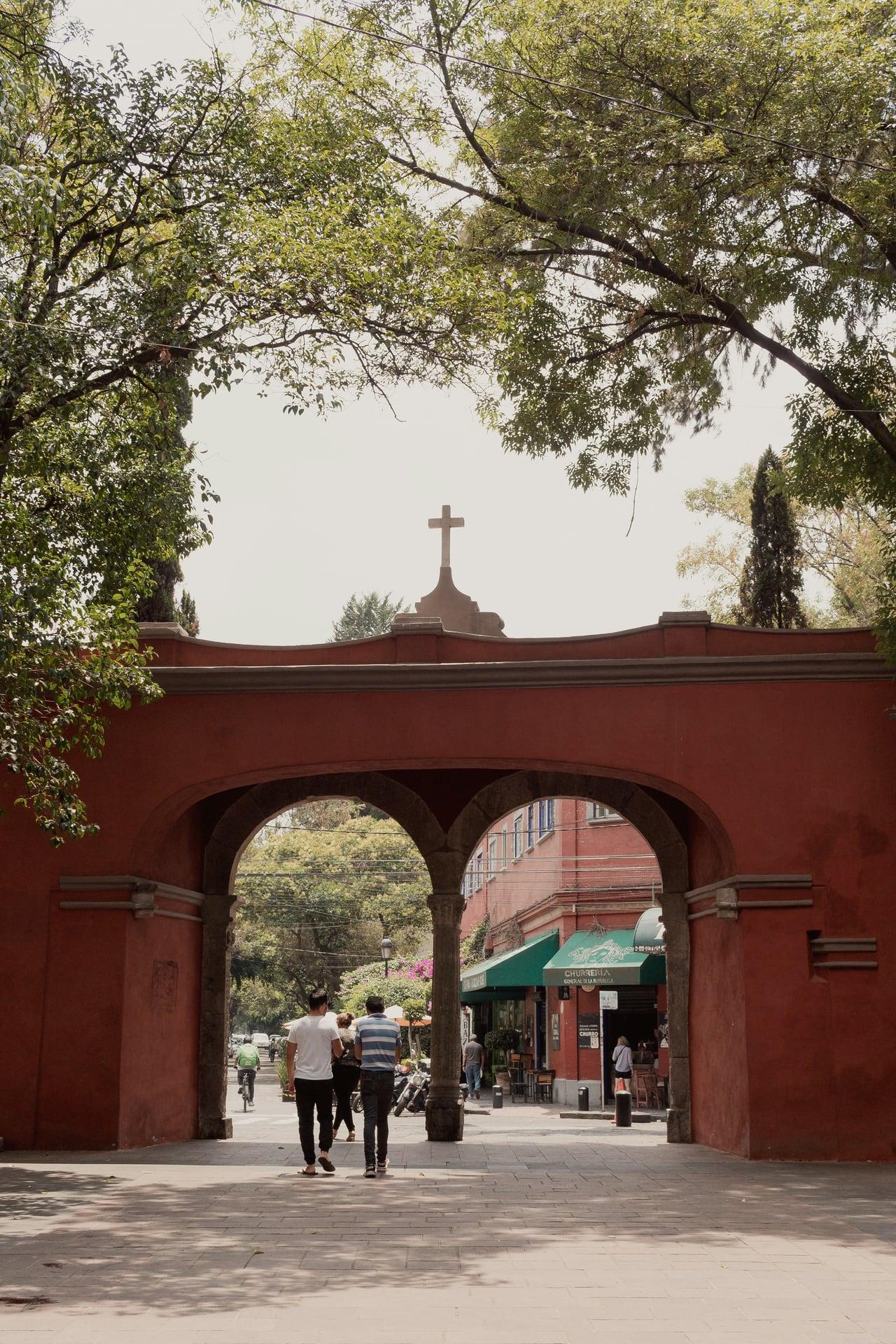
Coyoacán in Walls: Churchyards Torn Open, a Blue House Closed In
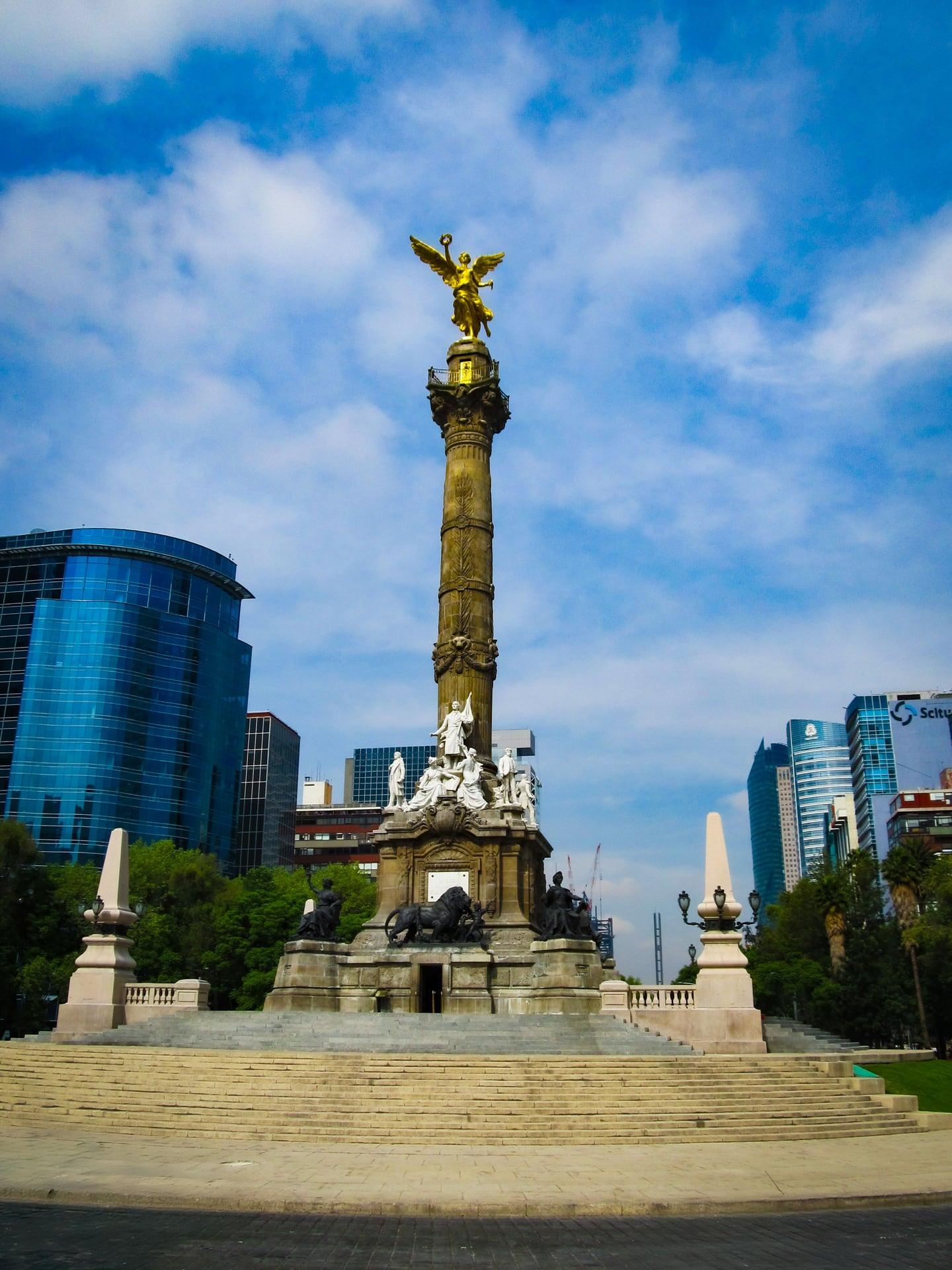
Paseo de la Reforma: Where Mexico Decides Who Gets a Statue
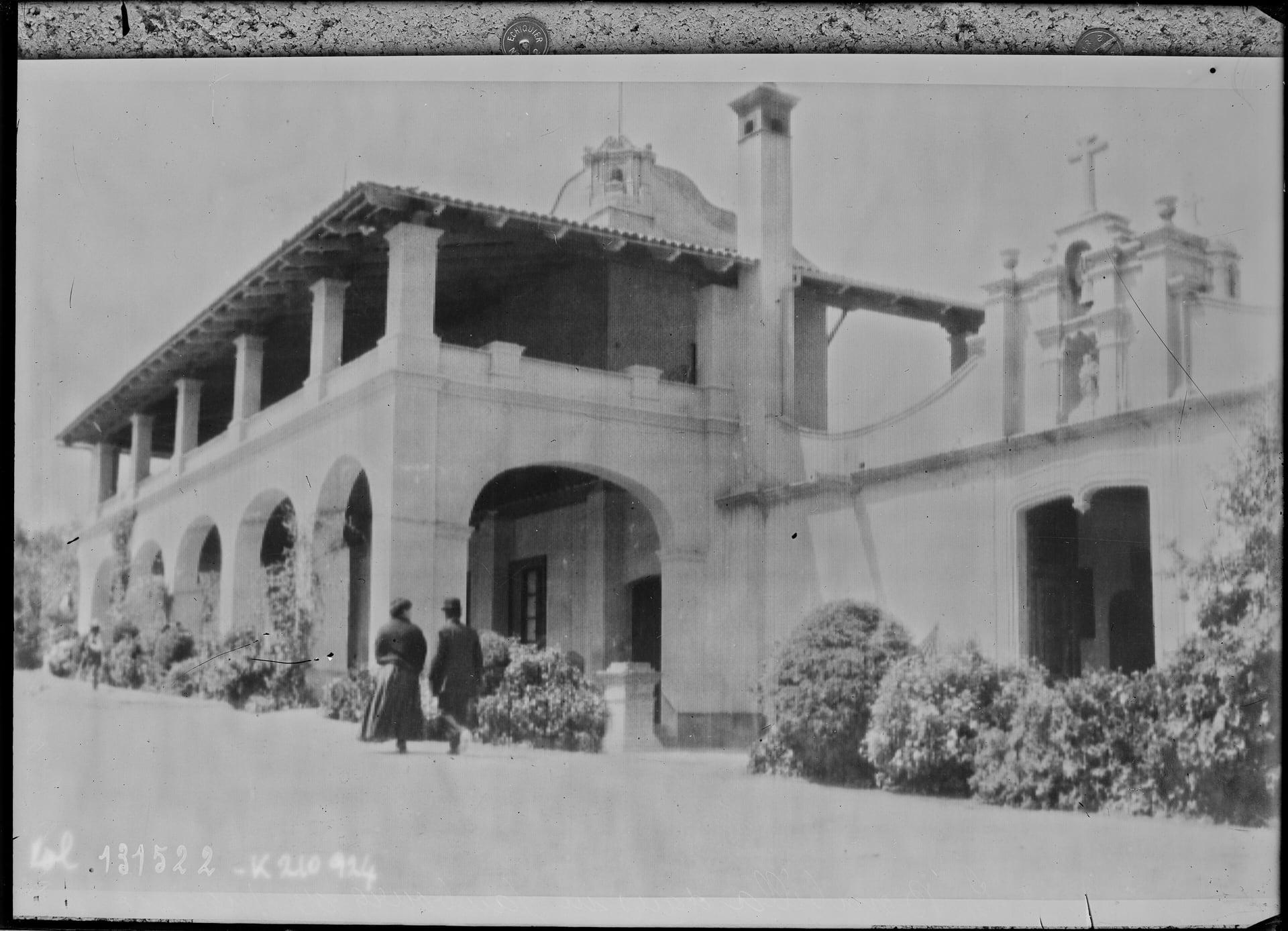
San Ángel: How a Friars' College Named a Village, and Two Concrete Houses Answered It
Capilla del Pocito: Red Stone, Tiled Domes and a Spring at the Basilica of Guadalupe
Casa del Risco: The Fountain of Broken China Hidden Behind a San Ángel Wall