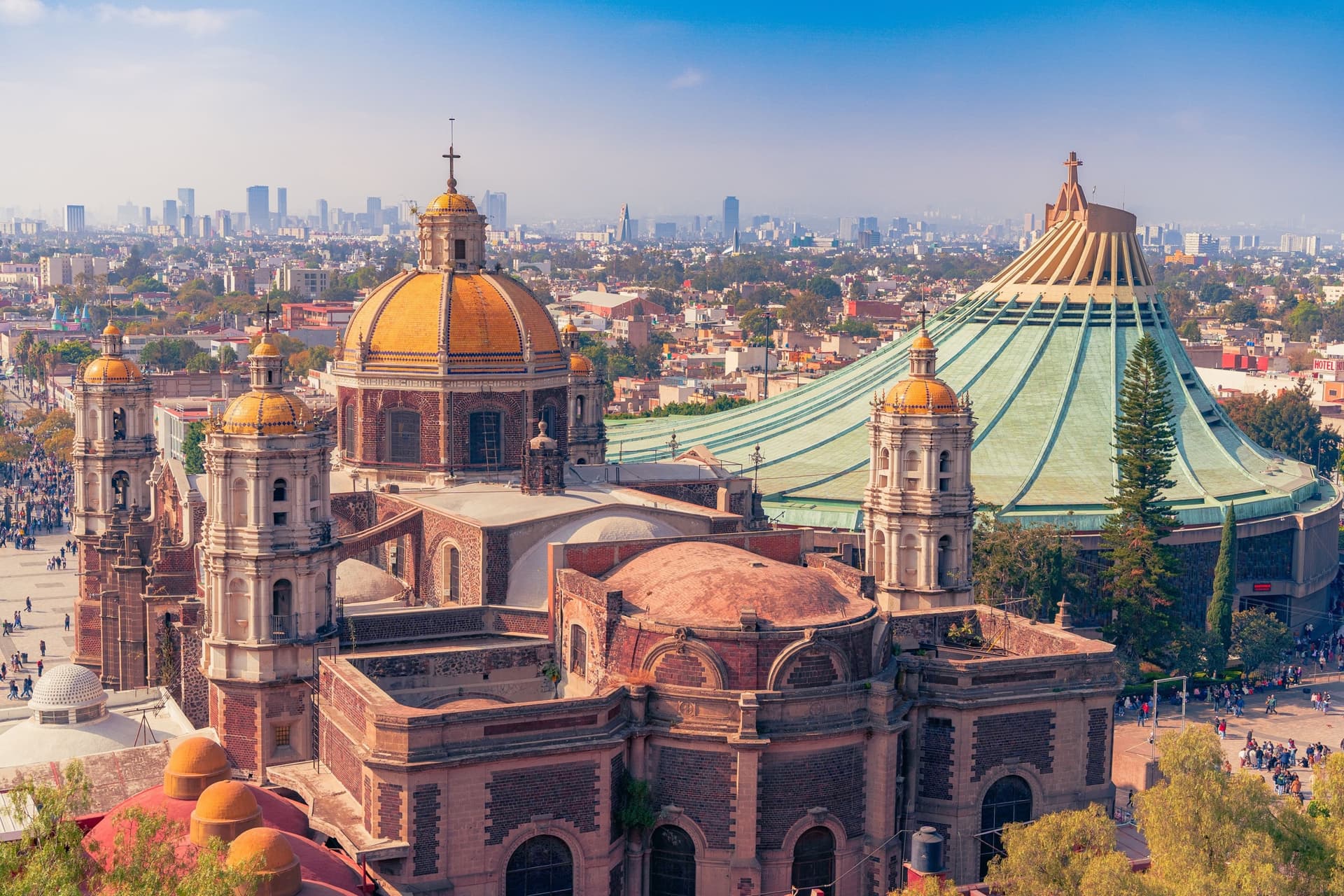
The old Basilica of Guadalupe is a Baroque church that sank so far into the soft lakebed that it had to be closed, lifted and re-founded. So the stone front you face at stop four of the walk is not a building that simply survived three centuries. It is one that was brought back toward level after the ground nearly took it. Today it is called the Templo Expiatorio a Cristo Rey, the church of Christ the King, and it is still a working church, with masses through the day.
The church the image lived in
This was the image's home for most of the shrine's history. The church was begun in 1695 and inaugurated on 1 May 1709, to designs by the architect Pedro de Arrieta, and the shrine counts 267 years of the image hanging here, from 1709 until the move next door in 1976. While it was being built, tradition holds, the image waited in the small Capilla de Indios at the foot of the hill.
Look at the front from the atrium. The shrine calls it a church of great Baroque beauty: twin towers, a clock, and a dome behind, the whole facade conceived in the rich taste of the late 1600s. It did not stay entirely Baroque. In the early 1800s parts were remodelled in the calmer neoclassical style, and that job was interrupted for years by the War of Independence. So even before the ground became the problem, the building was a layered thing, its taste changing with the century.
The morning of the bomb
Hear a stop from this walk
Above the Two Basilicas: Three Answers to Soft Ground
On the morning of 14 November 1921, a man left a flower arrangement at the foot of the altar. Minutes later it exploded. The blast damaged the altar, the candlesticks and a bronze crucifix, which was bent, but the image was not harmed, and neither were its frame and protective glass. The bent crucifix is kept today in the new basilica as the Santo Cristo del Atentado, the Christ of the attack. A suspect was named at the time, but it was never confirmed who planted the bomb. For the faithful, the image's survival that morning became part of its story.
The slower danger
The bomb was a single morning. The ground was a century-long threat. The shrine stands on the shore of an old lake, long since drained, and its clay compresses under weight. A stone church is a great deal of weight, set down on a very soft base. The old basilica sank so badly that it was closed for worship in 1976, the year the image was carried across the atrium to the new round basilica, built to cope with the same clay on 344 control piles.
What followed was a rescue, not a demolition. The building spent more than twenty years being lifted and given new foundations. For decades, while that work went on, its eight original columns stood wrapped in cement splints and scaffolding, holding the interior together. The church reopened in stages from the year 2000, a conservation and restoration plan began in 2001, and by the building's three-hundredth anniversary in 2009 the splints had been removed from the columns.
The fact dossier behind the walk is careful on one point, and it is worth repeating here: the old basilica was re-levelled, so do not expect a dramatic lean. What you see now is the result of the engineers' work. If you want to test it, line up a tower against something you know is vertical and judge for yourself.
Three answers, side by side
The old basilica makes the most sense in company. Next to it stands the Capuchinas church of the 1780s, closed once for sinking and later set on control piles. Across the atrium is the round basilica of 1976, designed for the clay from the start. Together they read as three answers to the same lakebed: trust the stone and pay later, fix it after the fact, or design for the ground from day one. The old basilica is the first answer, and the most expensive lesson.
Stand in the atrium and think of the weight of that stone pressing down on mud, and of the work it took to raise it. Take your time here; the walk does not move on until you do.
This is stop 4 of Basilica of Guadalupe: Churches on Soft Ground, a Story on the Hill, a self-guided walk on the Mexico City page.
Sources
- El Universal: a hundred years of the Cristo del Atentado: the 14 November 1921 bomb in a flower arrangement, the bent bronze crucifix, the undamaged image, frame and glass, the unconfirmed suspect, and the crucifix shown in the new basilica.
- EWTN News: the restored old basilica at three hundred: inauguration on 1 May 1709, Pedro de Arrieta, cement splints on the eight original columns since the 1960s, reopening in 2000 and the 2001 conservation plan.
- The tour's fact dossier (research/mexico/tours/cdmx-guadalupe/FACT-DOSSIER.md): the 1695 start, the 267 years, the closure in 1976 and the re-levelling on control piles.
Mexico eSIM· 10% off with ROAMER10
Ready to experience it?
Basilica of Guadalupe: Churches on Soft Ground, a Story on the Hill
75 min · 1.3 km · moderate
More from Mexico City
Explore more at your own pace.
Basilica of Guadalupe: Three Churches, One Lakebed, and the Hill Above
Coyoacán in Walls: Churchyards Torn Open, a Blue House Closed In
Paseo de la Reforma: Where Mexico Decides Who Gets a Statue
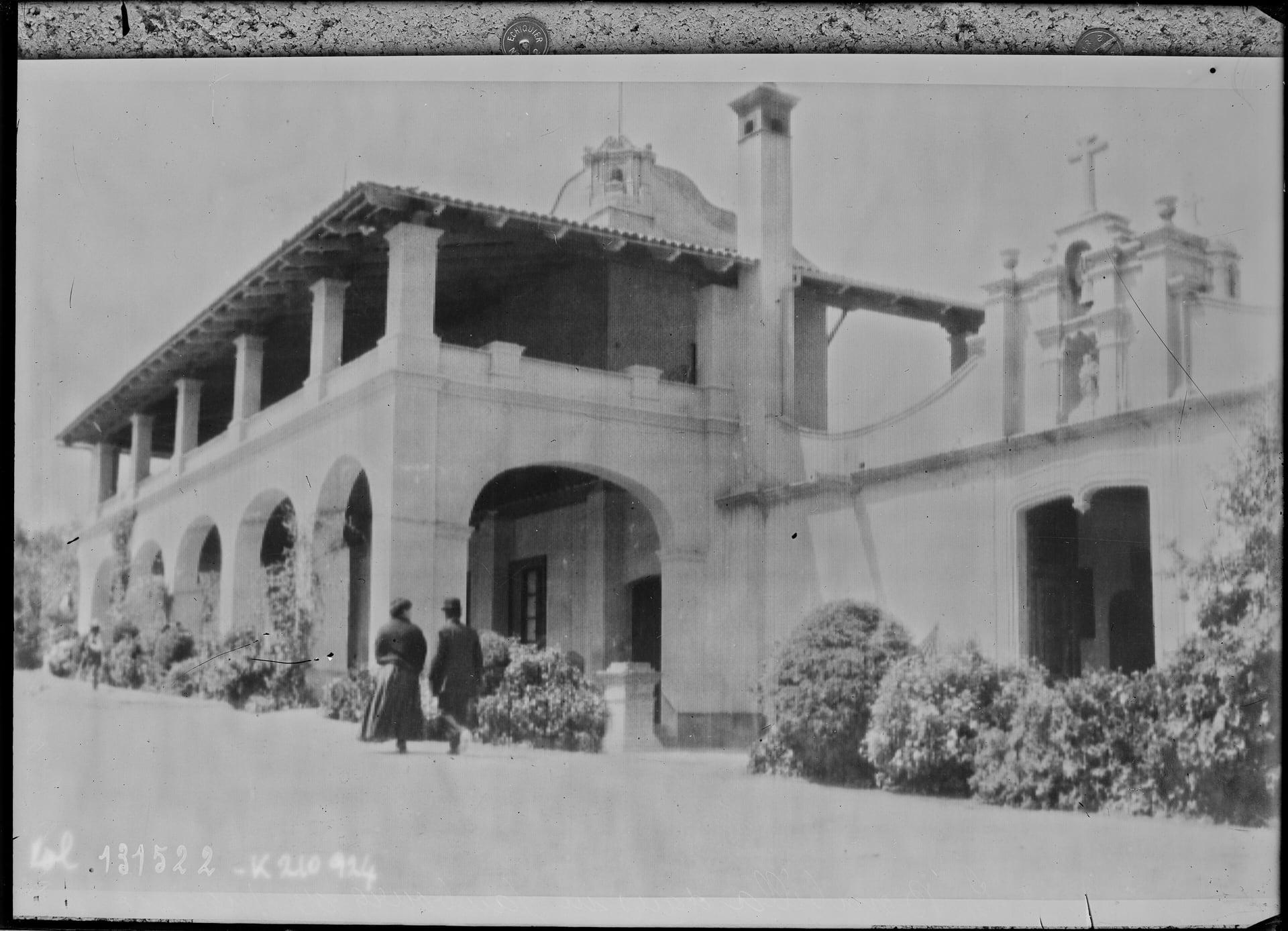
San Ángel: How a Friars' College Named a Village, and Two Concrete Houses Answered It
Capilla del Pocito: Red Stone, Tiled Domes and a Spring at the Basilica of Guadalupe