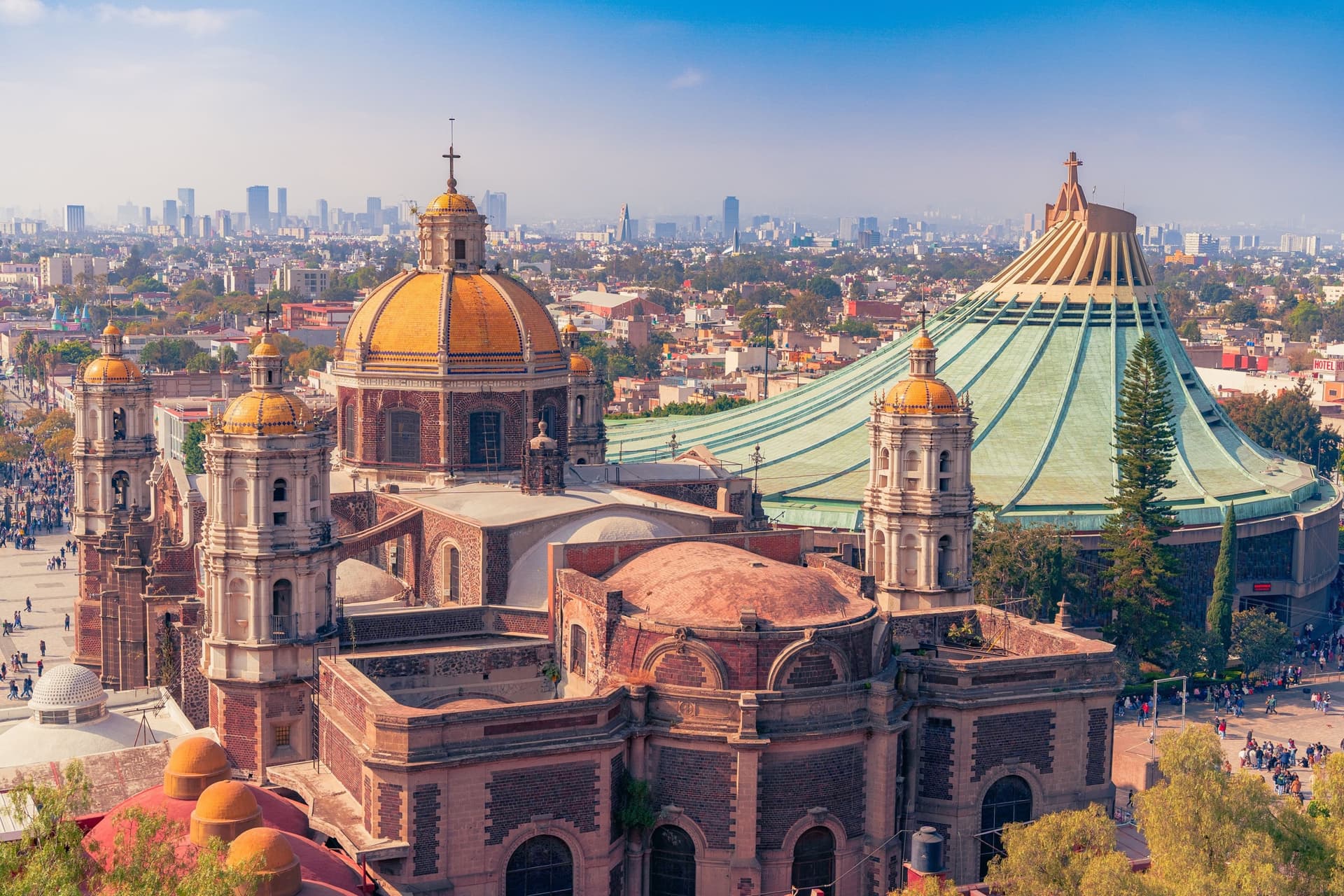
The Capilla del Pocito is a small chapel built between 1777 and 1791 over a spring that tradition tied to the fourth apparition. Its red stone, grey stone and blue-and-white tiled domes make it the place on Tepeyac where the design itself carries the story. At stop seven of the Basilica of Guadalupe walk the point is the outside, and you can see most of it from the path. You do not need to go in to read it.
Start with the colours
The walls are faced with tezontle, the porous red volcanic stone used all over Mexico City. Its rusty colour is everywhere in the old city. Against it, the doors and window frames are cut in pale grey stone, so every opening is outlined. Above, the domes are covered in blue-and-white glazed tile. Look for the windows shaped like stars.
The tiles are often called Talavera in guidebooks. The research behind the walk found no primary source for that name, so it calls them what you can see: blue-and-white glazed tile. Seen against a clear sky, the zigzag pattern of the main dome is the boldest thing on the hill.
A building shaped around water
Hear a stop from this walk
Above the Two Basilicas: Three Answers to Soft Ground
The chapel's name means the little well. It was built over a spring whose water people believed was miraculous, because tradition placed here the fourth meeting in the Church's account. On 12 December 1531, the story goes, Juan Diego went around the hill to avoid the Virgin, hurrying to find a priest for his dying uncle, and she came out to meet him. In the story she told him his uncle was already healed and sent him up to the summit for roses.
So the building had a job beyond being a chapel: it had to receive a spring and the people who came for its water. Its architect was Francisco Guerrero y Torres, and Mexico's national institute of anthropology and history dates the work to 1777 to 1791. Mexico's national institute calls the chapel a jewel of Latin American Baroque. That is the institute's phrase, and you can test it with your own eyes.
Sky and earth
In 2024 an architect from the national institute, Lucía Ezeta López, offered a reading of the design. The domes, with their star-shaped windows, refer to the sky, she said, and the red tezontle base to the earth. She also noted that the plan resembles the nahui ollin, a Mesoamerican sign of the four directions and the centre, and suggested the architect may have meant it as a gesture of reconciliation between Spaniards and Indigenous people.
It is an interpretation, not a document left by the builder, and the walk presents it that way. But it gives you something to look for. Stand back far enough to see the whole chapel: does the heavy red body read as ground, and the tiled domes as sky? Does the composition of domes around a centre suggest the four directions?
The lakebed again
The Pocito sits at the foot of the hill, but it shares the plaza's problem. The soft ground of the old lakebed reaches even here. In 1959 the engineer Manuel González Flores re-levelled the chapel. In 2024 the national institute reported that it was sinking again, and listed the damage: cracks in the walls and in the central dome, plants rooting in the stone, cement patches, and missing pieces of the red tezontle facing. If you notice gaps in the stone skin as you walk around, that is what you are seeing.
That makes the Pocito a fitting hinge on the walk. Behind you on the plaza, three big churches show three answers to soft ground. Ahead, the path climbs to the summit chapel where the account sets most of the story. Here, in one small building, both themes meet: a spring and a story, and a chapel the ground keeps trying to tilt.
The path up from here is steep in places, so take it slowly, and stop as long as you like for the domes.
This is stop 7 of Basilica of Guadalupe: Churches on Soft Ground, a Story on the Hill, a self-guided walk on the Mexico City page.
Sources
- INAH Boletín 332, 11 June 2024: symbolic elements of the Capilla del Pocito: built 1777 to 1791 by Francisco Guerrero y Torres, the spring believed miraculous and the fourth apparition, the 1959 re-levelling, Lucía Ezeta López's sky, earth and nahui ollin reading, the jewel of Latin American Baroque phrase, and the current damage.
- Insigne y Nacional Basílica de Santa María de Guadalupe: synthesis of the apparitions: the shrine's own account of the December 1531 meetings.
- The tour's fact dossier (research/mexico/tours/cdmx-guadalupe/FACT-DOSSIER.md): the colours of the stone and tile, and the note against calling the tiles Talavera.
Mexico eSIM· 10% off with ROAMER10
Ready to experience it?
Basilica of Guadalupe: Churches on Soft Ground, a Story on the Hill
75 min · 1.3 km · moderate
More from Mexico City
Explore more at your own pace.
Basilica of Guadalupe: Three Churches, One Lakebed, and the Hill Above
Coyoacán in Walls: Churchyards Torn Open, a Blue House Closed In
Paseo de la Reforma: Where Mexico Decides Who Gets a Statue
San Ángel: How a Friars' College Named a Village, and Two Concrete Houses Answered It
Casa del Risco: The Fountain of Broken China Hidden Behind a San Ángel Wall