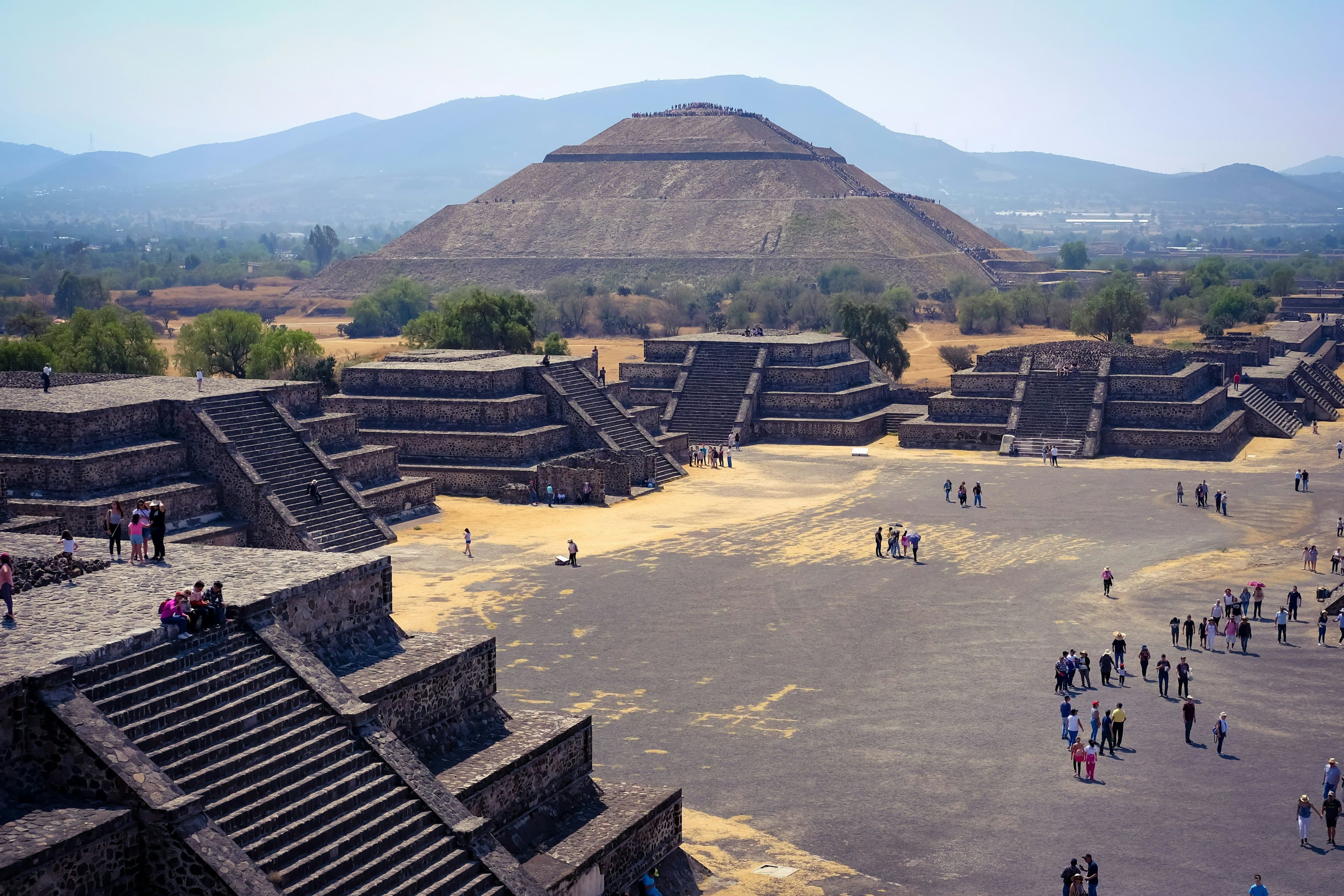
Walk Teotihuacán's Avenue of the Dead from the Temple of the Feathered Serpent to the Pyramid of the Moon, reading the city's plan as you go, and see the Plaza of the Moon rebuilt as it stood in 450 CE.
Inside the Palace of Quetzalpapalotl · 2 stops you tap
Start · Temple of the Feathered Serpent: The Carvings Saved by Burial
DirectionsStops
- 1
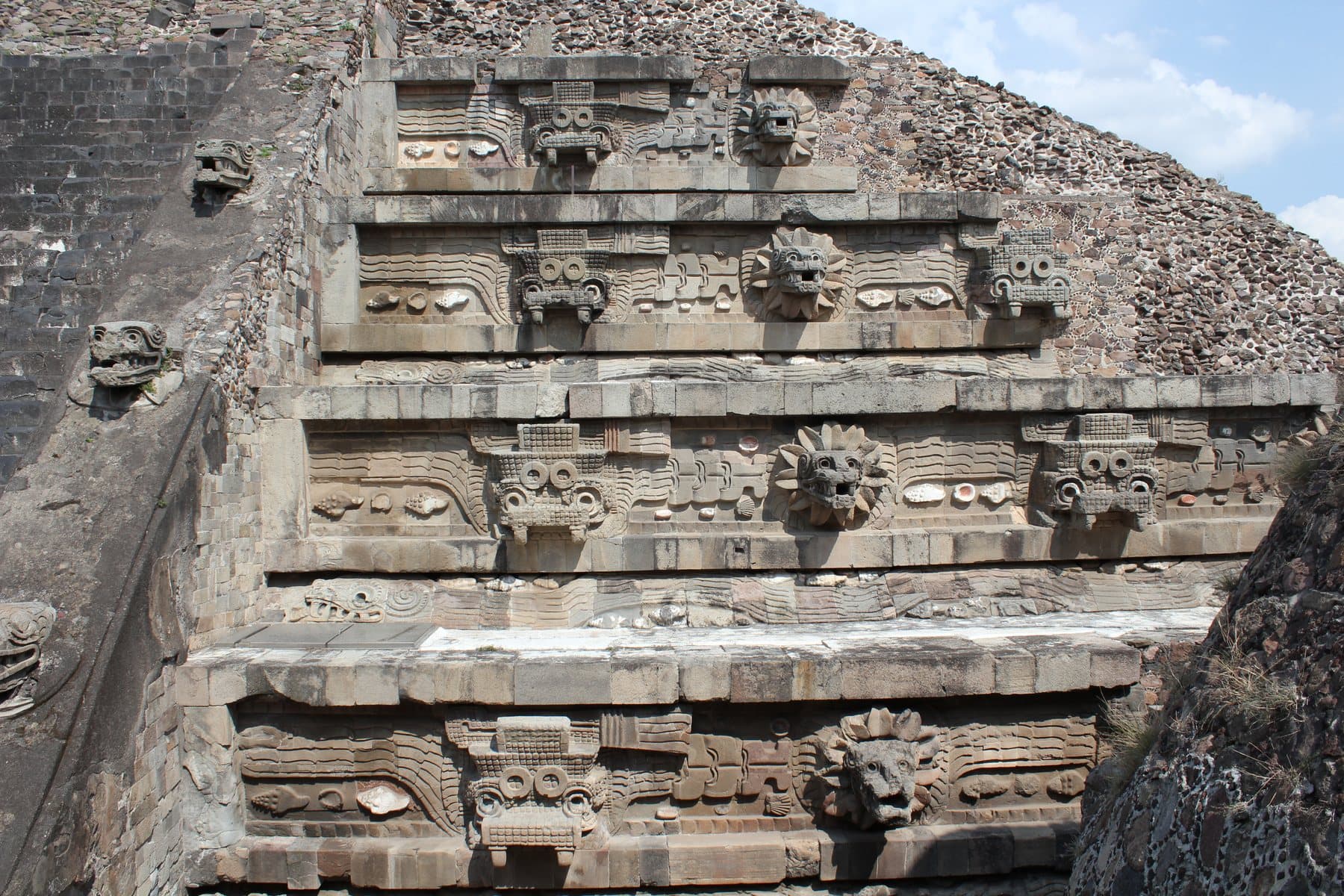
Temple of the Feathered Serpent: The Carvings Saved by Burial
A stepped temple once carved with feathered serpents on every face, saved because the city later buried its front behind a plain red platform.
- 2
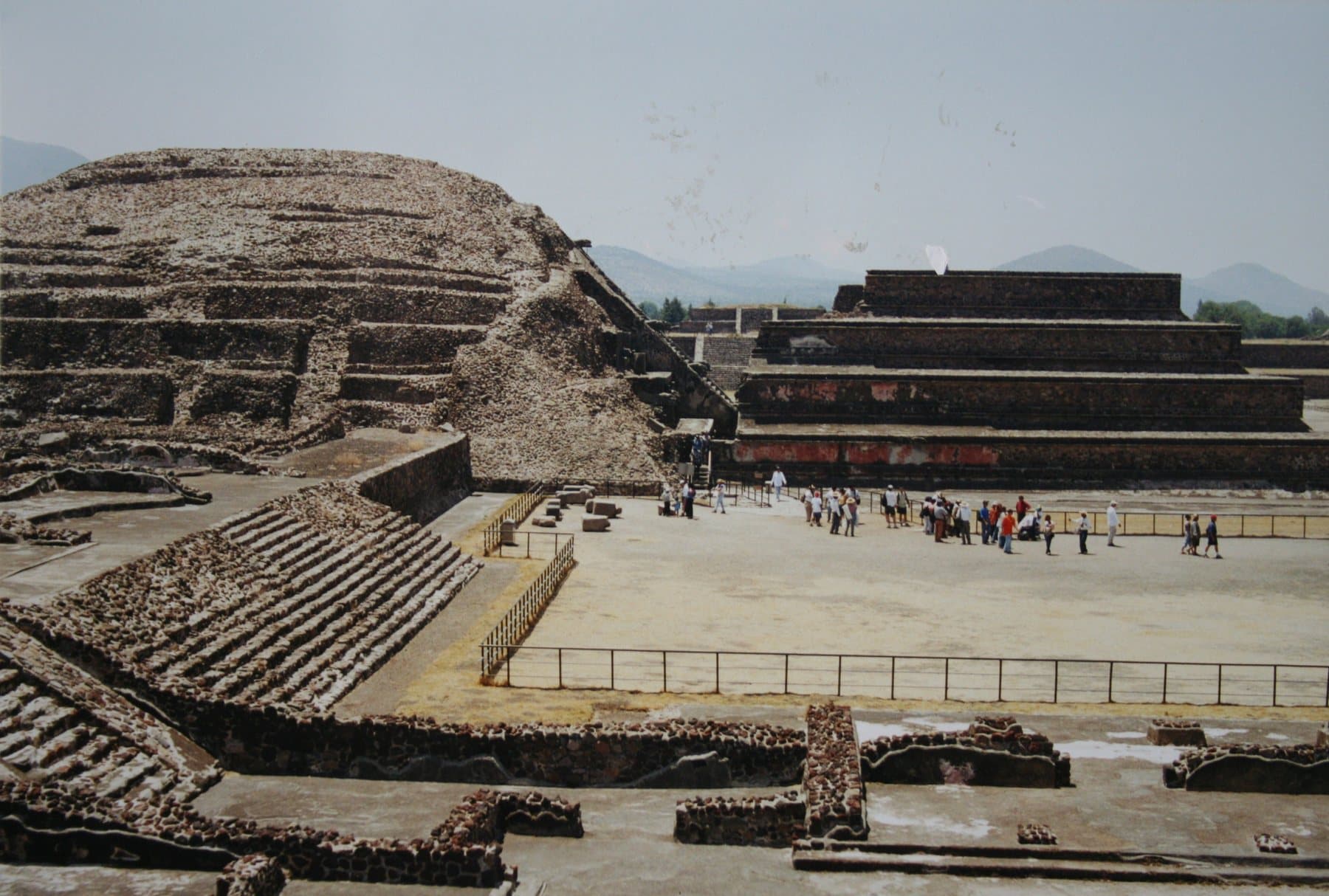
The Ciudadela: A Plaza Built for a Crowd
A walled square about four hundred metres across, ringed by fifteen small temples, where the city's two great avenues are thought to have met.
- 3
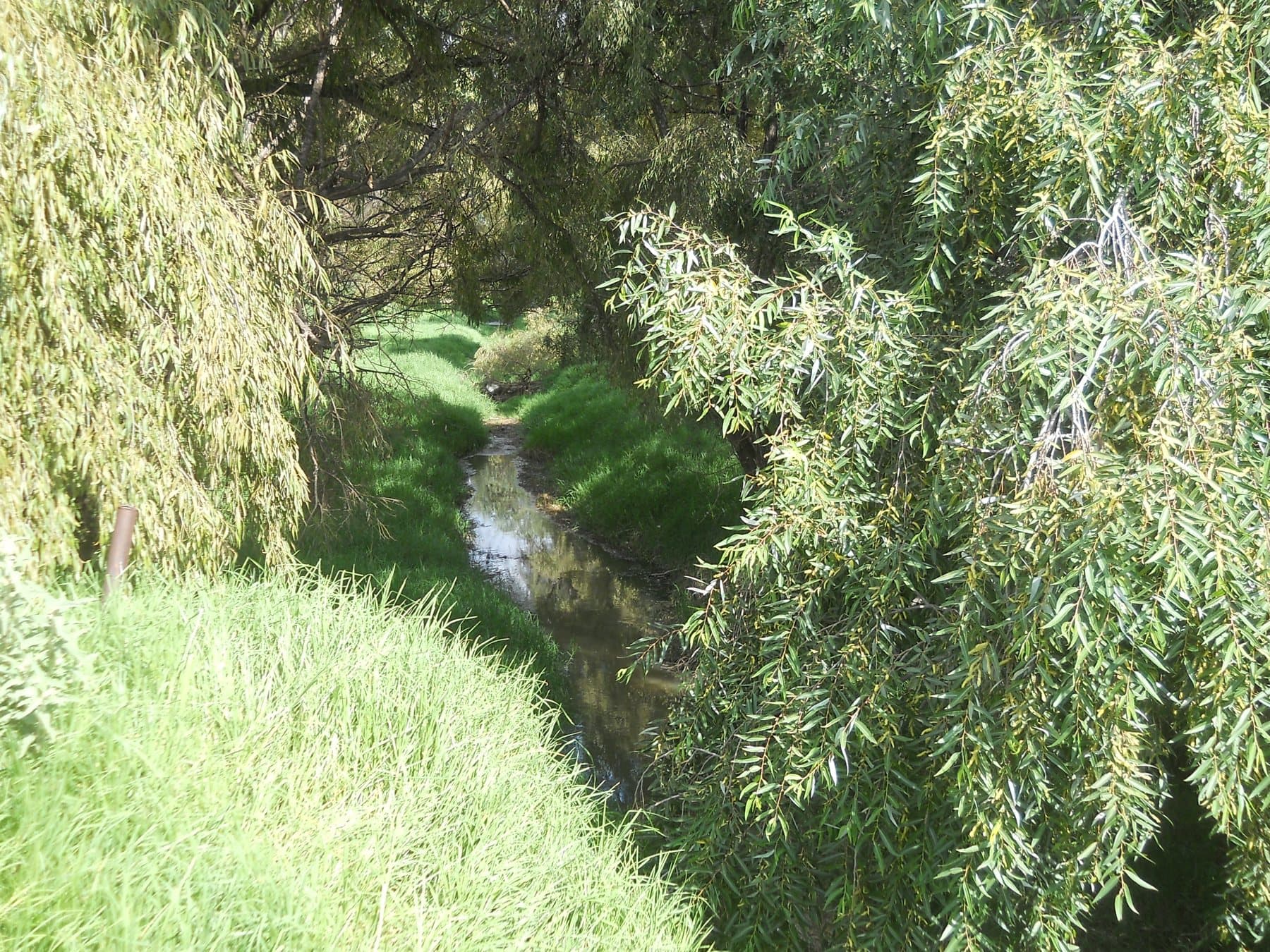
San Juan River: Even the Water Followed the Plan
The river under this bridge once wandered across the site; the city dug it a new, straight course set to the same angle as its streets.
- 4
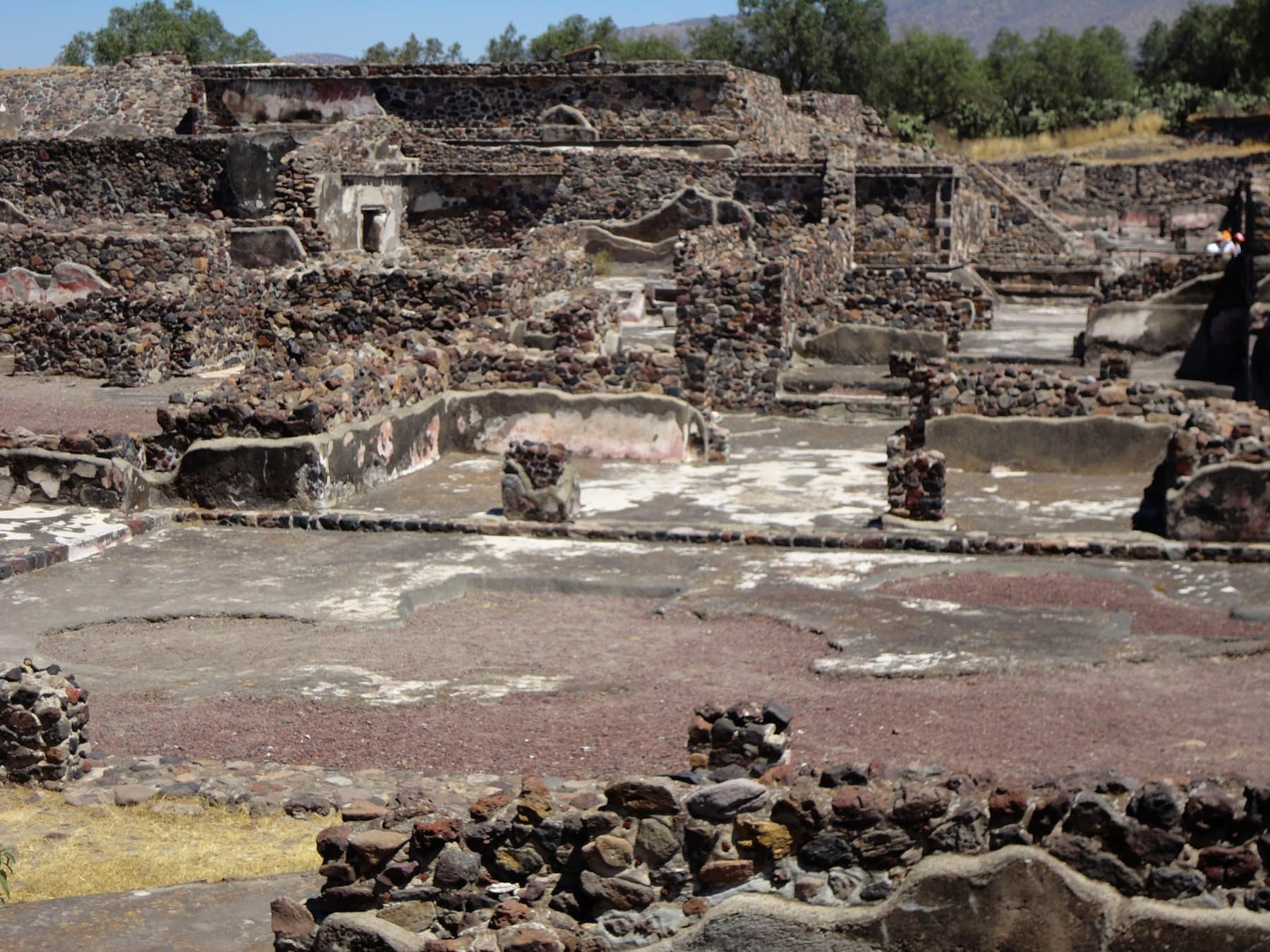
Superimposed Buildings: A City Built on Its Own Past
Two compounds where archaeologists left the layers exposed: one building inside another, one floor laid over the floor below.
- 5
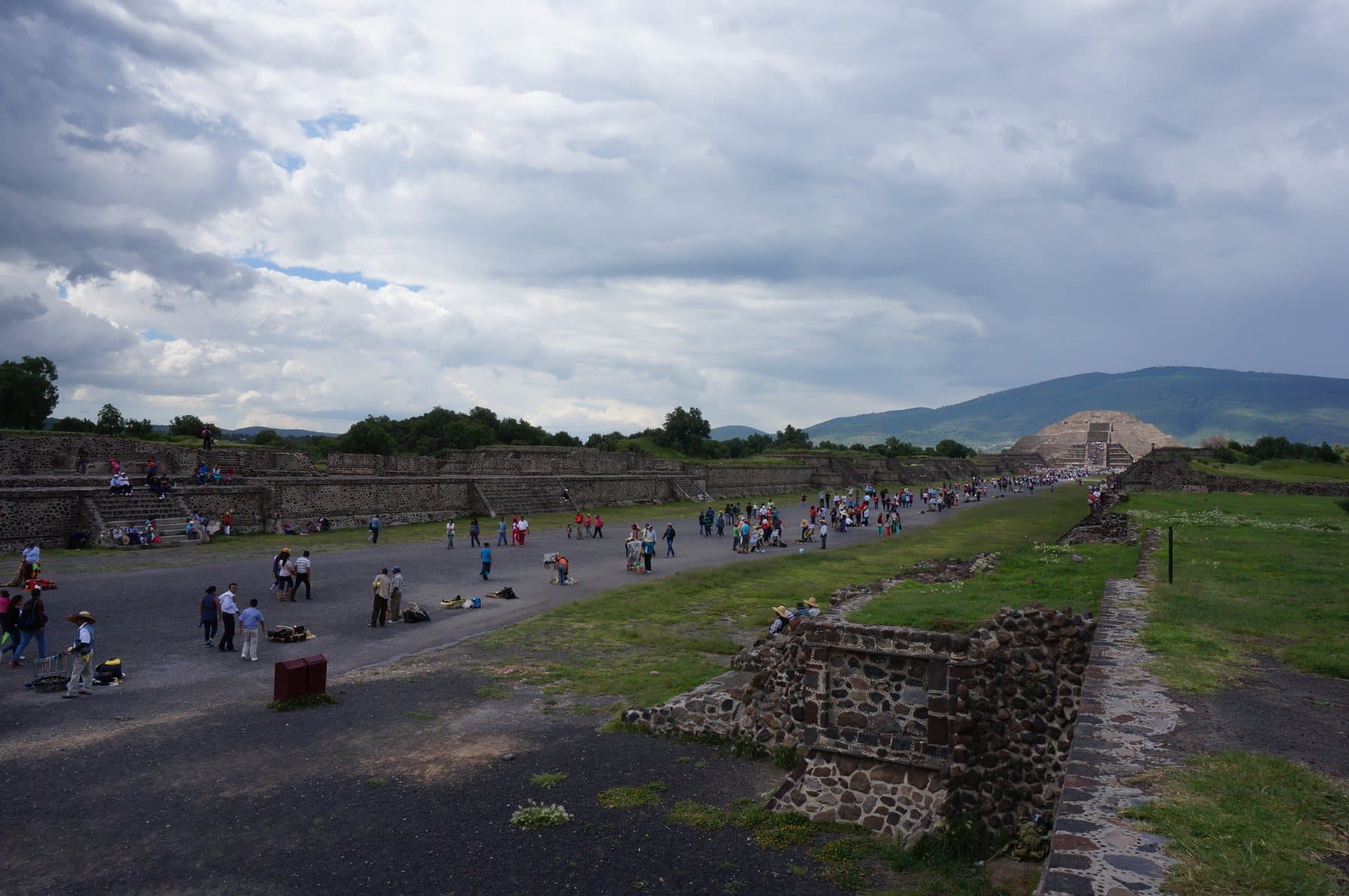
Avenue of the Dead: A Staircase Toward the Mountain
The avenue climbs twenty-seven metres in a chain of sunken courts, each closed by a wall like this one, toward a pyramid set against a mountain.
- 6
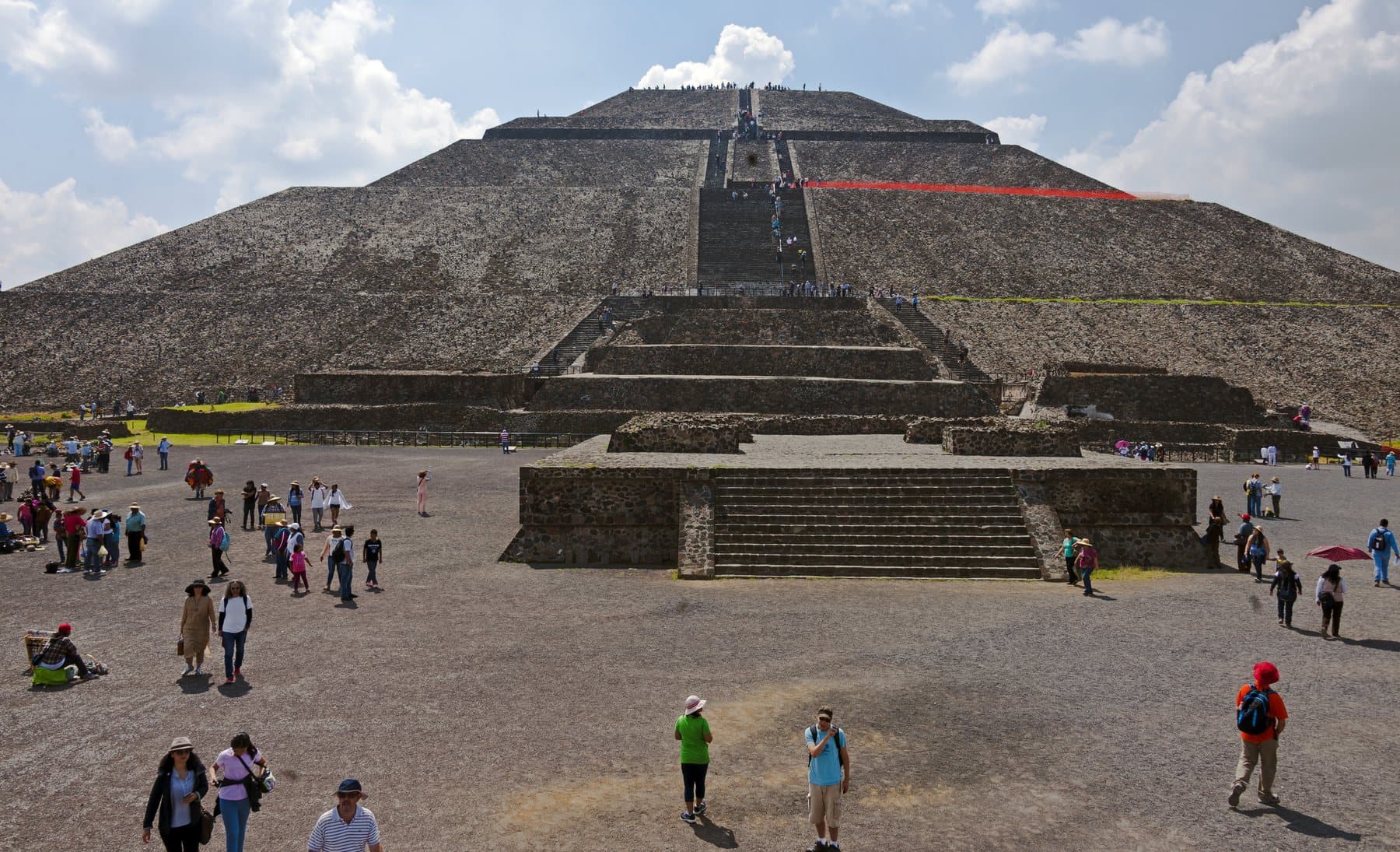
Pyramid of the Sun: The Mountain Built by Hand
Raised in one great effort in the first or second century CE over a tunnel dug into the rock beneath it, and about sixty-five metres high.
- 7
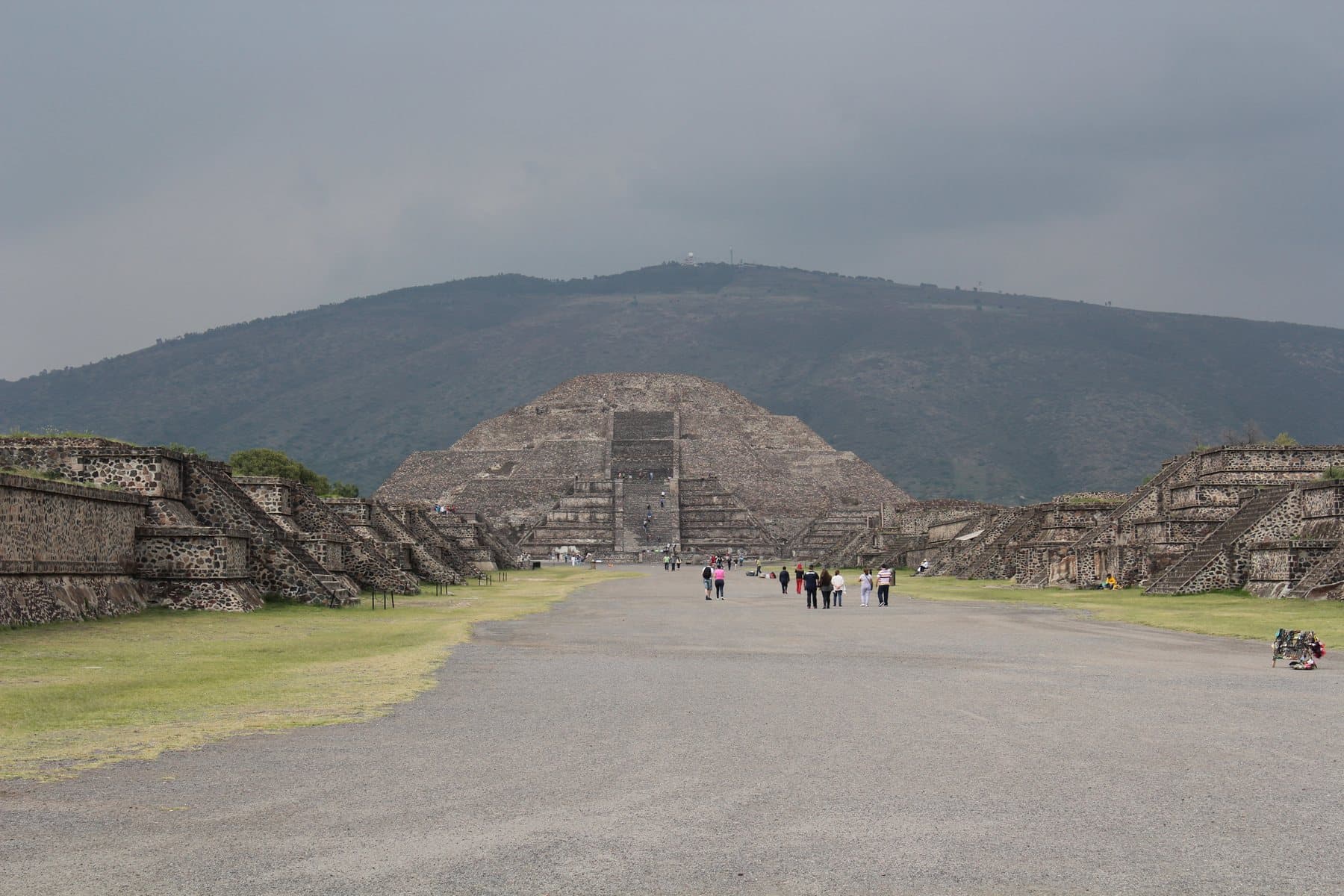
Avenue of the Dead: The View Up to the Moon
The avenue rising to the Pyramid of the Moon and the mountain behind it: the composition the avenue was laid out to end on.
- 8
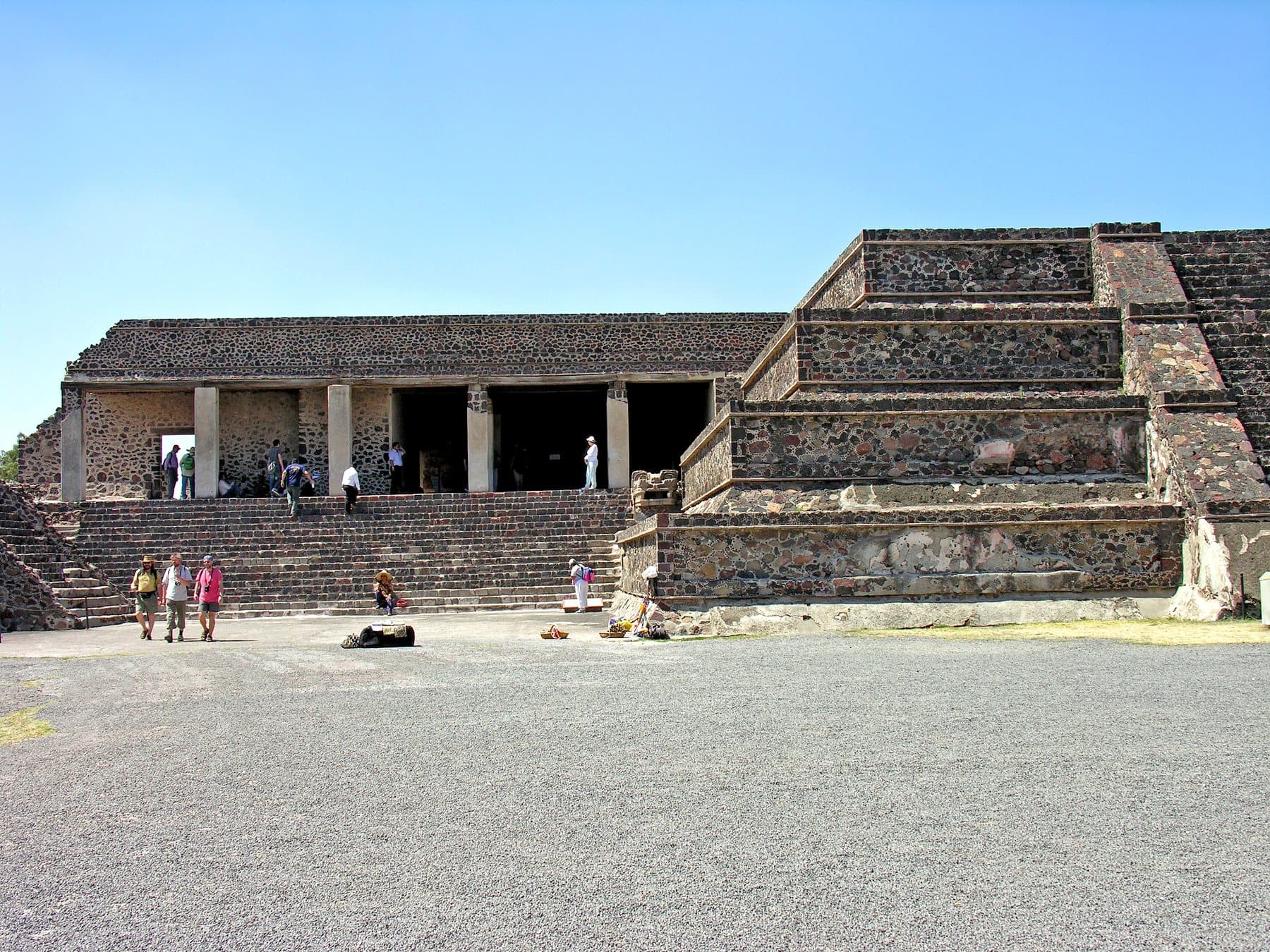
Palace of Quetzalpapalotl: The City at Human Scale
A palace up a stair guarded by a serpent head, built over an older temple and pieced back together in the 1960s; go inside in small groups.
- Inside the Palace of Quetzalpapalotl · tap each stop to play
- 9
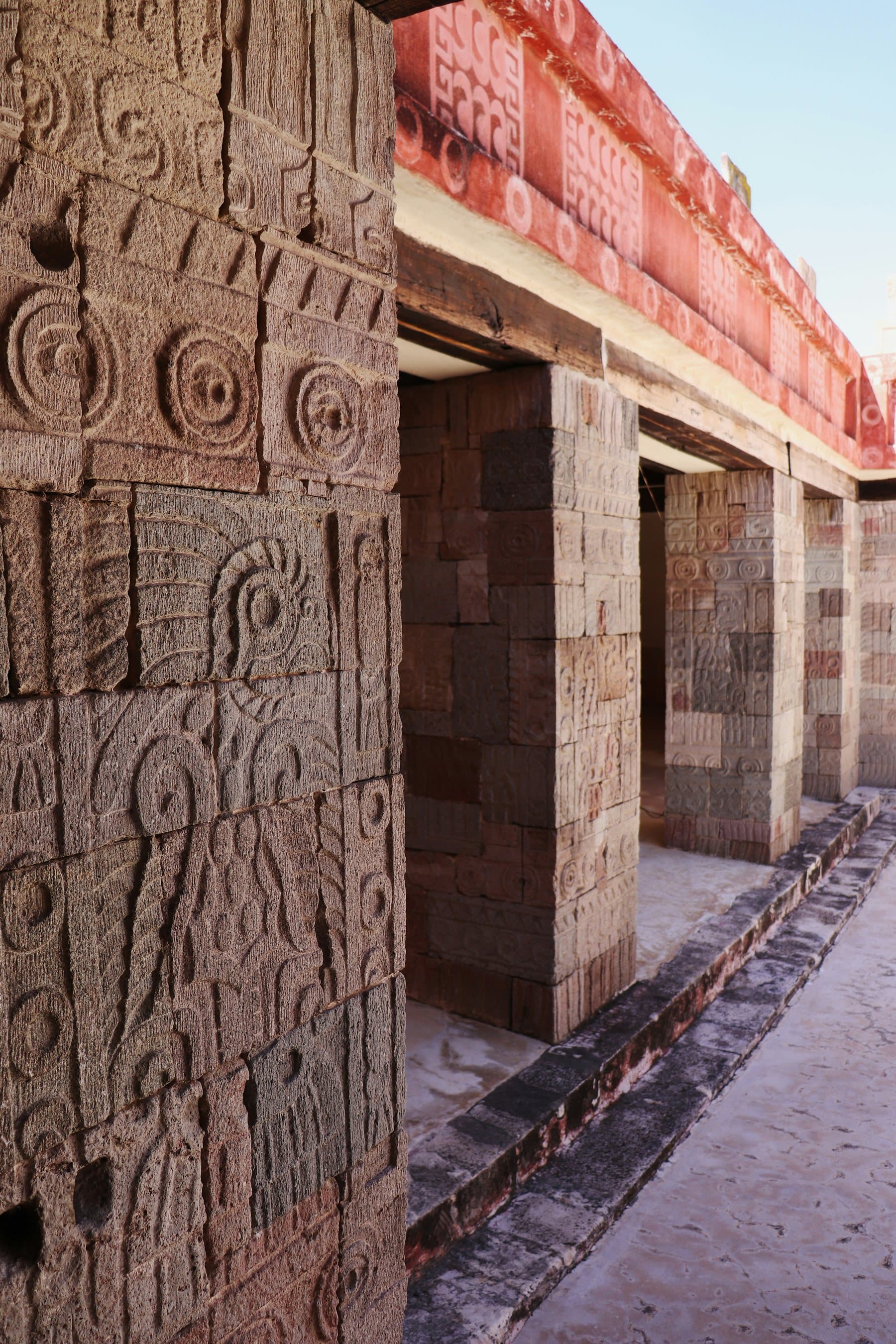
Patio of the Pillars: Quetzal and Butterfly
Square pillars carved with a quetzal in profile and butterfly wings seen from the front; on the west side they turn into the face of a night bird.
- 10
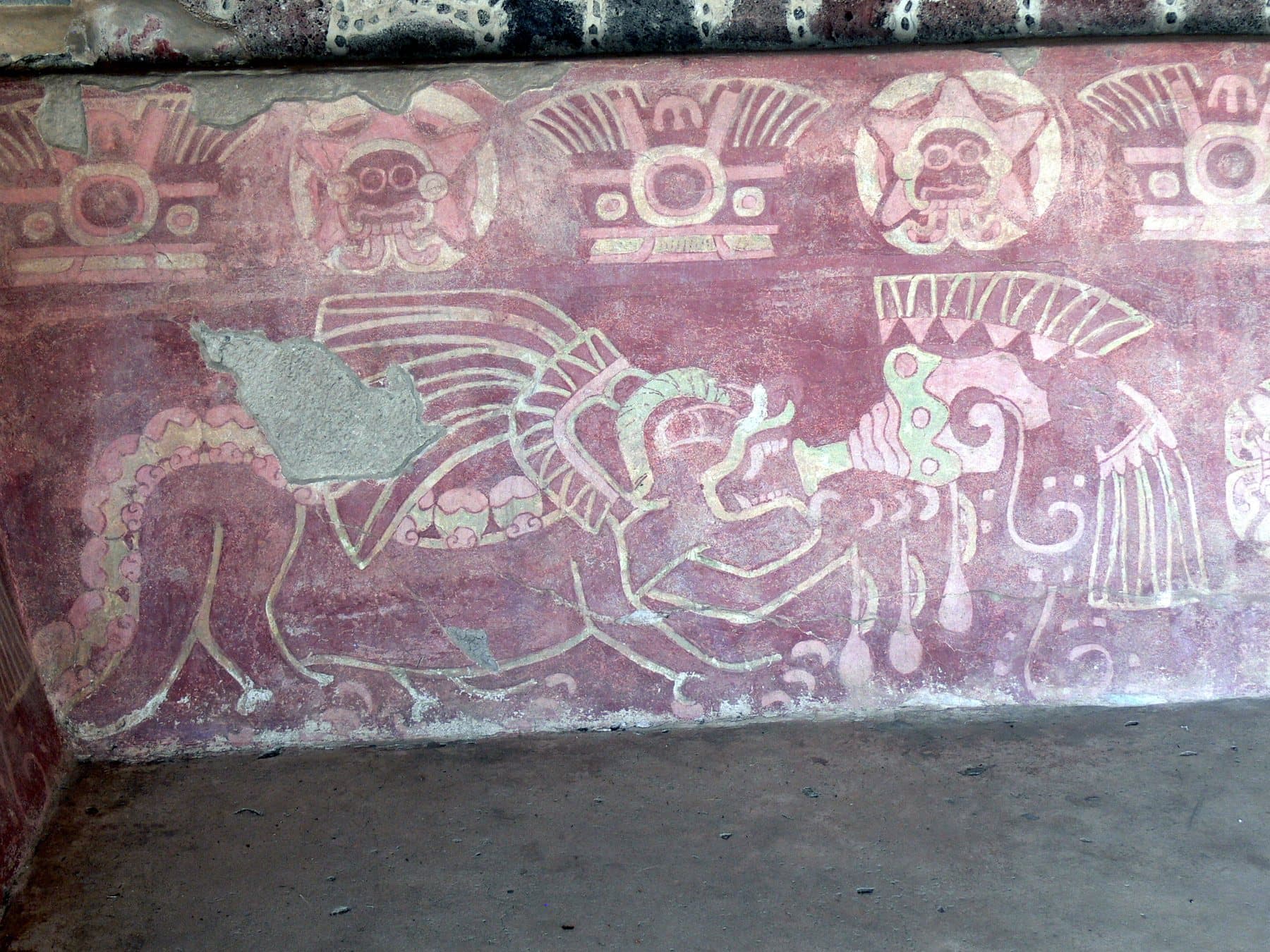
Jaguars and the Buried Temple of the Feathered Shells
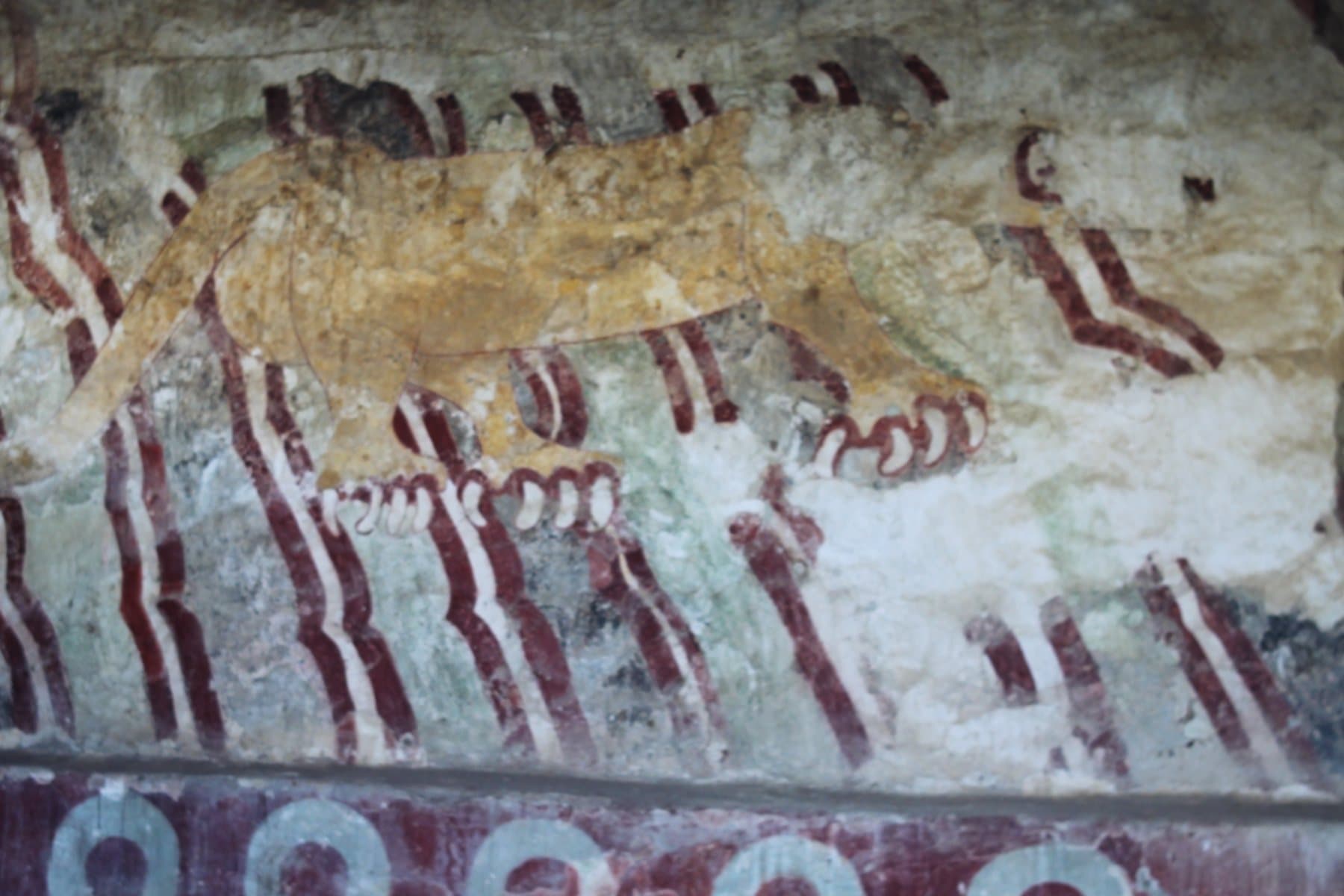
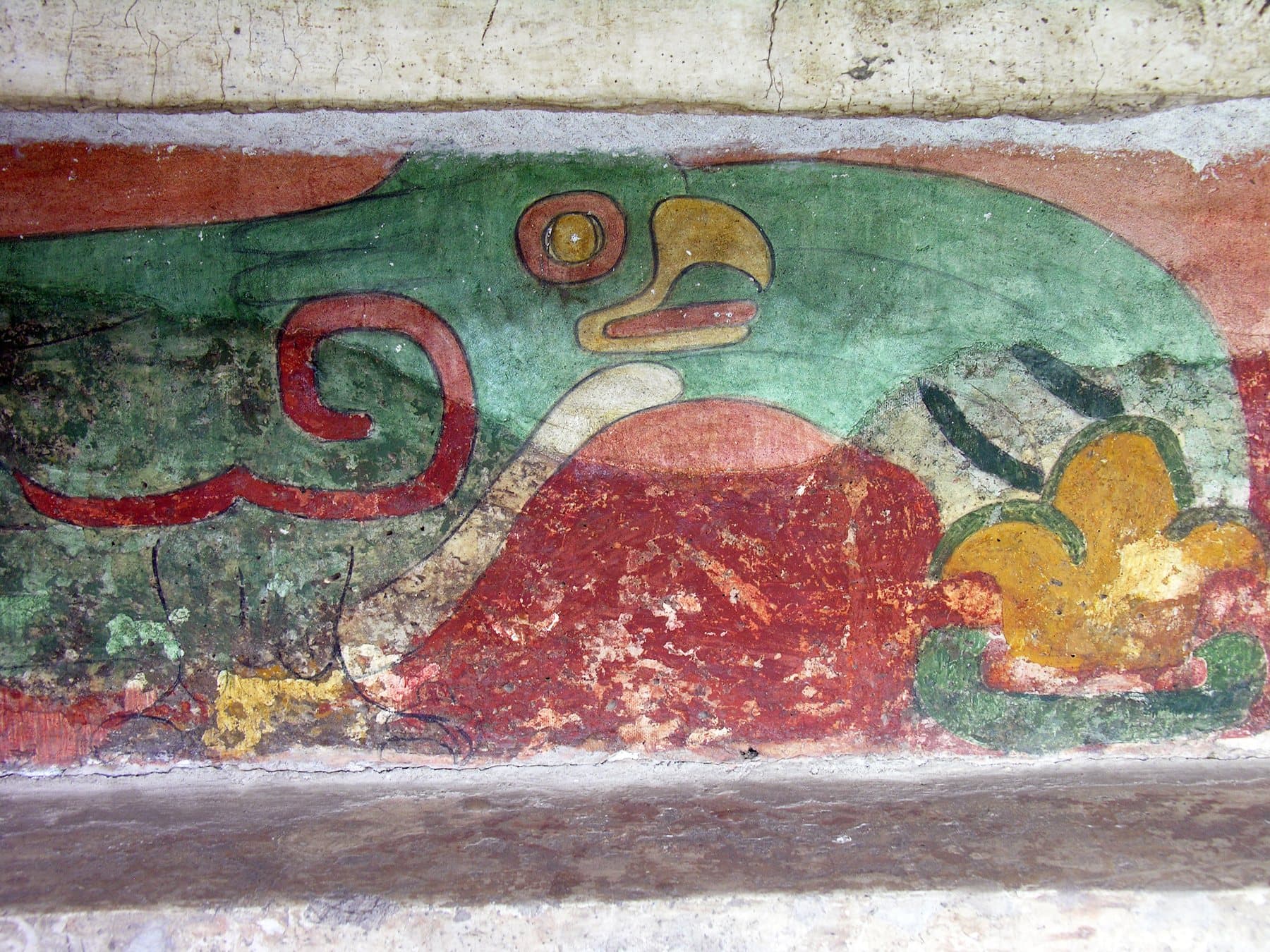
A procession of painted cats with feathered shell trumpets, then a tunnel to an older temple buried whole, its paint still bright.
- 11
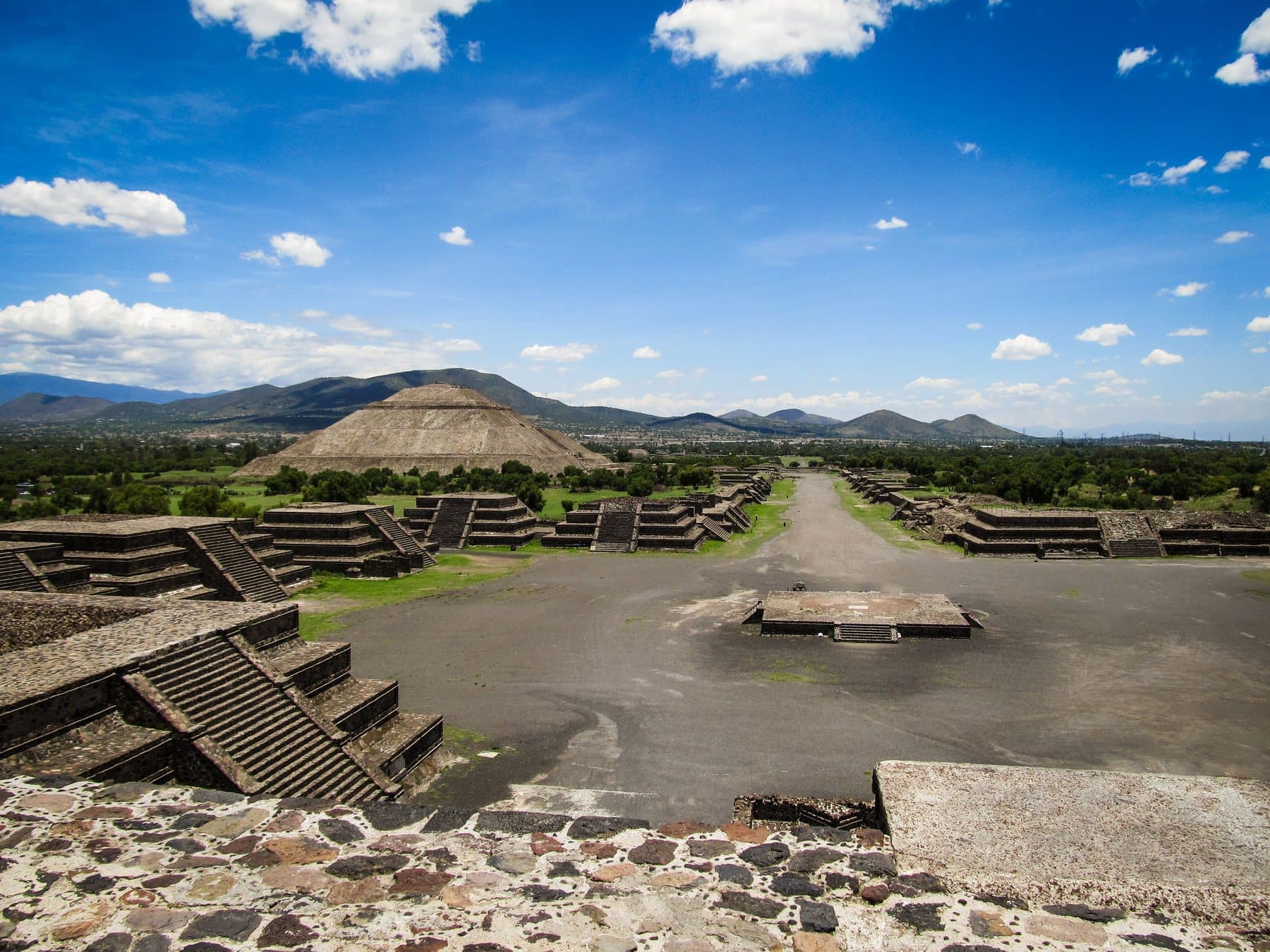
Plaza of the Moon: The Stage of the City
A plaza ringed by thirteen matching platforms, once all painted, with a central altar and an enclosure of altars set to the four directions.
- 12
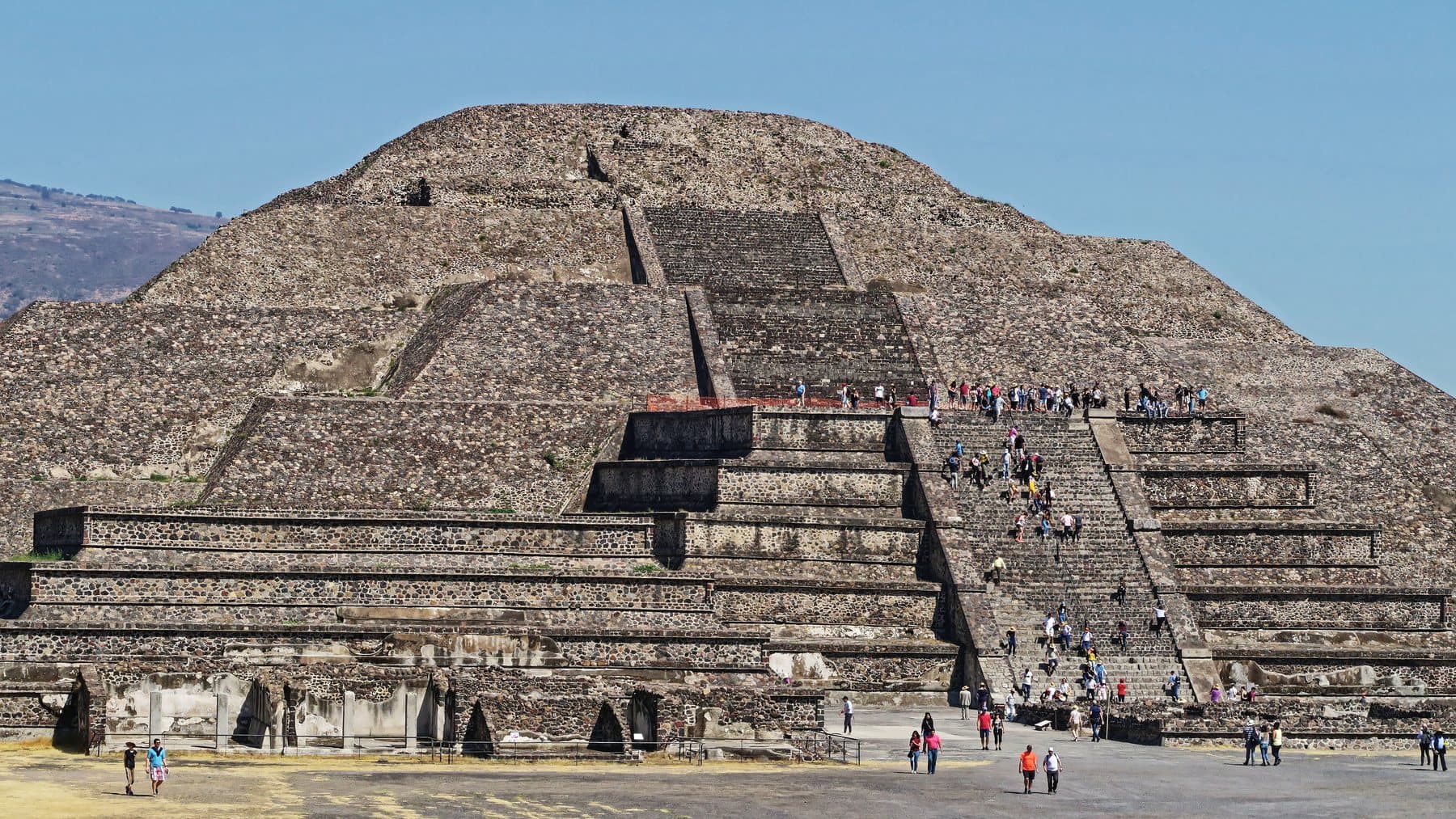
Pyramid of the Moon: Seven Pyramids in One
Seven pyramids wrapped one around the other, the last finished around 450 CE, set to repeat the mountain behind them.
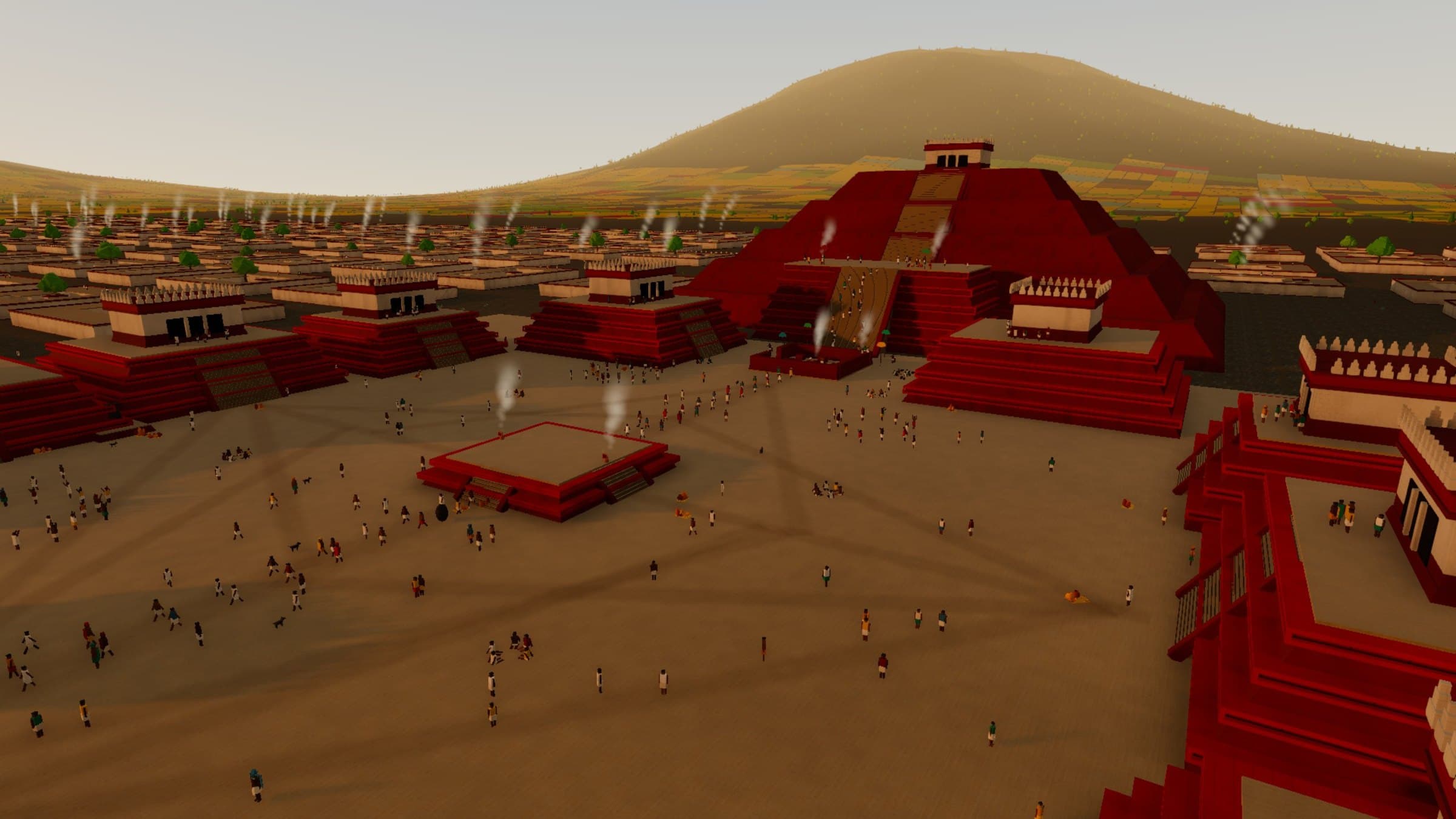
Details
Best Time to Visit
Come at opening time, 8:00, and start at the Ciudadela while it is cool; the avenue has almost no shade and the hottest hours are about 11:30 to 15:30. In the rainy season (roughly May or June to October) storms usually come in the afternoon, so mornings are best. The Feathered Serpent's carved face looks west and is at its best in afternoon light, so if you come late in the day, start there anyway and you will have the light. Sundays are free for Mexican nationals and residents and very busy. Checked 13 October 2026.
Pro Tips
- •Enter by Puerta 1, at the south-west corner of the site, a short walk west of the Ciudadela. The walk ends in the Plaza of the Moon, a few minutes from Puerta 3, so you never walk the avenue twice.
- •Buses from Mexico City's Terminal del Norte stop at Puerta 2, and sometimes Puerta 1. Some return buses are reported to pick up at Puerta 3, but that is not confirmed by an official source: if you are relying on the bus, ask the driver on the way in, or allow about fifteen minutes to walk back down to Puerta 2 (checked 13 October 2026).
- •Play the introduction before you enter the Ciudadela; stop 1 starts in the narrow gap behind the plain platform on its far side.
- •The Palace of Quetzalpapalotl is entered in small timed groups. If you want to see it with fewer people, it is quieter early in the morning.
- •Two museums are included in your ticket: the site museum (Museo de la Cultura Teotihuacana) south of the Pyramid of the Sun, by Puerta 5, and the mural museum (Museo de los Murales Teotihuacanos Beatriz de la Fuente), just north of Puerta 3. Both open 09:00 to 16:30 (checked 13 October 2026).
- •Tepantitla, an apartment compound with famous murals, is a short walk east of the Pyramid of the Sun, near Puerta 4. It is not on this walk, but it is worth a detour if you have the energy.
- •The 3D view of the city as it was in 450 CE works best with the phone held up at eye level, and it needs a data connection. Download the tour itself before you go: signal on the site can be weak.
Safety & Precautions
- •There is almost no shade on the avenue. Wear a hat and sunscreen, carry plenty of water, and rest in the shade of the museums if you need to. Toilets are at the gates and near the museums, not along the avenue.
- •The ground is gravel and earth, uneven in places, and the avenue's cross-walls are crossed by steep stone steps. Wear shoes with grip, and take the steps slowly.
- •Climbing the pyramids is not allowed at present: the Pyramid of the Sun has been closed to climbers since 2020, and the Pyramid of the Moon since April 2026 (checked 13 October 2026). Stay off the structures and behind the ropes.
- •Every gate has a security check with metal detectors and bag searches. Food and drones are not allowed.
- •Vendors with whistles and souvenirs work the avenue, especially near the Pyramid of the Sun. A polite "no, gracias" is enough.
- •In the rainy season, afternoon storms can bring lightning to this open site. If a storm builds, head for the museums or the gates.
Travel advisory: Exercise Increased Caution (Level 2).
Gallery
Read the walk
The full story of Teotihuacán: The Avenue That Climbs to the Moon, in words. Prefer to listen? Play it narrated, from home or on location.
Introduction
Teotihuacán lies in the Valley of Mexico, about forty kilometres northeast of central Mexico City. At its height it was the largest city in ancient Mexico, home to perhaps a hundred thousand people. Nobody knows what its people called it, or who ruled it. But we know how they built it: the plan is still here.
This walk follows the city's spine, the Avenue of the Dead, from the Temple of the Feathered Serpent in the south to the Pyramid of the Moon in the north, the route recommended by Mexico's National Institute of Anthropology and History, which runs the site. Along the way you will learn to read three things: one grid at one angle, an avenue built as a staircase toward a mountain, and a habit of building on top of the past.
There are ten stops on the walk, and two more you can play inside the palace near the end. It covers a little over two kilometres, and takes about three hours at an easy pace.
The last stretch, from the top of the avenue to the Moon, carries Roamer's reconstruction of the city in AD four hundred and fifty. When the hourglass appears on your map, tap it.
The walk starts inside the Ciudadela, the great walled square across the avenue from Puerta one. Go up the stairway, cross the plaza to the plain stepped platform on the far side, and walk round its end to the narrow gap behind it, where the information board stands.
1. Temple of the Feathered Serpent: The Carvings Saved by Burial
Welcome to Teotihuacán. One thing first: your site ticket covers everything on this walk, and the details are on this stop's card.
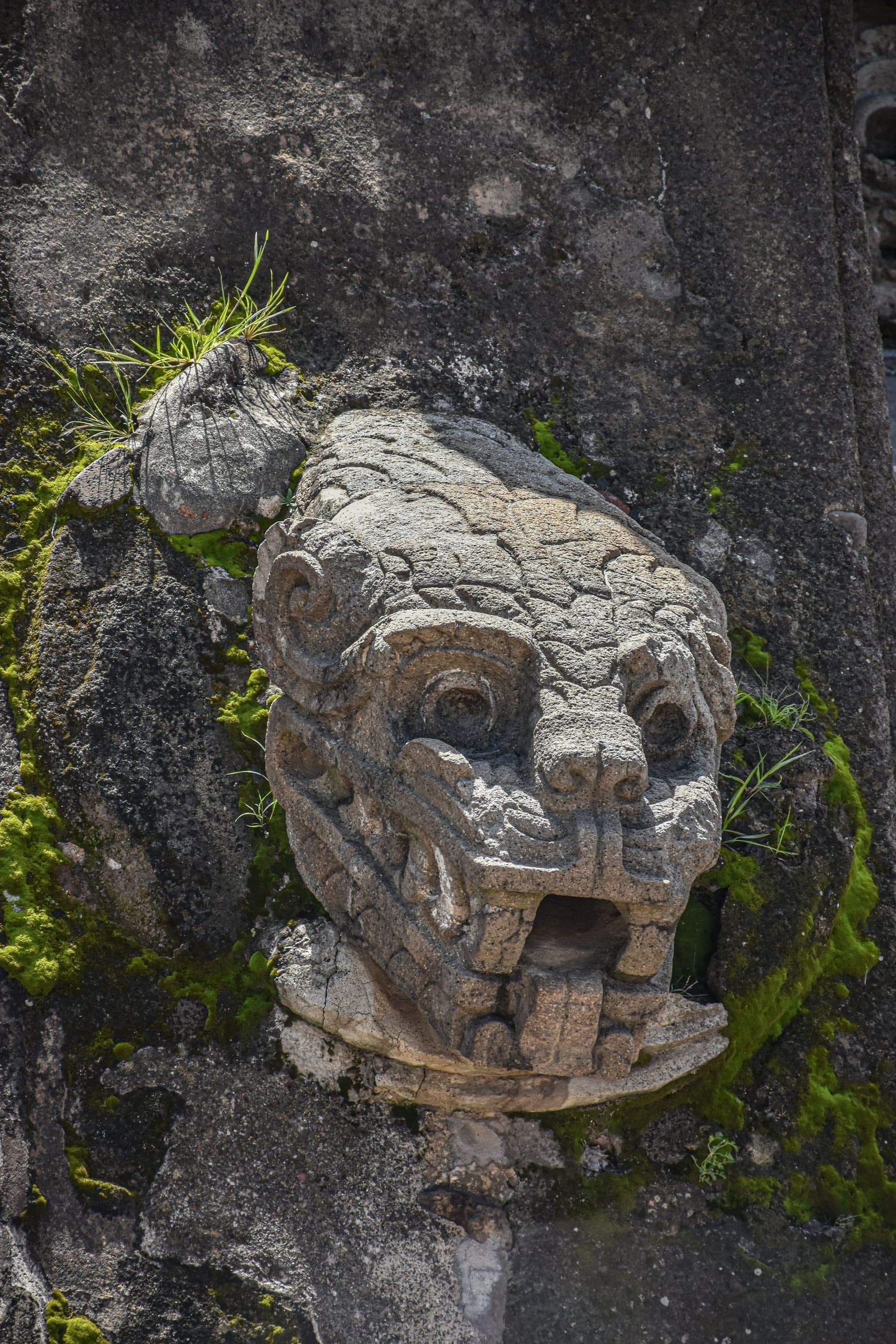
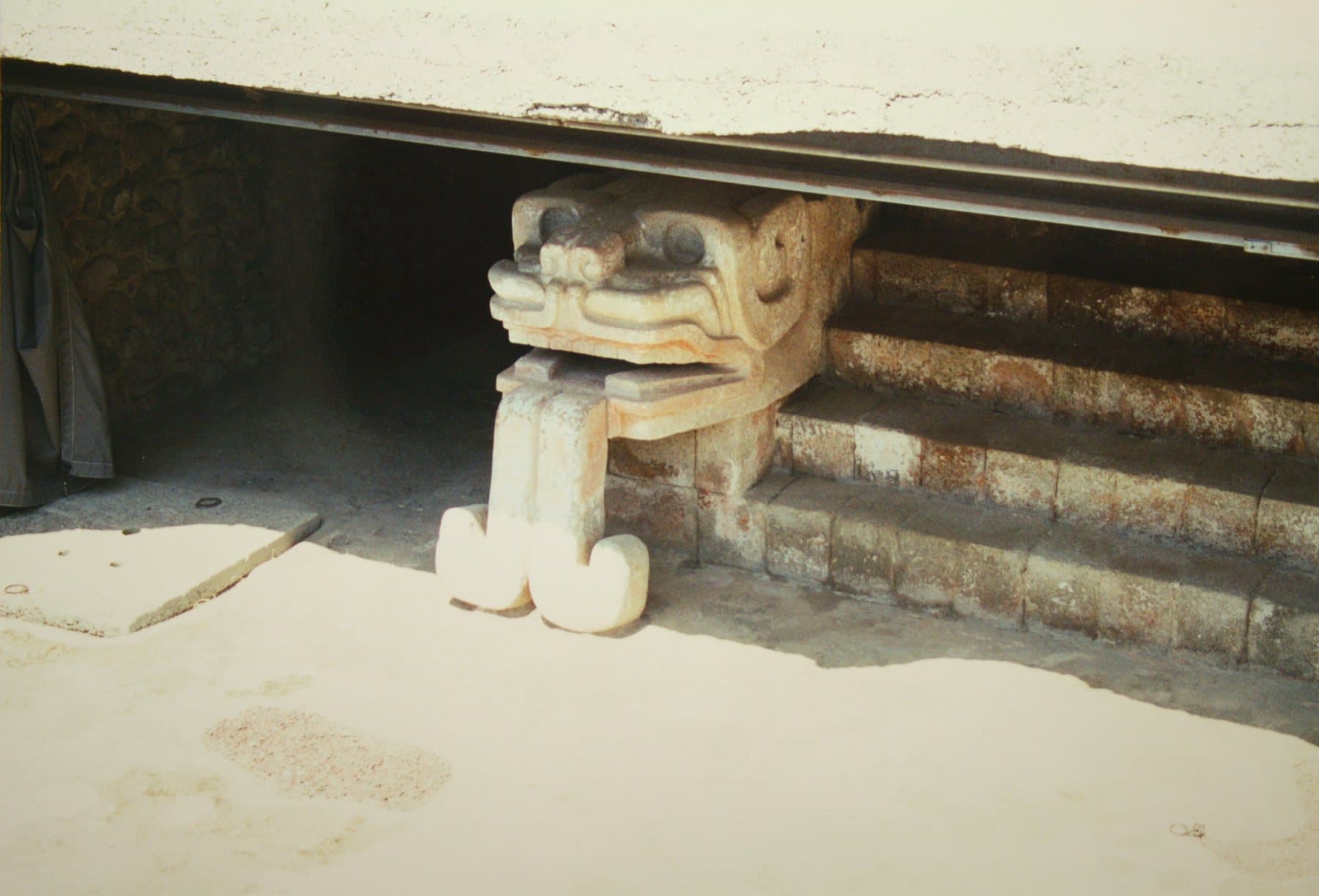
Walk into the mouth of the narrow gap behind the plain stepped platform, and look along it. One side is plain. On the other side, the one away from the plaza, great stone heads jut out of the wall. There are serpents, wrapped in carved feathers, and between them a second, blockier head whose meaning scholars still argue about. Along the slopes below them, the serpents' bodies ripple among carved shells.
This is the Temple of the Feathered Serpent. It was built around AD two hundred, and once it looked like this on every side and every tier. The plain platform in front of it came about a century later, built straight against its face. It is the exact opposite: smooth tiers, painted only red, and not one sculpture. Nobody knows why the city did it. It may have marked a change in who ruled or what they believed, or it may be the start of an enlargement that was never finished. The result is certain, though. By burying the carvings, the builders kept them. The most famous carvings in Teotihuacán survive because the city hid them.
Hold on to that idea, because you will meet it all day. Again and again, this city chose not to tear a building down. It wrapped the old one in a new one.
Look at the shape of each tier, too. There is a sloping base, and above it a flat vertical panel, framed like a picture. That profile is Teotihuacán's signature, and you will see it on nearly every platform from here to the Moon. In the afternoon, with the sun on this face, the heads stand out at their best.
Follow the route back across the plaza, toward the wide stairway on the far side.
2. The Ciudadela: A Plaza Built for a Crowd
Stop on top of the platform, and turn round to face the plaza you have just crossed.
This enclosure is the Ciudadela. The Spanish gave it the name, the citadel, because they took it for a fort. It was nothing of the kind. You are standing on one side of a raised square about four hundred metres across. Along its top sit fifteen small temples, the stepped mounds lined up on the platforms around you, every one in that same profile of a slope and a framed panel, and every one once plastered and painted. The temple you just left fills the far side, its carvings hidden behind the plain platform. In the open middle stands a low altar with a stair on each of its four sides.
Mexico's national archaeology institute estimates that this plaza could hold up to a hundred thousand people. Whatever the true number, this space was built for a crowd. Its walls close it in, there is one main way in from the avenue, and everything faces the centre.
Now turn the other way, toward the avenue. You are at the heart of the city's plan. The great avenue runs north from here, and the city's main east to west avenue crossed it here. Across the avenue, the flat open ground is the Great Compound, which archaeologists think was the city's main market. So at this crossroads, the city's most richly carved temple and, probably, its main market stood face to face.
Notice the angle. The avenue does not run due north. Nearly every street and wall in Teotihuacán is turned about fifteen and a half degrees east of north, from the pyramids down to the houses. Even the exceptions, like this enclosure, are off by only a degree or so. You will walk along that line for the next two kilometres.
Follow the route down the stairway and up the avenue, toward the Pyramid of the Moon.
3. San Juan River: Even the Water Followed the Plan
You are crossing the San Juan River, today only a modest stream. Look along it, both ways. It runs in a dead straight band, marked out by a double line of trees.
That straightness is not nature. The San Juan River used to wander across this ground from northeast to southwest, right through the space where the Ciudadela and the market now stand. So before those could be built, probably in the second century AD, the city moved the river. It dug a new channel, about three kilometres of it, and laid it on the same grid as the streets, turned to the same angle. Even the water was made to follow the plan.
That tells you how this city was made. Its centre was not a village that grew outward, street by street. It was laid out to a plan first, and built after. The avenue under your feet was laid out between AD one hundred and fifty and two hundred and twenty-five, about forty metres wide, and the avenue ran on to the south for kilometres beyond the Ciudadela. What you can walk today is the northern two kilometres, the ceremonial heart.
Look ahead. The long walls that cross the avenue in the distance are its steps. You will climb the first of them soon.
Follow the route along the avenue, toward the Pyramid of the Moon.
4. Superimposed Buildings: A City Built on Its Own Past
Stop here and look across the avenue, to the side away from the Pyramid of the Sun, at the low walled compound you are passing. These are the Superimposed Buildings, and they show the habit you met at the Feathered Serpent more plainly than anywhere else on the site.
When archaeologists dug here, they chose not to rebuild everything. They left the layers exposed. Walk in, and you can see one building inside another, and one floor laid over the floor below it. Each new structure used the old one as its foundation. Fragments of painted wall survive in there, with abstract scrolls and interlace laid out in strict symmetry, a style Mexico's archaeologists link to the Gulf Coast.
Just ahead on the same side, the West Plaza Complex tells the same story. Three buildings stand around a patio with an altar, built over earlier ones, and the stair rails of an older stage are still modelled in stucco as serpents, painted red, blue and yellow.
This whole stretch of avenue, between the river and the Pyramid of the Sun, was lined with compounds like these: palaces, temples, and the homes of the city's highest families. Several specialists think the city was governed from here, at least for a time in the third and fourth centuries.
Entry is included in your ticket, and it is all at ground level. If you go in, come back out to the avenue to carry on.
Follow the route on, toward the long walls that cross the avenue.
5. Avenue of the Dead: A Staircase Toward the Mountain
Climb the steps onto the wall that crosses the avenue ahead, and stop on top. Then look up the avenue, toward the Pyramid of the Moon. This is not one long flat road. It is a chain of sunken courts, each one closed by a wall like this, with steps going up and steps coming…
Full narration for this stop unlocks with the tour.
6. Pyramid of the Sun: The Mountain Built by Hand
Turn to face the Pyramid of the Sun, across its open plaza. It is about sixty-five metres high, and about two hundred and twenty-five metres along each side at the base, the biggest building in the city. It went up early, in the first or second century AD, mostly in one great…
Full narration for this stop unlocks with the tour.
7. Avenue of the Dead: The View Up to the Moon
Stop here and look straight up the avenue. This is the view the avenue was built to end on: the avenue running uphill to the Pyramid of the Moon, and the mountain behind repeating its shape. Now picture it at its height, around AD four hundred and fifty. Every platform you have…
Full narration for this stop unlocks with the tour.
8. Palace of Quetzalpapalotl: The City at Human Scale
You are at the foot of the stair to the Palace of Quetzalpapalotl, in the corner of the Plaza of the Moon. Look at the side of the stair: a carved serpent head guards it. After two kilometres of pyramids, this is the city at human scale. Archaeologists think it may have housed…
Full narration for this stop unlocks with the tour.
9. Patio of the Pillars: Quetzal and Butterfly
You are in the Patio of the Pillars. Stop by one of the square pillars, and move along to see its faces. Each face carries the same creature: the head of a quetzal bird in profile, and a butterfly's wings spread out as if seen from the front. That pairing gave the palace its…
Full narration for this stop unlocks with the tour.
10. Jaguars and the Buried Temple of the Feathered Shells
Down here is the Patio of the Jaguars, a level below the palace and built at the same time. Find the painted porticos. Big cats walk in profile, one behind another, wearing feathered headdresses. At each mouth is a shell trumpet decorated with feathers, and in front of it…
Full narration for this stop unlocks with the tour.
11. Plaza of the Moon: The Stage of the City
Stand by the low altar in the middle of the Plaza of the Moon, and turn slowly round. Everything in this plaza was arranged to frame the pyramid. Thirteen platforms ring it, matched to one another in that same profile of a slope and a framed panel, and every one of them was…
Full narration for this stop unlocks with the tour.
12. Pyramid of the Moon: Seven Pyramids in One
This is as close to the Pyramid of the Moon as the walk goes. Look past the low enclosure in front of you, up at the pyramid, and then at the mountain behind it. What you see is the seventh pyramid on this spot. Tunnels dug into it around the year two thousand found six earlier…
Full narration for this stop unlocks with the tour.
- Teotihuacan, Citadel, Temple of the Feathered Serpent Teotihuacan was an ancient — Arian Zwegers, CC BY 2.0 · source
- Sito archeologico di Teotihuacán, Messico — Adert, CC BY-SA 4.0 · source
- Edificios superpuestos - Teotihuacan, Estado de México, México — Juan Carlos Fonseca Mata, CC BY-SA 4.0 · source
- This is a photo of a monument in Mexico, identified by ID — Barbara Castro Mejia, CC BY-SA 3.0 · source
- The Plaza del Sol and the Pyramid of the Sun at Teotihuacan, Mexico — Daniel Case, CC BY-SA 3.0 · source
- Teotihuacan, Pyramid of the Moon, Cerro Gordo, and the Avenue of the Dead Teotih — Arian Zwegers, CC BY 2.0 · source
- Entrance to the Palace of Quetzalpapalotl — Dennis G. Jarvis, CC BY-SA 2.0 · source
- Palacio de Quetzalpalotl, Teotihuacán — Wolfgang Sauber, CC BY-SA 3.0 · source
- Temple of the Feathered Conch Shells, which is directly underneath the Palace of — Dennis G. Jarvis, CC BY-SA 2.0 · source
- Archäologische Bauten in der Ruinenstadt Teotihuacán — Burkhard Mücke, CC BY-SA 4.0 · source
Images may be cropped or resized. Other photos via Unsplash and Pexels.