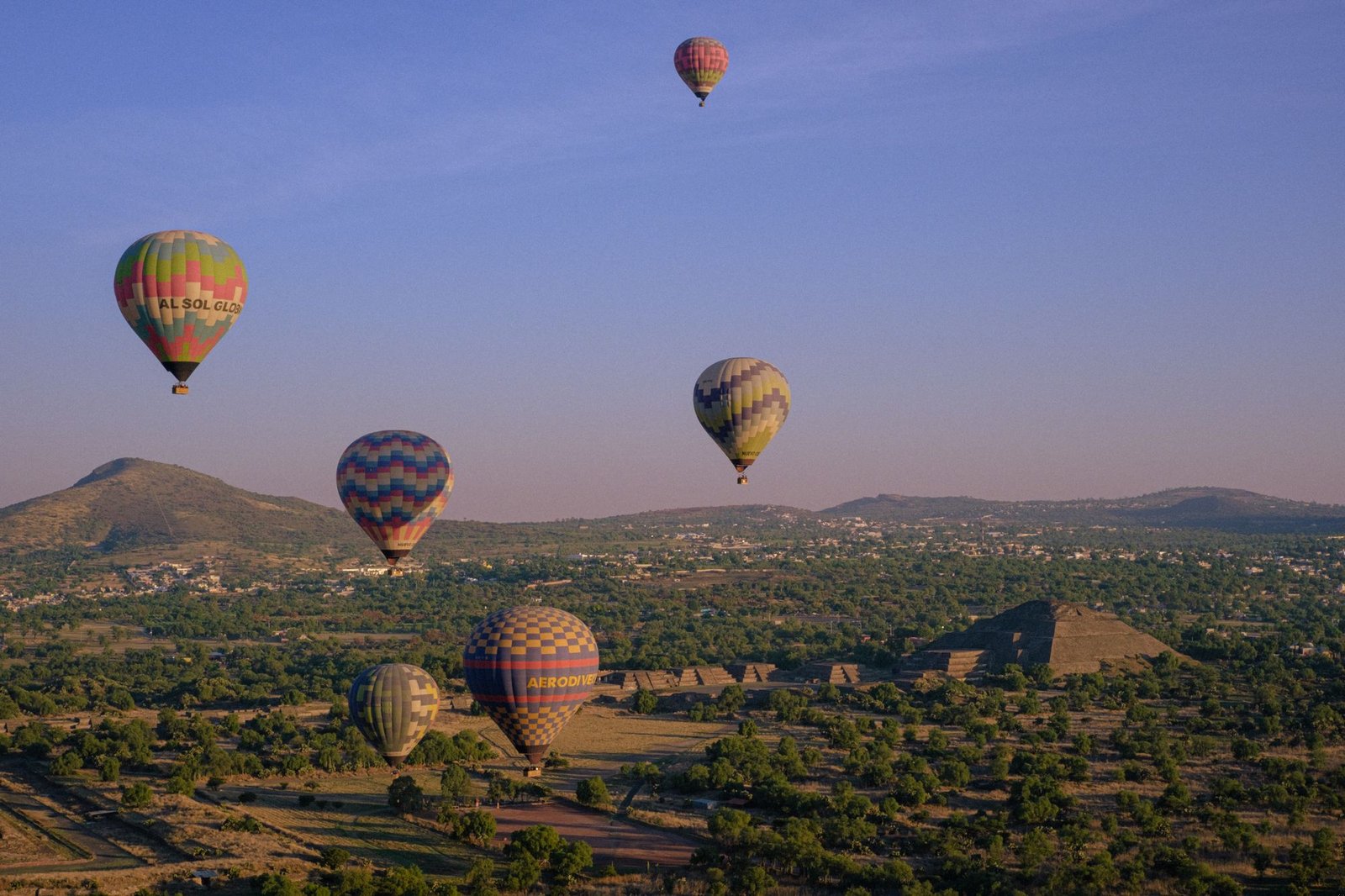
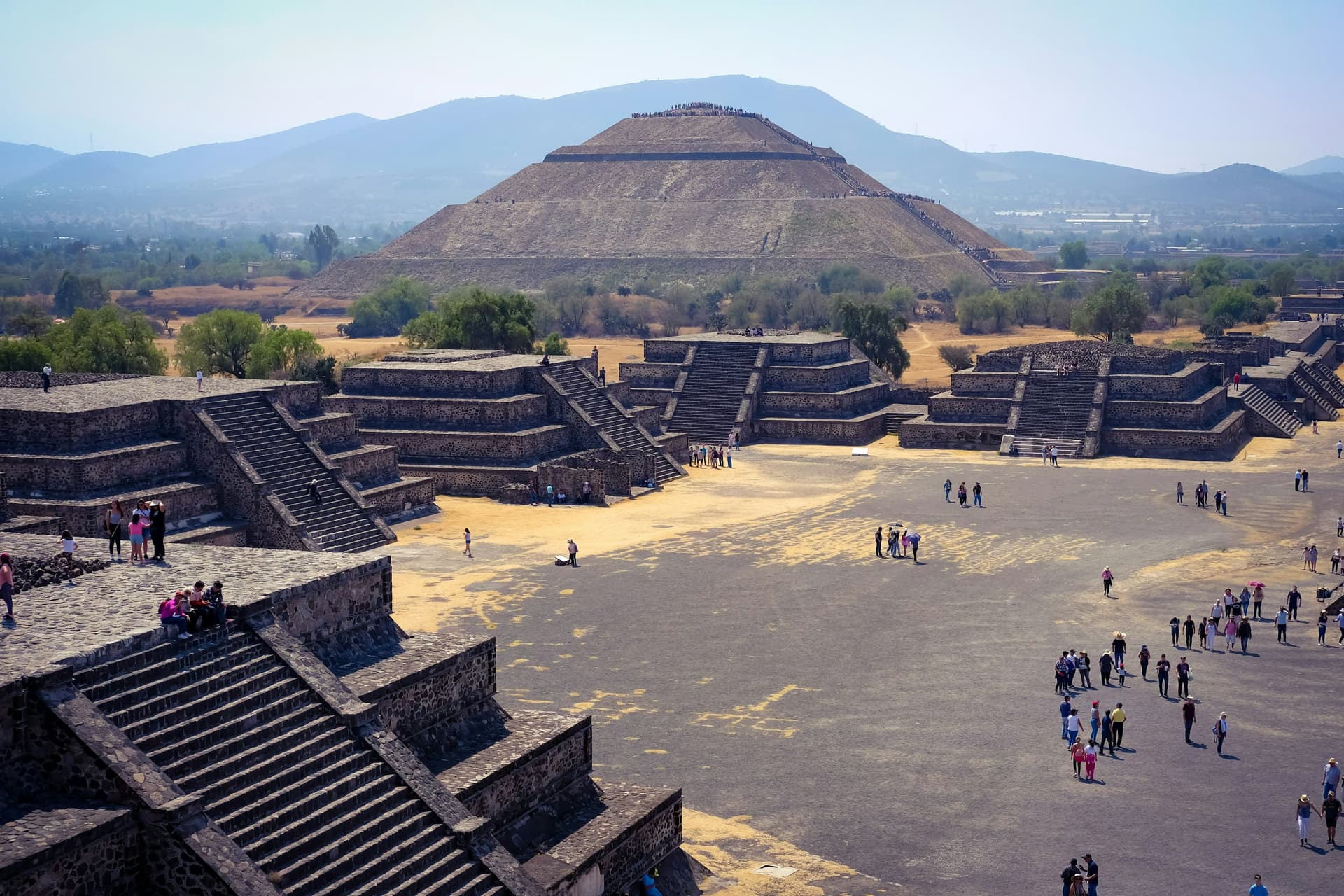
The Pyramid of the Moon is the seventh pyramid on its spot, each built around the last over about three and a half centuries. It was set so that, seen from the avenue, it repeats the mountain behind it. Stop twelve, the end of the Teotihuacán walk, brings you as close as the route goes: look past the low square enclosure in front of you, up at the pyramid, and then at Cerro Gordo rising behind.
Six pyramids inside
Between 1998 and 2004, archaeologists led by Saburo Sugiyama and Rubén Cabrera Castro explored the pyramid's interior through a tunnel 345 metres long. They found seven superimposed structures, numbered Buildings 1 to 7 from earliest to latest. The first was a small temple, radiocarbon dated to around AD 100. Building 4, raised in the third century, was about nine times larger than Building 3. Building 5 followed around AD 300, Building 6 around AD 350, and the pyramid you see, Building 7, was finished around AD 450. It stands about forty-five metres high.
The great stepped block below the summit is the front platform, the adosada. From Building 5 onward it was built in the city's signature profile of a sloping base and a framed vertical panel, the same talud-tablero you saw at the Temple of the Feathered Serpent and on the platforms along the avenue. The builders made room for it by scraping back the south side of Building 4 and covering the first three buildings completely.
So this is the city's habit at its largest scale. At the Feathered Serpent, one plain platform hid one carved facade. Here, a whole sequence of pyramids sits nested like shells, the oldest at the core.
What was laid in
Hear a stop from this walk
Pyramid of the Moon: Seven Pyramids in One
Inside, along the pyramid's centre line, the tunnels reached offerings of animals and people, laid in as several of the later stages were built. The excavators reported five dedicatory burial and offering complexes, associated with Buildings 4, 5 and 6, all lying along the pyramid's north to south axis, which roughly matches the line of the Avenue of the Dead. One held the remains of a puma, a wolf and an eagle. The detail is grim, but it says something about how each enlargement was treated: not as a building job but as a foundation rite.
The mountain behind
Look up the line of the avenue and the pyramid sits against Cerro Gordo, its stepped profile repeating the rounded mountain. Researchers report that the temple on the Moon Pyramid was deliberately positioned to overlap the mountain, and that the spot mattered from the city's earliest years. A careful note from the research behind the walk: the avenue does not point straight at the mountain's peak, but at an area just beside it. The effect you see from the avenue is the pyramid echoing the mountain, not a sightline aimed at the summit.
See it as it was
The stairway's status has changed more than once in recent years, so check on the day; the walk does not depend on a climb. Instead, the last stretch carries Teotihuacán as it was, 450 CE, Roamer's reconstruction of the Plaza of the Moon at the city's height. Tap the hourglass on your map and you can stand at the foot of the stair, and on the platform above, looking down the whole avenue you have just walked, with the pyramid as it stood when Building 7 was new.
The end of the city
Around AD 550 the great buildings along the avenue were set on fire, and sculptures inside the palaces were smashed. The archaeologist Linda Manzanilla reads it as a revolt against the ruling elite, not an invasion, because no trace of a foreign attack has been found. The city lived on, smaller, for perhaps another century. When the Aztecs came here, long after, they found it in ruins and named it Teotihuacán, the place where the gods were made. The names Sun and Moon are theirs too. What the builders called this pyramid, we do not know.
Take your time at the foot of it before you head for the exit. The walk ends here, and so does the avenue.
This is stop 12 of Teotihuacán: The Avenue That Climbs to the Moon, a self-guided walk on the Mexico City page.
Sources
- Saburo Sugiyama and Leonardo López Luján, Dedicatory burial/offering complexes at the Moon Pyramid, Ancient Mesoamerica 18 (2007): the 345 metre tunnel of 1998 to 2004, the seven superimposed buildings, stage dates for Buildings 4 to 6, Building 4 about nine times Building 3, the burial complexes on the north to south axis and the animal offering.
- Linda R. Manzanilla, PNAS 112 (2015): the burning of the avenue's buildings around AD 550, the shattered palace sculptures, no trace of foreign invasion, and the revolt reading.
- The tour's fact dossier (research/mexico/tours/teotihuacan/FACT-DOSSIER.md), citing Etsuo Sato (2023): the height of about 45 metres, Building 1 and Building 7 radiocarbon dates, the adosada built over Buildings 1 to 3, and the Cerro Gordo overlap.
Mexico eSIM· 10% off with ROAMER10
Ready to experience it?
Teotihuacán: The Avenue That Climbs to the Moon
180 min · 2.3 km · moderate
More from Mexico City
Explore more at your own pace.
Basilica of Guadalupe: Three Churches, One Lakebed, and the Hill Above
Coyoacán in Walls: Churchyards Torn Open, a Blue House Closed In
Paseo de la Reforma: Where Mexico Decides Who Gets a Statue
Capilla del Pocito: Red Stone, Tiled Domes and a Spring at the Basilica of Guadalupe
Casa del Risco: The Fountain of Broken China Hidden Behind a San Ángel Wall