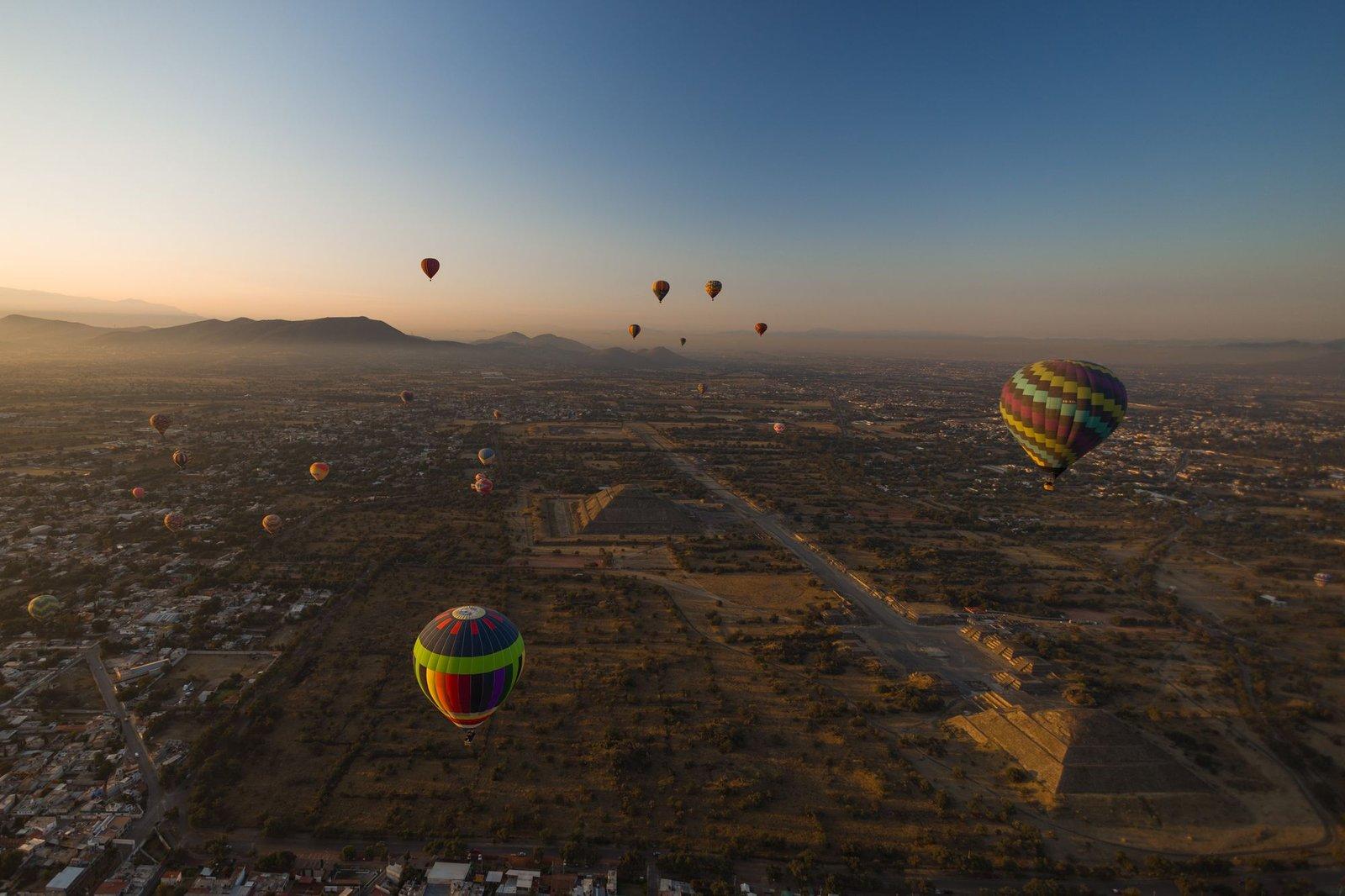
Teotihuacán was drawn before it was built: one grid at one angle, an avenue built as a staircase toward a mountain, and a city that wrapped its past in new buildings instead of tearing it down. Nobody knows what its people called it, or who ruled it. But the plan is still on the ground, and the Teotihuacán walk is a way of learning to read it. It follows the city's spine, the Avenue of the Dead, from the Temple of the Feathered Serpent in the south to the Pyramid of the Moon in the north, the route Mexico's National Institute of Anthropology and History recommends: twelve stops, ten along the way and two played inside the Palace of Quetzalpapalotl, over about 2.3 kilometres in about three hours.
One grid, one angle
At its height Teotihuacán was the largest city in ancient Mexico, home to perhaps a hundred thousand people. What makes it legible today is that nearly all of it shares one orientation. Nearly every street and wall is turned about fifteen and a half degrees east of north, from the pyramids down to the houses. Even the exceptions, like the great walled square called the Ciudadela, are off by only a degree or so.
The clearest proof is not a pyramid but a stream. At stop three you cross the San Juan River in a dead straight band of trees. It used to wander across this ground from northeast to southwest, right through the space where the Ciudadela and the city's probable main market now stand. So before those could be built, probably in the second century AD, the city dug about three kilometres of new channel and set it on the grid, at the same angle as the streets. Even the water followed the plan. A centre laid out like that is not a village that grew outward. It was drawn first and built after.
A staircase toward the mountain
Hear a stop from this walk
Pyramid of the Moon: Seven Pyramids in One
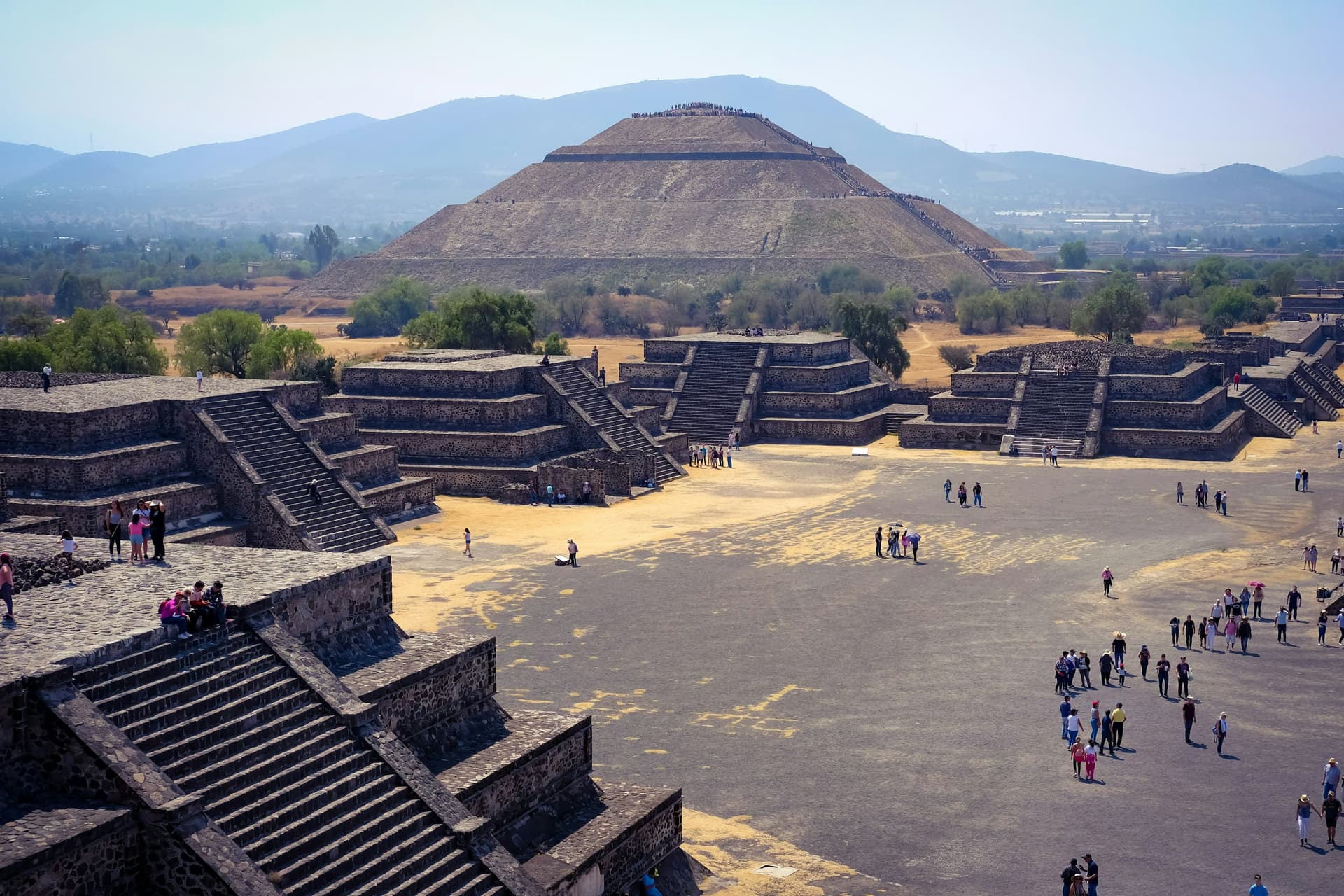
The avenue itself was laid out between AD 150 and 225, about forty metres wide. It looks like a straight road from a distance. On foot it is a chain of sunken courts, each closed by a wall with steps up and steps down. Between the Ciudadela and the Plaza of the Moon the ground rises about twenty-seven metres, and instead of a slope the builders made a staircase of plazas, each at its own level.
Walking north gives the avenue a rhythm: down into a court, across it, up the next wall. Each time you climb, the Pyramid of the Moon sits a little higher against Cerro Gordo, the big rounded mountain behind it. Seen from the avenue, the stepped pyramid repeats the mountain's outline, and the archaeologist who excavated the Moon Pyramid believes that was deliberate. The Aztecs, who reached the valley centuries after the city fell, took the eighty or so platforms lining the avenue for tombs and named it the road of the dead. They were wrong, but the name stuck.
Along the way the walk pauses at the Pyramid of the Sun, about sixty-five metres high and about two hundred and twenty-five metres along each side, raised mostly in one great effort in the first or second century AD over a tunnel that had already been cut into the rock.
Building on the past
The third habit is the one you meet first and last. At stop one, the Temple of the Feathered Serpent's carved heads survive in a narrow gap because about a century after it was built, around AD 200, a plain platform was built straight against its face. At stop four, the Superimposed Buildings were left unrestored so you can see one building inside another and one floor over the floor below. Under the Palace of Quetzalpapalotl, a tunnel leads to the Temple of the Feathered Shells, buried whole to make a floor for the palace and so preserved with its paint nearly intact. And the Pyramid of the Moon, where the walk ends, is the seventh pyramid on its spot, each one wrapped around the last.
Again and again, this city chose not to tear a building down. That choice is why so much of what it built can still be read.
The city at its peak
The last stretch of the walk does something no guidebook can. From the top of the avenue to the Moon, the walk carries Teotihuacán as it was, 450 CE, Roamer's reconstruction of the Plaza of the Moon at the city's height. When the hourglass appears on your map you hold up your phone and the plaza fills again: the platforms plastered and painted, smoke rising from the altars, the crowd facing the pyramid. Close it and the walk picks up where you left it.
Walking it your way
Three hours on an open avenue at altitude is a long morning, and the walk is built for that. Your site ticket covers everything on it. Start when you arrive, linger at the carvings or skip the palace line, sit in the shade between stops, and the audio waits for you. The palace stops play only when you tap them, so you choose whether to go in.
The walk is Teotihuacán: The Avenue That Climbs to the Moon, one of the self-guided walks on the Mexico City page.
Sources
- Saburo Sugiyama and Leonardo López Luján, Ancient Mesoamerica 18 (2007): the 1998 to 2004 tunnel into the Moon Pyramid and its seven superimposed buildings, with stage dates.
- George L. Cowgill, FAMSI report (2002): the Feathered Serpent Pyramid as the city's third largest, once carved on all its sides.
- Linda R. Manzanilla, PNAS 112 (2015): the phase dates and the burning of the avenue's buildings around AD 550.
- The tour's fact dossier and INAH portal notes (research/mexico/tours/teotihuacan/), which carry the grid angle, the river channel, the avenue's rise and the Sun Pyramid figures.
Mexico eSIM· 10% off with ROAMER10
Ready to experience it?
Teotihuacán: The Avenue That Climbs to the Moon
180 min · 2.3 km · moderate
More from Mexico City
Explore more at your own pace.
Basilica of Guadalupe: Three Churches, One Lakebed, and the Hill Above
Coyoacán in Walls: Churchyards Torn Open, a Blue House Closed In
Paseo de la Reforma: Where Mexico Decides Who Gets a Statue
Capilla del Pocito: Red Stone, Tiled Domes and a Spring at the Basilica of Guadalupe
Casa del Risco: The Fountain of Broken China Hidden Behind a San Ángel Wall