The Sydney Opera House is usually sold as a postcard, but it is closer to a monument to struggle: a building that drove its own architect out of Australia while its shells were still going up, born from a competition, a geometry no one could build, and a quarrel with the government. Read the shells on Bennelong Point that way, as a record of hard making rather than easy glamour, and the whole walk round the cove that ends at them changes character. The convict lanes of The Rocks, the steel arch, the quay built on a mudflat, the Customs House: each is a chapter in the same story of a young colony wrestling something permanent out of land that was never empty.
The shells that cost their maker
Start with the anchor. The Opera House stands on Bennelong Point, a headland named for Woollarawarre Bennelong, a senior Eora man of the Wangal clan who lived in the early colony as an intermediary between his people and the British, and who had a brick house built for him, at his own request, on this very point. That name is the first clue that the site was contested ground long before the concert halls arrived.
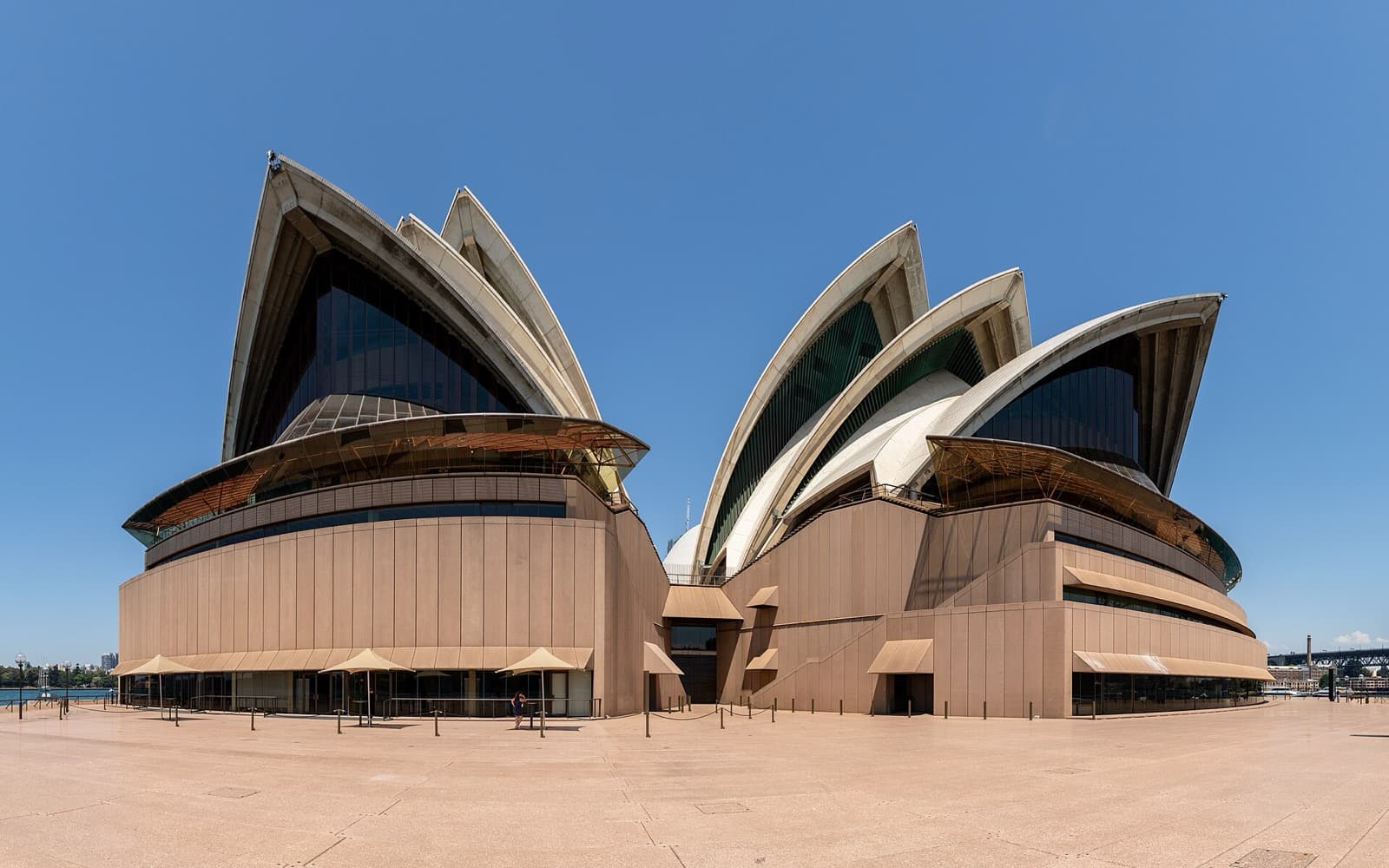
The Danish architect Jorn Utzon won the international design competition on the twenty-ninth of January, 1957, with an entry known simply as Design 218. His billowing roof was breathtaking on paper and, for years, unbuildable in fact. Nobody knew how to construct those curves. The solution was found by early 1962, and it was elegant in the way only the best engineering is: every shell is a section cut from the surface of one single sphere, so all of them could be made from the same repeated shapes. You will often hear that the idea came to Utzon while peeling an orange. Treat that as legend: the Opera House's own history credits the citrus comparison to Eero Saarinen, one of the competition judges, and says Utzon's breakthrough came while he was stacking the shells of a model. The documented answer is the sphere.
The building then ran far over cost and far over schedule. Amid conflict with the New South Wales government, Utzon resigned in 1966 and left Australia, and he never returned to see his work completed. The Australian architect Peter Hall, with Lionel Todd and David Littlemore, finished the interiors. Queen Elizabeth the Second opened the house on Saturday the twentieth of October, 1973. Four days later, across the cove, police cleared residents and builders' labourers from a green-banned demolition site on Playfair Street in The Rocks. In 2007, UNESCO inscribed it as a World Heritage masterpiece. The most photographed roof in the country is, underneath the sheen, a story of a man who lost his building.
The front door and the hidden stream
Hear a stop from this walk
Playfair Street: Where The Rocks Fought Back
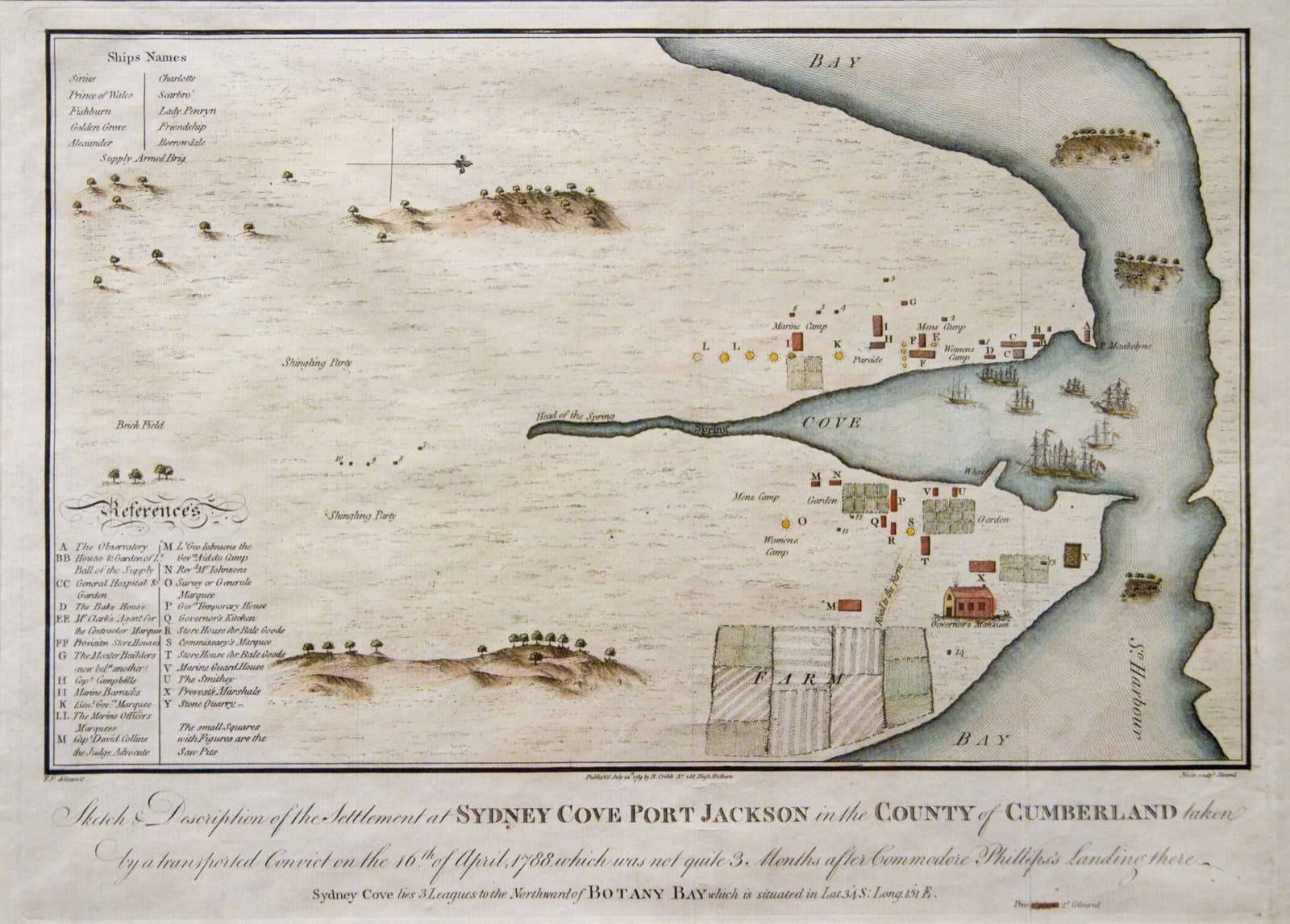
Just before the shells, the walk crosses the head of the cove at Circular Quay, where Sydney itself began. The Gadigal name for this cove is Warrane, and the Gadigal held this Country for tens of thousands of years before the First Fleet under Governor Arthur Phillip landed at Sydney Cove in January 1788 to found a penal colony. Almost none of the ground you stand on here is natural. The quay was built in stages between 1837 and 1855 over tidal mudflats, and much of its seawall was raised by convict labour in the 1840s. It was first called Semi-Circular Quay, for the shape of its curve, before the name was shortened.
Beneath the quay runs the Tank Stream, the small freshwater stream that decided where the colony would sit. It took its name from tanks cut into the sandstone in the colony's first years. The settlement fouled it into an open sewer within a generation and, from the 1850s, covered it in a stone culvert. It was never filled in: it still runs, carrying stormwater into the harbour beneath the promenade at First Fleet Park. The city's front door is built over the very thing that first kept it alive.
Trade, steel, and political theatre
At the back of the quay, behind the railway and the expressway, stands the Customs House, where for 145 years the colony, and after Federation the nation, collected its customs. Its first version was designed by Colonial Architect Mortimer Lewis and built in 1844 and 1845, a modest two-storey Georgian building. As the port grew, so did the building: James Barnet enlarged it in the 1880s, Walter Liberty Vernon added more around the turn of the century, and George Oakeshott raised a sixth storey between 1915 and 1917. Four architects, one growing port, stacked in stone. Step inside during opening hours and look down through the glass floor at a scale model of the city centre, one to five hundred, so you can walk over Sydney and see it whole.
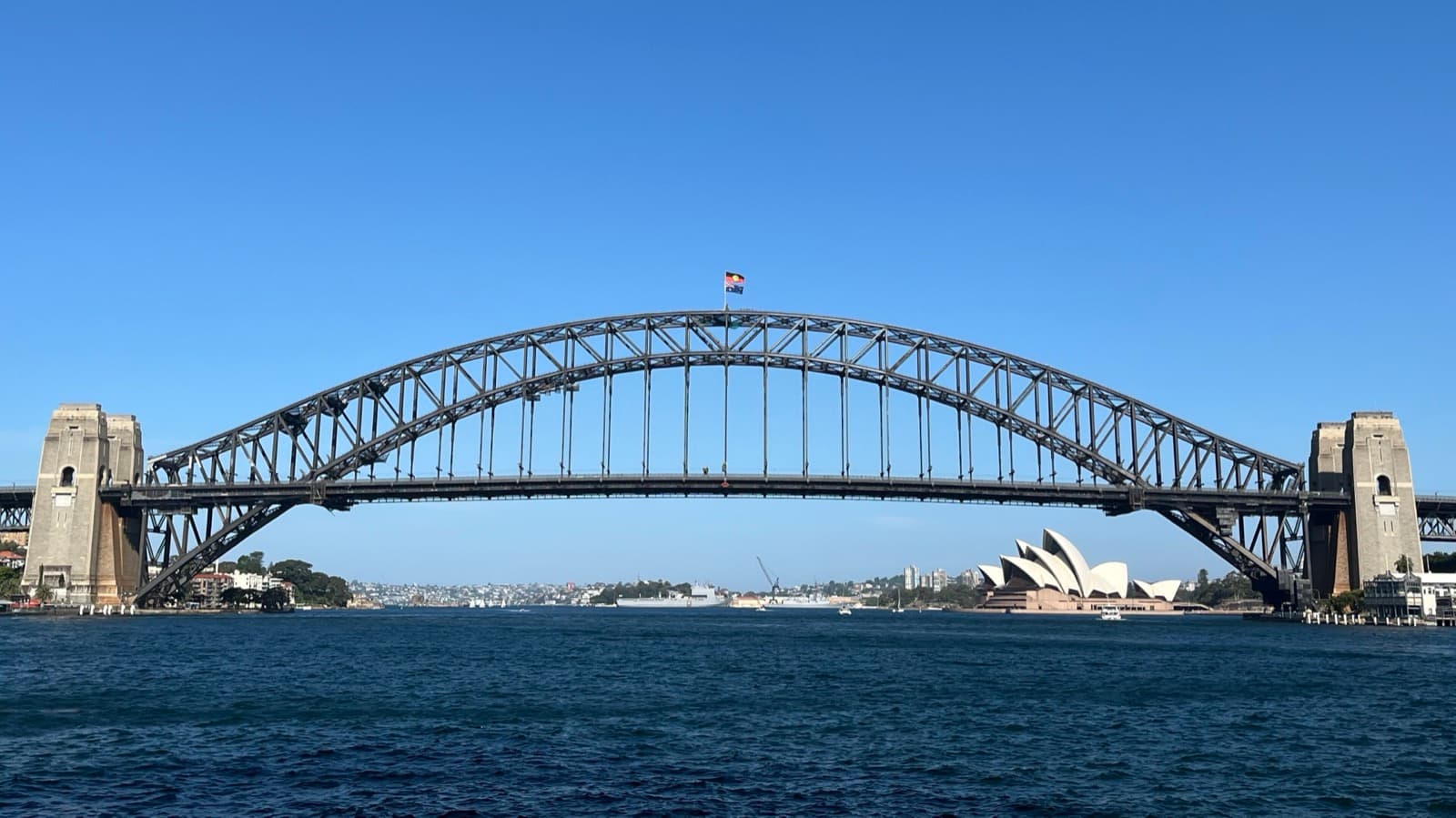
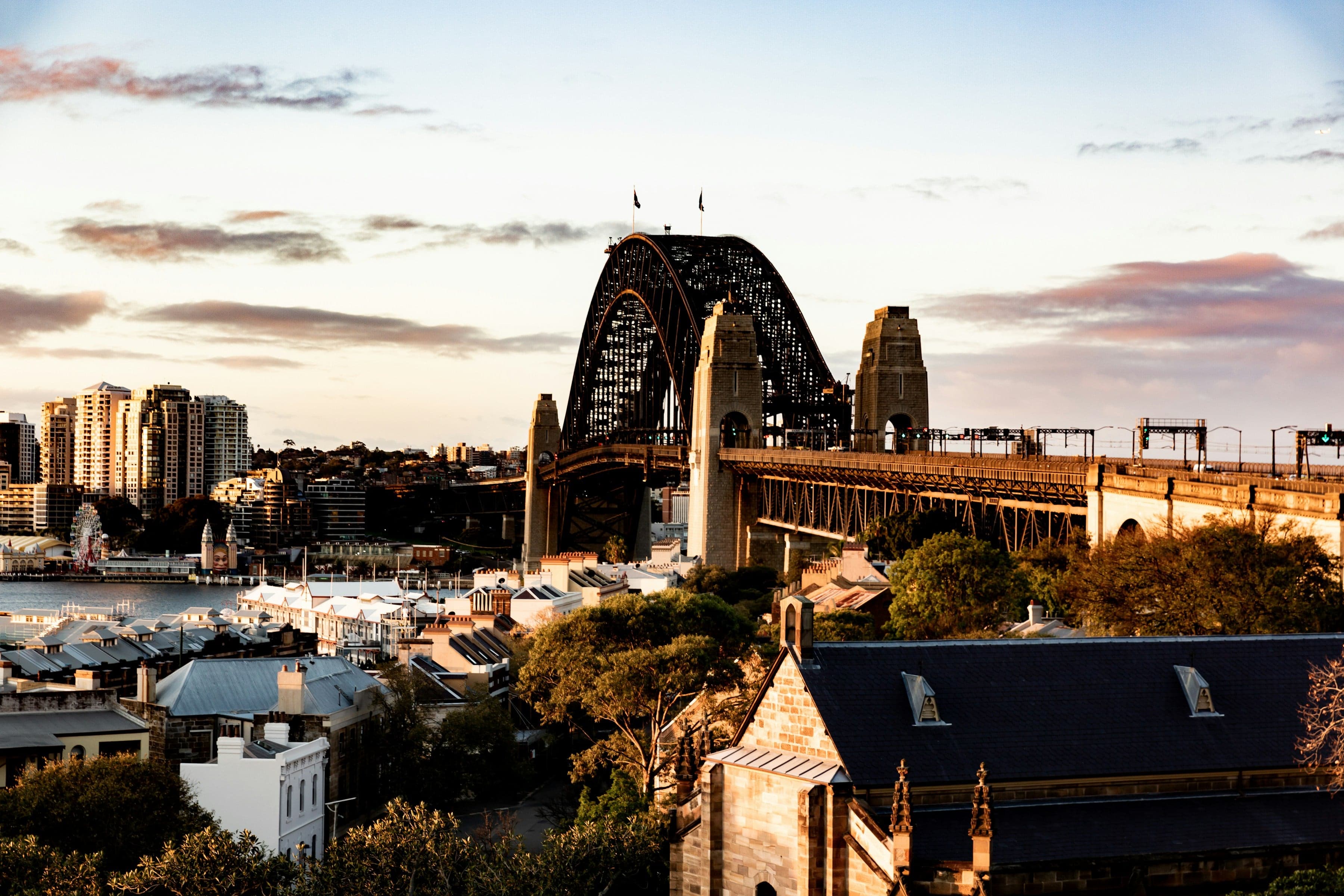
Across the water rises the arch the city calls the Coathanger. The Sydney Harbour Bridge was designed under John Bradfield and built by the British firm Dorman Long, its two half-arches meeting over the water in 1930. It opened on the nineteenth of March, 1932, in the depths of the Great Depression, and the opening became one of the strangest moments in the city's history. As Premier Jack Lang prepared to cut the ribbon, Captain Francis de Groot of a right-wing paramilitary group called the New Guard rode up on horseback in uniform and slashed it with his sword, declaring the bridge open in the name of the decent citizens of New South Wales. He was arrested, the ribbon was retied, and Lang cut it properly. A public work built in a time of hardship, opened as farce.
A failed farm and a seat on the rock
The walk ends at the shells, but the shore keeps going. Past them it widens into the Royal Botanic Garden, founded in 1816, the oldest botanic garden in Australia and its oldest living scientific institution, with more than 27,000 plants across some thirty hectares. Its beginning was hunger, not abundance. This is Farm Cove, named for the colony's first government farm, made here in 1788 on Gadigal land. The soil was poor, the seed and stock were lost, and the settlement came near starvation. On the rise above sits Government House, a Gothic Revival residence designed by the London architect Edward Blore, who never once set foot in Australia, and built between 1837 and 1845. The grandest house in the colony looked down over the shore where its people had gone hungry.
The path ends at Mrs Macquarie's Chair, a bench cut from the living sandstone by convict masons in 1810 for Elizabeth Macquarie, wife of Governor Lachlan Macquarie. From this point the Opera House and the Harbour Bridge finally line up in a single frame. Both are monuments to struggle. One drove its architect from the country; the other rose in the Depression. Both stand on Gadigal Country. That is the argument of the whole walk, held in one view.
You can walk the full route, from Cadmans Cottage round the cove to these shells, and hear each stop narrated at your own pace on The Rocks to the Opera House. See how the postcard was made through Sydney walking tours, or browse everything on offer in Sydney.
Sources
- Sydney Opera House, National Museum of Australia and the UNESCO World Heritage listing: competition win, sphere geometry, Utzon's resignation, 1973 opening.
- The Dictionary of Sydney and the NSW State Heritage Register: Circular Quay reclamation and the Customs House architects and construction phases.
- City of Sydney and Modelcraft, the model's maker: Customs House and the 1:500 model of the city under its glass floor.
- Sydney Water, The Tank Stream heritage fact sheet, and the Dictionary of Sydney: the colony's first water supply, its stone culvert, and its outlet beneath the Circular Quay promenade.
- The Rocks Discovery Museum: the Battle for The Rocks on Playfair Street, 24 October 1973.
- Sydney Harbour Bridge opens, National Museum of Australia: the 1932 opening and Francis de Groot's ribbon-cutting.
- Botanic Gardens of Sydney: the garden's 1816 founding, Farm Cove, and its standing as Australia's oldest botanic garden.
Ready to experience it?
The Rocks to the Opera House: The Town Sydney Kept Trying to Knock Down
120 min · 3.7 km · moderate
More from Sydney
Explore more at your own pace.
One Day in Sydney: A Walkable Morning-to-Evening Itinerary
Sydney in Sandstone: Reading a Convict City From Cove to Harbour
Hyde Park Barracks: The Building That Explains Convict Sydney
Cadmans Cottage: Sydney's Little House by the Water
Hyde Park and the ANZAC Memorial: Australia's Oldest Park and Its War Memory