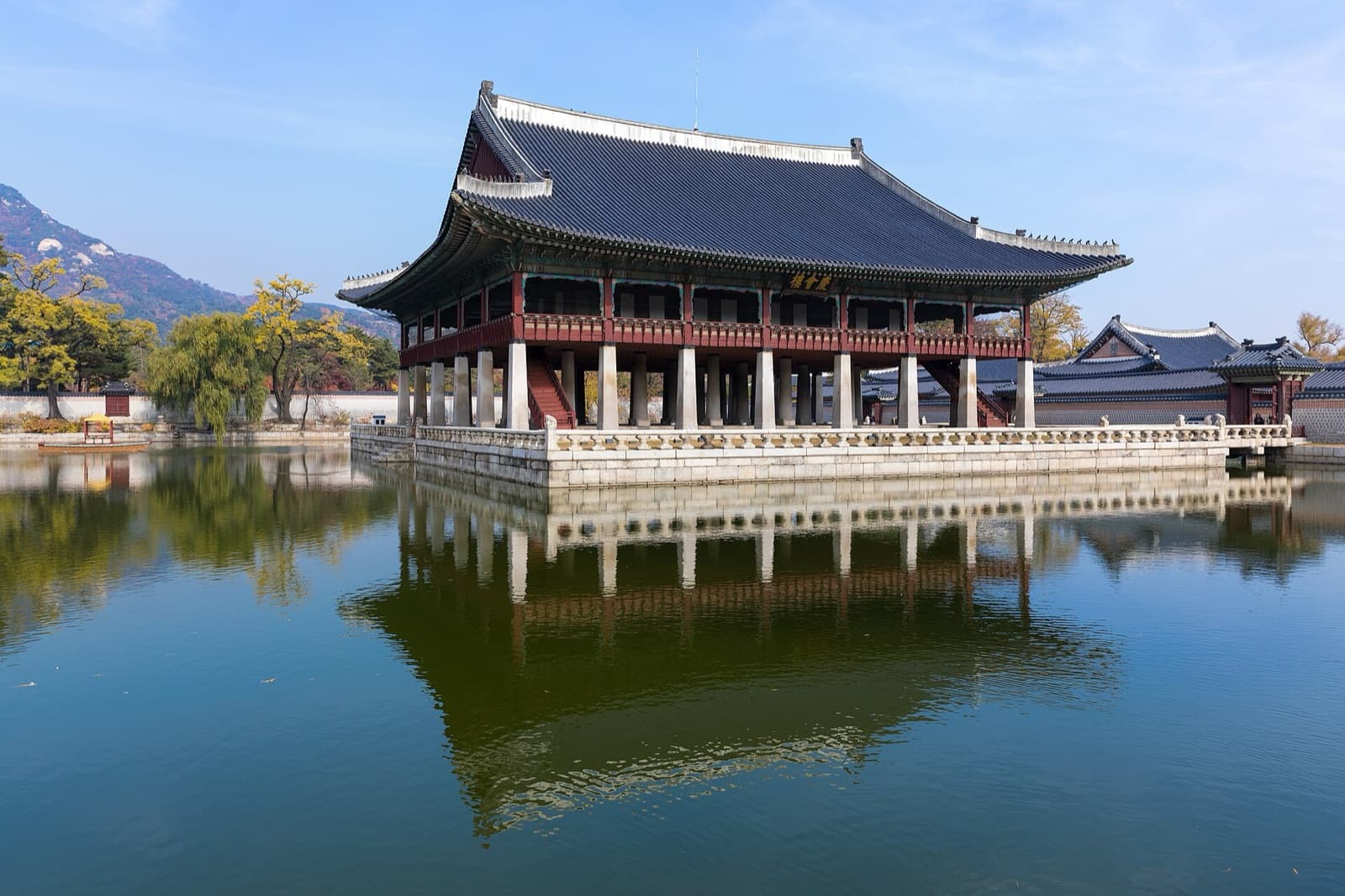
Gyeonghoeru Pavilion is the royal banquet hall of Gyeongbokgung Palace, an elevated timber structure carried on forty-eight stone pillars and set on an artificial island in a broad rectangular pond, and it reads as the moment the Joseon court turned its strict ceremonial order toward pleasure. Where the throne hall a few paces to the east was built to make royal power visible to an entire assembled court, this pavilion on the water was built to receive foreign envoys, to mark great occasions, and to let the same discipline that governed the state relax into celebration. Standing at the edge of the pond, you are looking at the palace exhaling.
What you are actually looking at
The pavilion sits on a small island, reached by stone bridges, in a pond that is deliberately rectangular rather than natural in shape. Its upper floor, the actual banquet room, rests on a forest of forty-eight stone pillars standing in the open air. From the water's edge those columns read twice: once as stone and once as reflection, doubled in the still surface below. That doubling is not incidental. A calm pond was part of the design, and the architecture was built to be seen against it.
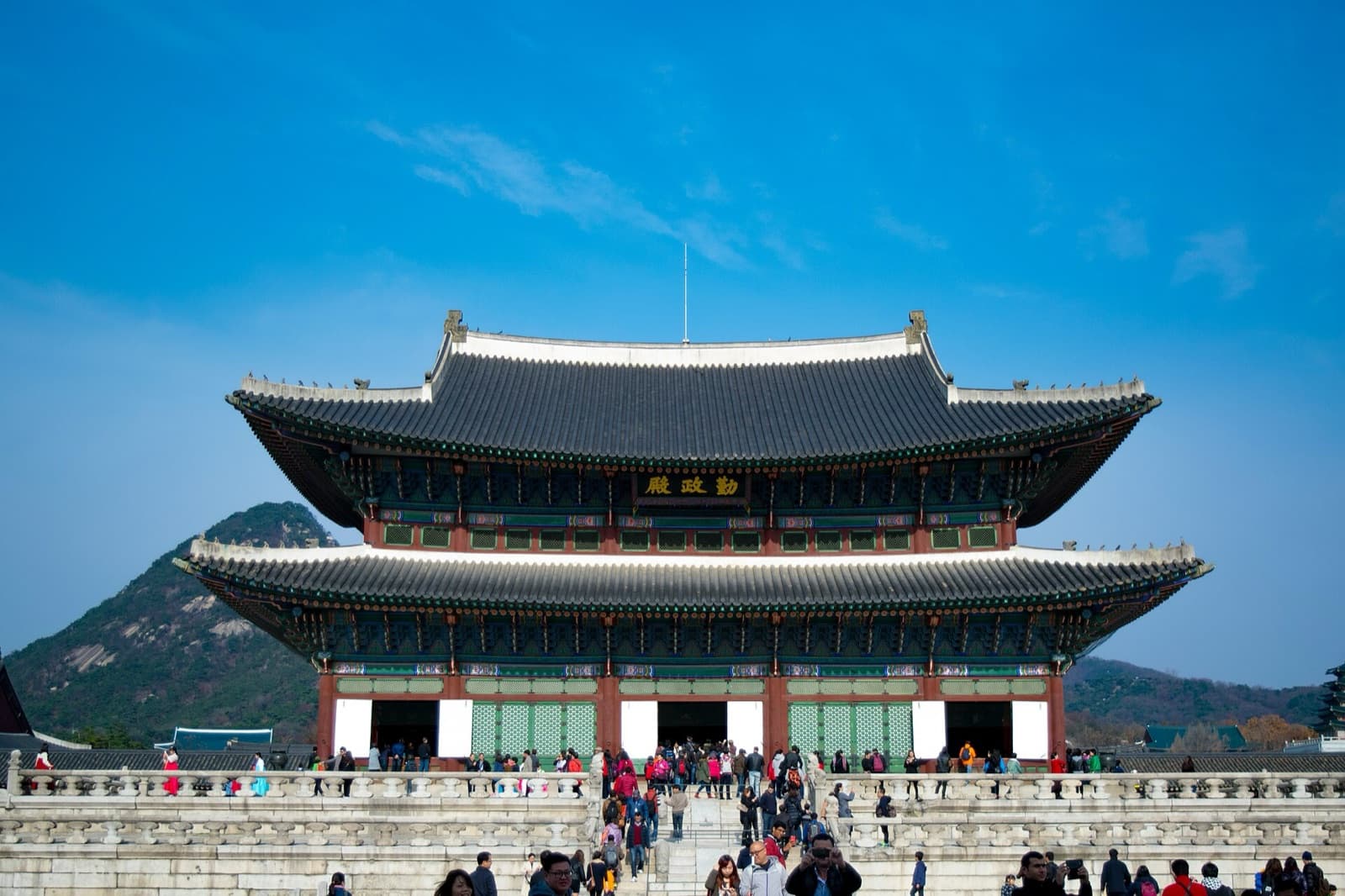
The Korea Heritage Service designates Gyeonghoeru National Treasure number two hundred and twenty-four, a listing made on the eighth of January, nineteen eighty-five. That status places it among the most protected structures in the country, and it sits beside its neighbor Geunjeongjeon, the throne hall, which carries National Treasure number two hundred and twenty-three from the same listing date. The two buildings are a pair in more than paperwork. One is where the king governed. The other is where he celebrated. Walk from the throne-hall courtyard to this pond and you cross, in a few dozen metres, from the public face of Joseon kingship to its private register.
The numbers under the pleasure
Hear a stop from this walk
Geomancy and Mount Bugak: reading the whole diagram
There is quiet mathematics built into this pavilion. Joseon builders did not treat a banquet hall as mere decoration. The design plays with meaningful numbers, the kind that court craftsmen read as a map of heaven, earth, and the calendar, so that even a place of feasting was ordered by a larger cosmological idea. This is the thing to understand while you stand here: the same care for order that fixed the position of every rank stone in the throne-hall court is present in the pillars and proportions of a pleasure pavilion. Nothing in Gyeongbokgung is casual. The palace was laid out as an argument in stone and timber, sited between a guardian mountain to the north and water to the south along a single ceremonial axis, and Gyeonghoeru is that argument carried into the register of joy. If you want to walk the full axis and see how the pavilion fits the founders' diagram, the Seoul walking tours collection is the place to start.
Built under one king, rebuilt after ruin
The pavilion was originally completed in the year fourteen twelve, under King Taejong, early in the life of the dynasty that had been founded only two decades before. Like almost everything at Gyeongbokgung, it did not survive intact. It was destroyed during the Japanese invasions of the fifteen nineties, the same catastrophe that leveled the throne hall and the front gate, and for centuries much of the palace lay in ruin. The Gyeonghoeru you see today is the reconstruction of the year eighteen sixty-seven, part of the sweeping nineteenth-century rebuilding that raised most of the complex from long neglect.
That timeline matters when you look at the stone. The forty-eight pillars carry not just a wooden floor but a long story of destruction and recovery. This is a reconstruction, an act of return rather than an unbroken survival, and the honesty of that fact is part of what makes it worth your attention. The palace has been a site of erasure and of the deliberate undoing of erasure, and this pavilion on its pond is one of the places where the recovery reads most gracefully.
The pavilion on the banknote
One small measure of how deeply this building settled into Korean life: its image appeared on the ten thousand won banknote for years, from the year nineteen eighty-three until two thousand and seven, nearly a quarter century in circulation. Generations of people in South Korea carried Gyeonghoeru in their wallets without necessarily thinking about it, the pavilion and its reflection reproduced on a note handled every day. When a country puts a building on its money, it is making a quiet statement about what it considers essential to its own image. For twenty-four years, this was that building.
What to understand standing here
If you take one idea away from the pond's edge, let it be this: Gyeonghoeru is where a palace built as a diagram of order allowed itself to be beautiful. The throne hall proves the design with rank stones and terraces and sightlines. The banquet pavilion proves that the same order could hold when the court gathered to feast an envoy or mark a coronation. The rectangular pond, the forty-eight pillars, the numbers folded into the proportions, all of it is the founders' grammar spoken in a warmer voice.
Spend a few minutes walking the perimeter of the water. Watch how the pillars change as you move, how the reflection breaks and settles, how the pavilion sits lower and calmer than the great hall behind it. Then, if you want the full sequence, from the front gate through the throne hall to this pond and out to the guardian mountain that anchors the whole plan, walk the Gyeongbokgung Royal Axis tour that includes this stop. It reads the palace the way the founders drew it, one deliberate step at a time. Start from the city page for Seoul to find it.
Sources
- Gyeonghoeru, Wikipedia. Core reference for the pavilion's function, forty-eight stone pillars, island-and-pond setting, and construction and reconstruction dates.
- Gyeongbokgung Palace, Korea Heritage Service. Official designation of Gyeonghoeru as National Treasure number two hundred and twenty-four and context on the palace's ceremonial layout.
- Ten thousand South Korean won banknote (Gyeonghoeru Pavilion), Leftover Currency. Documentation that the pavilion appeared on the note in circulation from nineteen eighty-three to two thousand and seven.
- Geunjeongjeon, Wikipedia. Reference for the adjacent throne hall (National Treasure number two hundred and twenty-three) that pairs with Gyeonghoeru on the palace axis.
Ready to experience it?
The Palace and the Mountain
100 min · 2.5 km · easy
More from Seoul
Explore more at your own pace.
One Day in Seoul: A Walkable Jongno Itinerary
Geunjeongjeon Throne Hall: Reading the Royal Axis of Gyeongbokgung
Insadong-gil: Reading Seoul's Craft Quarter One Shop Window at a Time
Who Built Bukchon: The Developer Behind Seoul's Most Photographed Roofs
Bukchon-ro 11-gil: The Most Photographed Lane in Seoul, and the Curfew That Guards It