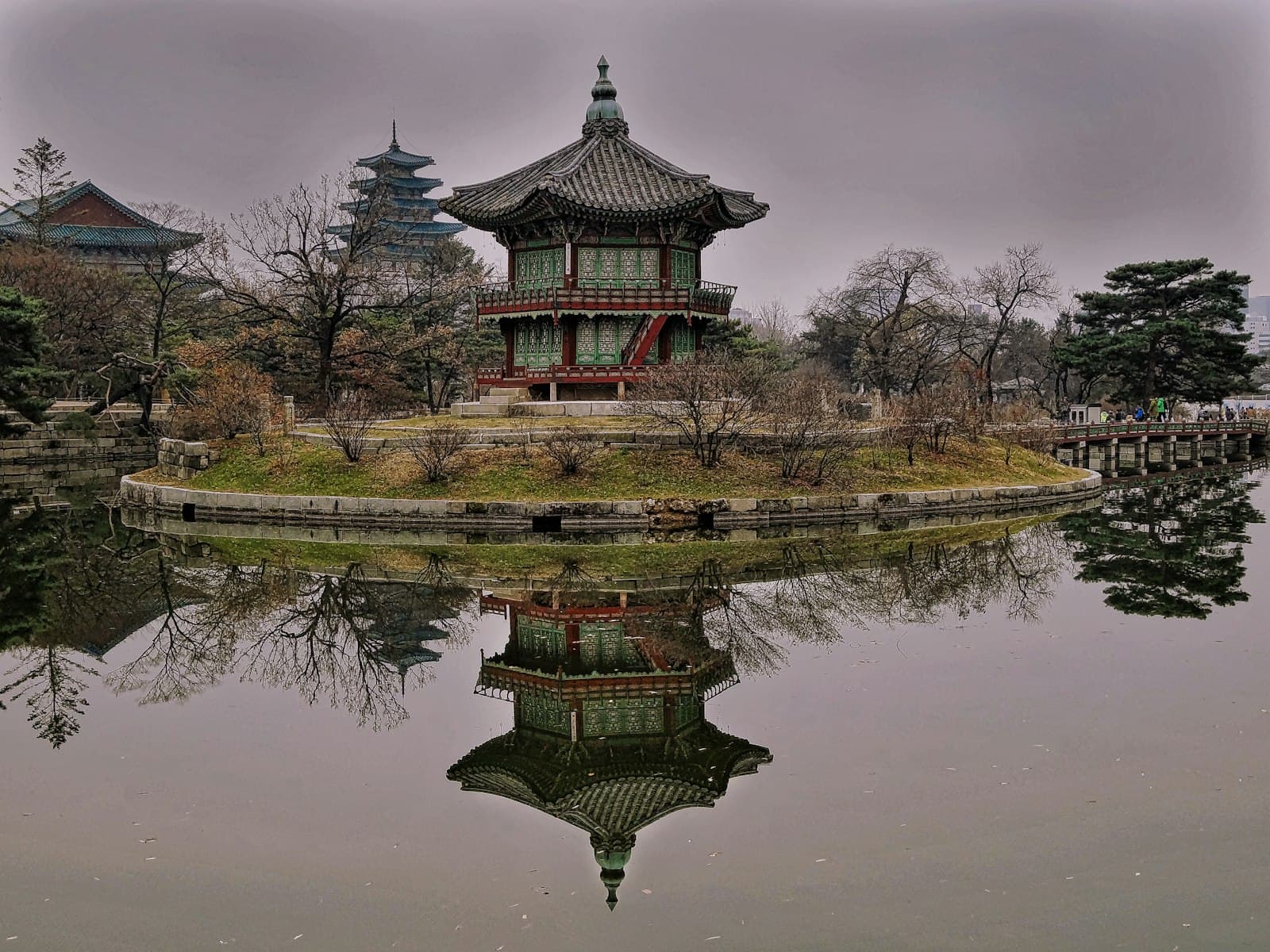
Walk the central axis of Gyeongbokgung Palace and read the founding grammar of the Joseon dynasty in stone and timber, from the guardian mountain behind the throne hall to the pond pavilions of the rear garden.
Start · Gwanghwamun Gate and Square: the threshold of the axis
DirectionsStops
- 1
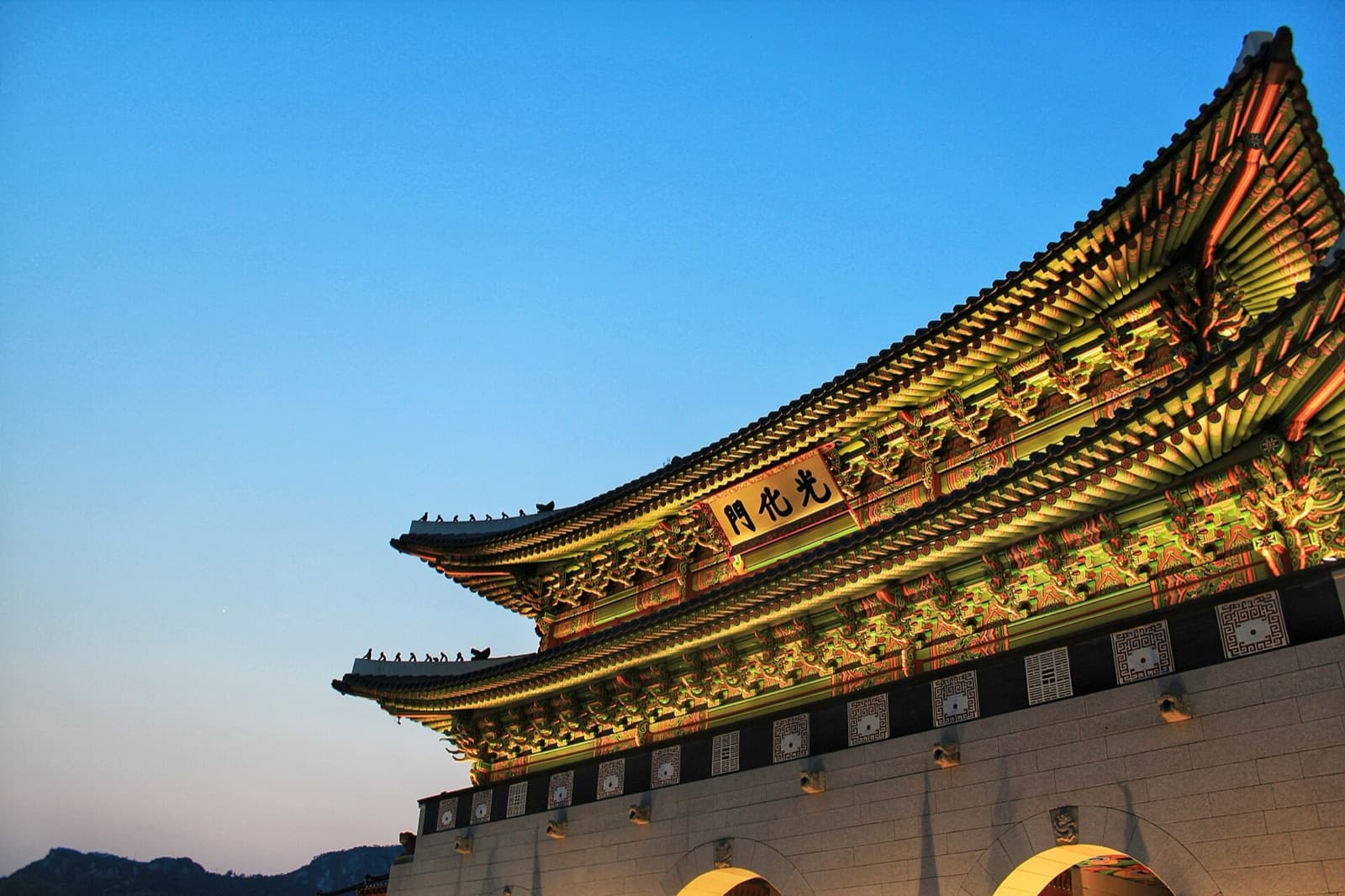
Gwanghwamun Gate and Square: the threshold of the axis
The main southern gate of Gyeongbokgung and the broad public square before it, where the palace's ceremonial axis begins.
- 2
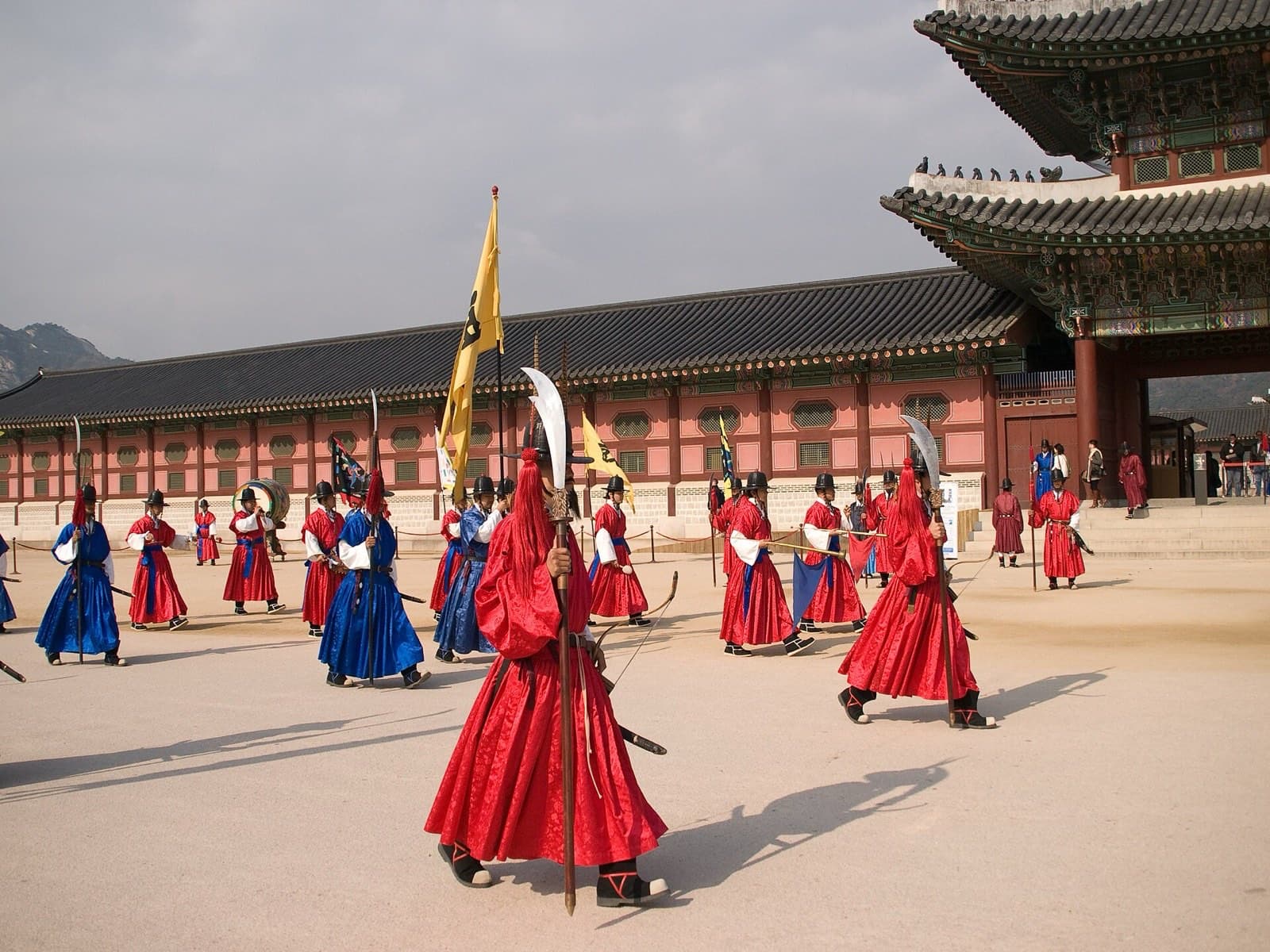
Heungnyemun Gate and the changing of the guard
The inner gate opening toward the throne-hall court, where a re-created royal guard ceremony is staged twice a day.
- 3
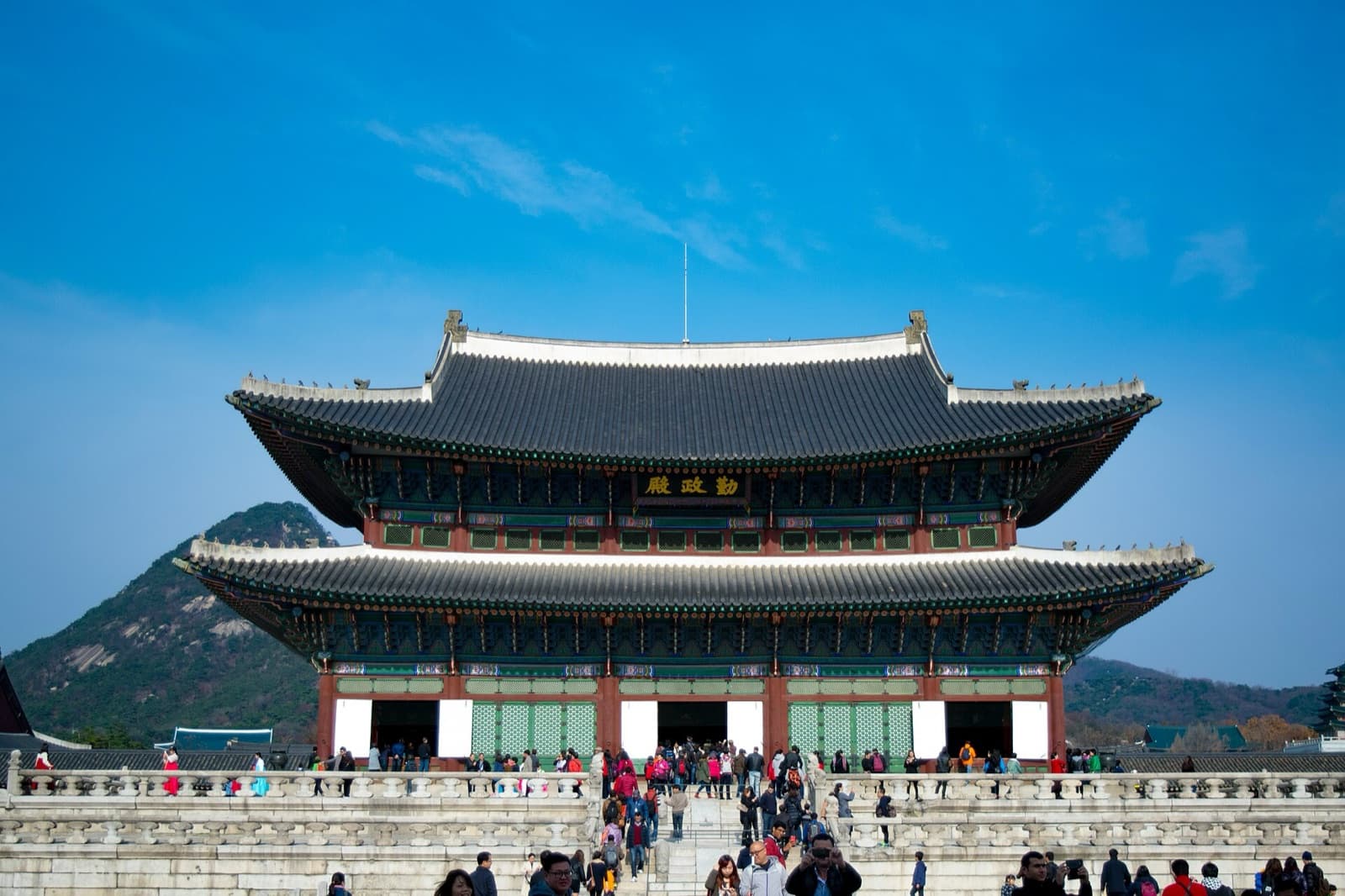
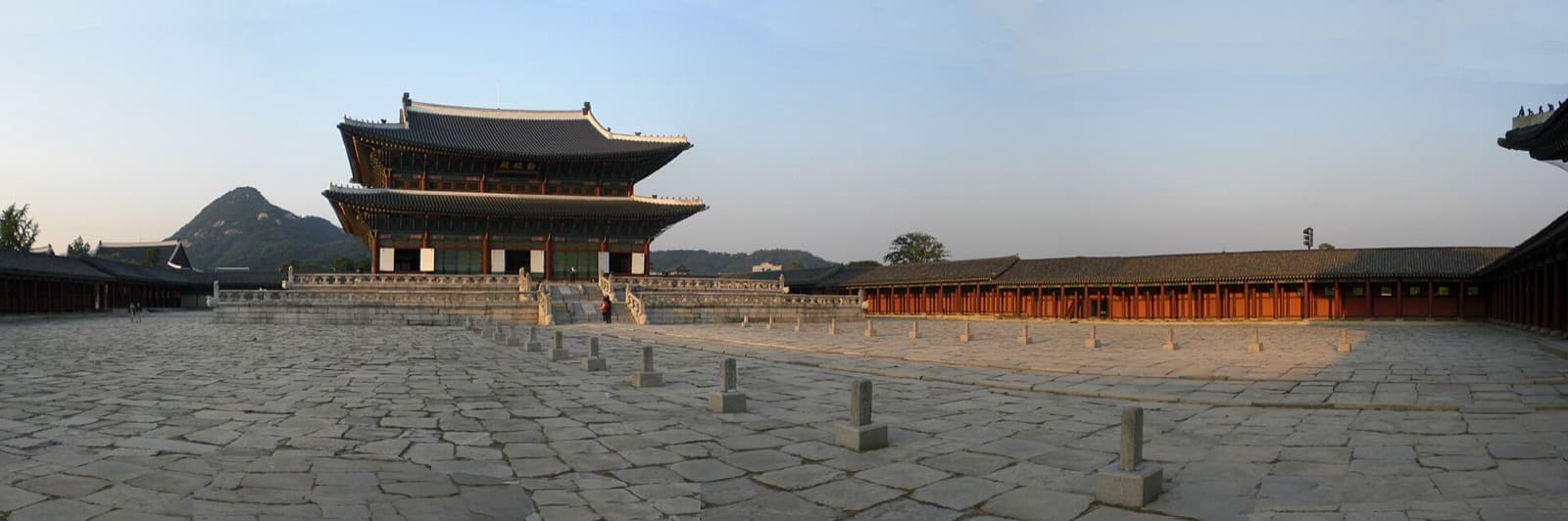
Geunjeongjeon Throne Hall: the heart of the diagram
The palace's main throne hall on its double stone terrace, the ceremonial center of the whole axis, with rank stones in the courtyard and the guardian mountain rising behind.
- 4
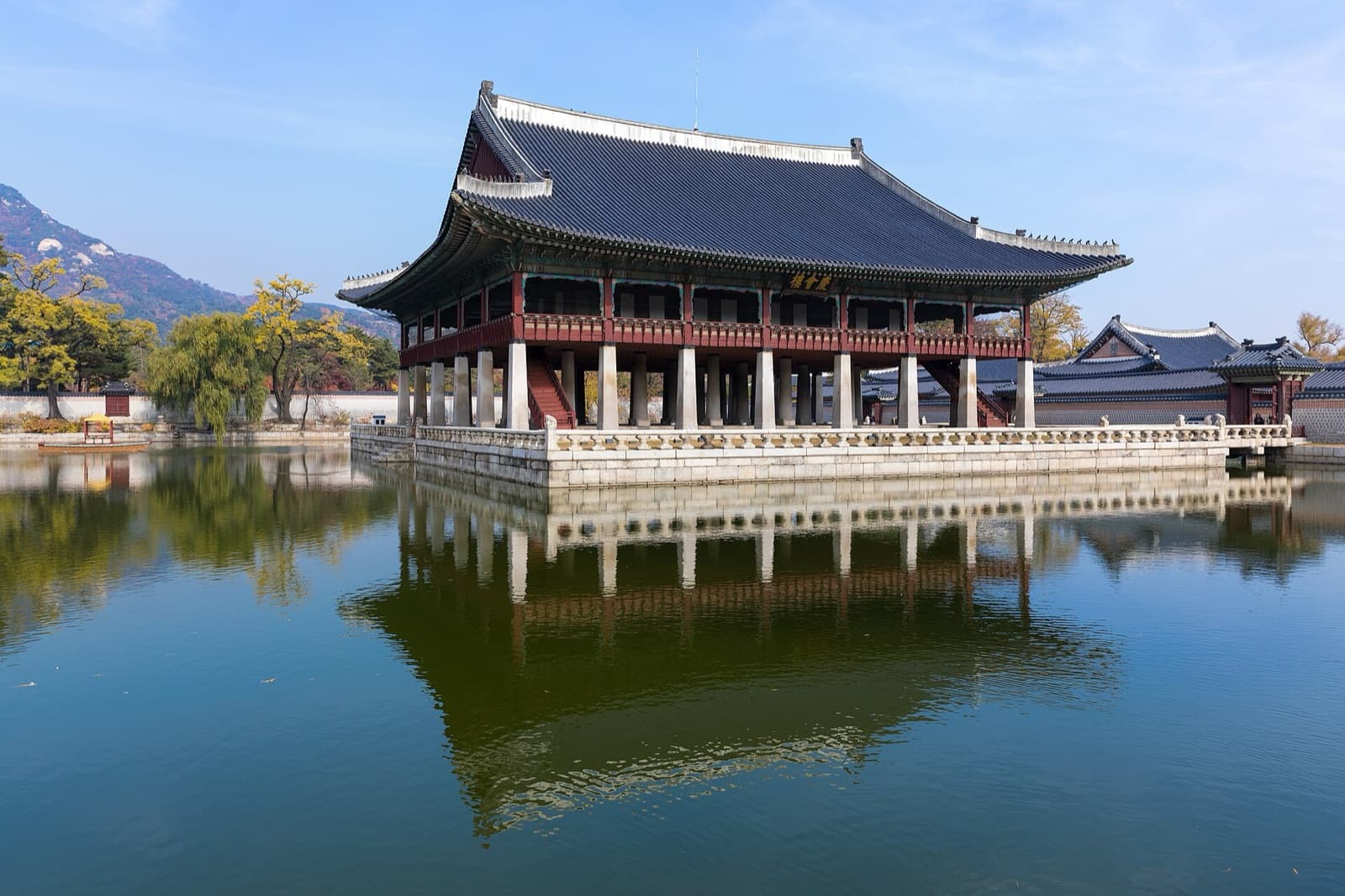
Gyeonghoeru Pavilion: the banquet on the water
The elevated royal banquet pavilion standing on an island in a rectangular pond, carried on forty-eight stone pillars.
- 5
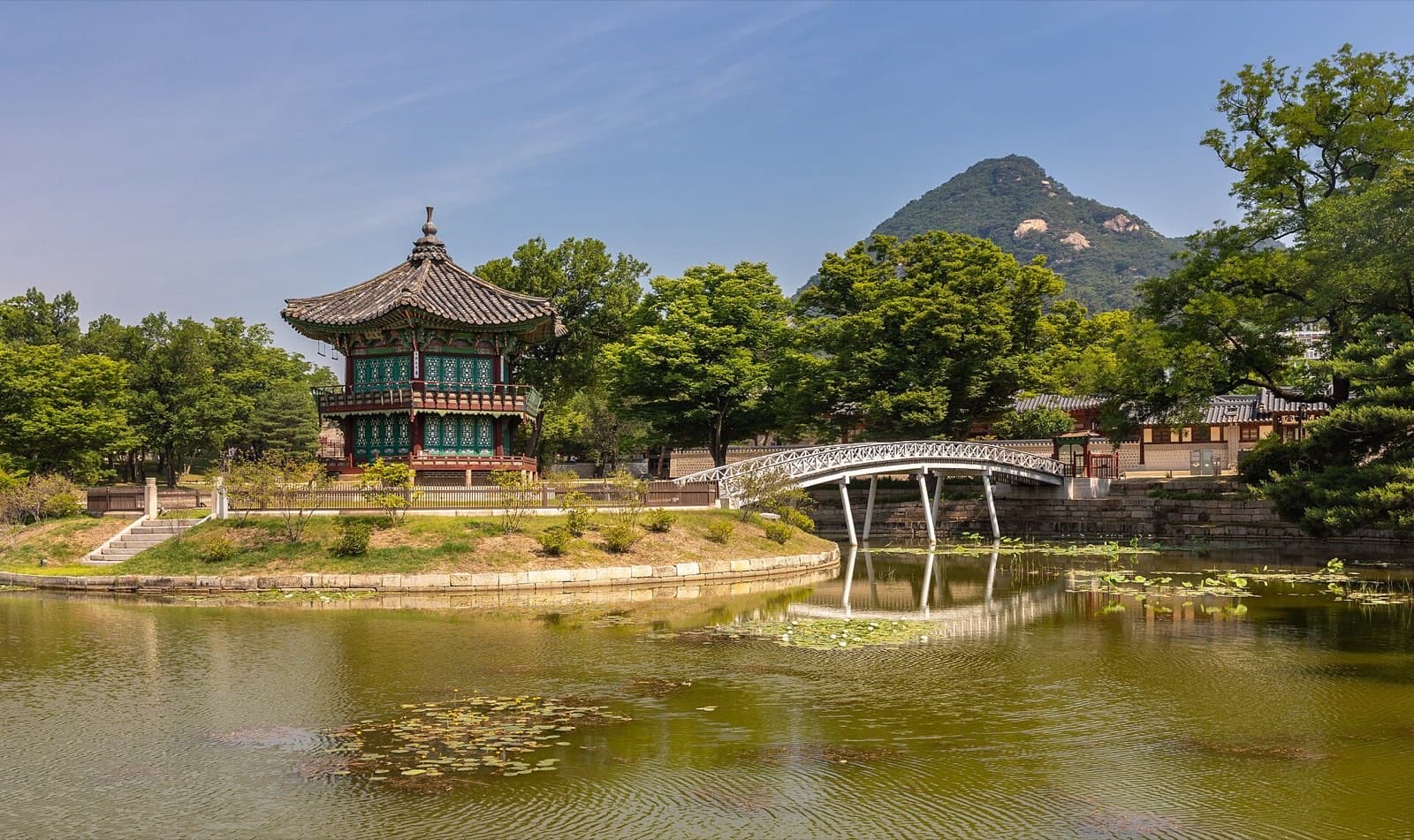
Hyangwonjeong Pavilion and the rear garden
A two-story hexagonal pavilion on a small island in a pond in the palace's rear garden, reached by a long wooden bridge.
- 6
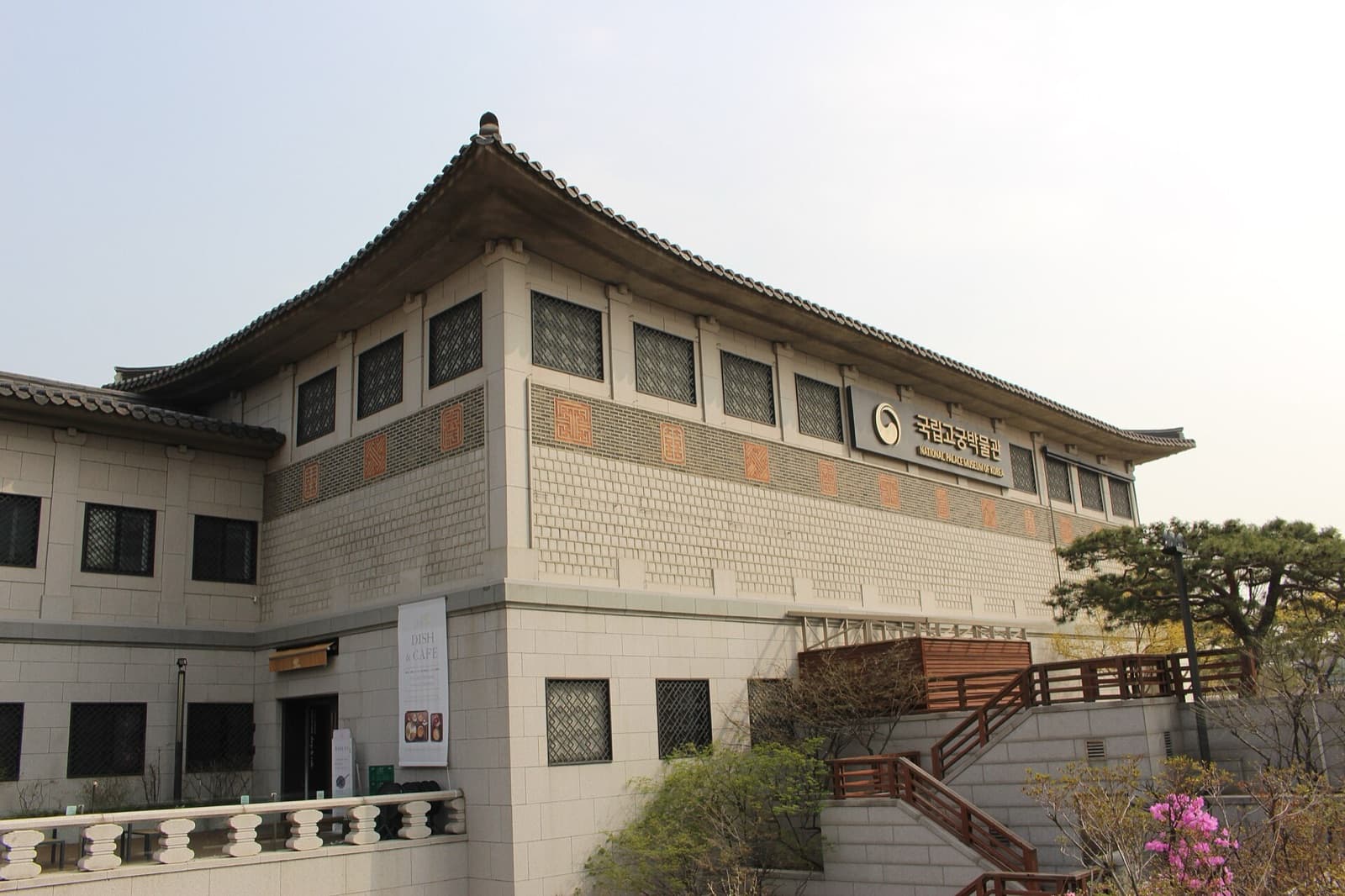
The colonial erasure and the reopened axis
The front-court site where a massive colonial government building once blocked the palace, later demolished to reopen the founders' ceremonial axis.
- 7
Geomancy and Mount Bugak: reading the whole diagram
The closing view toward the guardian mountain that anchors the palace's siting, where the entire axis reads as a diagram written into the landscape.
Details
Best Time to Visit
Spring, roughly April to early June, and autumn, September to November, are the most comfortable seasons, with mild air and clear light on the palace courtyards. Arrive close to opening in the morning to walk the axis before the crowds thicken, or come mid to late afternoon for softer light on the pond pavilions. Aim to be at Heungnyemun for the changing-of-the-guard re-enactment at either ten in the morning or two in the afternoon. Note that Gyeongbokgung is closed on Tuesdays.
Pro Tips
- •You must buy a palace ticket to pass through Gwanghwamun Gate into the grounds; admission is three thousand won for adults, but the gate exterior and Gwanghwamun Square in front are free public space.
- •Time your visit around the changing-of-the-guard re-enactment at Heungnyemun, staged twice daily at ten in the morning and two in the afternoon, and arrive a few minutes early for a clear view.
- •If you wear hanbok, the traditional Korean dress, palace entry is free, and it is a lovely way to experience the courtyards; rental shops cluster in the surrounding streets.
- •Gyeongbokgung is closed on Tuesdays, so plan another day if that is your only window, and check the last-Wednesday-of-the-month free Culture Day if it falls during your trip.
- •From the throne hall, look north to line up the guardian mountain behind the hall; that single sightline is the whole point of the tour and makes the palace's design click into place.
- •Load a rechargeable transit card for the subway and buses so you can reach the palace easily and continue exploring central Seoul without fumbling for fares.
Safety & Precautions
- •Seoul summers are hot and humid and winters are genuinely cold with icy patches, so dress for the season, carry water in warm months, and wear layers and good footing in winter; the open stone courtyards offer little shade or shelter.
- •Parts of the palace grounds and the surrounding historic lanes have uneven stone paving, terrace steps, and sloped ground, so wear comfortable, sturdy shoes and take the terrace stairs at the throne hall with care.
- •The colonial-history stop covers the occupation of Korea and the deliberate dismantling of the palace; treat this ground and its story with quiet respect, and remember other visitors may hold personal feelings about it.
- •Carry your palace ticket for spot checks, mind the posted opening hours and the Tuesday closure, and if you wander into nearby residential hanok lanes afterward, keep your voice down and respect residents' privacy, as people actually live there.
Travel advisory: Exercise Normal Precautions (Level 1).
Gallery
Related Reading
Go deeper on what you'll see, hear, and walk through.
Overview
Best Self-Guided Walking Tours in Seoul (2026)
3 min
Overview
One Day in Seoul: A Walkable Jongno Itinerary
6 min
Overview
Seoul Travel Guide: Days, Transport, Seasons, Safety, Budget
7 min
Thematic
Seoul: How the Joseon Court Folds Into a Megacity
7 min
Companion
Geunjeongjeon Throne Hall: Reading the Royal Axis of Gyeongbokgung
6 min
Deep dive
Gyeonghoeru Pavilion: The Joseon Banquet Hall on the Water
6 min
Read
What to Eat in Seoul
8 min
Read the walk
The full story of The Palace and the Mountain, in words. Prefer to listen? Play it narrated, from home or on location.
Introduction
Some buildings are shelter. This one is an argument. When the founders of the Joseon dynasty laid out Gyeongbokgung Palace here in the year thirteen ninety-five, they were not only making a home for a king. They were drawing a diagram in stone and timber, siting the whole complex by Korean geomancy between a guardian mountain to the north and water to the south, and threading its gates and halls along a single ceremonial axis. This walk reads that diagram, step by step, along the axis the founders drew. It also reads a harder story layered over it, because this serene palace was burned, ruined for centuries, rebuilt, and then deliberately dismantled under colonial rule. What you see today is a careful reconstruction, an act of recovery. This is a linear route of seven stops through the heart of Seoul, in South Korea, covering about two and a half kilometres and taking roughly ninety minutes to two hours at an unhurried pace, longer if you linger. The stops are short and skippable. This is your walk, at your speed, with no group to keep up with and no schedule but your own. You will move from the front gate on its great public square, through the inner gate and its costumed guard ceremony, to the throne hall at the center of the design, out to the pavilion on the pond, into the quiet rear garden, past the site of a colonial erasure since undone, and finally to a view of the mountain that started it all. When you arrive at Gwanghwamun Gate on Gwanghwamun Square, begin with stop one.
1. Gwanghwamun Gate and Square: the threshold of the axis
You are standing at the mouth of the diagram. Gwanghwamun is the main southern gate of Gyeongbokgung Palace, the threshold where the ceremonial axis begins, and the word mun simply means gate. It was first completed in the year thirteen ninety-five, and in the year fourteen twenty-six it was given the name Gwanghwamun by King Sejong the Great. The gate has lived the palace's whole violent history in miniature. It was destroyed during the Japanese invasions of the fifteen nineties. Under colonial rule it was moved from its place. Its wooden structure burned down completely during the Korean War, leaving only the stone base. In the year nineteen sixty-eight it was rebuilt in concrete and steel, and then, decades later, restored in proper wood and timber, that work concluding on the fifteenth of August, two thousand and ten, when the gate was shifted about fourteen and a half metres to sit once more on its true historical line. Turn around and the square opens before you. Gwanghwamun Square was laid out as public space and opened on the first of August, two thousand and nine. Two figures stand along it. Seated toward the palace is a statue of King Sejong the Great, unveiled in that same year. Further down stands Admiral Yi Sun-sin, a sixteenth-century naval hero, on a tall pillar, a bronze figure raised here in the year nineteen sixty-eight. Take a moment before you pass through. Beyond this gate the axis runs straight and deliberate, and everything ahead was built to be read in sequence.
2. Heungnyemun Gate and the changing of the guard
Having passed the front gate, you now face a second, inner gate: Heungnyemun. Again, mun means gate. This is the threshold between the outer approach and the inner court that leads to the throne hall, and it was reconstructed in the year two thousand and one as part of the long restoration of the palace. If your timing is lucky, you will find the courtyard here filled with color and slow ceremony, because Heungnyemun is where the changing of the royal guard is performed. It is worth being clear about what this is. The ceremony you see is a modern re-enactment, first staged in the year nineteen ninety-six, not an unbroken tradition handed down through the centuries. But it is carefully made. Roughly one hundred performers appear in traditional military dress, and their costumes were re-created from fifteenth-century records and surviving artifacts: the long gown-like robes, the round feathered hats, the shoes with upturned toes. In the Joseon dynasty, the royal guards were the gatekeepers who opened and closed the palace gates on rotating shifts, and the handover between shifts was itself a formal court rite. The re-enactment runs twice each day, at ten in the morning and at two in the afternoon. If it is not underway when you arrive, do not worry: the gate itself is worth standing under. Notice how the passage frames the court beyond and pulls your eye forward along the axis toward the great hall you are about to reach. Everything here is built to move you in one direction, deeper into the design.
3. Geunjeongjeon Throne Hall: the heart of the diagram
This is the center of everything. Geunjeongjeon is the main throne hall of Gyeongbokgung, and its name carries the idea of governing diligently. The Korean word jeon means hall. According to the Korea Heritage Service, it is designated National Treasure number two hundred and twenty-three, listed on the eighth of January, nineteen eighty-five, and it is the largest main hall of all the Joseon palaces. Stand in the wide stone courtyard and let your eye do the work the founders intended. The hall rises on a raised double stone terrace, lifted above everyone who approaches. In two rows down the courtyard you will see low marker stones, the rank stones, called pumgyeseok, that showed officials of each rank exactly where to stand during a state ceremony. This was the room where the king granted audiences, made his declarations, and received envoys from abroad. The building's story is the palace's story compressed. It was first completed in the year thirteen ninety-five, destroyed in the invasions of the fifteen nineties, and reconstructed in the year eighteen sixty-seven. What makes it precious is that it is one of only three of the palace's nineteenth-century buildings to survive both the colonial period and the Korean War. Now do the thing the design was made for. Look past the hall to the north and you will see the guardian mountain rising behind it. That sightline is not an accident. The whole axis was drawn to link the seat of the king with the mountain at his back, order below and protection above. Stand here long enough and the diagram becomes obvious. Rank stones, terrace, throne, mountain, all on one line.
4. Gyeonghoeru Pavilion: the banquet on the water
Now the mood turns. You have seen where the king governed. This is where he celebrated. Gyeonghoeru is the royal banquet pavilion of Gyeongbokgung, and it stands on a small artificial island in a broad rectangular pond, reached by stone bridges. The Korea Heritage Service…
Full narration for this stop unlocks with the tour.
5. Hyangwonjeong Pavilion and the rear garden
Deeper still, past the great ceremonial halls, the palace grows quiet and personal. Here in the rear garden sits Hyangwonjeong, a small two-story hexagonal pavilion perched on an island in a round pond. The Korean word jeong means pavilion, and the name of this one carries the…
Full narration for this stop unlocks with the tour.
6. The colonial erasure and the reopened axis
This part of the walk asks for a sober pause. To read the palace honestly, you have to know what was done to it. After Japan annexed Korea in the year nineteen ten, the colonial authorities began systematically dismantling many of Gyeongbokgung's buildings. Then, between the…
Full narration for this stop unlocks with the tour.
7. Geomancy and Mount Bugak: reading the whole diagram
End your walk by stepping back and looking up. Behind the palace, to the north, rises Mount Bugak, called Bugaksan, and the word san means mountain. It stands about three hundred and forty-two metres high, one of a ring of guardian peaks around the Seoul basin. This mountain is…
Full narration for this stop unlocks with the tour.