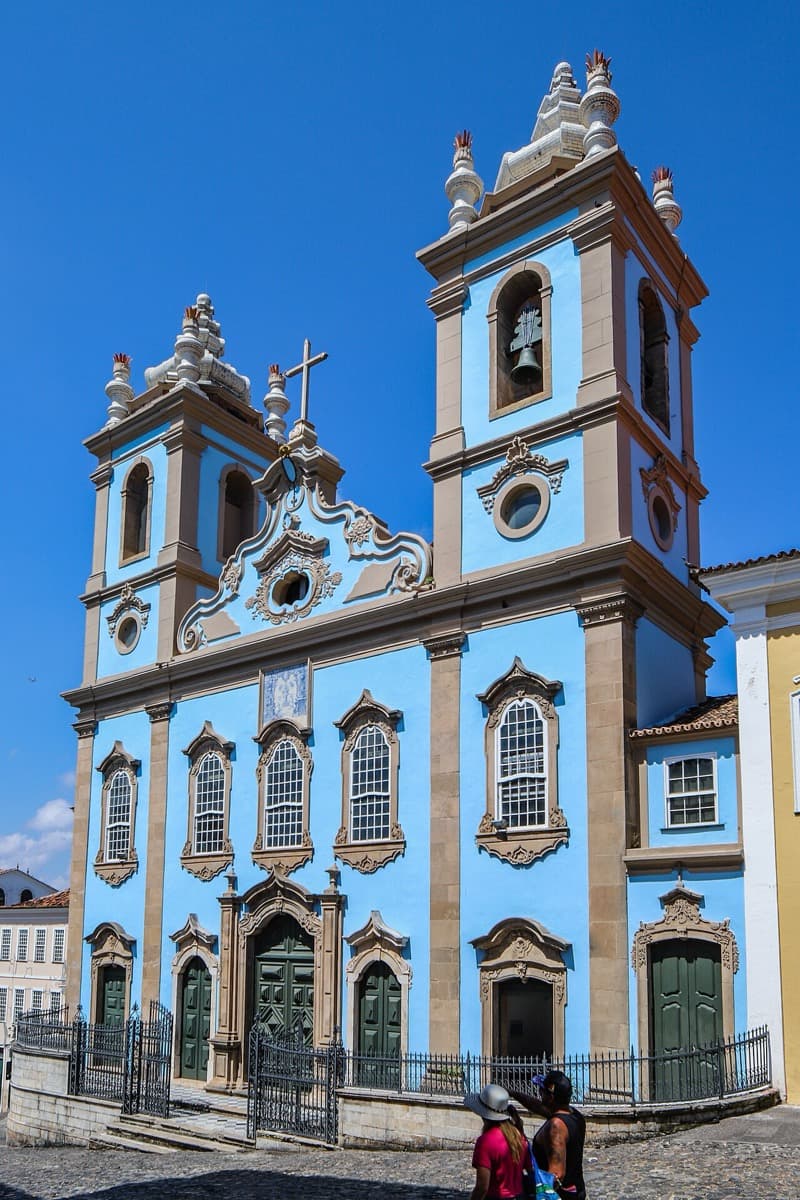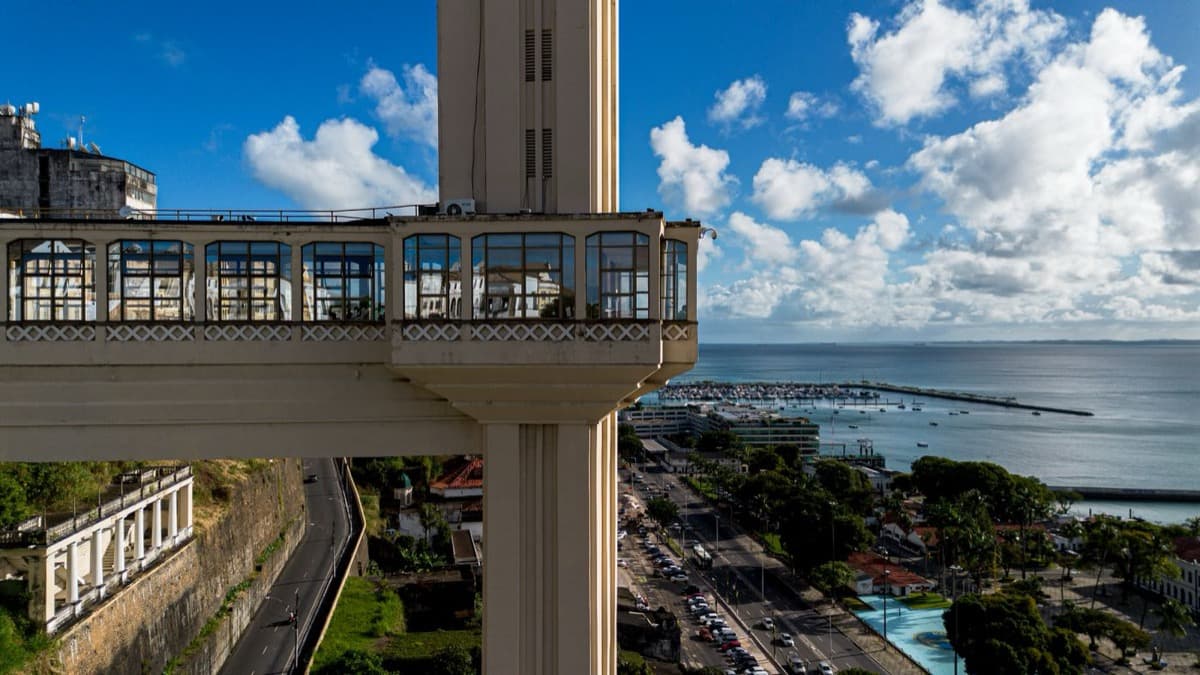
Salvador has a problem that no other Brazilian city has quite so sharply: it is built on two levels. The old capital sits high on a bluff, the Cidade Alta, and the working port lies far below at the water, the Cidade Baixa, and for centuries getting between them meant a steep, exhausting climb. The Elevador Lacerda is the answer the city built to that problem, a giant public elevator that has carried people up and down the cliff for a century and a half. Read it as infrastructure, not as a monument, and it explains the entire vertical geography of Salvador.
A city built on a cliff
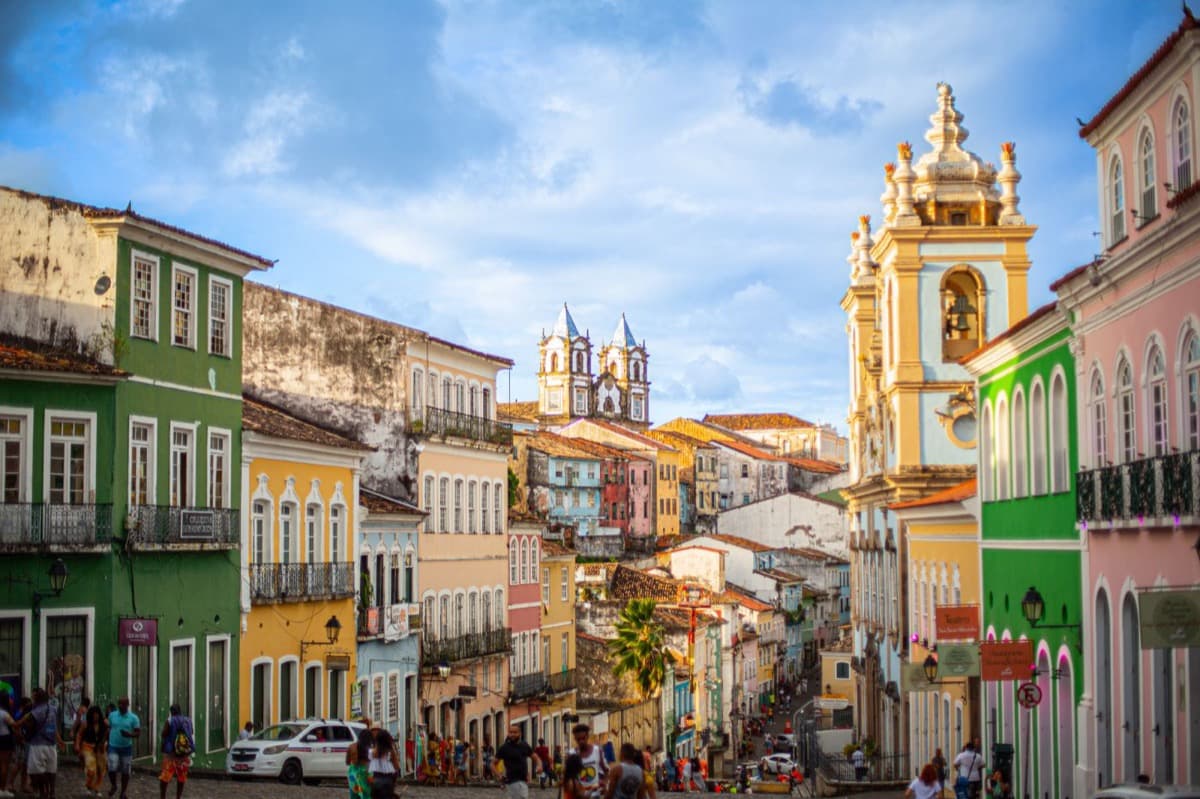
To understand the elevator you first have to understand the split. When Salvador was founded in 1549 as the capital of colonial Brazil, its planners put the administrative and religious city, the churches, palaces, and the founding square of the Pelourinho, up on the defensible high ground of the bluff. The commerce, the docks, and the warehouses stayed down at the harbor where the ships landed. That made military and mercantile sense, but it left the city permanently divided by a cliff roughly seventy meters high. For most of Salvador's history, moving goods and people between the high city and the low city meant hauling up a punishing slope.
The elevator that solved it
Hear a stop from this walk
Praca Municipal: The Founding Square
The solution was radical for its time. Between 1869 and 1873 a public urban elevator was built to connect the two levels, and it was named after Antonio de Lacerda, who directed the Commercial Association of Bahia and drove the project. The structure stands about seventy-two meters tall, matching the height of the cliff it conquers, and when it opened it was one of the earliest public urban elevators anywhere, a piece of civic engineering that treated vertical movement as a public utility, like water or a tram.
The machinery kept pace with the century. The elevator originally ran on hydraulic power, then converted to electricity in 1906. In 1930 the towers were rebuilt in the Art Deco styling that gives the elevator its familiar streamlined silhouette today, the tall pale shaft that appears in nearly every photograph of Salvador's waterfront. It now runs four lifts, each carrying dozens of passengers on a journey of about thirty seconds, and it remains genuine daily transit rather than a tourist ride. By recent counts it moves more than thirty thousand passengers a day, and Brazil's national heritage institute listed it as protected in 2006.
Why it belongs in the story of the capital
The Lacerda is not a curiosity bolted onto Salvador. It is the hinge of the city. Stand at the top, at the belvedere on the edge of the Cidade Alta, and the whole geography snaps into focus: the historic capital behind you, the Bay of All Saints and the port spread out below, and the sheer drop between them that the elevator crosses in half a minute. The two Salvadors, the high city of church and palace and the low city of ship and warehouse, were built by the same colonial economy, and the elevator is the seam that stitches them together. It is the most efficient way to feel, in your own body, why the city is shaped the way it is.
Reading it in place
Ride the Lacerda, ideally in both directions, and pay attention to the transition. Going down, you drop from the world of the Pelourinho's baroque churches to the world of the docks and the Mercado Modelo in seconds. Going up, the city reassembles itself vertically in front of you. The top platform offers one of the best free views in Salvador, over the bay and the lower city. It runs long daily hours and costs only a small fare, and it is busiest during commuting times, when it is doing the ordinary job it was built for.
The elevator anchors Roamer's Pelourinho: Brazil's First Capital, which reads the founding district on the bluff above it. For the wider picture of the two-sided city, see Salvador, first capital and African soul. To plan a day around it, see one day in Salvador.
Sources
- Wikipedia, Lacerda Elevator: the public urban elevator linking the Cidade Baixa and Cidade Alta, built between 1869 and 1873, named after Antonio de Lacerda of the Commercial Association of Bahia, the height of about 72 meters, the original hydraulic operation and conversion to electricity in 1906, the 1930 Art Deco rebuild of the towers, the four lifts carrying 27 passengers each on a roughly 30-second journey, the more than 33,000 daily passengers by 2019, and the IPHAN heritage listing on 7 December 2006.
- Roamer tour transcript, Pelourinho: Brazil's First Capital (salvador-pelourinho-first-capital), fact-audited: the Elevador Lacerda as the link between the high and low cities.
Brazil eSIM· 10% off with ROAMER10
Ready to experience it?
Pelourinho: Brazil's First Capital
85 min · 2.4 km · moderate
More from Salvador
Explore more at your own pace.
One Day in Salvador: A Walkable Old-City and Bay Itinerary (2026)
Salvador Travel Guide: How Many Days, Getting Around, When to Go, Is It Safe (2026)

Salvador: Brazil's First Capital and Its African Soul

What to Eat in Salvador: A Bahian Food Guide (2026)
Pelourinho Means Whipping Post: The Truth Behind Salvador's Prettiest Square