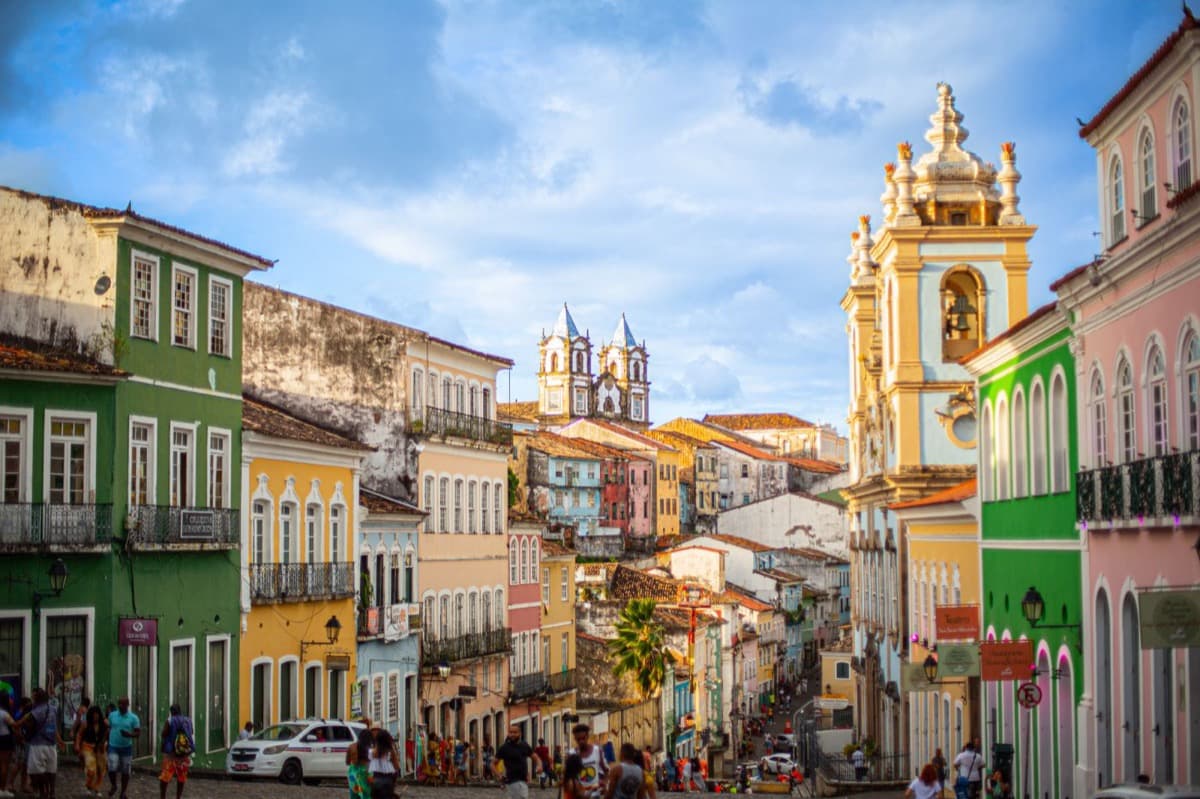
The sloping, triangular square at the center of Salvador's old town is named after the public post where enslaved Africans were whipped. The word Largo do Pelourinho means, in plain Portuguese, "square of the pillory," and the whipping post is not a metaphor here. It is the literal thing that gave the district its name. Tall pastel townhouses now line the cobbles, and the light on their facades is genuinely beautiful. But the beauty carries a wound, and it also carries a second, quieter reckoning: the memory of the mostly Afro-Brazilian residents a 1990s restoration pushed out of the very streets that made the district famous.
Most visitors arrive at the Pelourinho for the color. The photos are everywhere: blue, ochre, rose, and mint houses stacked up a hill, church towers rising behind them. What the photos do not tell you is that "pelourinho" is a common Portuguese word for pillory, the post where offenders were bound and punished in public. In colonial Salvador that punishment fell largely on enslaved Africans, and it was carried out in the open, on purpose, as a warning to everyone watching. The district took its name from that instrument. To stand in the Largo do Pelourinho is to stand inside a place-name that describes an act of violence, one that most people repeat without knowing what they are saying.
A capital built on the slave trade
Salvador is often called the most African city outside Africa, and the reason is grim arithmetic. Bahia was a principal landfall of the transatlantic slave trade to Brazil, and Brazil received more enslaved Africans than any other country in the Americas. Roughly four in ten of all Africans carried across the Atlantic were taken to Brazil, and Salvador de Bahia was one of the two great ports where they landed. The people brought here arrived with nothing but their knowledge, their faith, and their bodies. From that starting point they built the culture that now defines the city: the Candomble religion, the acaraje fritters fried in orange palm oil a few streets over, the samba-reggae drums of Olodum, the fight-dance of capoeira. Every one of those traditions is a form of survival that became identity. The Pelourinho is where you can trace all of them on foot, and it is also where the machinery of captivity was most visible. The square holds both facts at once.
UNESCO honored it in 1985. Then came the polish.
Hear a stop from this walk
Largo do Pelourinho: The Whipping Post
In 1985, Salvador's historic center was inscribed on the UNESCO World Heritage List, recognized largely for the Afro-Bahian culture that took root in these streets. That recognition matters. It is one of the clearest official statements that the culture built by formerly enslaved people is world heritage. But recognition and preservation are not the same as justice for the people who carry that culture, and the story of the Pelourinho splits in two right here.
After the abolition of slavery in 1888, the district slowly fell into decay. The grand houses subdivided into cramped tenements, and the population that remained was overwhelmingly poor and Black. Then, in the 1990s, the state of Bahia led a sweeping restoration. The goal was tourism, and by that measure it worked. Roughly 1,350 properties were restored, the facades were repainted in the colors visitors now cross the world to see, and the district was turned into a showcase.
The families who are no longer here
The paint came at a human cost, and the numbers are stark. The restoration displaced mostly Afro-Brazilian residents, the same population that gave the district its living culture. The resident population fell from 9,853 people in 1980 to 3,235 by the year 2000, a loss of more than six thousand people from the streets that were being celebrated as heritage. Read that sequence carefully. The center that shows Afro-Bahian culture to the world was polished by removing many of the people who make that culture living rather than curated.
This is the second wound layered over the first. The whipping post named the district. The restoration emptied it. Both fell on the same population, in the same place, centuries apart. So when you look at the Largo do Pelourinho, the honest response is not simply to admire it and not simply to mourn it. It is to hold beauty and pain together, in the same cobblestones, because that is the truthful way to see this square.
How to stand in it
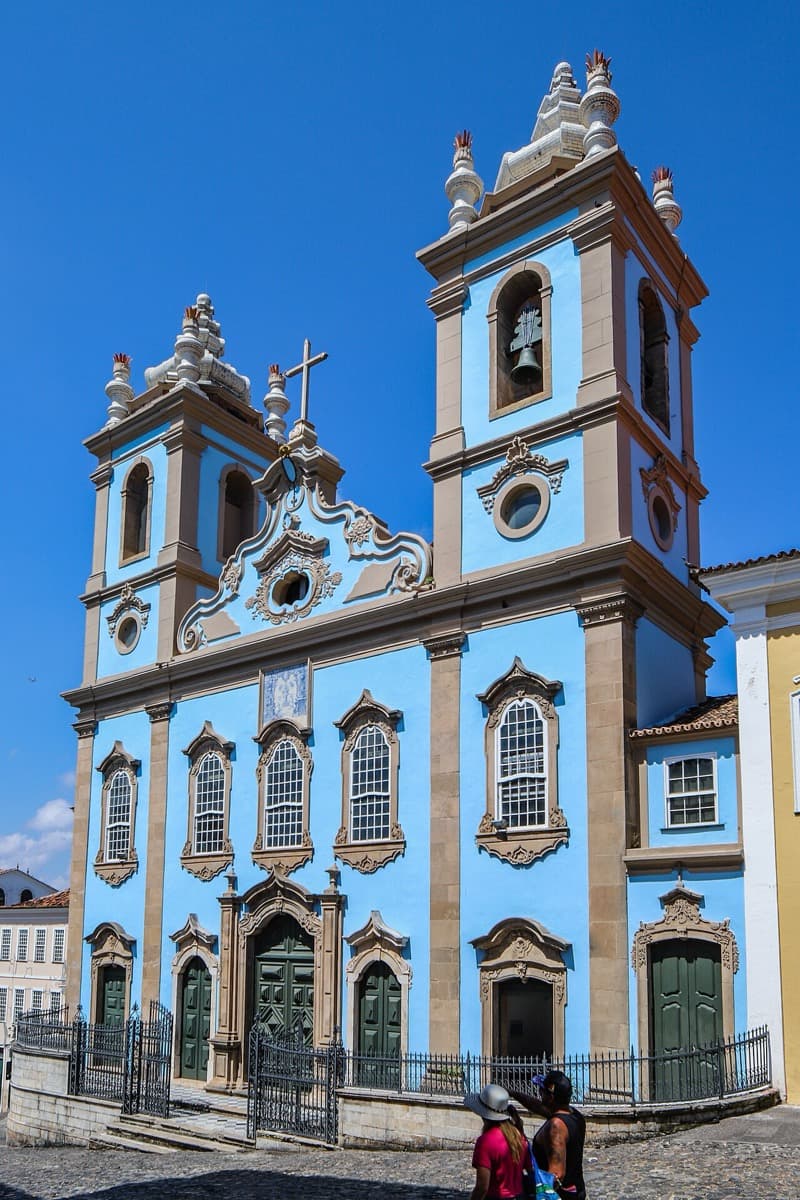
You do not need a guide to feel this, but you do need to slow down. Read the name on the sign and let it mean what it means. Look at the pastel houses and picture, at the same time, the families who lived here in 1980 and were gone by 2000. The square rewards that kind of double vision. Around it, the resistance is still very much alive: the church of Nossa Senhora do Rosario dos Pretos at the lower end, built over roughly a century by a brotherhood of Black worshippers barred from the white congregations, and the drums of Olodum a short walk away, a movement built on Black pride and anti-racism. The Pelourinho is not only a monument to what was taken. It is a working record of what survived being taken.
If you want to walk the full arc of that survival, from the acaraje frying on a street corner to the hilltop fort where capoeira is now protected as heritage of humanity, the Largo do Pelourinho is one stop on a longer route through the district. You can explore the wider city and its tours from the Salvador city page. But even a single, honest pause in this square is enough to change how you see it. The name was never decoration. It was a description, and it still is.
Sources
- Historic Centre of Salvador de Bahia, UNESCO World Heritage List entry 309. Confirms the 1985 inscription, the Afro-Bahian significance of the historic center, and the resident population fall from 9,853 in 1980 to 3,235 in 2000.
- Historic Center of Salvador, Wikipedia. Documents the district's name from the pillory (whipping post) and the 1990s tourism-driven restoration that dislocated Afro-Brazilian residents.
- Atlantic Slave Trade to Brazil, Wikipedia. Grounds Brazil as the largest destination in the Americas and Salvador de Bahia as one of its principal landfalls.
- Church of Nossa Senhora do Rosario dos Pretos, Salvador, Wikipedia. Confirms the church was built over roughly a century by a Black Catholic brotherhood barred from the white congregations, with permission to build secured around 1704.
Brazil eSIM· 10% off with ROAMER10
Ready to experience it?
The African City: Salvador of the Orixas
95 min · 2.5 km · moderate
More from Salvador
Explore more at your own pace.
One Day in Salvador: A Walkable Old-City and Bay Itinerary (2026)
Salvador Travel Guide: How Many Days, Getting Around, When to Go, Is It Safe (2026)
Salvador: Brazil's First Capital and Its African Soul
What to Eat in Salvador: A Bahian Food Guide (2026)
Elevador Lacerda: The Public Elevator That Joins Salvador's Two Cities