Salvador demolished its oldest cathedral in 1933 to clear a path for a streetcar line, and the empty square that resulted, the Praça da Sé, helped push Brazil toward its first national heritage-protection law. Most visitors walk across it without noticing that anything is missing. The square is too open for the dense old town around it, a wide flat space where the buildings pull back for no obvious reason. That emptiness is the whole story. A mother church of the colony once stood on this exact ground, and the city took it down on purpose.
The church that stood here
The building lost here was the old Sé of Bahia, the primatial cathedral of Brazil. That was not a courtesy title. Salvador was the first capital of Portuguese Brazil, founded on March 29, 1549, by the first governor-general, Tomé de Sousa. In 1551 the city became the seat of Brazil's first Catholic diocese, and the cathedral raised here was the senior church of the entire colony, the one from which the rest took their rank. It rose on this ground from the sixteenth century onward and stood for roughly three hundred years, watching the capital grow up the cliff around it.
Then, on August 7, 1933, it came down. The demolition was not an accident of war or fire or slow decay. It was a decision. Whole blocks of historic buildings were cleared along with the cathedral to make room for the expansion of tram routes through the upper city, run by the Companhia Linha Circular de Carris da Bahia. A colonial capital that had guarded its churches for three centuries erased its oldest one in the name of moving streetcars a little faster. For a while the new open space was used to store the trolleys themselves, which is a detail that says everything about the priorities of the moment.
An outcry that changed the country
Hear a stop from this walk
Praca Municipal: The Founding Square
The loss set off a furious public reaction. People understood, too late for the cathedral, that a city could lose its memory this way, that the past was not automatically safe simply because it was old. The anger did not save the church. What it did do was help change the rules for everything that came after.
Brazil at the time had no comprehensive national law protecting historic buildings. Within a few years it did. The country's first national heritage-protection framework, Decree-Law Number 25, was enacted on November 30, 1937, creating the legal machinery that still governs the protection of historic sites in Brazil today. The debate over demolitions in Salvador and elsewhere is widely credited with helping to build the political will behind that law and behind the federal heritage service it established. In a real and painful sense, the destruction of this one church helped teach a nation to protect the rest. The buildings you see standing all through the old town, the mansions of the Pelourinho, the surviving Jesuit church a short walk uphill, exist inside a legal shield that the vanished cathedral helped forge.
A monument to an absence
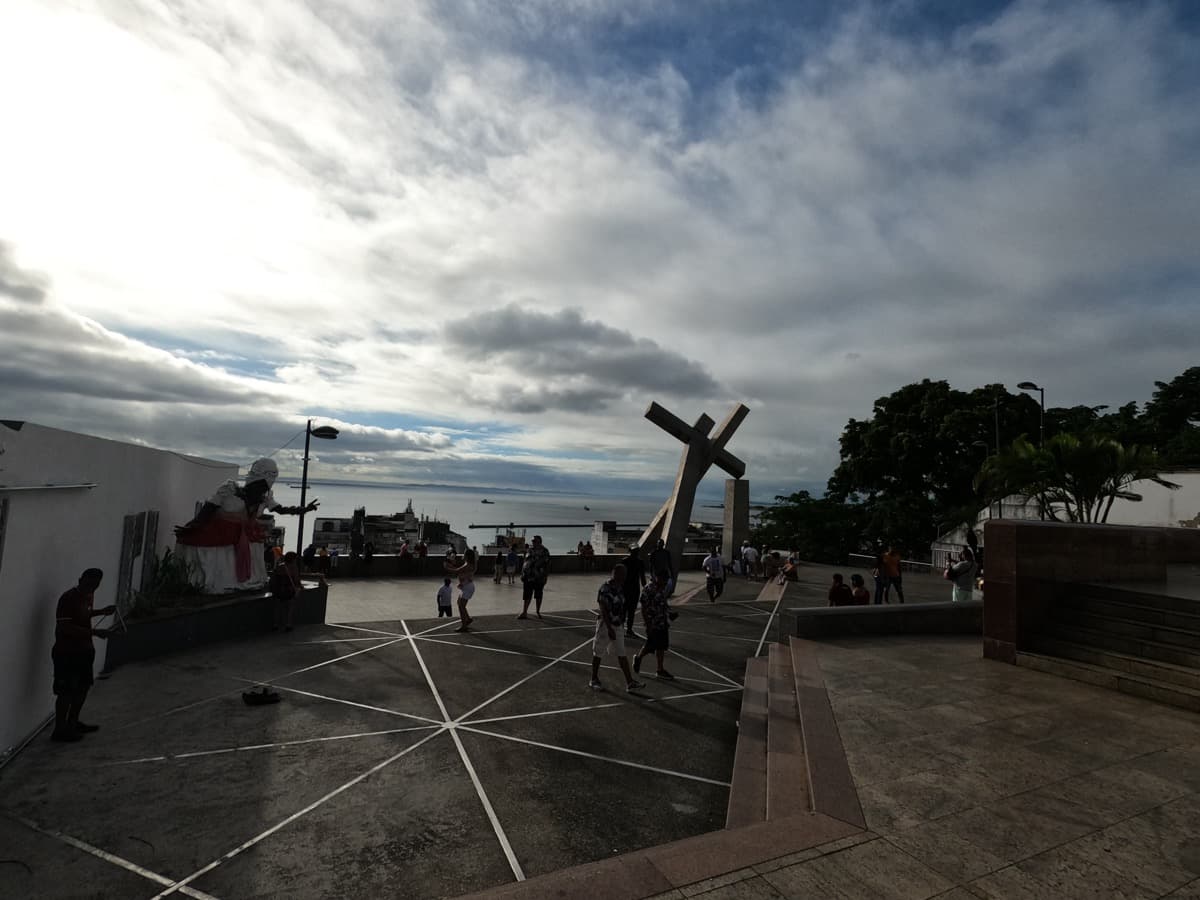
For decades the square simply stayed empty, a hole in the map that older residents remembered and younger ones never questioned. Then, much later, the city gave the loss a form. At the edge of the square, on the belvedere that looks out over the Bay of All Saints, stands the Cruz Caída, the Fallen Cross. It was created by the Bahian sculptor Mário Cravo Júnior, who lived from 1923 to 2018 and was one of the leading figures in modern Brazilian sculpture. The monument was inaugurated in 1999, the year Salvador marked four hundred and fifty years since its founding, more than sixty years after the church it commemorates had been pulled down.
The design is unusual and deliberate. It is a great cross, rendered in stainless steel, toppled and lying as though it had fallen where it stands. It rises roughly twelve meters. It does not rebuild the cathedral, and it does not pretend the church is coming back. It marks the absence directly. This is one of the strangest and most honest kinds of landmark a city can build: a monument not to a thing that exists but to a thing that is gone, a memorial to its own decision. Stand at the belvedere and you get the bay in front of you and the emptiness behind you at once, which is exactly the tension the sculpture was made to hold.
Reading the square on the ground
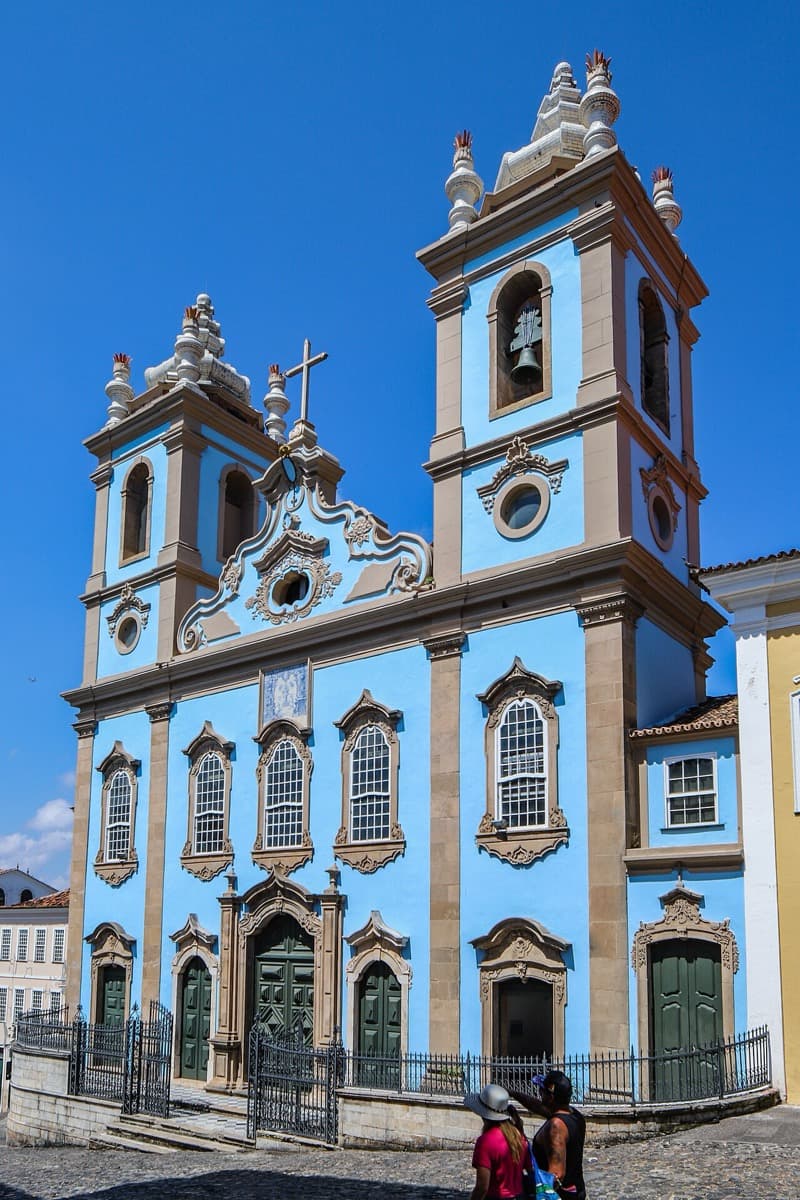
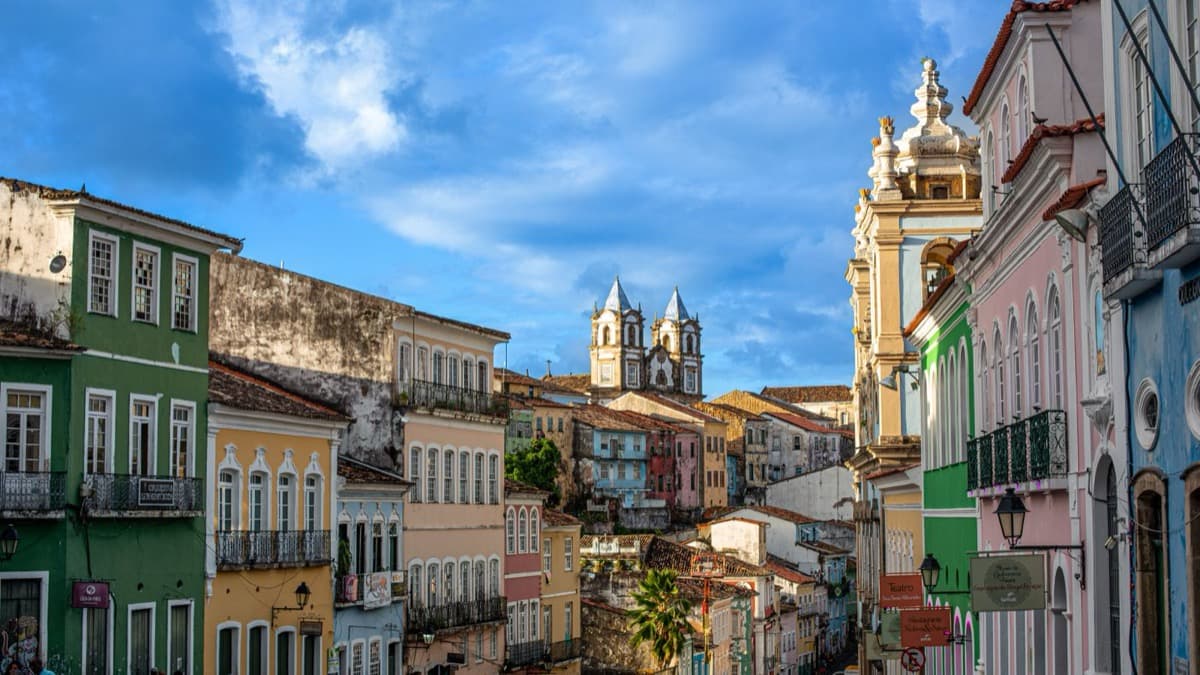
The Praça da Sé sits in the middle of a descending walk through Salvador's old town, between the founding square at the top of the cliff and the sloping Largo do Pelourinho at the bottom. On the ground the story reads better than any photograph can carry it, because the point is spatial. You feel the square open up around you, feel how the town's density suddenly relaxes, and only then does the missing church become obvious. Walk to the belvedere, find the Fallen Cross, and look back at the flat ground where three centuries of colonial faith once stood.
The self-guided walking tour of Salvador's first capital treats this square as its turning point, the place where the old town's grandeur and its losses meet. If you want to see the whole descent, from the governor's palace and Brazil's first elevator down through the Jesuit heart to the Pelourinho, you can find it on the Salvador tours. But even a single slow pass across the Praça da Sé, with the story in mind, changes what the emptiness means. It stops being a plaza and becomes a record of what a city chose to destroy, what that destruction taught it, and the fallen cross it finally raised to say so.
Sources
- Old Cathedral of Salvador, Wikipedia. Details the August 7, 1933 demolition for tram expansion and the 1999 Cruz Caída by Mário Cravo Júnior.
- Historic Centre of Salvador de Bahia, UNESCO World Heritage List (whc.unesco.org/en/list/309). Context on the protected old town the demolition scandal helped shield.
- Salvador, Bahia, Wikipedia. Founding of the first capital in 1549 and the 1551 diocese.
- Cathedral Basilica of Salvador, Wikipedia. The Jesuit church that inherited the cathedral title in 1933, the same year the old Sé fell.
- National Institute of Historic and Artistic Heritage, Wikipedia. Debates over Salvador demolitions and the 1937 Decree-Law 25 that created Brazil's federal heritage protection.
Brazil eSIM· 10% off with ROAMER10
Ready to experience it?
Pelourinho: Brazil's First Capital
85 min · 2.4 km · moderate
More from Salvador
Explore more at your own pace.
One Day in Salvador: A Walkable Old-City and Bay Itinerary (2026)
Salvador Travel Guide: How Many Days, Getting Around, When to Go, Is It Safe (2026)
Salvador: Brazil's First Capital and Its African Soul

What to Eat in Salvador: A Bahian Food Guide (2026)
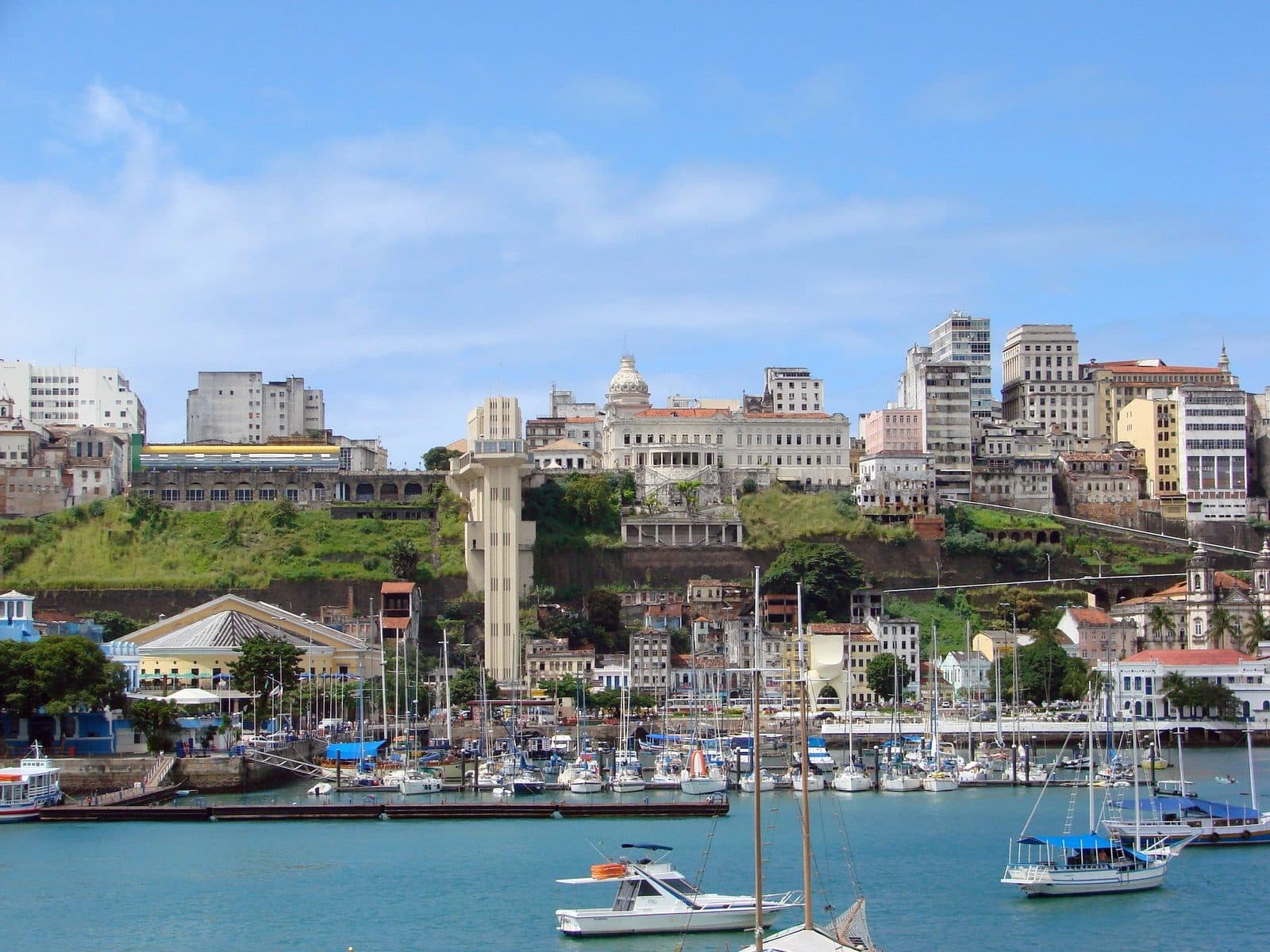
Elevador Lacerda: The Public Elevator That Joins Salvador's Two Cities