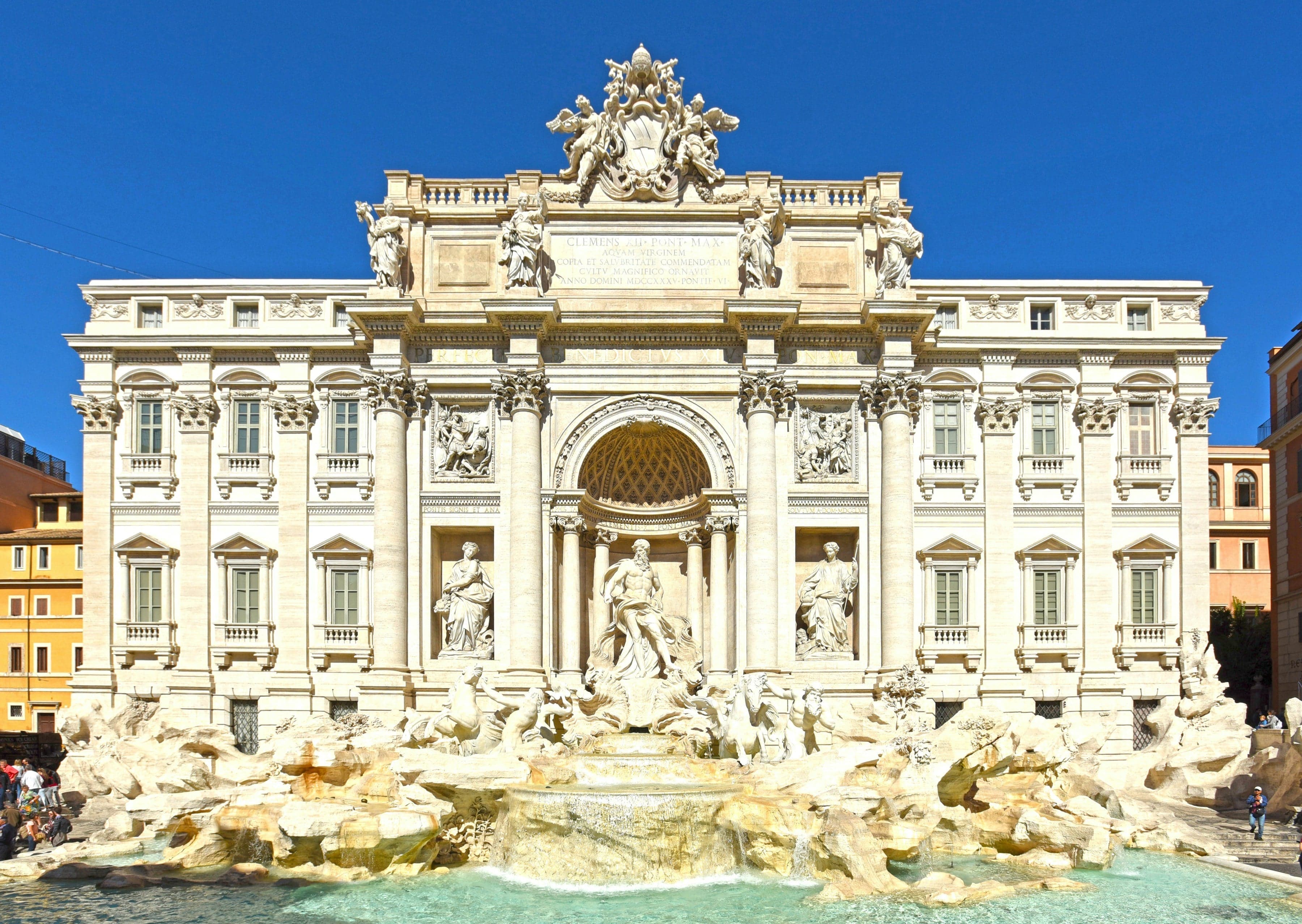
Every year millions of people throw a coin into the Trevi Fountain, and most of them are looking at a palace wall that has been turned into a waterfall. Look instead at the water. It arrives by the Acqua Vergine, the Virgin water, an aqueduct ordered by Marcus Agrippa in 19 BC, and Rome's tourism office calls it the only ancient aqueduct still in use. Trevi is the place where that aqueduct puts on its show. The one thing to understand while you stand in the crowd is that the fountain is the end of a pipe.
The fountain as a display
Palazzo Poli has become the back wall of the fountain. Its lower part melts into a carved cliff, and water pours down it into a wide basin. In the central arch the god Ocean rides a shell-shaped chariot pulled by two horses, one wild and one calm, each held by a triton. Above them are two carved panels that tell the aqueduct's story: in one, a young woman points Roman soldiers to a spring, and in the other Agrippa orders the aqueduct to be built. The spring is at Salone, outside Rome. A pope held a competition for the fountain, and it was built from 1732 to 1762.
The city's tourism office describes Trevi as the "display end" of the modern Vergine line. That matters, because the ancient line did not end here. According to the same office, the Vergine entered the walls at the Muro Torto, the crooked wall at the foot of the Pincio, ran on underground, and ended in a monumental display at Agrippa's baths, near the Pantheon.
Seeing it in 2026
Hear a stop from this walk
Piazza del Popolo: Twins That Are Not
The fountain is always visible from outside. Since 2 February 2026, non-residents pay a 2 euro ticket to enter the monumental area, the inner perimeter by the water. The ticket office and the entrance are in Via della Stamperia, and the view from the lane is free. Keep your bag in front of you in the crowd.
The boat that low pressure built
Walk upstream and you reach Piazza di Spagna, where the same water created a different problem. A plan of 1570 called for public fountains in the squares crossed by the restored Acqua Vergine. But here the Vergine had too little pressure for jets or cascades, so the fountain was set below the level of the street and made to look like a sinking boat. That is the Barcaccia, the old boat, with low sides over which the water spills and mock cannon mouths at bow and stern that frame a coat of arms with three bees, the badge of the Barberini family.
Tradition links the shape to the Tiber flood of 1598, when boats could float as far as this square. It was made in the 1620s for a Barberini pope by the sculptor Pietro Bernini, with his son Gian Lorenzo probably involved. Whoever drew it, the lesson is that a fountain can be a plumbing solution. Rome's tourism office says the aqueduct came up from underground onto arches around here, and a surviving arch can still be seen in Via del Nazareno, with more in Via del Bufalo.
The hill where the water came in
The walk this article belongs to, Trevi Fountain and Spanish Steps: Upstream to the Pincio, is built on that logic. It starts on Piazza Colonna, passes the Trevi Fountain and Borromini's tower at Sant'Andrea delle Fratte, climbs the Spanish Steps and crosses the Pincio, a garden hill designed by Giuseppe Valadier in the early 1800s, to the terrace above Piazza del Popolo.
On the terrace, the water story closes. The Vergine came into the city through the walls at the Muro Torto at the foot of this hill. Below the terrace, the ramps from the square climb the hill in three stagings, and the top one carries the belvedere on a loggia of three arches. In 1936 a fountain was made in that loggia as a display of the Acqua Vergine. From the middle of Piazza del Popolo, look back for the three arches. You have walked against the flow, from the show to the gate.
How to walk it
The walk is eleven stops over just under two and a half kilometres, about an hour and a half. The big climb is the Spanish Steps, about twenty metres, with a step-free way round by Via Sistina or Via Gregoriana. Sitting on the steps or the fountains is banned and fined, so rest on the landing at the top instead. The way down from the Pincio is by stairs or a winding road. Rome's tourism office recommends the terrace view in the late afternoon, toward sunset.
If you want the full stop-by-stop reading with the audio cued to each fountain and facade, the tour sits alongside the other walks on the Rome walking tours hub and the Rome city page. It also pairs well with the Historic Center walk, which ends about five minutes from where this one begins. Come for the coin. Stay for the pipe.
Sources
- Roma Capitale, Turismo Roma: the Trevi Fountain, the Acqua Vergine, Piazza di Spagna and the Barcaccia, the Pincio and Piazza del Popolo. Agrippa's aqueduct, its course through the Muro Torto, its display end and the arches of Via del Nazareno.
- Official Trevi Fountain site (fontanaditrevi.roma.it): the 2 euro ticket for the inner perimeter from 2 February 2026 and the entrance in Via della Stamperia.
- Roamer tour dossier for "Trevi Fountain and Spanish Steps: Upstream to the Pincio" (rome-trevi-spanish-steps), fact-checked October 2026.
Ready to experience it?
Trevi Fountain and Spanish Steps: Upstream to the Pincio
90 min · 2.4 km · moderate
More from Rome
Explore more at your own pace.
One Day in Rome on Foot: A Walkable Morning-to-Evening Itinerary
Best Architecture Walking Tours in Rome (2026)
St. Peter's Square and the Surprise Rome Demolished: Borgo, the Spina and Via della Conciliazione
The Aventine's Orange Garden and Keyhole: A Fortress That Became a View
Palatine Hill: Where Rome Says It Was Born