Climb the Aventine from the Circus Maximus and you walk through a short course in how Rome changes the use of things. A valley was shaped into a chariot track. Two ancient temples by the river became churches. A medieval fortress became a public garden of orange trees. And a lock in a garden gate became a view that people cross the city to queue for. The one thing to understand at the top is that none of it was designed as the view you now see.
From temples to churches
The climb starts at Piazza della Bocca della Verita. Under the porch of Santa Maria in Cosmedin is the Mouth of Truth, a marble disc carved with a bearded face. Rome's tourism office says it was probably a Roman drain cover; the church argues it is the face of a god. A film made it famous in 1953.
Across the square, behind a fence, a round temple ringed with columns is considered the oldest surviving marble building in Rome, dedicated to Hercules toward the end of the second century BC by an olive-oil merchant. It became a church in the twelfth century.
A fortress wall that changes sides
Hear a stop from this walk
Knights of Malta Square: The Keyhole
Above the square the cobbled Clivo di Rocca Savella climbs beside what is left of the fortress the Savelli family built between 1285 and 1287, on top of an older castle. The fortress itself was almost entirely pulled down in 1613, though the walls and a few underground storerooms stayed. A fortress wall keeps people out, and at the top of this lane the same wall does the opposite: a restoration repaired the walls to reopen one of the old ways into the garden above.
The garden turned inside out
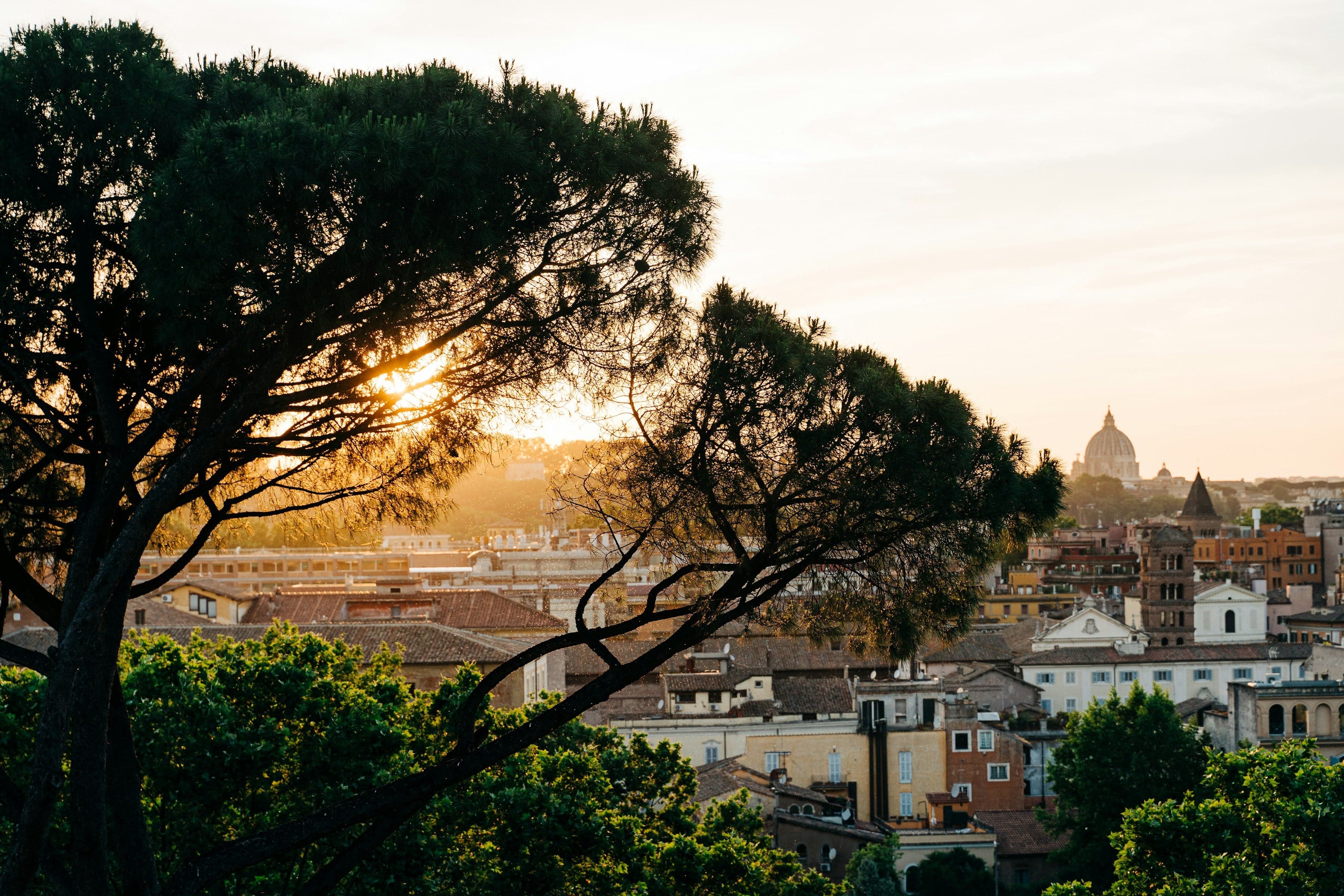
For centuries this hilltop was a fortress, then the vegetable garden of the Dominican friars, and the view was private. In 1932 the architect Raffaele De Vico made it a public park, the Orange Garden, which the city's signs call Parco Savello, with a terrace meant to stand comparison with Rome's lookouts on the Pincio and the Janiculum. A central avenue runs straight to the terrace, so the whole garden points at the view. The trees are evergreen bitter oranges, not the sweet kind you eat. The city says they were planted in memory of Saint Dominic, who preached here, the story goes, under an orange tree.
The city's own description of the view runs from the Tiber Island to the Janiculum ridge and the dome of St. Peter's. The garden is free, but it has gates: it is open from 7:00 to 18:00 from October to February and later in the warmer months, so in autumn and winter you will not see the sun go down from the terrace. If the gate is shut, keep climbing the lane to Via di Santa Sabina; there are no steps on that way round.
The plain basilica
Next to the garden is Santa Sabina, a working church, free to enter when open. It was built between 422 and 440, probably on the site of the house of a Roman woman named Sabina. Later centuries dressed it up, and a restoration in the early nineteen hundreds stripped the additions away again, so thoroughly that the city's tourism office now calls it the perfect example of a fifth-century Christian basilica. Its carved cypress doors are called the most complete doors to survive from late antiquity. It is still the mother church of Saint Dominic's order.
The keyhole
At the end of the street, in the Knights of Malta square, a line of people waits at a door in the wall. Through its brass lock you see a path between the hedges of an eighteenth-century garden, pointing straight at the dome of St. Peter's, framed like a picture. Rome's own description puts it simply: the only obstacle is the queue. The Order of Malta, which owns the villa behind the wall, calls it the one place where you can see three states at a glance: the Order's own ground, Italy and the Vatican.
The square itself is the work of Giovanni Battista Piranesi, the engraver of Rome's ruins. In 1764 the Order's grand prior asked him to transform the small church behind the wall, and the work finished in October 1766. The church and the square are in effect the only building he ever completed. Whether he also planned the view through the lock, no document says. The church and garden are closed to visitors.
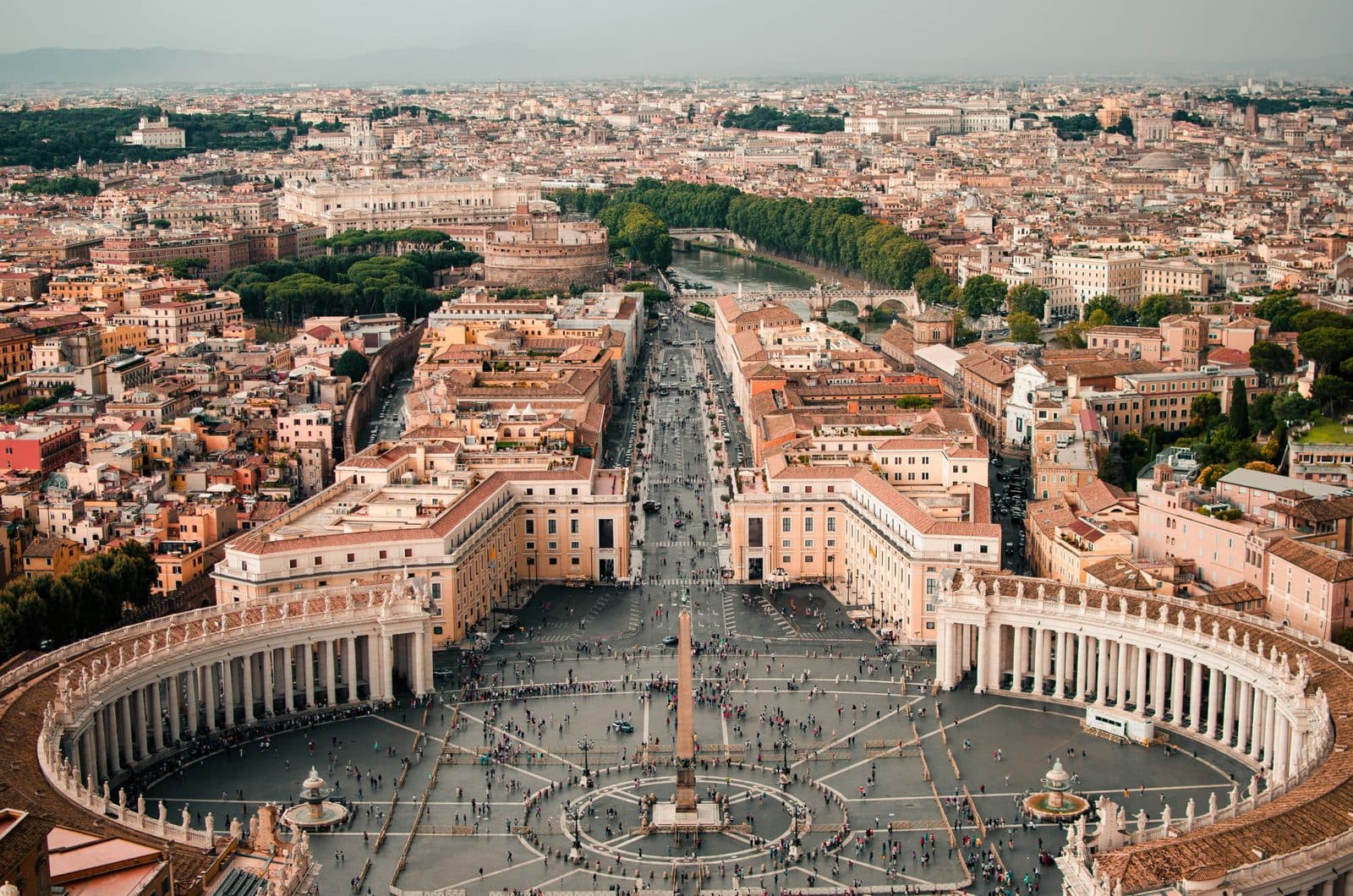
One more reuse is nearby: a fountain in Piazza Sant'Alessio, placed there in 1937, came from a palace lost when old houses were cleared for Via della Conciliazione, the avenue in the Vatican's lost surprise.
Walking it
The walk is Circus Maximus and Aventine: Racetrack to Orange Garden: nine stops over about a kilometre and a half and an hour of walking, with one gentle climb of about thirty metres on cobbles and about thirty steps. A step-free way up is the Clivo dei Publicii, from the Mouth of Truth square to Santa Sabina. Find it alongside the other walks on the Rome walking tours hub and the Rome page.
Sources
- Roma Capitale, Turismo Roma and the city's park page for the Orange Garden (Parco Savello): the Savelli fortress, De Vico's 1932 design, the oranges and the garden's hours.
- Roma Capitale, Turismo Roma: Santa Maria in Cosmedin, the round temple and the temple of Portunus, Santa Sabina and Piazza Sant'Alessio.
- Treccani, Dizionario Biografico, entry on Piranesi: the 1764 commission and the work finished in 1766.
- Roamer tour dossier for "Circus Maximus and Aventine: Racetrack to Orange Garden" (rome-aventine-circus-maximus), fact-checked October 2026. The copy for this walk was still under audit when this article was written.
Ready to experience it?
Circus Maximus and Aventine: Racetrack to Orange Garden
60 min · 1.5 km · moderate
More from Rome
Explore more at your own pace.
One Day in Rome on Foot: A Walkable Morning-to-Evening Itinerary
Best Architecture Walking Tours in Rome (2026)
St. Peter's Square and the Surprise Rome Demolished: Borgo, the Spina and Via della Conciliazione
The Water Behind the Trevi Fountain: Following the Acqua Vergine to the Pincio
Palatine Hill: Where Rome Says It Was Born