Trastevere and the Ghetto: The River Walled In
75 min · 1.7 km · easy
After the flood of 1870 Rome walled in the Tiber, and much of what you see between the old Ghetto and Trastevere was cut, rebuilt or moved to fit around those walls. In December 1870 the river rose above seventeen metres. The decision followed to hold it between tall stone embankments, finished in 1926. In the same decades one Roman bridge was rebuilt and another cut down, an avenue was driven through Trastevere, the Ghetto was demolished, and a fountain was taken apart on one bank and put back together on the other. This walk is a tour of that one decision and everything it touched.
The quarter by the water
The walk starts at the Portico d'Ottavia, a Roman gateway Augustus named for his sister, with a church built into its back and a stone slab that once regulated the fish market around it. One rough corner of the gateway marks the edge of the Ghetto. In 1555 Pope Paul the Fourth forced Rome's Jews, a community living in the city without a break for about two thousand two hundred years, into one of the most unhealthy quarters of the city, here on the flood-prone riverbank. They were free only in 1870.
The square is named for 16 October 1943, when Nazi troops took more than a thousand Jewish Romans from their homes and sent them to Auschwitz. Sixteen came back. Rome remembers them here each October. Treat this first stop as a place of memory before it is a place of architecture.
Next door, the Theatre of Marcellus shows Rome's older way of dealing with a building: keep it and stack on top. Its two surviving tiers of travertine arches carry a palace of the fifteen hundreds, and the street has risen around its base since Roman times.
Two bridges, one island, a broken arch
Hear a stop from this walk
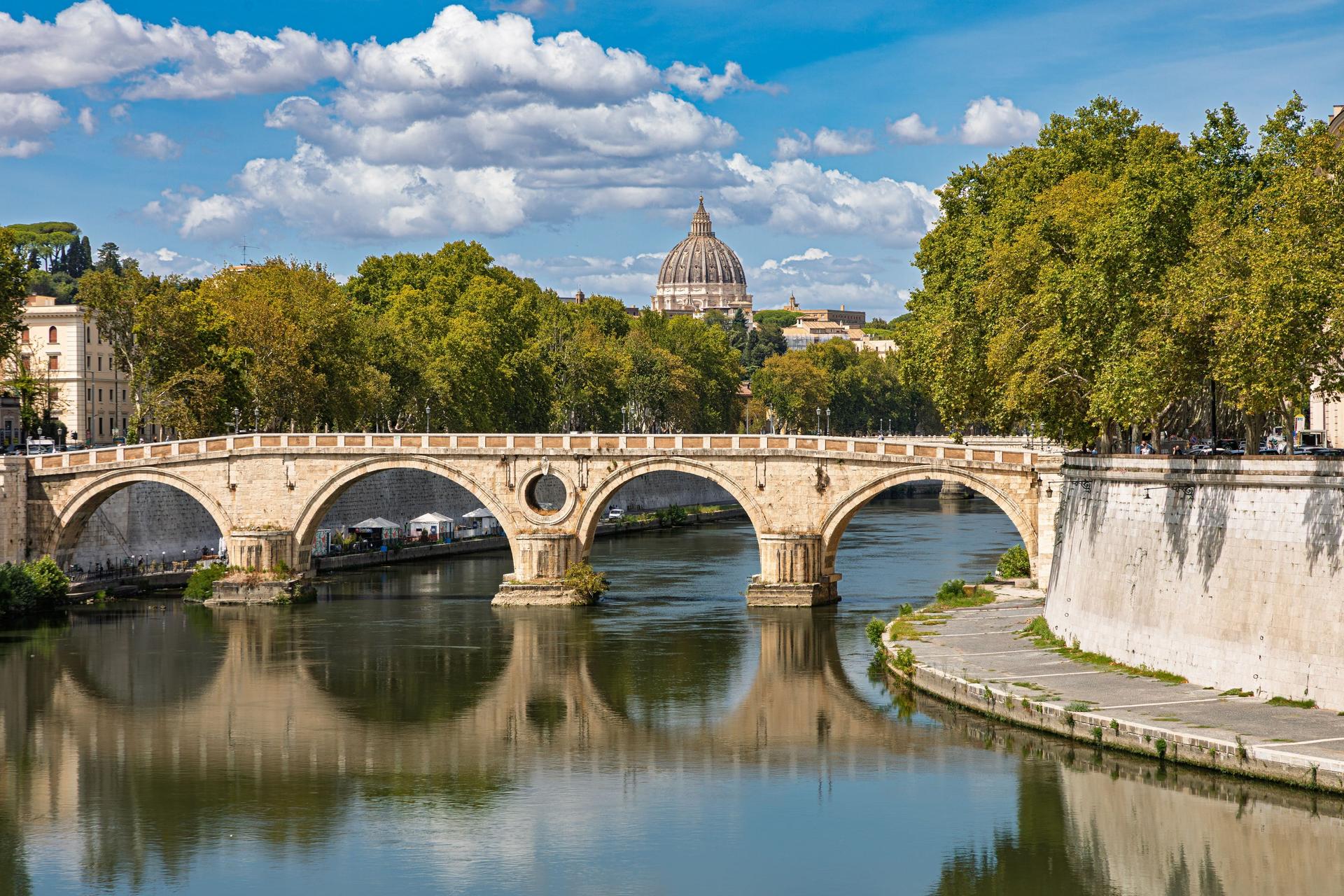
Ponte Sisto: A Pope's Bridge for Pilgrims
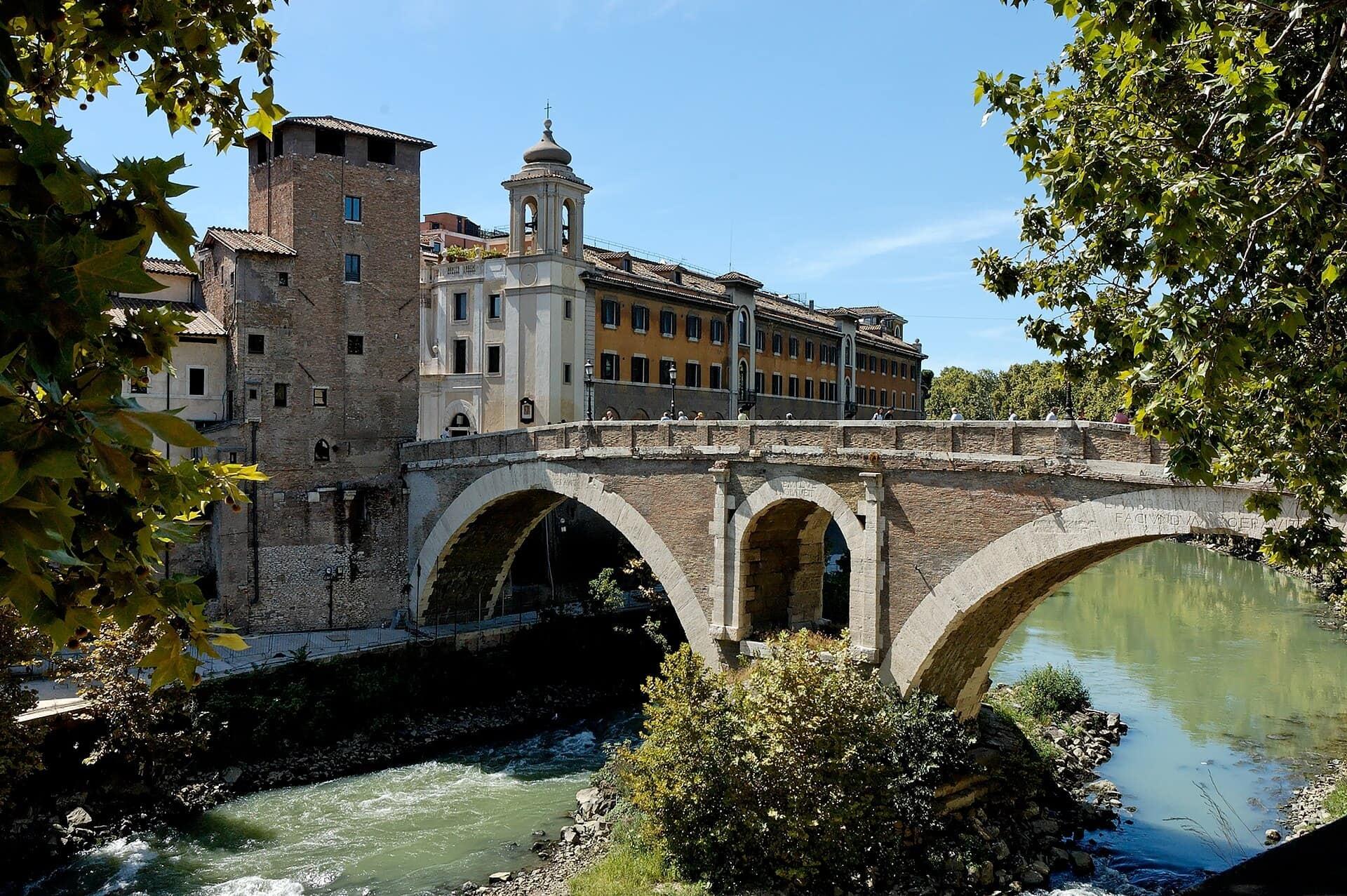
Ponte Fabricio, built in 62 BC, is the oldest bridge on the walk and one of the two oldest Roman bridges still in use. Its builder, Lucius Fabricius, had his name cut four times into the arches. When the embankments went in, workers found the bridge had once run out over a ramp of small arches, and the new walls swallowed them. Look back from the bridge and you may glimpse the square aluminium dome of the Great Synagogue, opened in 1904 on the cleared ground of the old Ghetto.
The Tiber Island, between the bridges, has carried healing since a temple to Aesculapius was dedicated there in 291 BC; a hospital founded in 1584 still works beside the church of San Bartolomeo. Its far bridge, Ponte Cestio, is the clearest casualty of the walls. Built around 46 BC, it was rebuilt in 1892, as the inscription on its parapet records, with three large arches faced in its original travertine, because the walls had forced the channel wider and the old bridge no longer fitted.
From Ponte Cestio, look downstream for the single arch standing alone in the river. That is the Pons Aemilius, the broken bridge. The record flood of Christmas 1598 took three of its arches, and in 1887, for the walls and a new bridge beside it, the city cut away two more and left the one you see. Two bridges reshaped for the embankments, in one view.
An avenue through the lanes
Trastevere's lanes look untouched, and mostly they are. At San Benedetto in Piscinula the city counts the smallest bell tower in Rome, holding a bell cast in 1069. But walk along Via della Lungaretta and it stops at a wide road. In 1888 the city cut the King's Avenue, today Viale di Trastevere, straight through the quarter and demolished whole blocks of houses. The Lungaretta now continues in two halves, one on each side. It belongs to the same years as the river walls and the clearing of the Ghetto.
Beyond the avenue, the older layers return: the gold mosaic over Santa Maria in Trastevere, the church of Santa Maria della Scala that refused a Caravaggio, and Porta Settimiana, a gate rebuilt in 1498 with swallow-tailed battlements and given an even more warlike look in 1798, long after anyone needed to defend it.
The fountain that crossed the river
Piazza Trilussa holds the neatest example of the thesis. The fountain of the Acqua Paola at the top of its steps was made in 1613 for Pope Paul the Fifth, and it first stood at the end of Via Giulia, on the far bank. When the river was walled in, it was taken apart, and about half its pieces were broken or scattered among the city's storerooms. In 1898 it was rebuilt here from what survived, raised on fifteen steps and lined up with the bridge. A fountain built to celebrate water crossing the river ended up crossing it too.
The walk ends on Ponte Sisto, built for the Jubilee of 1475. Look upstream to the dome of Saint Peter's, then down at the Tiber running between its walls, where it has been held since the flood.
Walking it
The route is twelve stops over about 1.7 kilometres and takes about seventy-five minutes. It is flat, with three short flights of steps and plenty of cobbles, and needs no tickets. Walk it at your own pace, linger in a Trastevere square, and step into a church when its doors are open and no service is on.
The fountain that crossed the river is stop 11 of Trastevere and the Ghetto: The River Walled In. For more walks, see the Rome city page.
Sources
- Turismo Roma, Piazza Trilussa (https://turismoroma.it/it/luoghi/piazza-trilussa): the Acqua Paola fountain made in 1613 for Paul the Fifth, first at the end of Via Giulia, dismantled for the embankments with about half its pieces lost, rebuilt in Piazza Trilussa in 1898 on fifteen steps.
- Turismo Roma, Ponte Cestio (https://turismoroma.it/it/luoghi/ponte-cestio): built around 46 BC and rebuilt with three arches faced in the original travertine, recorded on the parapet inscription, because the riverbed was widened for the embankments.
- Roamer tour dossier for "Trastevere and the Ghetto: The River Walled In" (rome-trastevere), fact-checked October 2026, which draws on Turismo Roma, the Sovrintendenza Capitolina and the Jewish Museum of Rome.
Ready to experience it?
Trastevere and the Ghetto: The River Walled In
75 min · 1.7 km · easy
More from Rome
Explore more at your own pace.
Best Architecture Walking Tours in Rome (2026)
Colosseum and Roman Forum: A Walk Through a City Built From Itself
Rome Historic Center Walk: The City That Reuses Everything
St. Peter's Square and the Surprise Rome Demolished: Borgo, the Spina and Via della Conciliazione
The Aventine's Orange Garden and Keyhole: A Fortress That Became a View