Rome's historic center survived by reuse rather than replacement, and the ground rose over whatever it did not reuse. Inside the bend of the Tiber, a stadium became a square, a temple became an office front, ancient bath tubs became fountains and ruins became the stone of palaces. What Rome did not recycle, it buried: the ancient city often lies several metres under the street. Walk from Largo di Torre Argentina to the church of Sant'Ignazio and you can read both habits, one square at a time.
First, look down
The walk opens at a railing above a pit. Below the traffic of Largo di Torre Argentina lie four temples of the Roman Republic, labelled A to D because nobody is sure who most of them belonged to. They were found by accident in 1926, when an old block was being demolished. One of them, Turismo Roma notes, was later turned into a church, and its apse still stands among the columns. Behind two of the temples is the base of the hall of Pompey's theatre complex, where the Senate was meeting on the Ides of March in 44 BC when Julius Caesar was stabbed.
That pit teaches the rule for the rest of the route. The street you are standing on is not the ancient street. It is several metres higher, built up over centuries of rubble, silt and floods. At the Pantheon later on, the same rule has buried most of the seven steps that once raised its porch above the square.
Stone that came from somewhere else
Hear a stop from this walk
Sant'Ignazio: The Dome That Isn't There
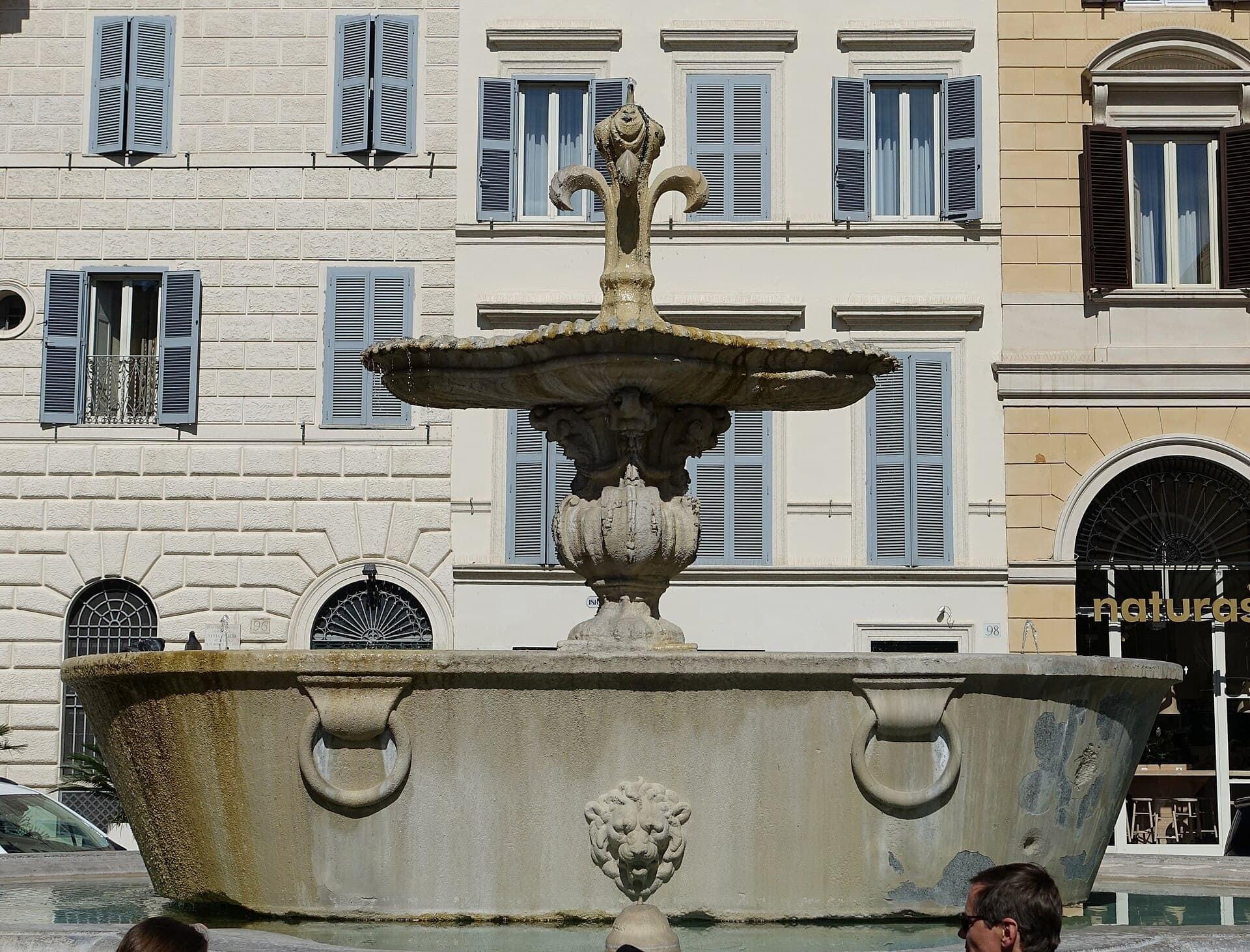
Between Campo de' Fiori and Piazza Navona, the walk passes three kinds of borrowed stone. In Piazza Farnese, the two fountains in front of the French Embassy are built around huge basins of Egyptian granite. They were bath tubs from one of the great public baths, traditionally the Baths of Caracalla, and became fountains in the fifteen and sixteen hundreds. Nobody doubts they are ancient and reused; exactly where they came from is still argued.
Further on, the long, pale front of the Cancelleria is a palace built out of ruins. Turismo Roma says its bone-coloured travertine was taken from ancient buildings, including the Colosseum and the Theatre of Pompey, the same theatre whose hall you saw in the pit. A few steps later, Pasquino, a battered fragment of an ancient statue group, got a second career as one of Rome's talking statues, the place where anonymous verses mocking the powerful were posted from the fifteen hundreds. Notes still go up on the board beside him.
A stadium that kept its shape
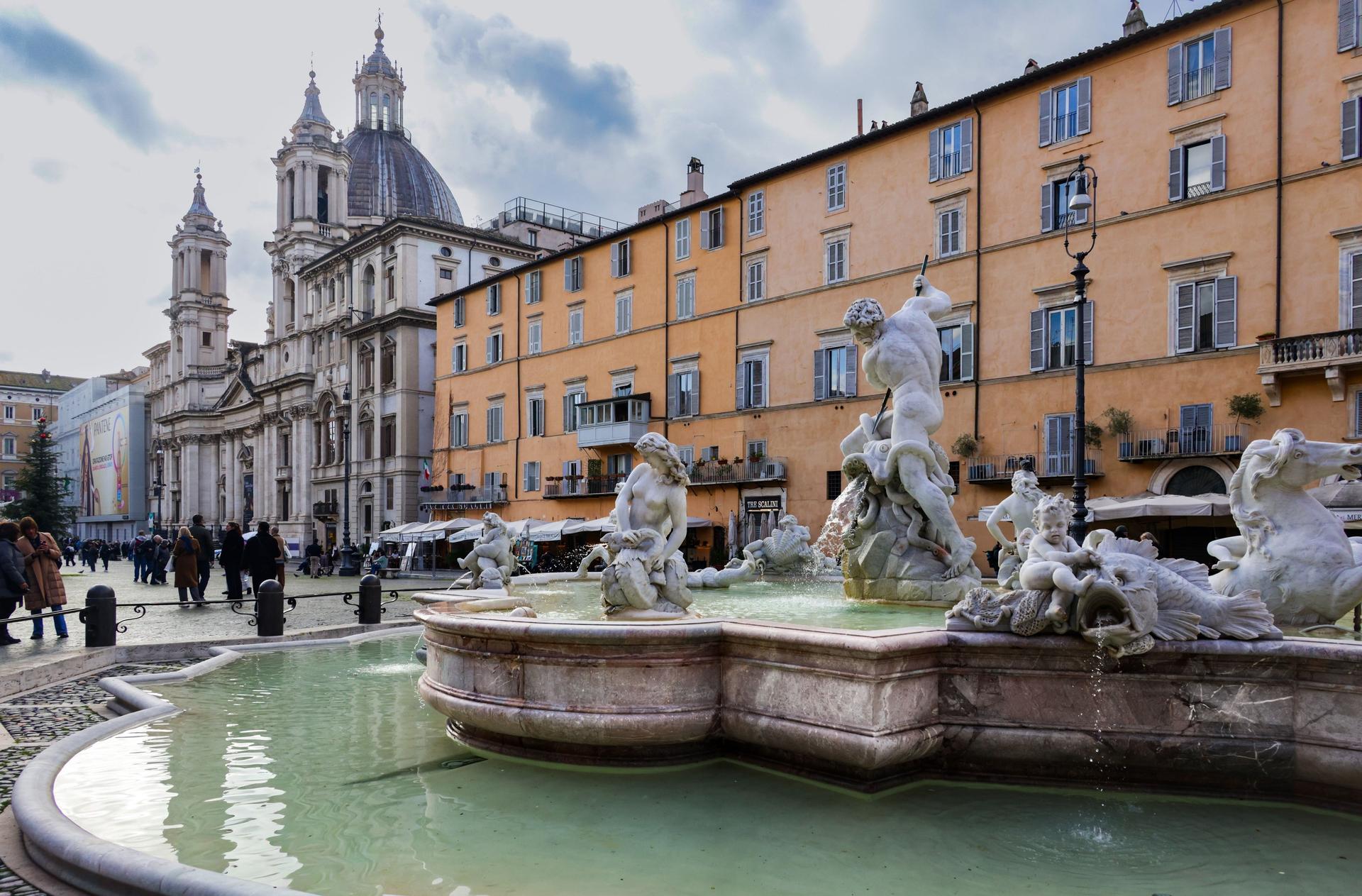
Piazza Navona is the walk's big reveal. Look at the square's outline: long, narrow and rounded at one end. That is Domitian's stadium, opened in the year 86 for running, wrestling and boxing, about two hundred and seventy-five metres long. Its remains lie about four and a half metres below the paving, and the houses around you stand on its old arcades. Nobody designed this square. It is a stadium that was never cleared away.
On top of that kept shape, the sixteen hundreds staged a show. Bernini's Four Rivers fountain, unveiled in 1651, carries an obelisk that looks Egyptian but was carved in Rome, then stood in a circus on the Appian Way before it was dug up and brought here. Behind it, Borromini curved the front of Sant'Agnese inward. Compare it with the porch of Santa Maria della Pace, two lanes back, which swells outward into its tiny square. The same decades remade an old church and a few old houses into a stage set.
The pattern of rescue by reuse runs on past Navona. At Piazza della Minerva, Bernini's marble elephant carries a genuinely Egyptian obelisk, set up by a pharaoh around 580 BC, brought to Rome for a temple of Isis, lost under the city and dug up again in 1665. At the Pantheon, Hadrian rebuilt Agrippa's temple and kept Agrippa's name on the front. It survived because it was given to the pope in 609 and consecrated as a church.
Columns with an office behind them
The plainest example comes near the end, in Piazza di Pietra. Eleven fluted columns of the Temple of Hadrian, finished in 145, stand built into the front of a later palace. In the sixteen hundreds a papal building was fitted into the ruin; it later held Rome's stock exchange, and today it houses the Chamber of Commerce. Ancient columns and a modern wall share one face, and the square is even named for the stones.
The last stop pushes the idea to its limit. Sant'Ignazio was meant to have a dome, and the money ran out. In 1685 a Jesuit lay brother painted one on canvas instead, as an illusion. That painting burned and was painted again in 1823 from his drawings. So the dome inside is a copy of a painting of a dome that was never built. A marble disk in the nave floor marks the spot to stand.
Walking it
The route is eleven stops over just under two and a half kilometres and takes about ninety minutes. It is flat with no steps, on small, bumpy cobbles. Most of it is seen free from the street; the Pantheon is ticketed, and Sant'Ignazio is free to enter. Because the walk is self-guided, you can stop for coffee in any square, skip a church you have already visited, or come back to Navona after dark.
The stadium that became a square is stop 6 of Historic Center: The City That Reuses Everything. For more walks, see the Rome city page.
Sources
- Turismo Roma, Sacred Area of Largo di Torre Argentina (https://www.turismoroma.it/en/node/1040): discovery in 1926 during demolition, four Republican temples labelled A to D, the church in Temple A, the Curia of Pompey and Caesar's murder.
- Turismo Roma, Palazzo della Cancelleria (https://turismoroma.it/en/places/palazzo-della-cancelleria): the palace's bone-coloured travertine taken from ancient ruins including the Colosseum and the Theatre of Pompey.
- Roamer tour dossier for "Historic Center: The City That Reuses Everything" (rome-piazza-navona-baroque), fact-checked October 2026.
Ready to experience it?
Historic Center: The City That Reuses Everything
90 min · 2.4 km · easy
More from Rome
Explore more at your own pace.
Best Architecture Walking Tours in Rome (2026)
Colosseum and Roman Forum: A Walk Through a City Built From Itself
St. Peter's Square and the Surprise Rome Demolished: Borgo, the Spina and Via della Conciliazione
The Aventine's Orange Garden and Keyhole: A Fortress That Became a View
The Water Behind the Trevi Fountain: Following the Acqua Vergine to the Pincio