Rome builds out of what came before, and the walk from the Colosseum valley to the Capitoline Hill reads that habit in stone. Emperors took carvings from earlier emperors for their own monuments. The Colosseum went up on the site of a palace lake and later served as a quarry. In 1932 a hill and a neighborhood were cut away for a parade avenue. And on top of the Capitoline, Michelangelo turned a whole square to face away from the Forum it had always looked at. Nothing on this route was built on empty ground.
An arch made of other arches
Start where the walk does, at the Arch of Constantine. It is the largest of the three triumphal arches that survive in Rome, put up in 315 for Constantine's victory over his rival Maxentius at the Milvian Bridge. Look at the top level. The eight standing figures there are Dacians, the people Trajan fought, and they were taken from Trajan's Forum. The big rectangular panels and the round medallions also come from monuments of earlier emperors, and the old emperors' faces were recut to look like Constantine. Rome's tourism office calls the arch probably the first example of the systematic reuse that lasted through the Middle Ages.
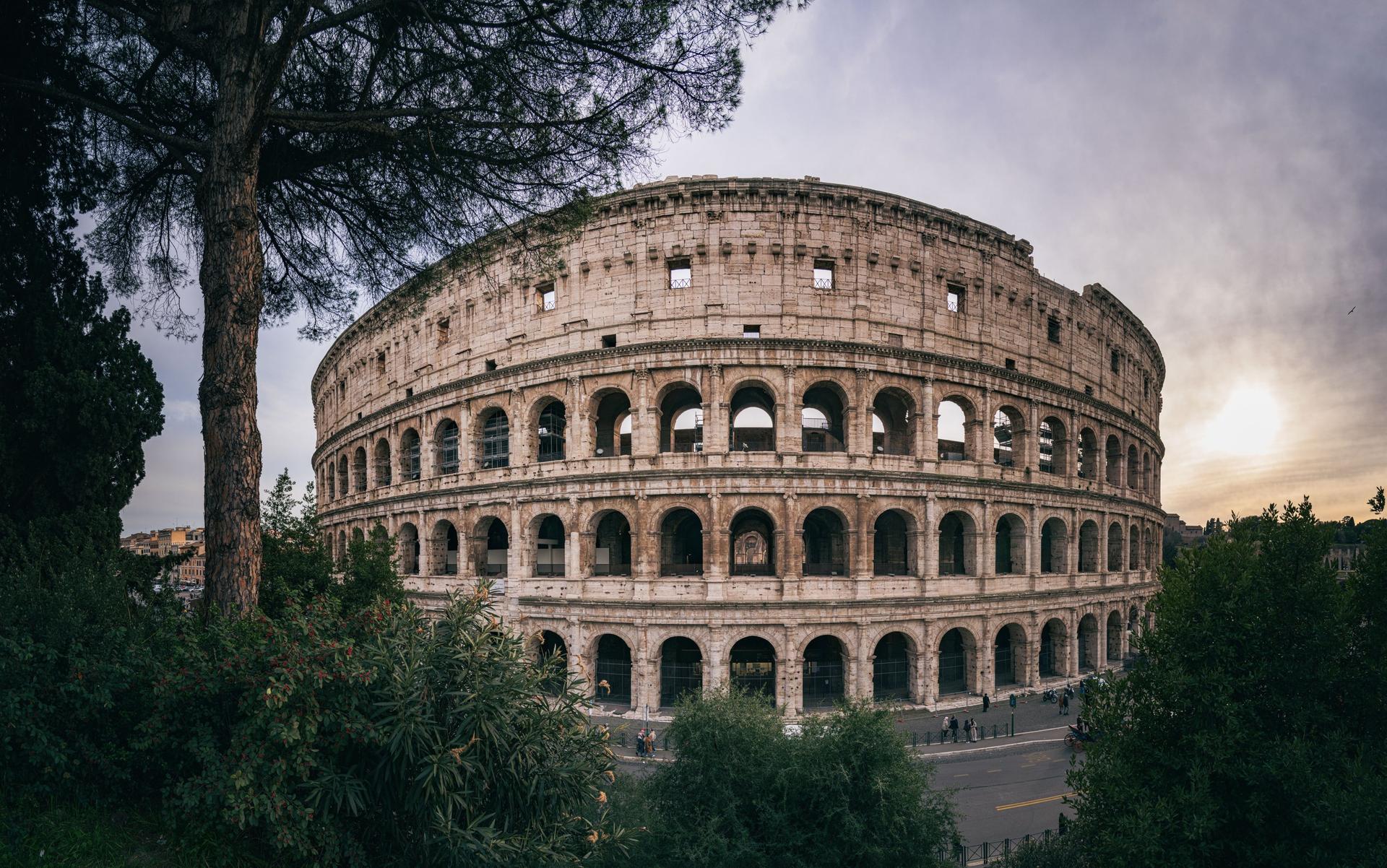
Keep that in mind as you circle the Colosseum, because the arena repeats the move. It stands where Nero's palace had an artificial lake, opened by Titus in the year 80. A palace lake became an arena: take what the last ruler built, and make it your own. Then Rome took the arena too. On the south side, arches of the second ring fell in an earthquake in 1703, and through the Middle Ages and the Renaissance the building was quarried for stone. Where the big blocks show, look for holes in them: iron clamps once held the blocks together, and the holes are where the clamps were pulled out. The north face, where the outer wall still stands to full height, shows what the south side lost: three rows of arches framed by half-columns, and a solid top band that once held the supports for the awning over the crowd.
The hill that was cut away
Hear a stop from this walk
Tarpeian Rock: The Cliff and the Church
From the north face, the Via dei Fori Imperiali runs straight away from the Colosseum. The Fascist government opened it on 28 October 1932, and it was built to end here, at the arena. To give the road its finish line, a hill called the Velia was cut down. The next stretch of the walk runs through that cut, and the Basilica of Maxentius stands on what is left of it.
The basilica tells the arch's story again in brick. Maxentius began the hall in 308. Constantine, who beat him, finished it and turned it round with a new entrance. Only the northern of its three naves stands, and from the avenue you look at its three huge coffered vaults. Its last standing marble column was carried off in 1613 by a pope and set up in front of Santa Maria Maggiore. Even the colossal statue inside started as Maxentius and was adapted for Constantine.
Below the street, the Senate house in the Forum did the same thing over thirteen centuries. A pope turned it into a church in 630, it was redone in Baroque style, and then, between 1930 and 1936, while the avenue was being built, it was stripped back to its ancient look. Further along, the avenue runs over the Imperial Forums themselves, where the Alessandrino quarter of houses, churches and monasteries was demolished to make room for the road. In October 2026 the city announced a plan to keep two lanes for buses and taxis and turn the rest of the roadway into one surface for people on foot and on bicycles. Rome is now editing the edit.
A column and a square that changed direction
At the end of the avenue, Trajan's Column rises out of Trajan's Forum, raised in 113 for the Dacian wars. Its carved ribbon winds round the shaft twenty-three times and holds about two thousand five hundred figures. It is the only monument of that forum to survive practically intact, and the Dacians on the Arch of Constantine were taken from the same ground. Its statue of Trajan was lost, and in 1587 a pope put Saint Peter on top.
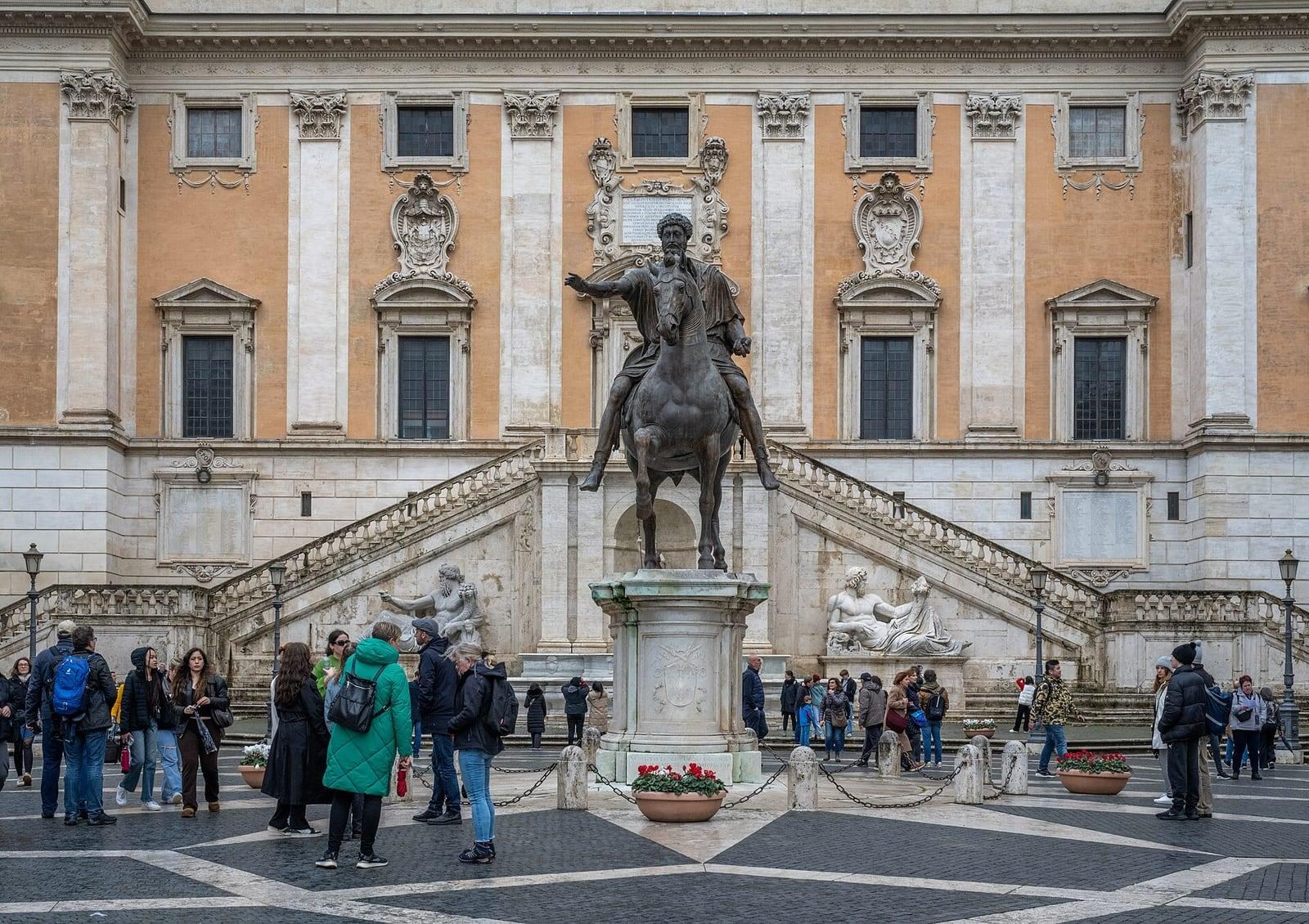
Then the walk climbs the Capitoline by its back stair, from the Forum side. At the top is the clearest single act of turning around on the route. In 1536 a pope asked Michelangelo to give the hilltop a proper square, and the result faces the other way. The Capitoline Museums say the new flight of steps, the Cordonata, marked a definitive shift of the hill's main axis toward the modern city, away from its ancient position facing the Forum. Stand by the bronze horseman, Marcus Aurelius, and you can feel it: you came up the back, and the front door now looks out over modern Rome. The horseman in the square is a copy; the ancient original is indoors in the museums.
Walk down to the railing behind the Senators' Palace and you see what the square turned its back on: the Temple of Saturn, the Arch of Septimius Severus, the Senate house, and the Palatine beyond. The walk ends below the Capitoline's southern cliff, where tradition places the Tarpeian Rock, beside the church of Santa Maria della Consolazione.
Walking it
The walk is twelve stops over just under two kilometres and takes about an hour and a quarter. It works entirely from free streets and squares, looking into the ticketed archaeological park over its railings, so you can do the outside first and go in another day. It is level until the end, where a steep cobbled lane and a long flight of steps climb onto the Capitoline, with a longer way round that avoids the steps. Go at your own pace, linger at the railings, and skip what you have already seen.
The square that turned around is stop 10 of Colosseum and Roman Forum: Rome Built From Rome. For more of the city, see the Rome city page.
Sources
- Turismo Roma, Arch of Constantine (https://www.turismoroma.it/en/places/arch-costantine): erected in 315 for the victory over Maxentius, the largest of the three surviving triumphal arches, reliefs reused from monuments of Trajan, Hadrian and Marcus Aurelius with faces remodelled, eight Dacians from Trajan's Forum.
- Turismo Roma, Arco de Costantino, Spanish page (https://turismoroma.it/es/places/arco-de-costantino): the arch as probably the first instance of the systematic reuse of salvaged material that continued through the Middle Ages.
- Musei Capitolini, The square and the flight of steps (https://museicapitolini.org/en/node/2494): the Cordonata marking a definitive shift of the hill's axis toward the modern city, Michelangelo's oval and the copy of Marcus Aurelius.
- Roamer tour dossier for "Colosseum and Roman Forum: Rome Built From Rome" (rome-colosseum-forum), fact-checked October 2026.
Ready to experience it?
Colosseum and Roman Forum: Rome Built From Rome
75 min · 1.9 km · moderate
More from Rome
Explore more at your own pace.
Best Architecture Walking Tours in Rome (2026)
Rome Historic Center Walk: The City That Reuses Everything
St. Peter's Square and the Surprise Rome Demolished: Borgo, the Spina and Via della Conciliazione
The Aventine's Orange Garden and Keyhole: A Fortress That Became a View
The Water Behind the Trevi Fountain: Following the Acqua Vergine to the Pincio