Old Town and Astronomical Clock: The Town and the Crown
75 min · 2 km · easy
The New Town's grand fronts were paid for by people with something to sell or something to prove: a merchant, a builder's family, a publisher, four insurance companies, a theater funded by public collection twice, and artists in debt. The things people remember here came from elsewhere. A borrowed key, a plaque put up without permission and two names in the paving were nobody's commission. Walk from the top of Wenceslas Square down to the river with one question in hand, who paid for this, and Prague's Art Nouveau stops being decoration and starts being a ledger.
A king's market, filled in later
Charles the Fourth laid out the New Town, Nové Město, in 1348, with a great horse market at its spine. That market is Wenceslas Square, about 750 meters long. At its top stands Josef Václav Myslbek's bronze Saint Wenceslas, which took from 1887 to 1924 to complete, and Czechoslovak independence was read out before it on 28 October 1918. Almost everything else around the square was paid for much later, mostly around 1900, by people who wanted to be noticed.
The clients
Hear a stop from this walk
Old Town Bridge Tower: Charles's Gate
The Grand Hotel Evropa, given its yellow, green and red front between 1903 and 1905, shows how a sign follows ownership: a new owner put his own name on it in 1924, and the state renamed it Evropa when it took the building in 1951. Further down, the Lucerna Passage was built by Vácslav Havel, a builder and the grandfather of the future president, from about 1907 to about 1920. Its real innovation is structural. It was one of the first reinforced-concrete buildings in Prague, and the frame let its engineer put the largest hall three floors below ground. Havel wanted a skating rink. It became a ballroom. Overhead in the passage hangs David Černý's upside-down horse with Saint Wenceslas on its belly, there since 2000.
At U Nováků on Vodičkova Street the answer is simplest. Josef Novák was a merchant, and he built it between 1901 and 1904, with Osvald Polívka as architect. High on the front is Jan Preisler's mosaic, Trade and Industry, which shows a meadow of dancing couples rather than any industry. Low on the front, small frogs climb the wall. They sell nothing. They reward the person who stops.
Polívka appears twice more on Národní. Topič House, redone for the publisher František Topič around 1906, carries his name three times, which is what a publisher who understands a title page would do. Next door, the Praha Building was rebuilt from 1906 to 1907 for the insurer Pojišťovna Praha, its top windows spelling Praha and its owls guarding the Czech word for insures. One architect, one street, two clients: one wanted his name read, one wanted its business made handsome.
That insurer is one of four on the route. An Italian insurer paid for Adria Palace in the early 1920s, the rounded, arched style sometimes called rondocubism. A life insurance company paid for Koruna Palace at the foot of the square in 1911 and 1912, crowned with a corner tower. And at the end of the walk, the Dutch insurer Nationale Nederlanden bought the bombed gap where the Dancing House opened in 1996, designed by Vlado Milunić and Frank O. Gehry.
The public, twice; the artists, in debt
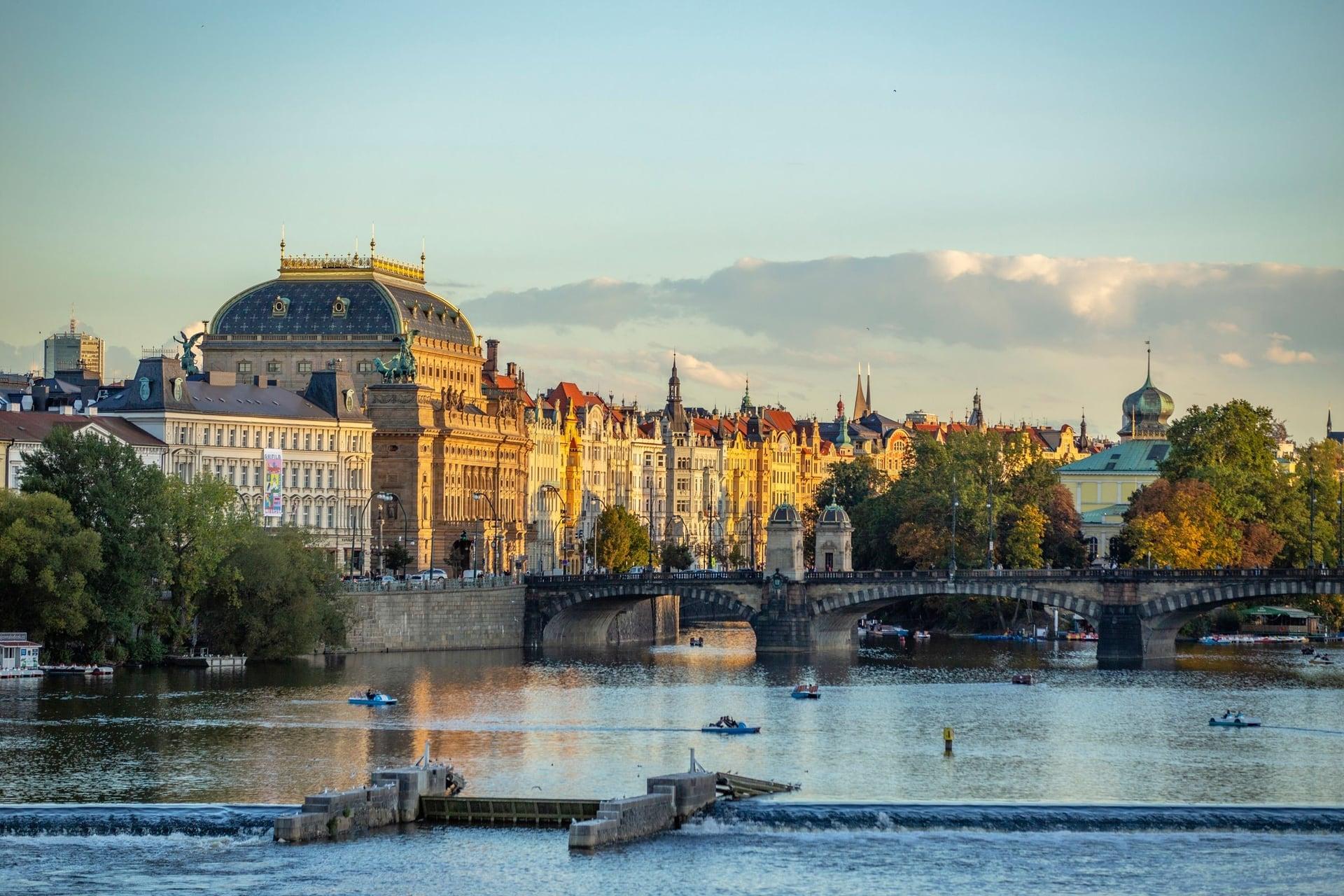
The National Theatre is the counter-example. Collections began in 1848, and the donors included nobles, societies, factory workers and thousands of ordinary citizens. It opened on 11 June 1881 with Smetana's Libuše. Sixty-two days later, workers on the roof left their charcoal smoldering, and fire took the dome, the stage and the auditorium. A new national collection began at once, and it reopened on 18 November 1883 with the same opera. The public paid for this front twice.
On the river, the Mánes Union of artists built its own gallery in 1930 beside the old Šítek water tower, and had to borrow to do it. The loan was paid off from restaurant and café rents, and cleared only three years after the Second World War.
Cubism, in small doses
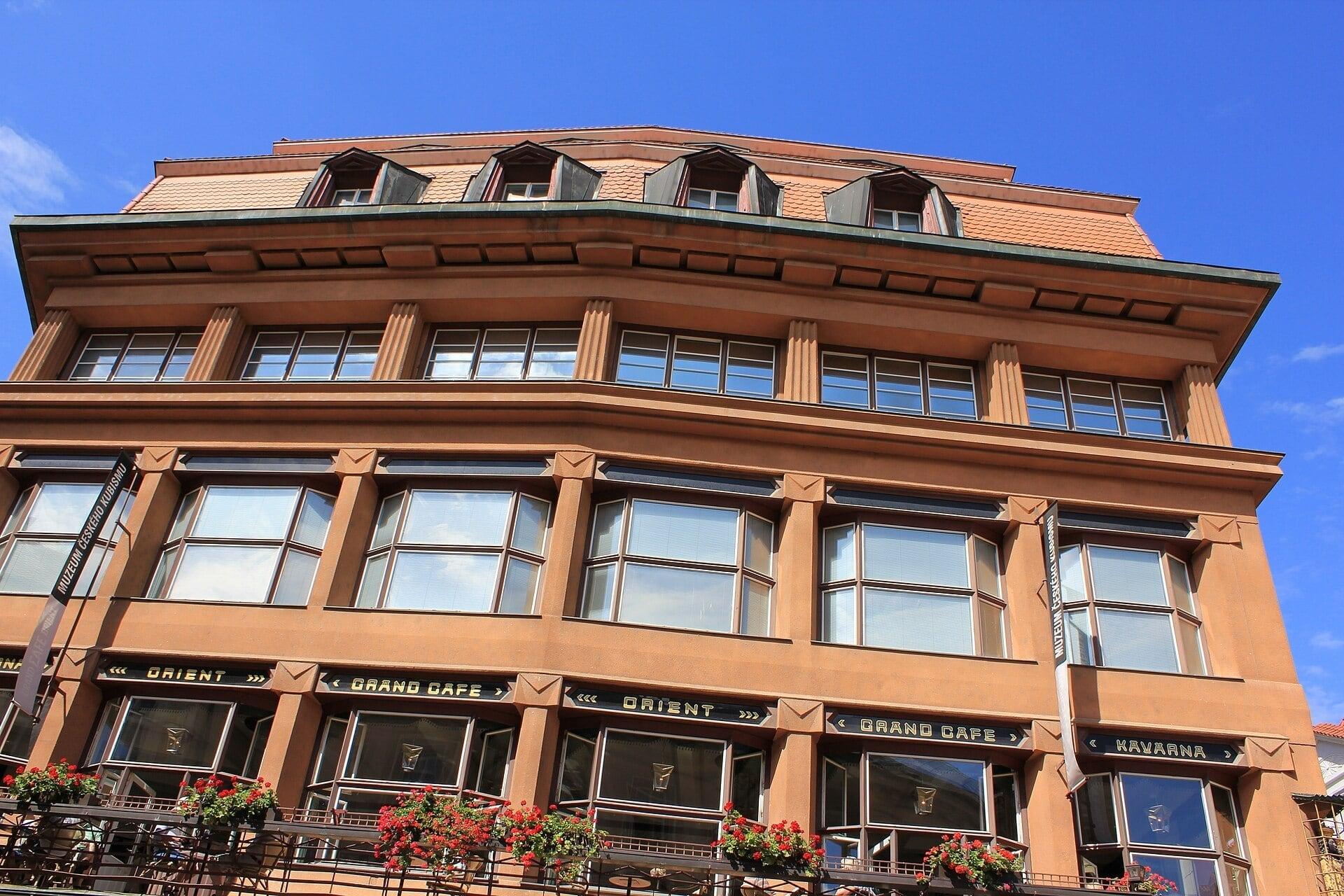
The walk is honest that Prague's famous Cubism mostly lives elsewhere. Here it comes as a single street lamp in Jungmannovo náměstí, designed by Emil Králíček around 1913, its column cut into planes like a crystal, repaired and lit again by March 2024. The rounded version is Adria. For the full statement, the Cubist house on the Old Town walk is the place: the House of the Black Madonna.
What nobody commissioned
The walk's last argument is that the most remembered things here had no client. On 21 November 1989, Václav Havel spoke to the crowd from the Melantrich balcony on Wenceslas Square because an editor with the only key lent it to a friend. On Národní, a bronze plate of eight hands, some making the V sign and some held open and empty, marks the police attack on students on 17 November 1989. It went up in 1990 without permission and stayed. And at the top of the square, a low bronze cross in the paving carries the names of Jan Palach and Jan Zajíc, the students who set themselves on fire in 1969 in protest at the occupation.
How to walk it
The route is thirteen stops over about three kilometers, roughly ninety minutes, gently downhill overall. It uses roofed passages that make it workable in rain, crosses tram tracks three times, and has two short sets of steps, each with a way round. The National Theatre's interior and the Mánes gallery are ticketed, and every stop works from outside. You can take it at your own pace, pausing in a passage café or skipping the garden if its gate is shut.
Begin at stop 1 of Wenceslas Square and New Town: Who Paid for the Front, and find the other walks on the Prague page.
Sources
- Prague City Tourism, National Theatre: the collections, the 1881 opening and fire, the 1883 reopening.
- Prague City Tourism, Lucerna Palace: Havel's building and its passage.
- Prague City Tourism, Koruna Palace: the insurer behind the corner tower.
- Prague City Tourism, Dancing House: the 1996 building by Milunić and Gehry.
- Jan Palach project, places of memory at the National Museum: the memorial in the paving to Palach and Zajíc.
Ready to experience it?
Old Town and Astronomical Clock: The Town and the Crown
75 min · 2 km · easy
More from Prague
Explore more at your own pace.
One Day in Prague: A Walkable Morning-to-Evening Itinerary
Prague's Layered City: The Coronation Route, Josefov, and a Modern Grammar
Charles Bridge and Malá Strana: What the Vltava Took and Who Put It Back
Petřín Hill: How Prague's Walled Gardens Became One Park
The House of the Black Madonna: How Prague Built Cubism Into a Wall