Petřín was divided by walls, the monks', a king's, a baroque fortress's, a convent's and a count's, and they came down one by one until the gardens became a single public park. One walled garden still stays shut. At the foot of the hill stands a memorial you can connect to all this without being told to. Roamer's walk crosses the hill from Strahov at the top to Újezd at the bottom, and it reads the slope as a story of enclosure undone.
The monks at the top
Strahov Monastery was founded in the 1140s near the road to the prince's castle, at a place where a guard was kept, which is what its name recalls. A community on a ridge had to feed and water itself. At the end of the 1500s an abbot brought the hill's spring water to the garden and monastery through tunnels, planted an orchard and started keeping bees. The Great Strahov Garden below it covers about eleven hectares and drops about a hundred meters down the slope. The wide promenade across it is still a border: monastery ground above, city ground below. Until the 1970s a wall shut this garden off from the park around the tower, and a last modern wall came out only at the end of 2016.
A king's wall that stayed
Hear a stop from this walk
Memorial to the Victims of Communism
At the top of the walk runs the Hunger Wall, about eight meters high and well over a kilometer long. The legend says Charles the Fourth built it in a famine to give the hungry work for food. Prague's own City Hall calls that a mere fiction. The wall went up from 1360 to 1362 as a fortification, a new defensive line for the Lesser Town over the summit, and a scholarly study of those defenses calls it high Gothic masonry. Look along it for patches of uneven ocher and gray stone and red brick: repairs by later rulers, by the twentieth century, and again from 2002 to 2005. It is a wall on Charles's line, rebuilt many times. Most of the walls on this hill came down. This one Prague kept.
Just through it lies the Rose Garden, laid out from 1932 to 1934 on ground that belonged to the army, held between the Hunger Wall and a baroque fortification. Even its clipped hornbeam hedges behave like walls.
A copy and a stage set
Petřín Tower is the hill's best joke. Members of the Czech Tourist Club, a hiking club, saw the Eiffel Tower at the 1889 Paris fair and came home wanting one. The architect Vratislav Pasovský drew it, work began on 16 March 1891, and it opened that August for Prague's Jubilee Exhibition. It is about a fifth of the size, around sixty meters, with eight sides instead of four legs, and the hill supplies the rest of the height.
Beside it, the Mirror Maze is a timber copy of a ruined Gothic gate at Vyšehrad, painted to look like stone. It was the club's pavilion at the same 1891 exhibition and was moved here the next year. A curator of the city's towers calls it a kind of stage flat, and it has outlasted the show by more than a century.
The walls come down
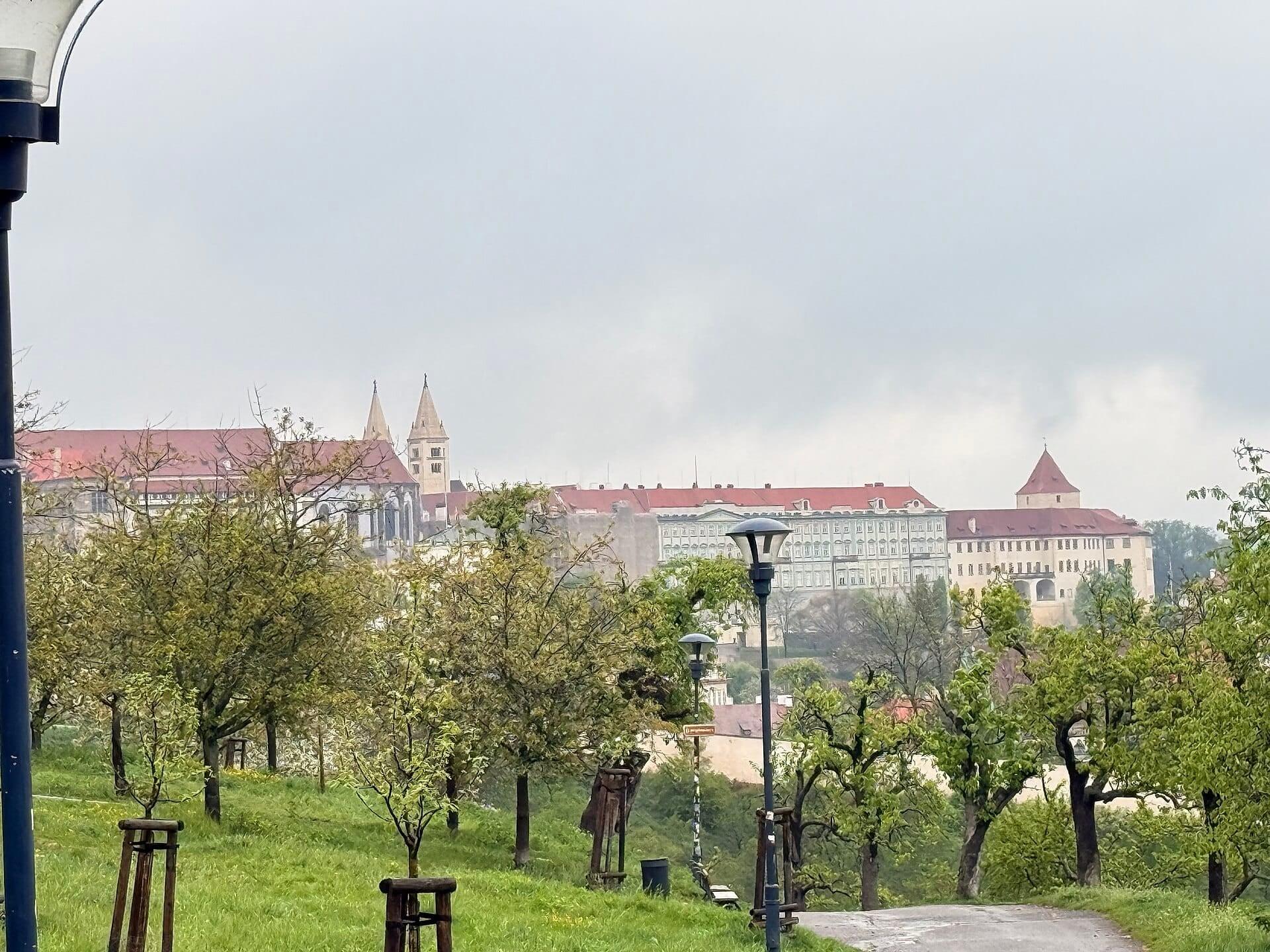
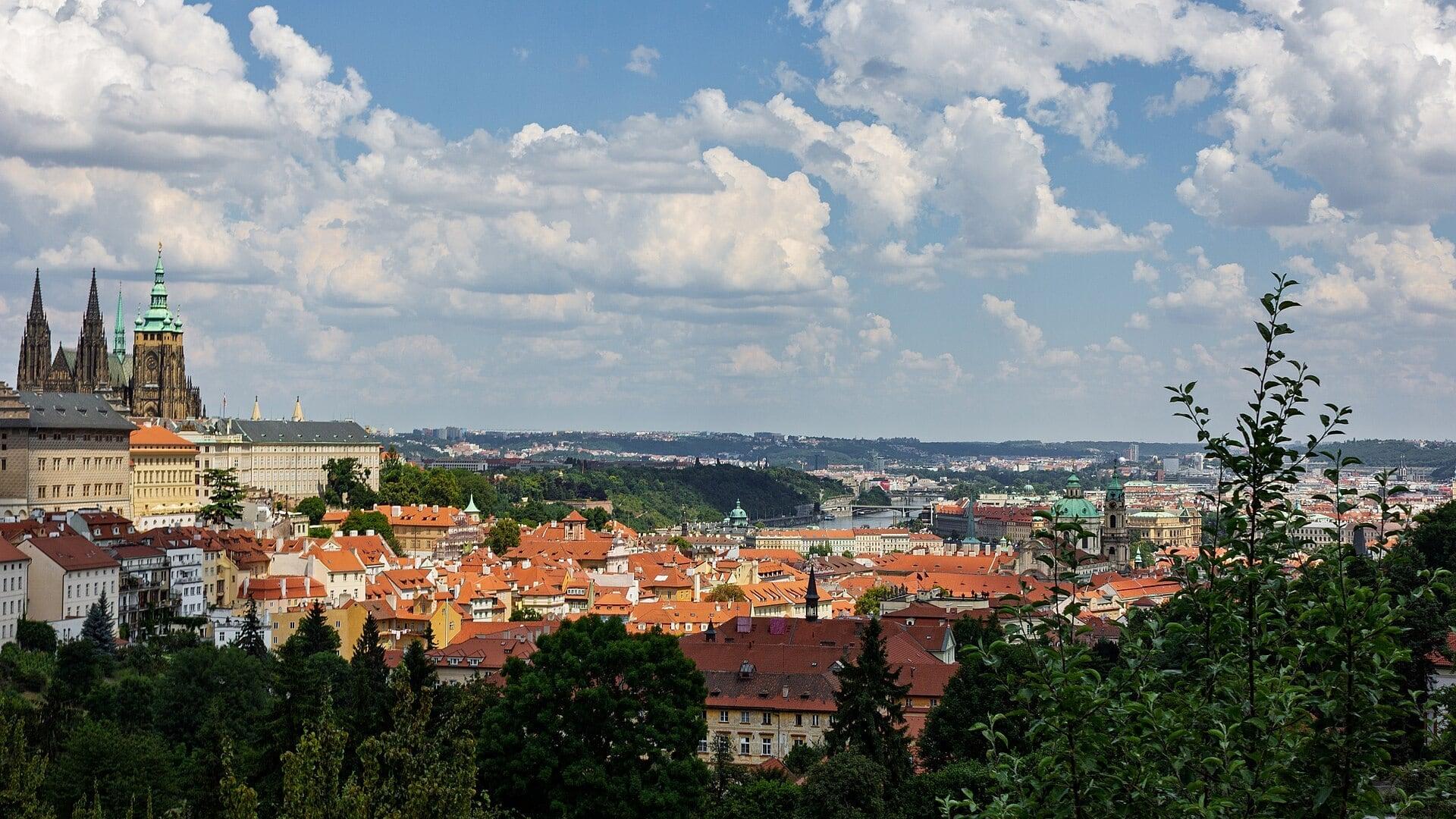
The Seminary Garden is where the thesis becomes visible. About thirteen hectares of slope, held by Carmelites in the first half of the 1600s and by the archbishop's seminary from the end of the 1700s, it had walls all the way round. In 1927 the city of Prague bought it and knocked them out, and it opened to the public on 1 May 1930. Its orchard, about two thousand fruit trees, mostly comes from a great planting of 1912 to 1914, not the monks. From its terrace, when the leaves allow, you look over the red roofs of the Lesser Town to the long front of Prague Castle, the view in the cover photograph.
The one that stays shut
Below the orchard is the garden you cannot enter. It belongs to the Schönborn Palace, now the United States Embassy. Count Rudolf Colloredo, commandant of Prague, bought an old vineyard there in 1643. A chronicler says that when the Swedes burst into the Lesser Town in 1648, Colloredo fled through that garden at night in his nightclothes and had himself ferried across the river. In 1967 two scholars studying these slopes noted that the garden was already American ground, so they could write of it only theoretically. The walk's path is as close as anyone gets.
At the foot
Past Jan Neruda's statue and a small fountain fed by the hill's water, the walk ends on Újezd at the Memorial to the Victims of Communism, unveiled in 2002. Six bronze figures stand on steps that narrow as they rise, each one more broken than the last. A bronze strip records the count for 1948 to 1989: convicted, executed, died in prison, died at the border, emigrated. Its sculptor, Olbram Zoubek, had taken Jan Palach's death mask in 1969, and the secret police later melted down the gravestone he made for him. The walk does not draw the line from a hill of opened walls to a memorial for people who could not leave. It leaves that to you.
How to walk it
The route is ten stops over about two and a half kilometers, roughly ninety minutes, with about four hundred steps and no sensible way round them: about one hundred ninety climb early, and from the sixth stop nearly everything goes down. The library, the tower and the Mirror Maze are ticketed, and every stop works without them. Stone stairs are slippery in the wet. Because it is all park, it suits an unhurried pace, with time to sit in the orchard or skip the tower queue as you like.
Begin at stop 1 of Petřín Hill: Orchards, Walls and the Way Down, and see the rest of the city's walks on the Prague page.
Sources
- Prague City Tourism, Petřín Gardens: the Hunger Wall's size, the Rose Garden, the gardens' history.
- Prague City Tourism, Seminary Garden: its owners, the 1912 to 1914 planting, the 1927 purchase and the 1930 opening.
- Prague City Tourism, Great Strahov Garden: eleven hectares, the hundred-meter drop, the 2016 wall.
- Prague City Tourism, Petřín Tower: the Tourist Club, the octagonal free copy at one fifth scale.
- Čiháková, Staletá Praha (2009): the Hunger Wall as a high Gothic fortification.
- Prague City Tourism, Memorial to the Victims of Communism: the figures and the inscription.
Ready to experience it?
Petřín Hill: Orchards, Walls and the Way Down
90 min · 2.5 km · moderate
More from Prague
Explore more at your own pace.
One Day in Prague: A Walkable Morning-to-Evening Itinerary
Prague's Layered City: The Coronation Route, Josefov, and a Modern Grammar
Charles Bridge and Malá Strana: What the Vltava Took and Who Put It Back
The House of the Black Madonna: How Prague Built Cubism Into a Wall
Wenceslas Square and the New Town: Who Paid for Prague's Grand Fronts