The river keeps taking the bridge and the island beneath it, and someone keeps paying to put them back. That is the thread through Roamer's walk from the Old Town Bridge Tower over Charles Bridge into Malá Strana. Beyond the water, the losses have other authors: war at Our Lady Under the Chain, the state at the Lennon Wall, the Jesuits' own demolition at Saint Nicholas. The walk says so, rather than forcing a flood onto every stop.
A bridge born of a flood
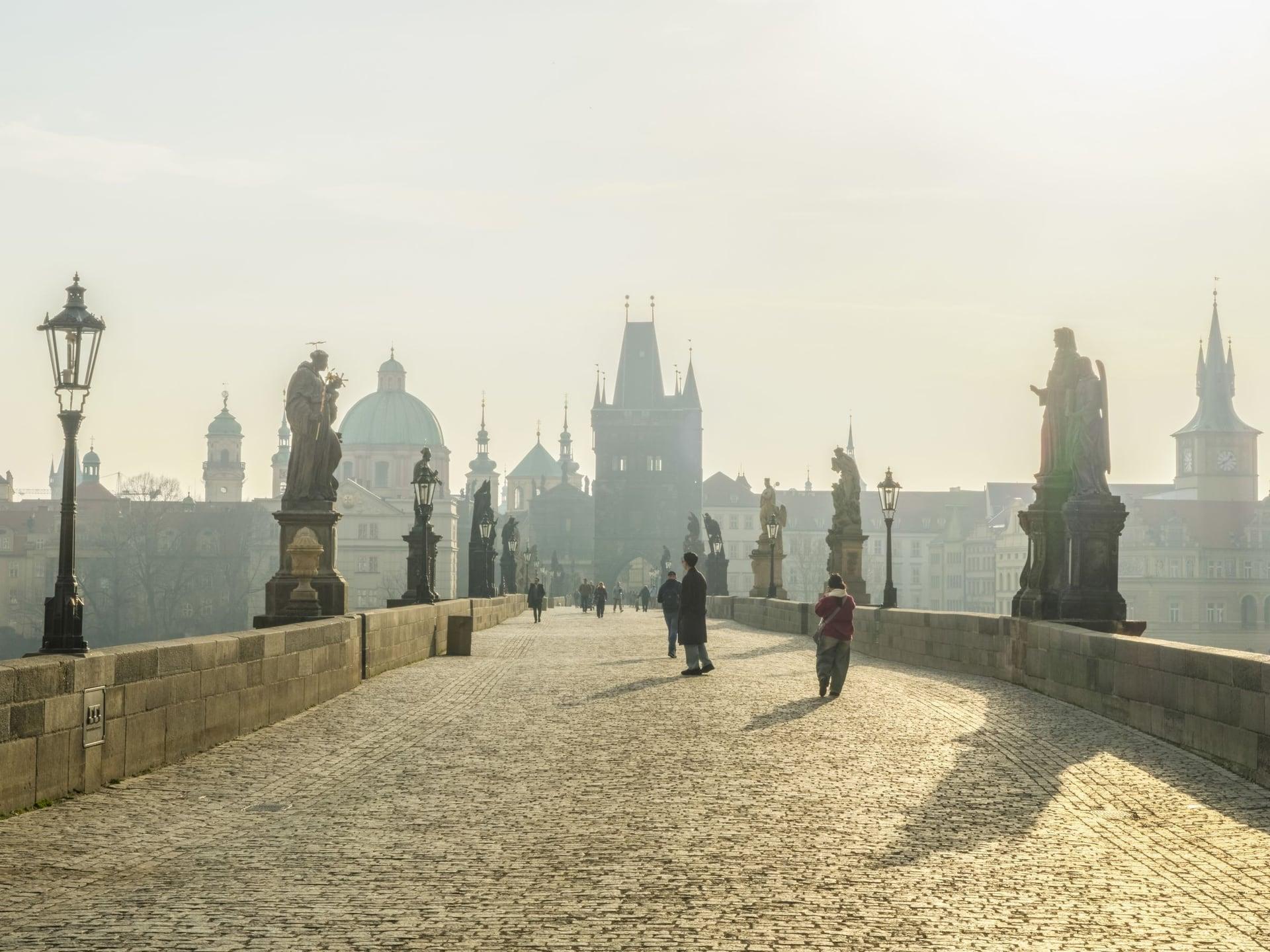
Charles Bridge exists because the Vltava destroyed its predecessor. A flood in 1342 took the Judith Bridge, the stone crossing built around 1170, and Charles the Fourth founded the new one in 1357. It runs a little over five hundred meters on sixteen sandstone arches and bends on the way across. Until about 1870 it was simply the Stone Bridge.
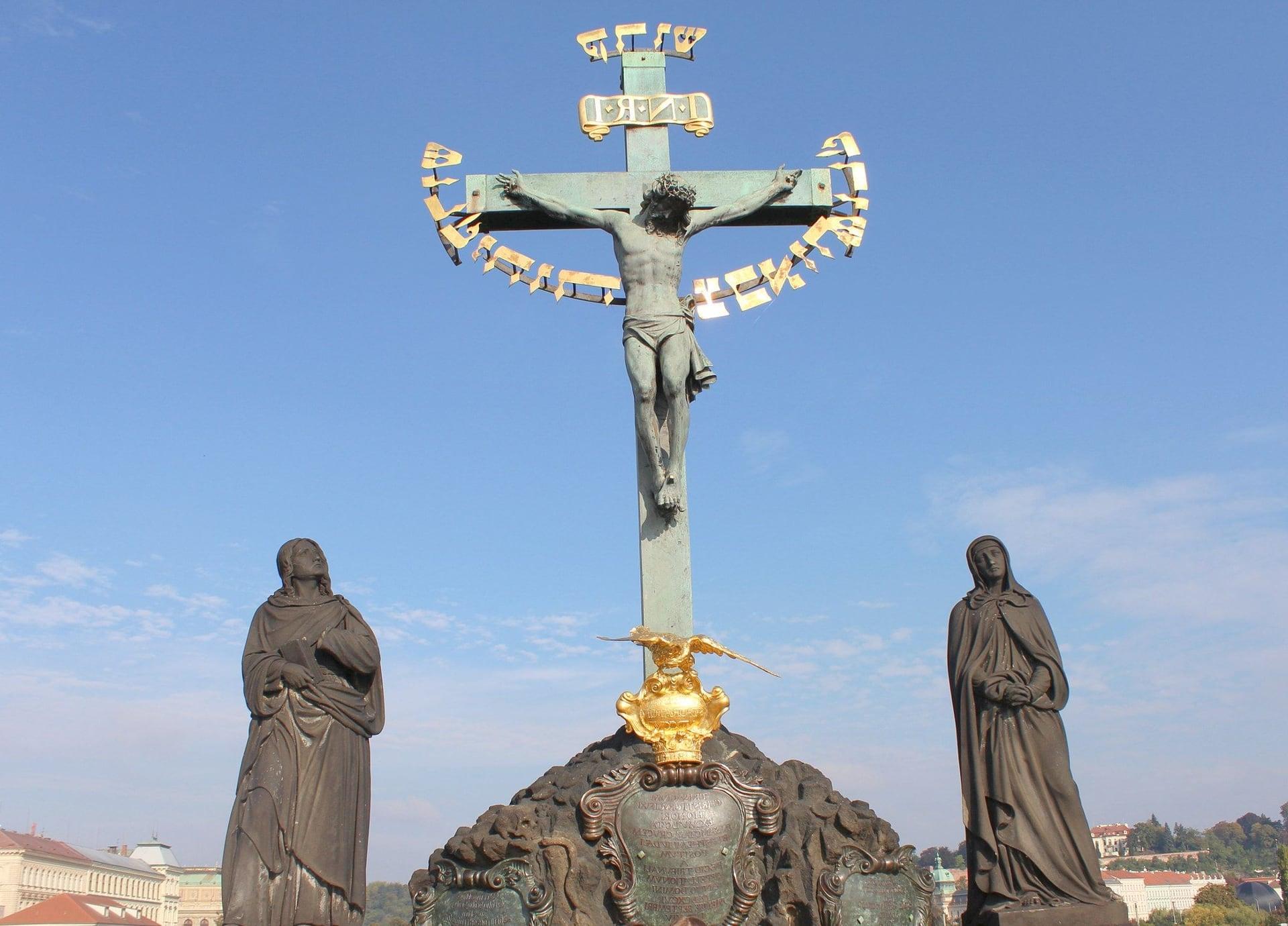
The Old Town Bridge Tower at its start was built by the workshop then raising Saint Vitus Cathedral, and it served as both a fortified gate and a triumphal arch for coronation processions. The figures on its front are stand-ins; the Gothic originals went indoors to a museum. That sets up the walk's habit of noticing replacements. Among the thirty statues and groups along the parapets, most from just after 1700, many are copies now. The bronze Saint John of Nepomuk, from 1683, is the oldest still standing. The real John of Pomuk died under torture in 1393, and most historians tie his death to a dispute over an abbey, not the queen's confession the legend on the base describes.
What the water did
Hear a stop from this walk
Nerudova: The Two Suns
In September 1890, after four days of rain, wrecked rafts and timber jammed against the piers, and three arches fell into the river, taking two groups of statues with them. Several people died. You walk over what was put back.
Look over the parapet and you see the bridge's defense: oak ice guards standing in front of seven of the fifteen piers, catching ice and floating logs so the soft sandstone does not have to. The current ones went in during 2019. In the August 2002 flood the Vltava peaked at about 5,160 cubic meters a second, above the old record of 1784. Firefighters put a tracked excavator on the deck to break up wreckage and steer it past the piers, and pulled back only when the bridge began to shake. It stood. Nearly fifty thousand people across the city were evacuated.
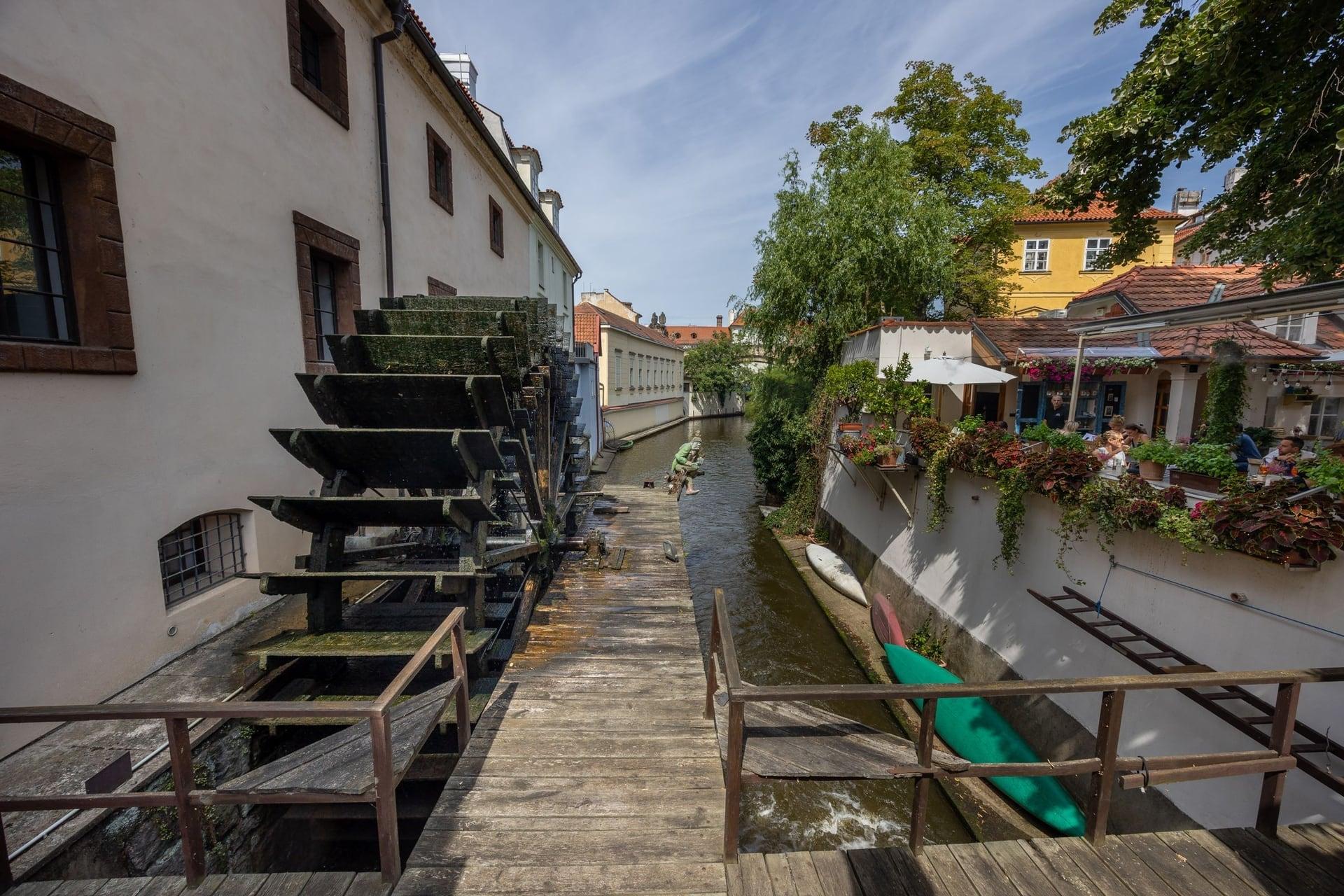
Below the bridge, Kampa Island is itself a product of water and work. The Čertovka channel was dug to drive mill wheels, and the land was raised over time, especially with rubble after the great fire of 1541. The big wheel of the Grand Prior's Mill, in the cover photograph, is a restoration of 1992 kept for looks. In 2002 it vanished under the flood to the tips of its paddles. Sova's Mills at the island's far end, rebuilt in stone about 1589, now hold Museum Kampa, and the flood reached them too.
Prague liked to say its bridge mortar was mixed with eggs. In 2008 a laboratory announced it had found them. In 2010 the same institute took it back.
Losses with other authors
Step off the bridge into Malá Strana and the cause changes. At Our Lady Under the Chain, two heavy towers stand over a courtyard where a nave should be. The Knights of Saint John demolished most of their Romanesque basilica from about 1314 to start a larger Gothic one, and the Hussite wars stopped it partway. The church you can enter is a choir with no nave. No river did that.
At the Lennon Wall, the agent was the state. A garden wall of the Knights of Malta, about thirty-five meters long, collected messages from the 1960s, and after John Lennon's death in December 1980 a memorial appeared in a niche. The Communist authorities had it painted over several times. It kept coming back. Since 2019 it has been an official memorial place, with spray paint banned.
At Saint Nicholas the demolition was the builders' own. After 1620 the Jesuits took the Gothic parish church of 1283, knocked it down, bought gardens, a parsonage, a school and twelve houses, and built a block about sixty meters long. Christoph Dientzenhofer built the curving west front and nave, consecrated in 1711, and his son Kilian Ignaz finished the dome in 1751. The belfry beside it belonged to the town, and its watchman rang for fires until 1891. What the water took on the bridge was put back. Nobody put those houses back.
Up Nerudova
The last stretch climbs Nerudova, the old road toward the Castle, reading house signs from before 1770, when Maria Theresa ordered houses numbered to count men for the army. The Three Little Fiddles mark a family of violin makers, and the Two Suns at number 47 carry the plaque to Jan Neruda, who grew up there and gave the street its name.
How to walk it
The route is thirteen stops over about two and a half kilometers, roughly ninety minutes, flat to Kampa and then climbing about fifty meters, mostly up Nerudova, with no stairs. The towers, the museum and Saint Nicholas are ticketed, and every stop works from outside. The bridge is crowded by day, so you might go early or late; on your own schedule you can linger under the bridge on Kampa or skip ahead to the climb. For the bridge's own story in depth, read Charles Bridge: the crossing Charles the Fourth built to last.
Begin at stop 1 of Charles Bridge and Malá Strana: What the River Left, and see all walks on the Prague page.
Sources
- Prague City Tourism, Charles Bridge: dates, dimensions, the 1890 and 2002 floods, the stairs.
- Prague City Tourism, statues and groups on Charles Bridge: the thirty statues, their donors, the copies, Saint John of Nepomuk.
- Novinky, the new ice guards (2019): oak ice guards in front of seven of fifteen piers.
- ČT24, no eggs in Charles Bridge (2010): the retraction of the egg finding.
- Praha 1, the Lennon Wall: ownership by the order, the wall's size and its rules.
Ready to experience it?
Charles Bridge and Malá Strana: What the River Left
90 min · 2.5 km · easy
More from Prague
Explore more at your own pace.
One Day in Prague: A Walkable Morning-to-Evening Itinerary
Prague's Layered City: The Coronation Route, Josefov, and a Modern Grammar
Petřín Hill: How Prague's Walled Gardens Became One Park
The House of the Black Madonna: How Prague Built Cubism Into a Wall
Wenceslas Square and the New Town: Who Paid for Prague's Grand Fronts