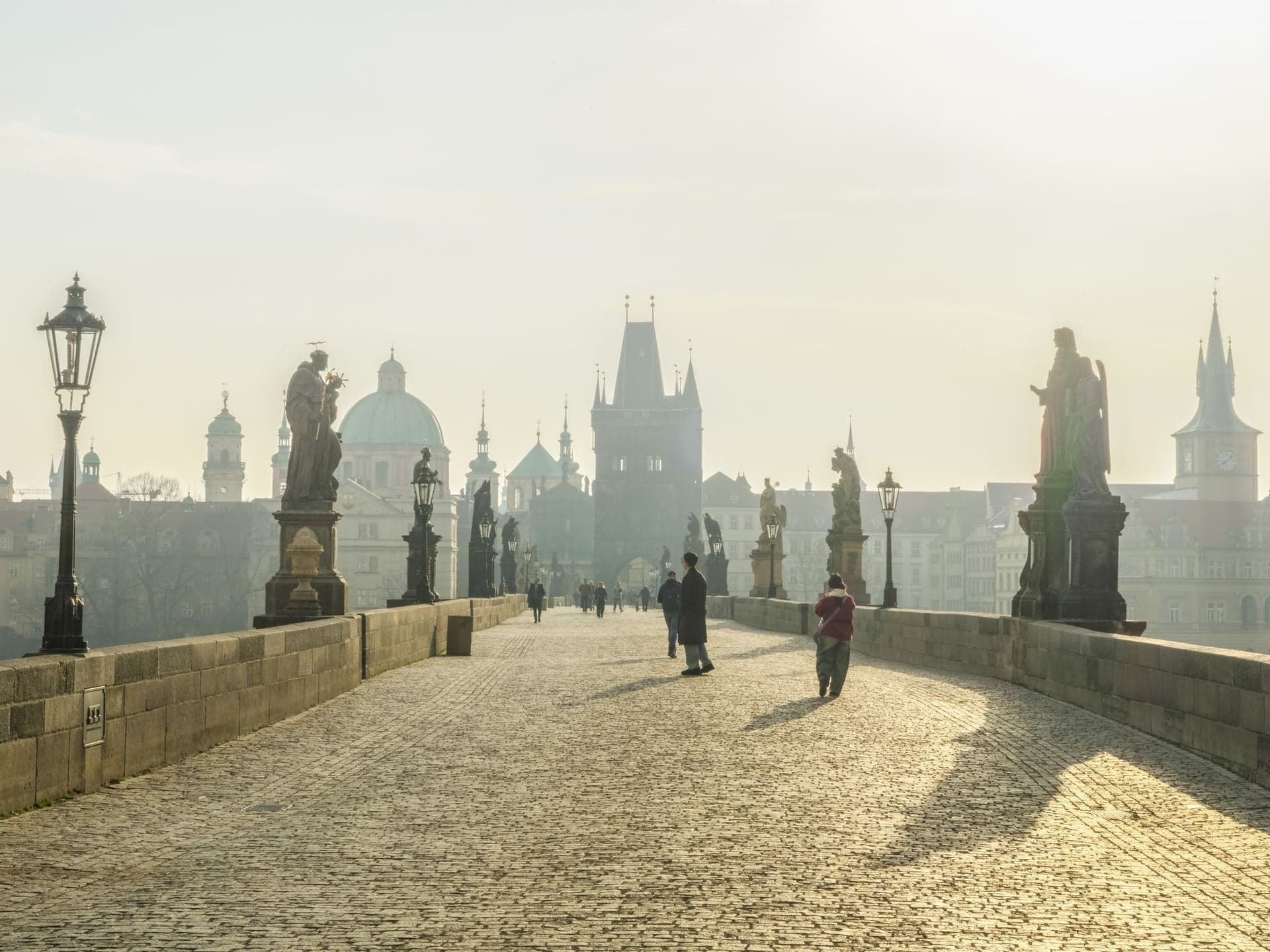
From the Old Town Bridge Tower across Charles Bridge to the Lesser Town towers, the Lennon Wall, Čertovka and Kampa, back under the arches to Saint Nicholas, then up Nerudova's house signs to Jan Neruda's Two Suns.
Start · Old Town Bridge Tower
DirectionsStops
- 1
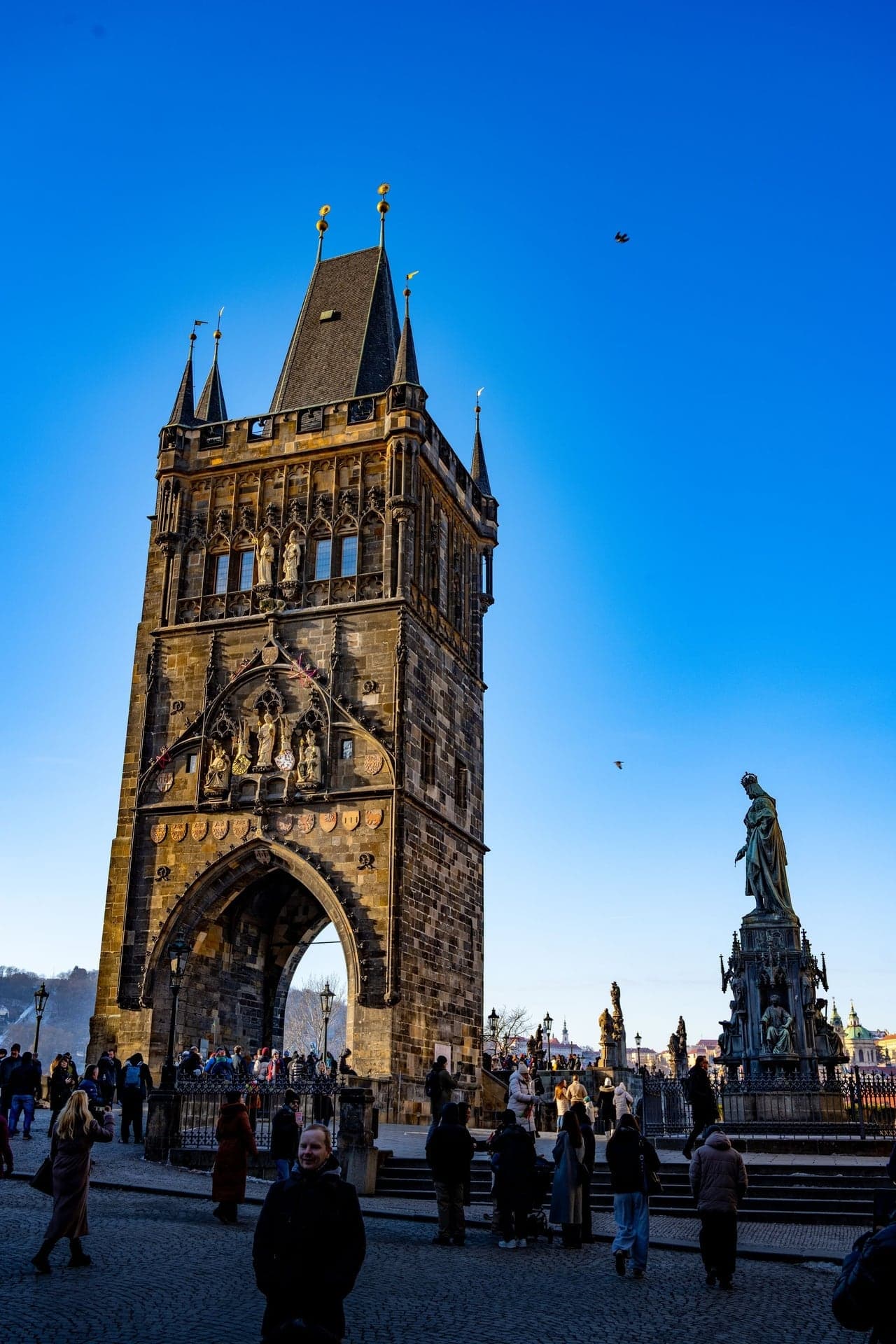
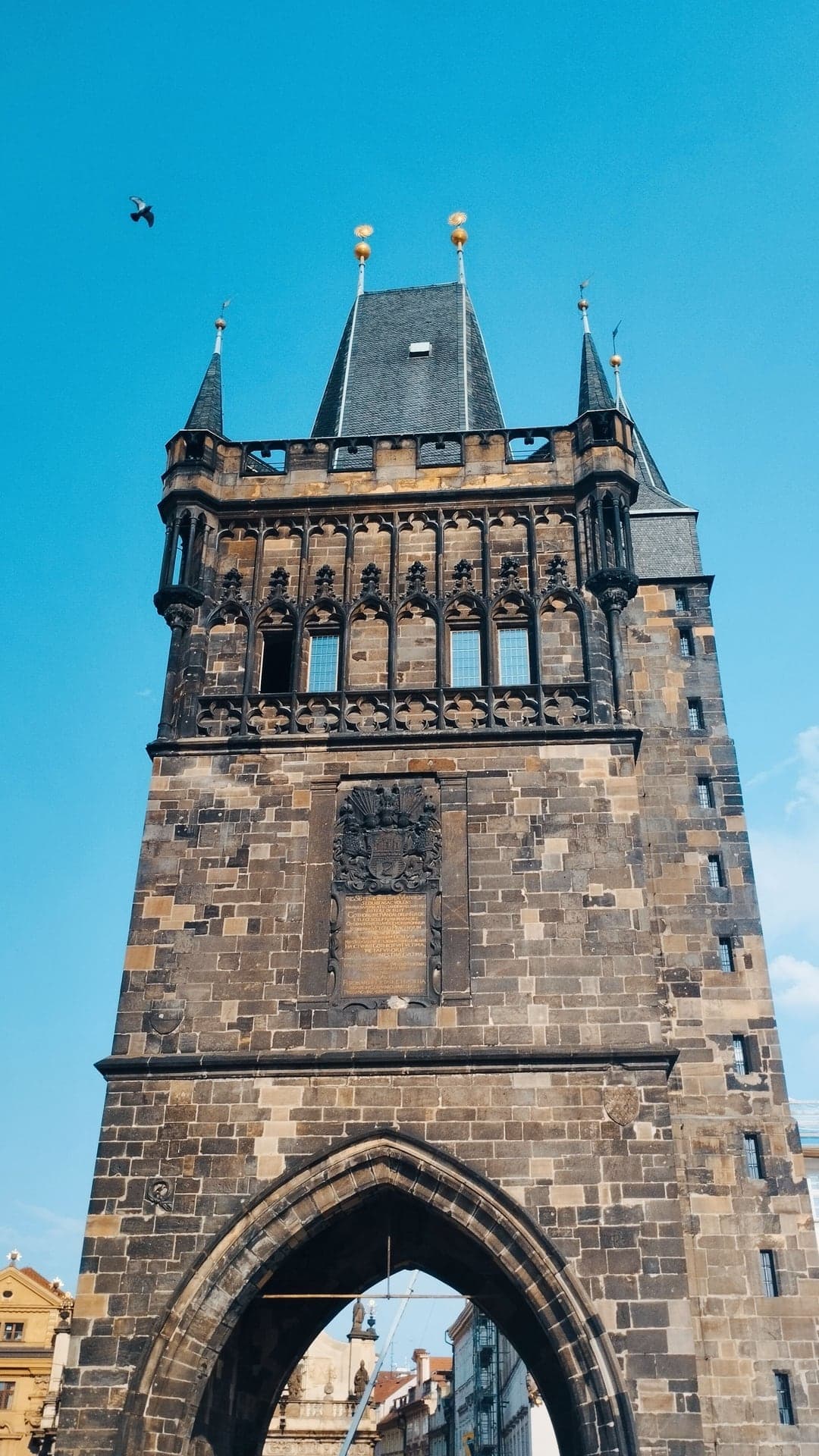
Old Town Bridge Tower
A Gothic gate doubled as a triumphal arch, with stand-ins for the kings on its front. Walking under it is free; the climb is ticketed.
- 2
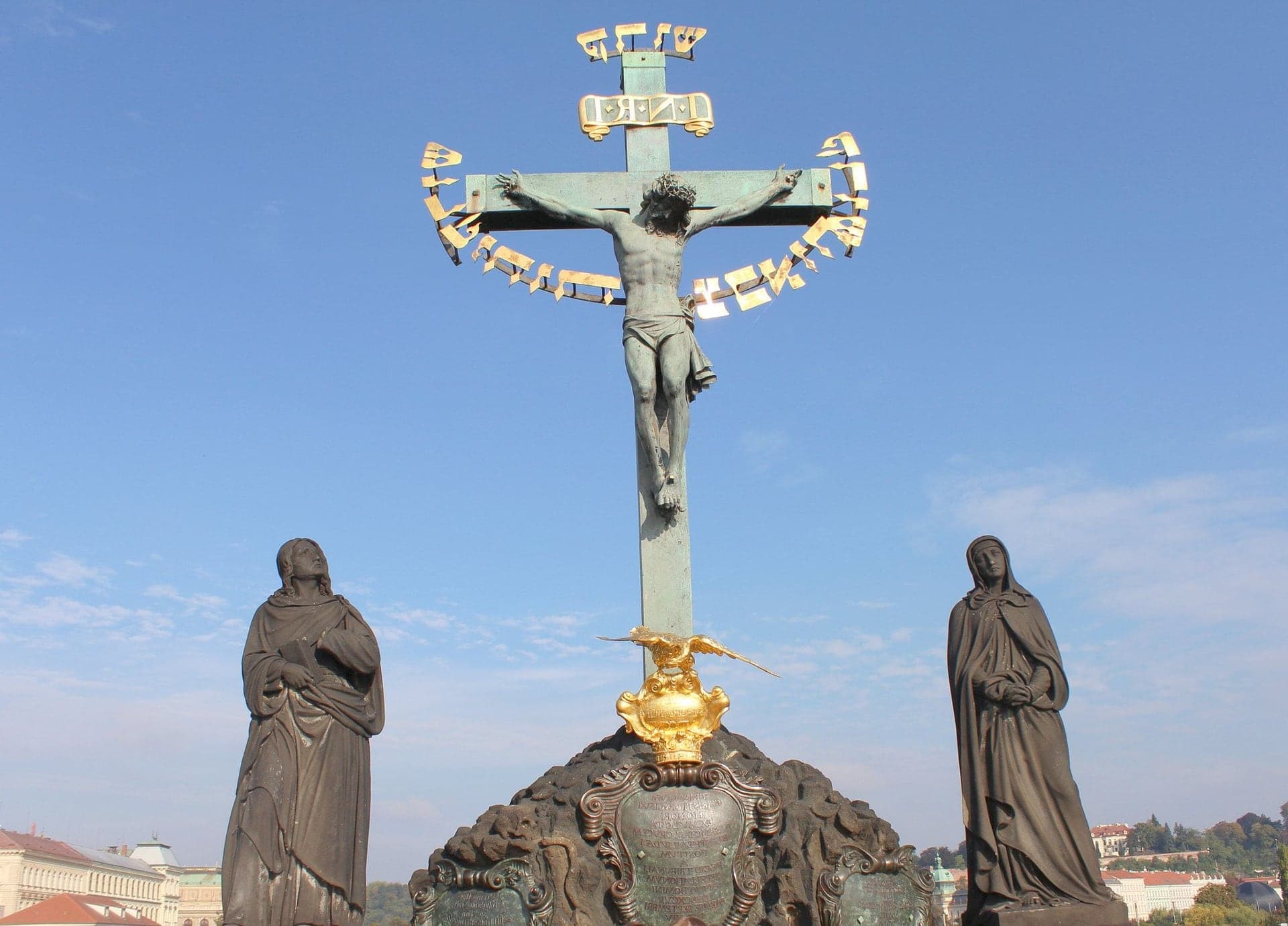
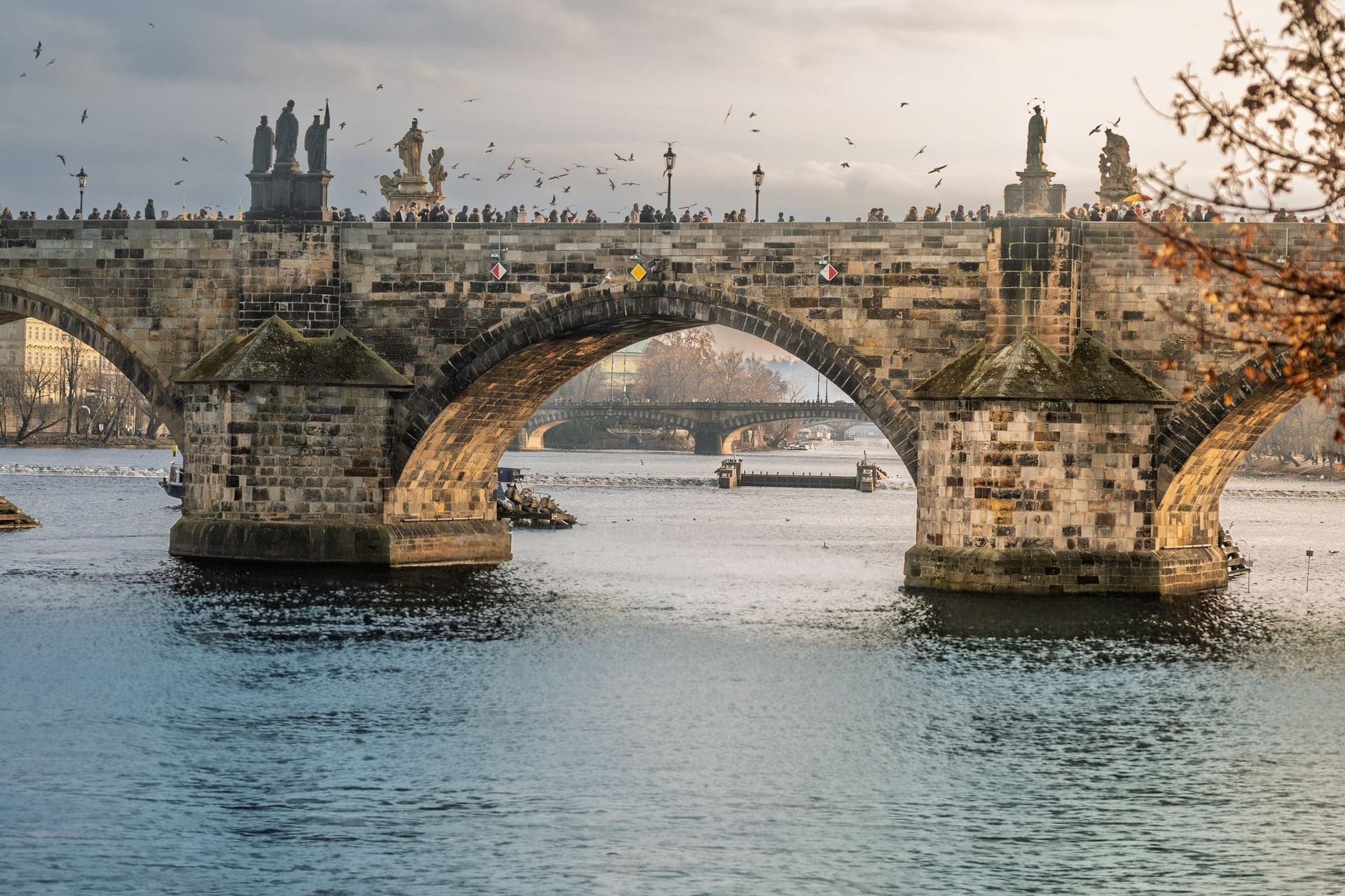
Charles Bridge: Crucifix and First Arches
The first stand over the Vltava, above the ice guards. Three arches fell in 1890, and the crucifix across the deck carries a hard history.
- 3
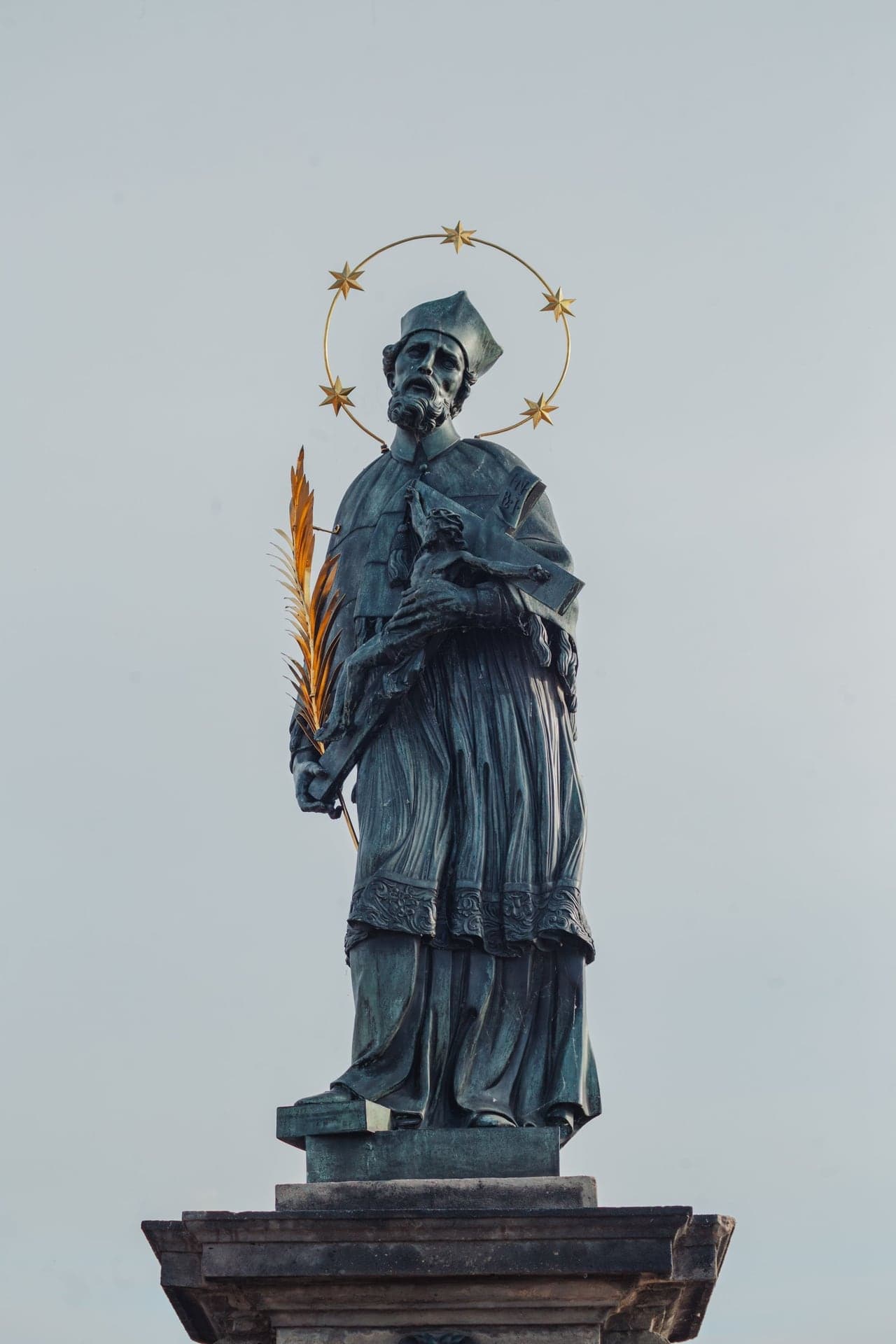
Charles Bridge: Saint John of Nepomuk
One bronze saint among the sandstone, the oldest statue still on the bridge. His story on the base is a legend; most historians think it was about an abbey.
- 4
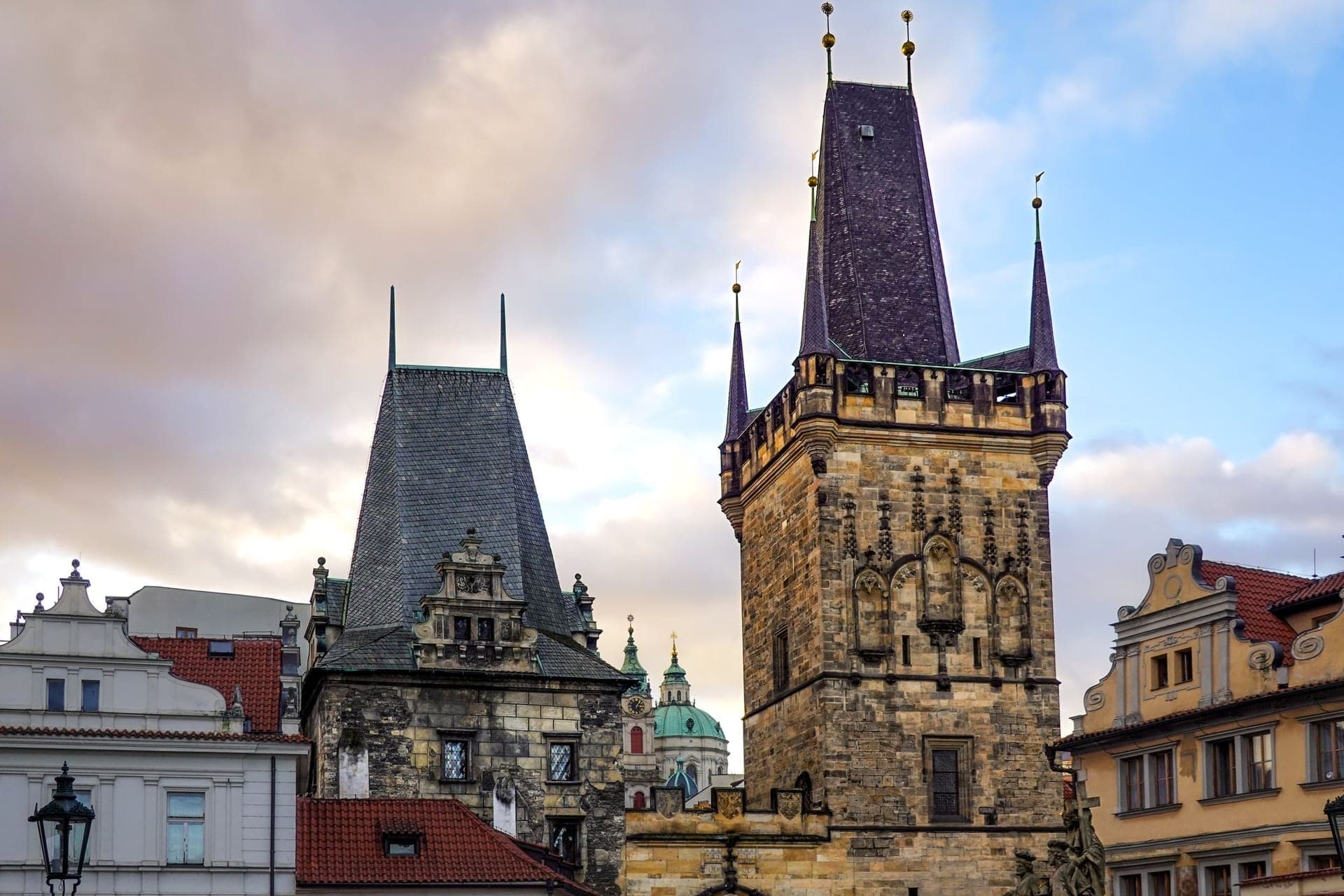
Lesser Town Bridge Towers
Two towers of different ages flank this gate. The lower one is older than the first stone bridge here, and the taller is open on a ticket.
- 5
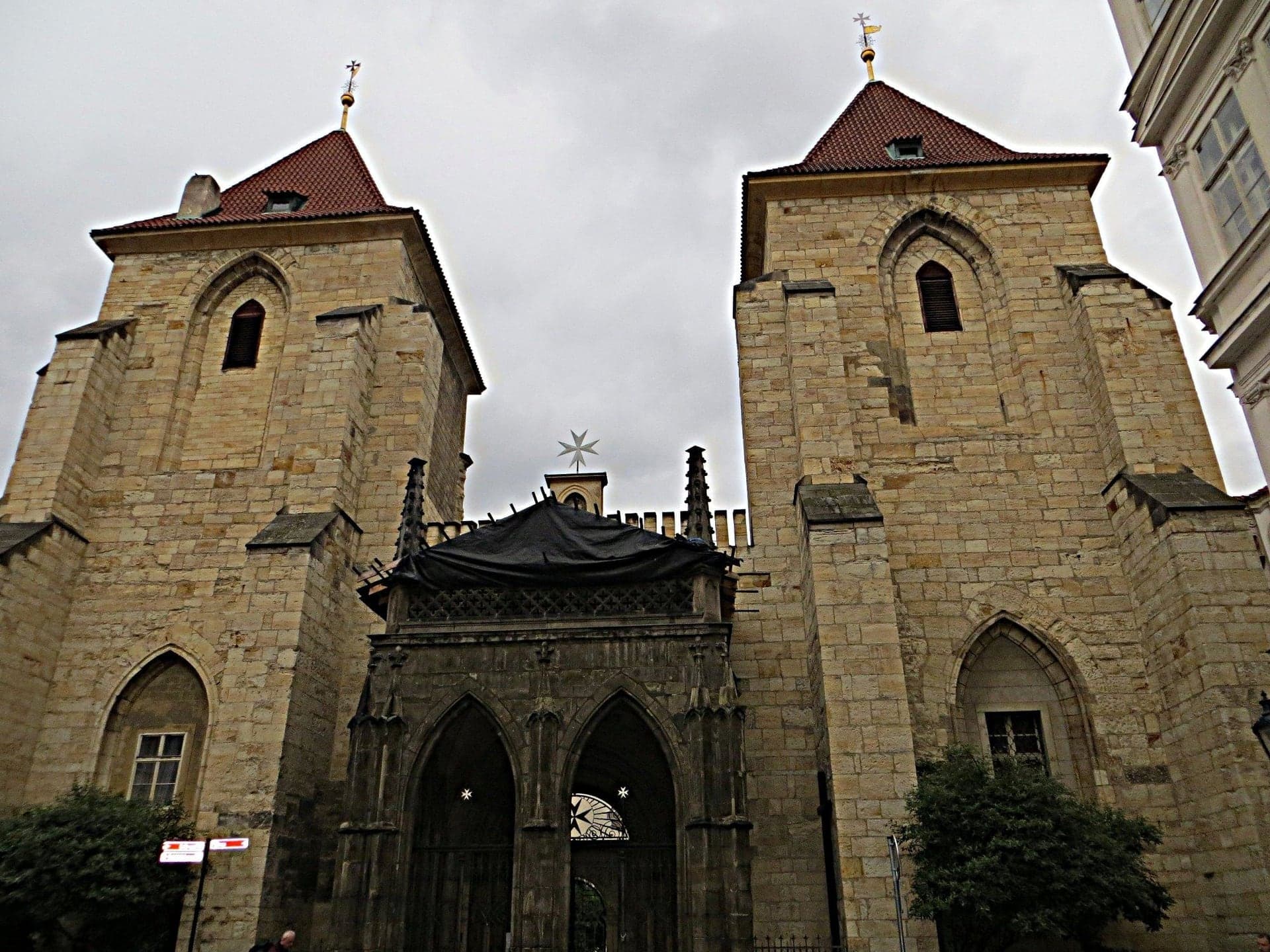
Maltese Square and Our Lady Under the Chain
A church lost its nave for good. Two heavy towers stand in front of the gap, where the Hussite wars stopped the work.
- 6
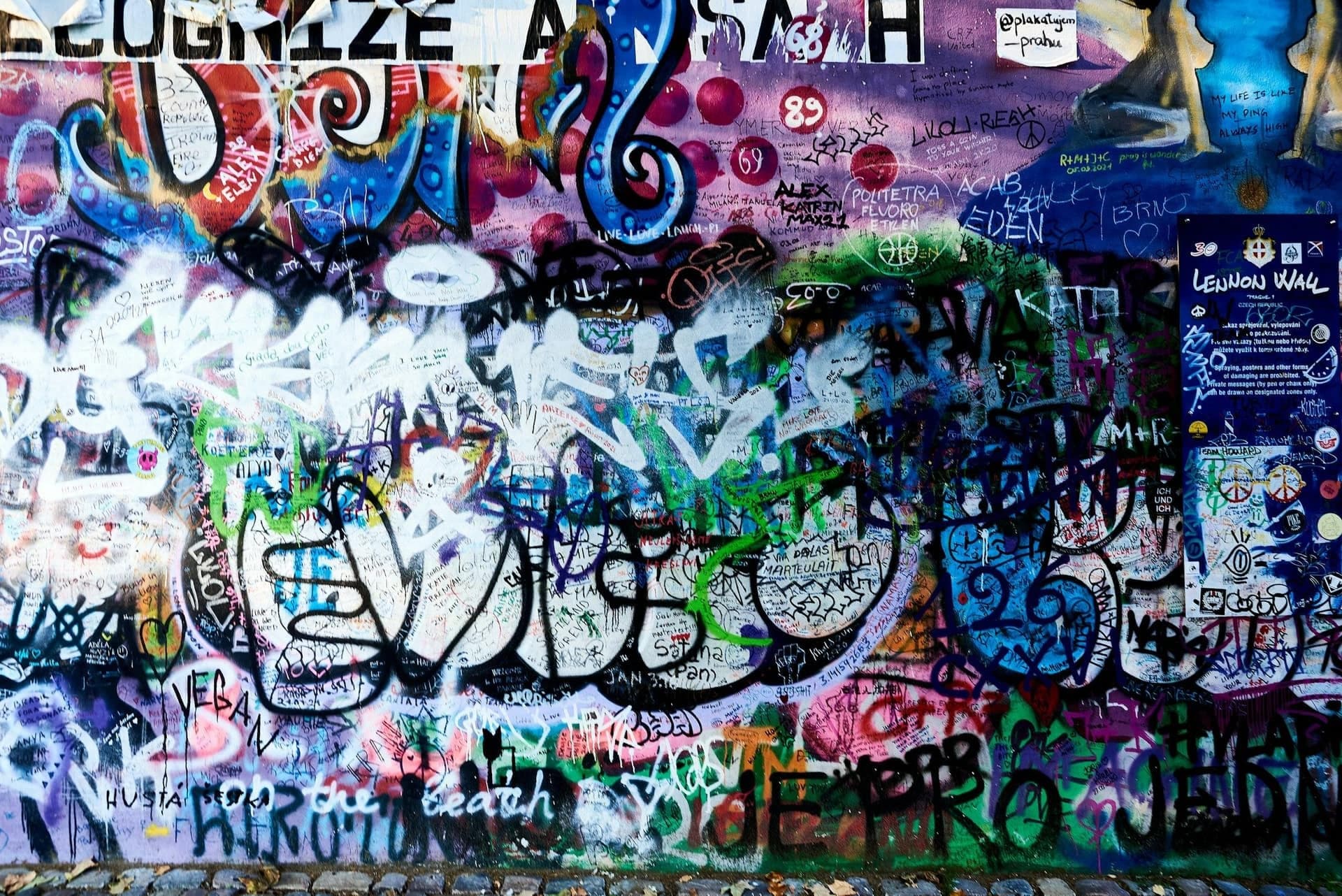
Lennon Wall
A wall painted over keeps coming back. It belongs to the Order of Malta and has been an official memorial place since 2019.
- 7
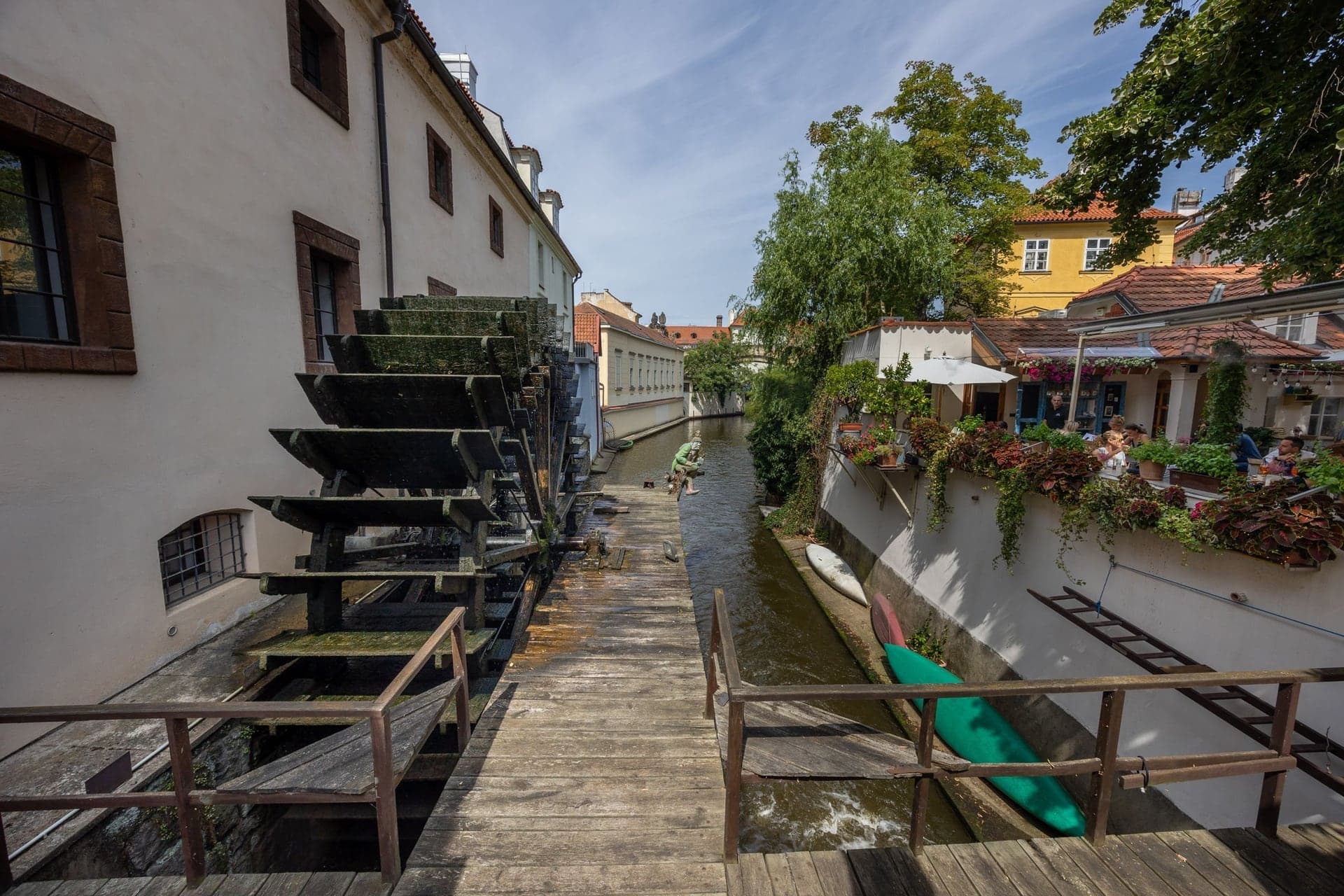
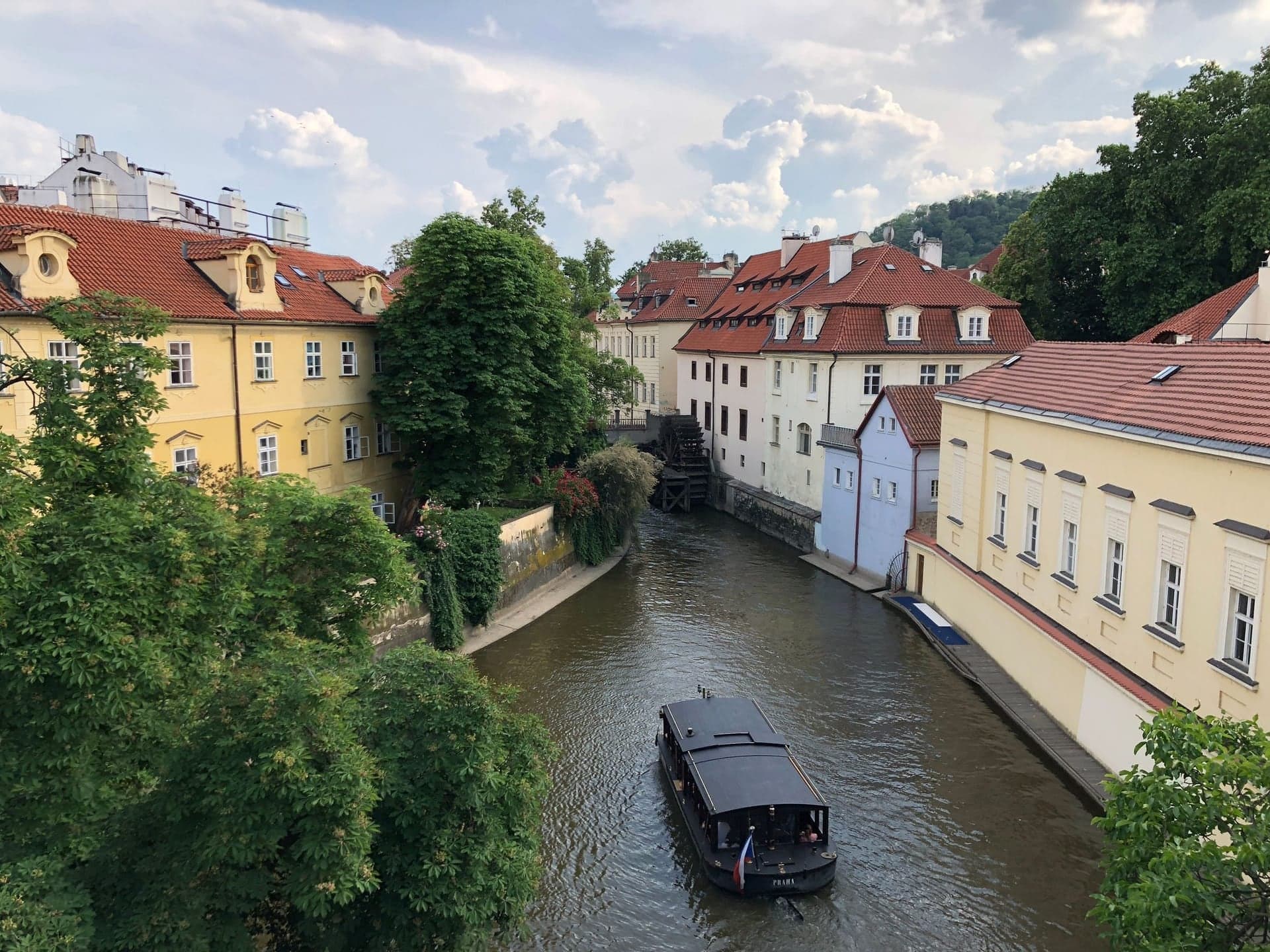
Čertovka and the Grand Prior's Mill
A dug channel made this island, for the sake of mills. The wheel is about eight meters across and vanished in the 2002 flood.
- 8
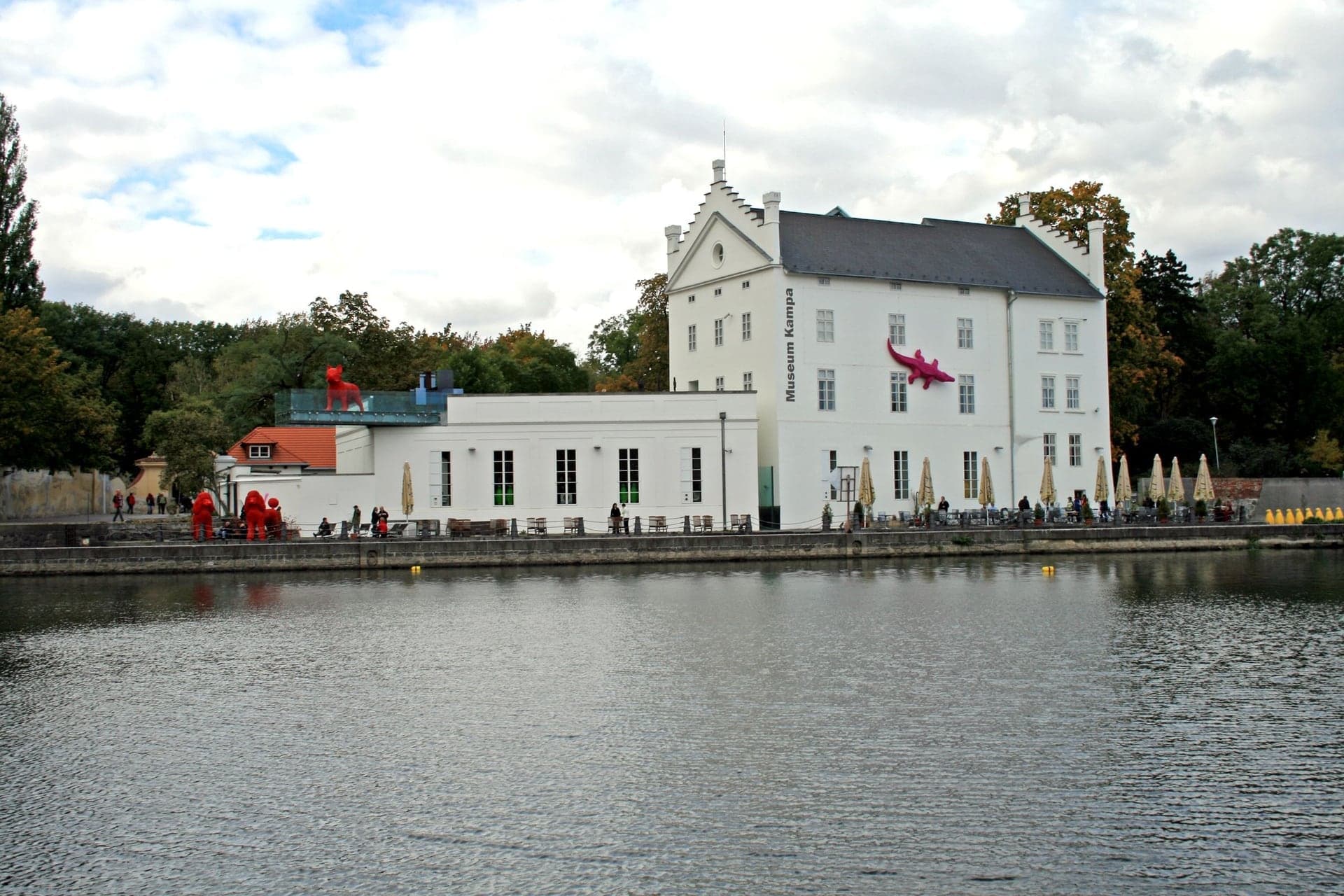
Kampa Park and Sova's Mills
An old mill holds a modern museum. It was a Swedish gun position in 1648, and the flood reached it in 2002.
- 9
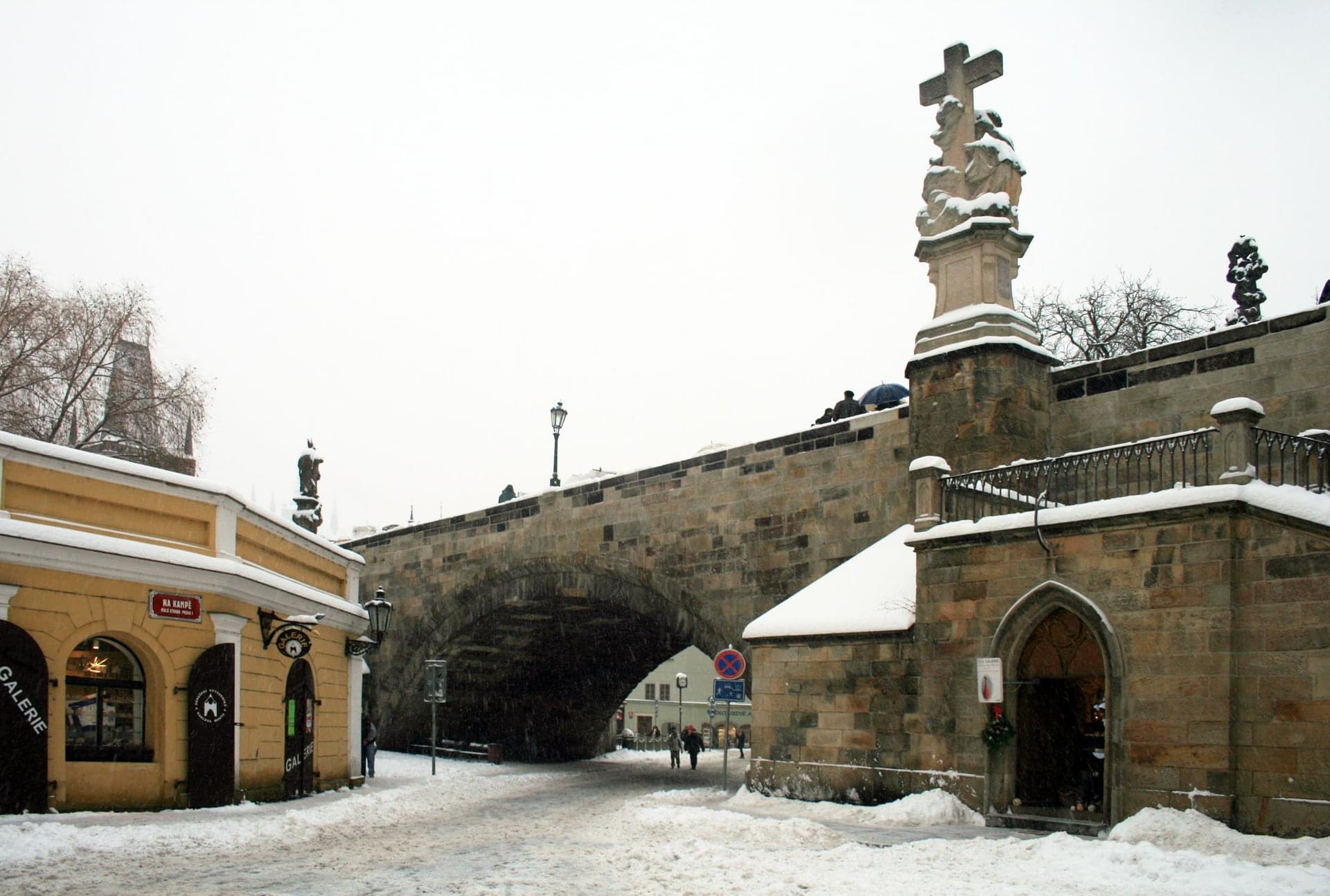
Na Kampě: The Bridge from Below
The bridge seen from below at last, on the cobbles of Na Kampě. Firefighters on its deck fought the 2002 flood until it began to shake.
- 10
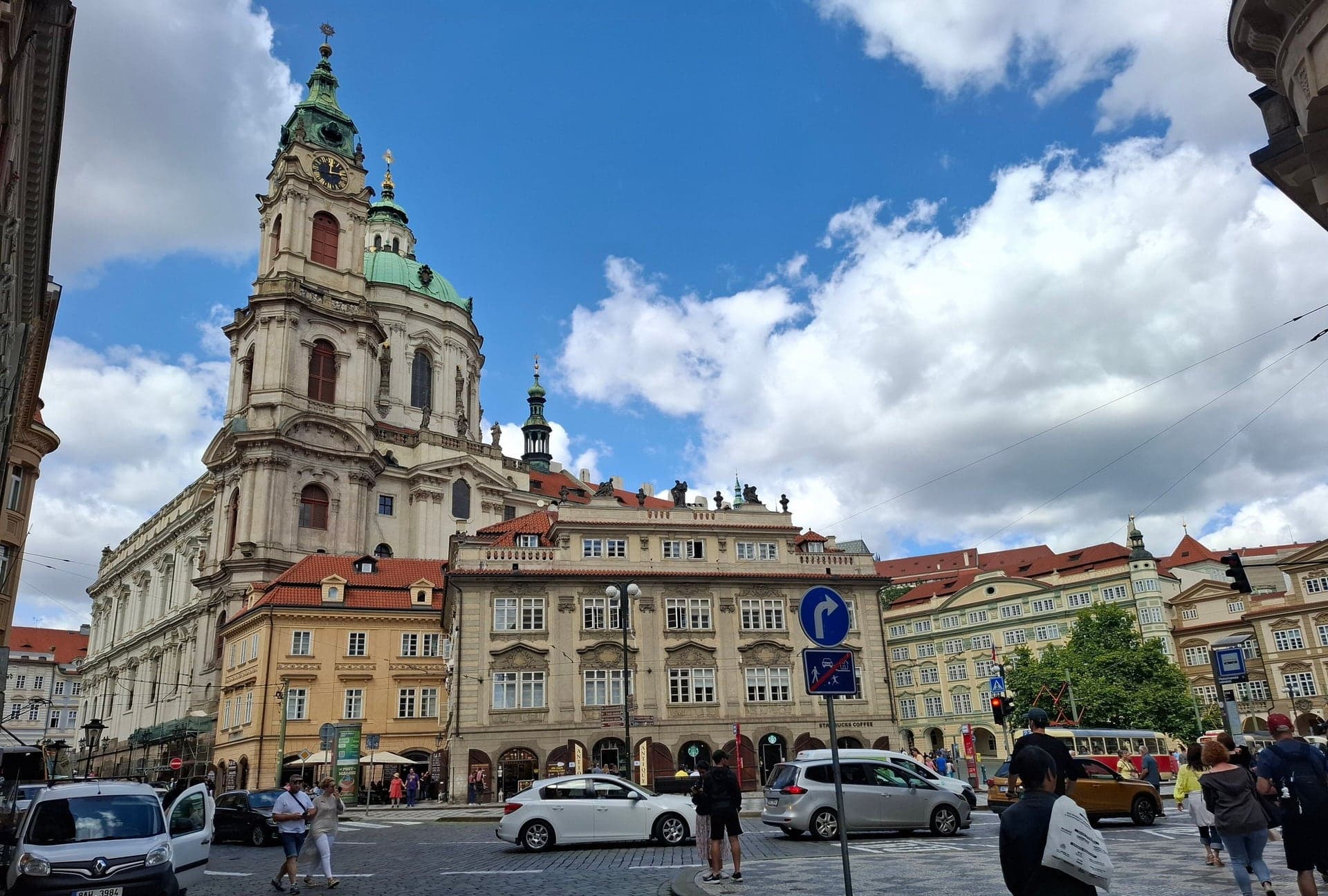
Lesser Town Square: Dome and Belfry
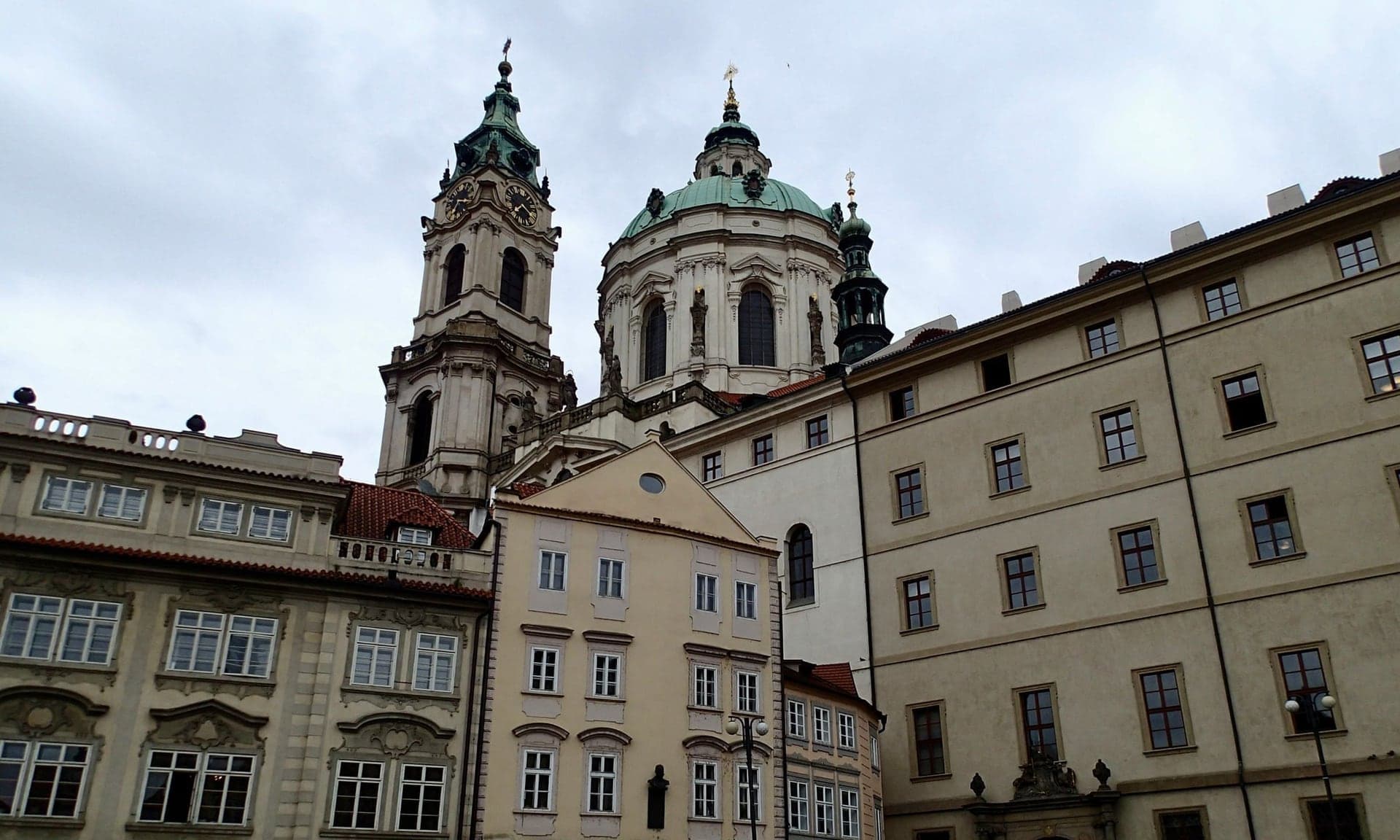
Dome and tower had two owners. The church was the Jesuits' and the belfry was the town's, with its own door and its own watchman.
- 11
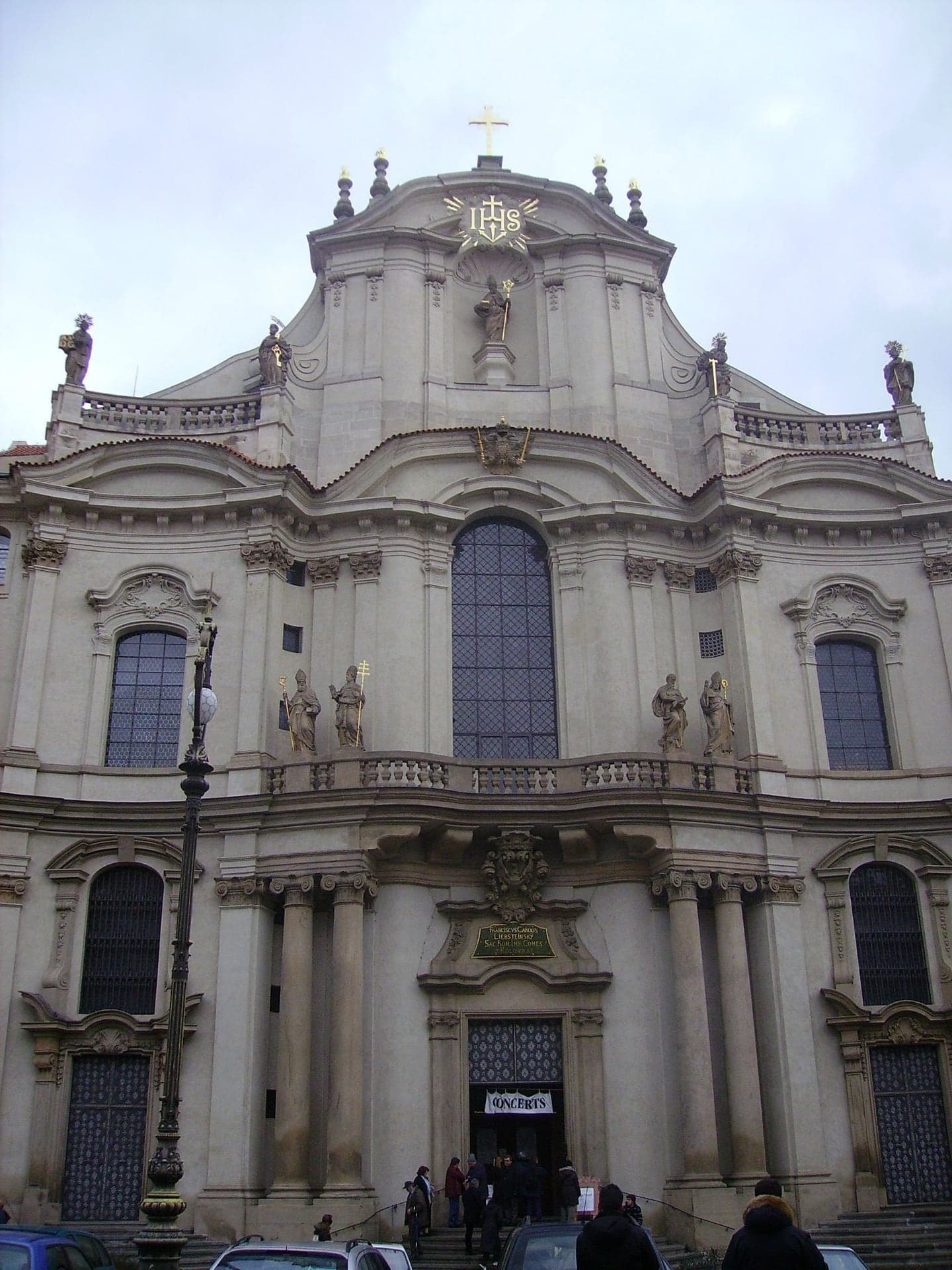
Saint Nicholas: West Front
Jesuits razed a parish church here, buying twelve houses to make room. A father built it, and his son went on to complete the dome.
- 12
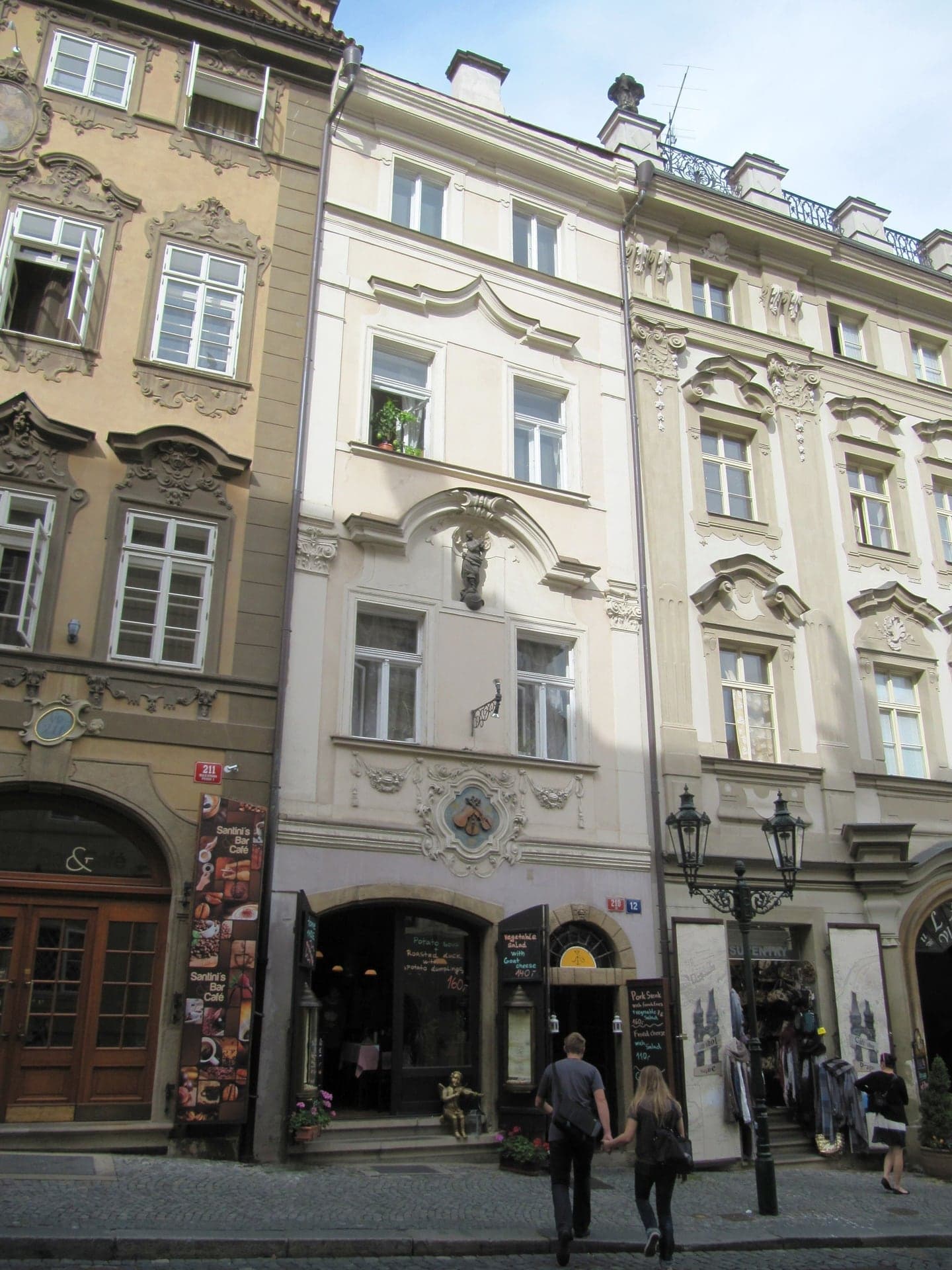
Nerudova: The Three Little Fiddles
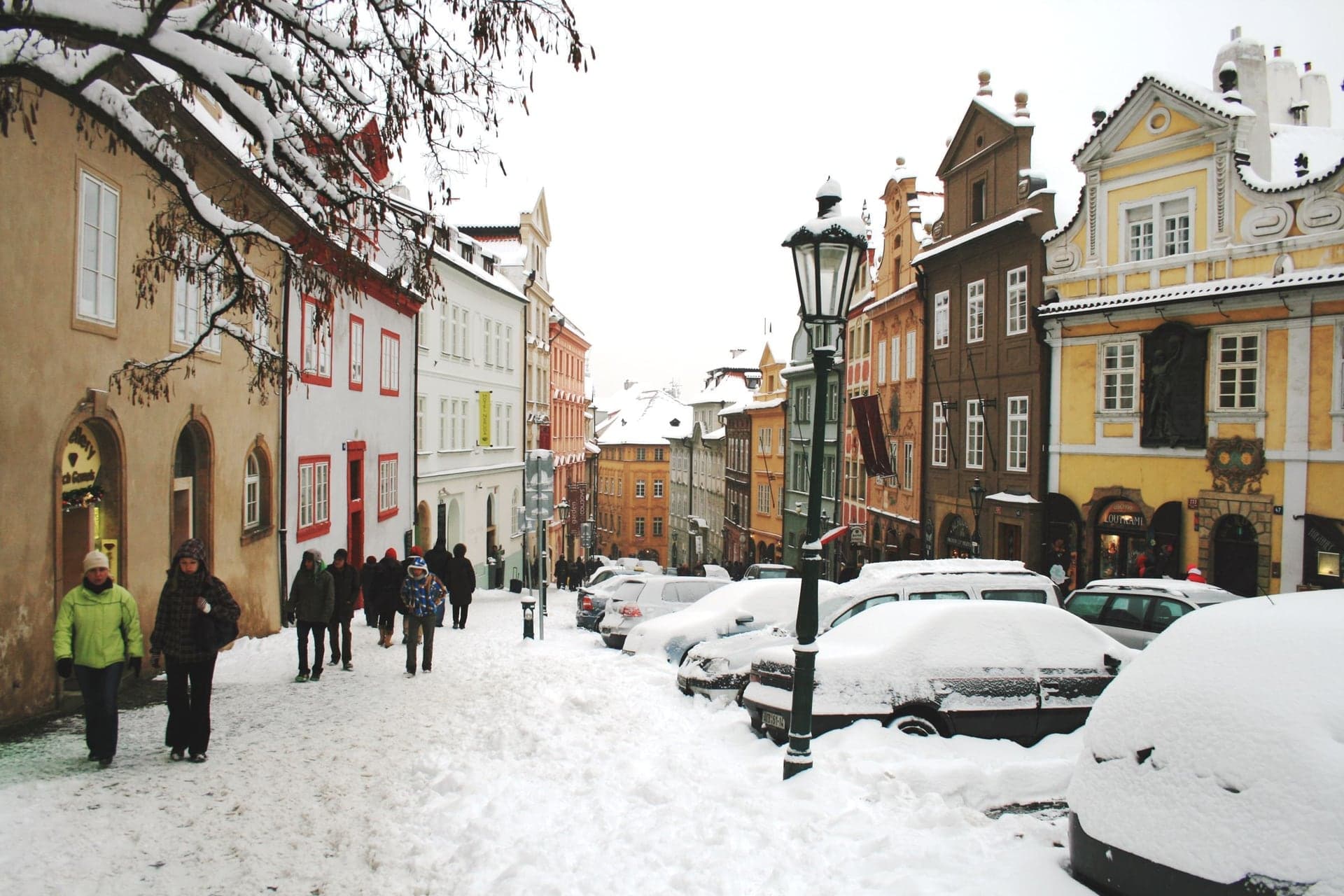
A house sign came before the number, and a family of violin makers chose it. Most houses still carry two numbers, one red and one blue.
- 13
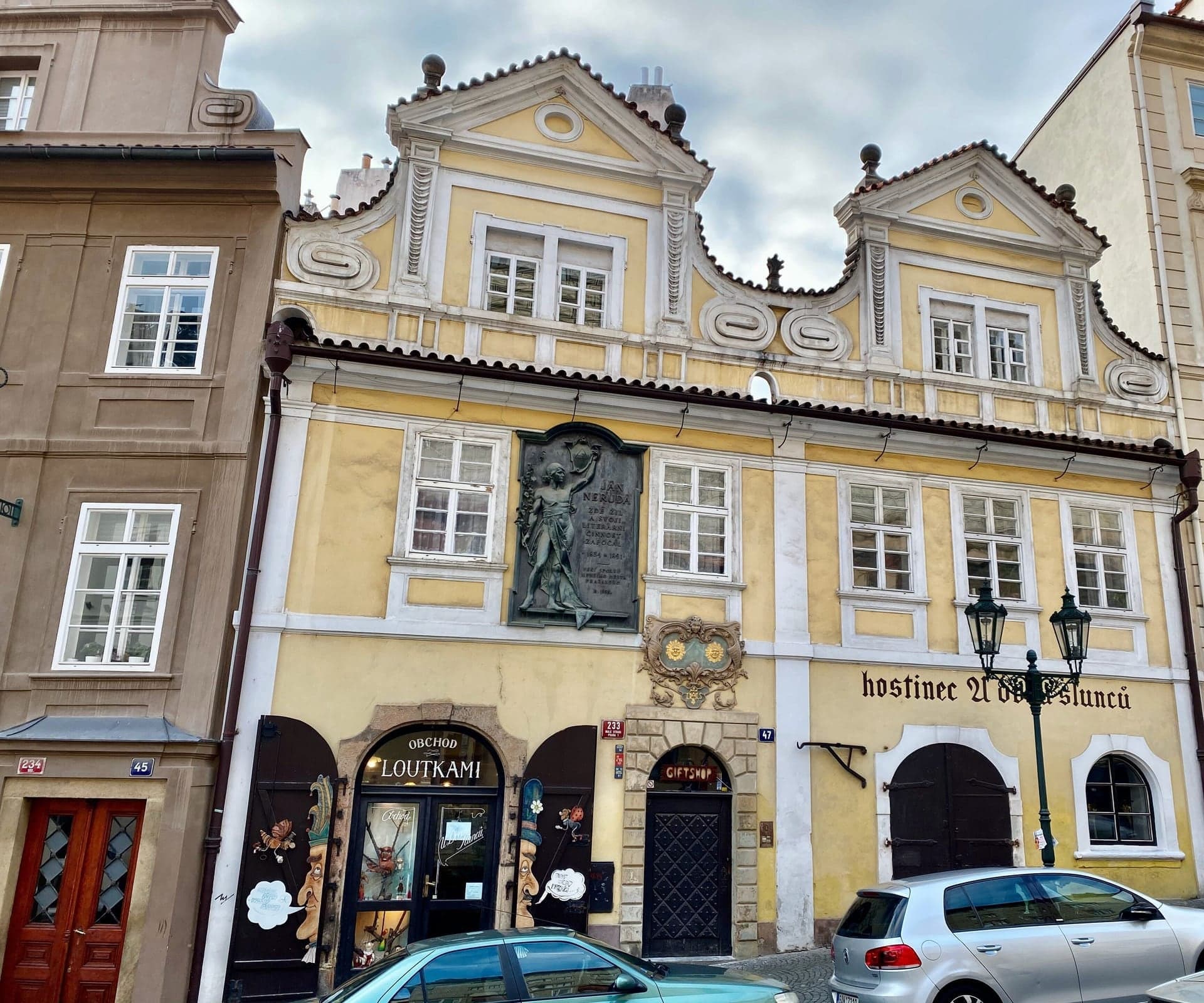
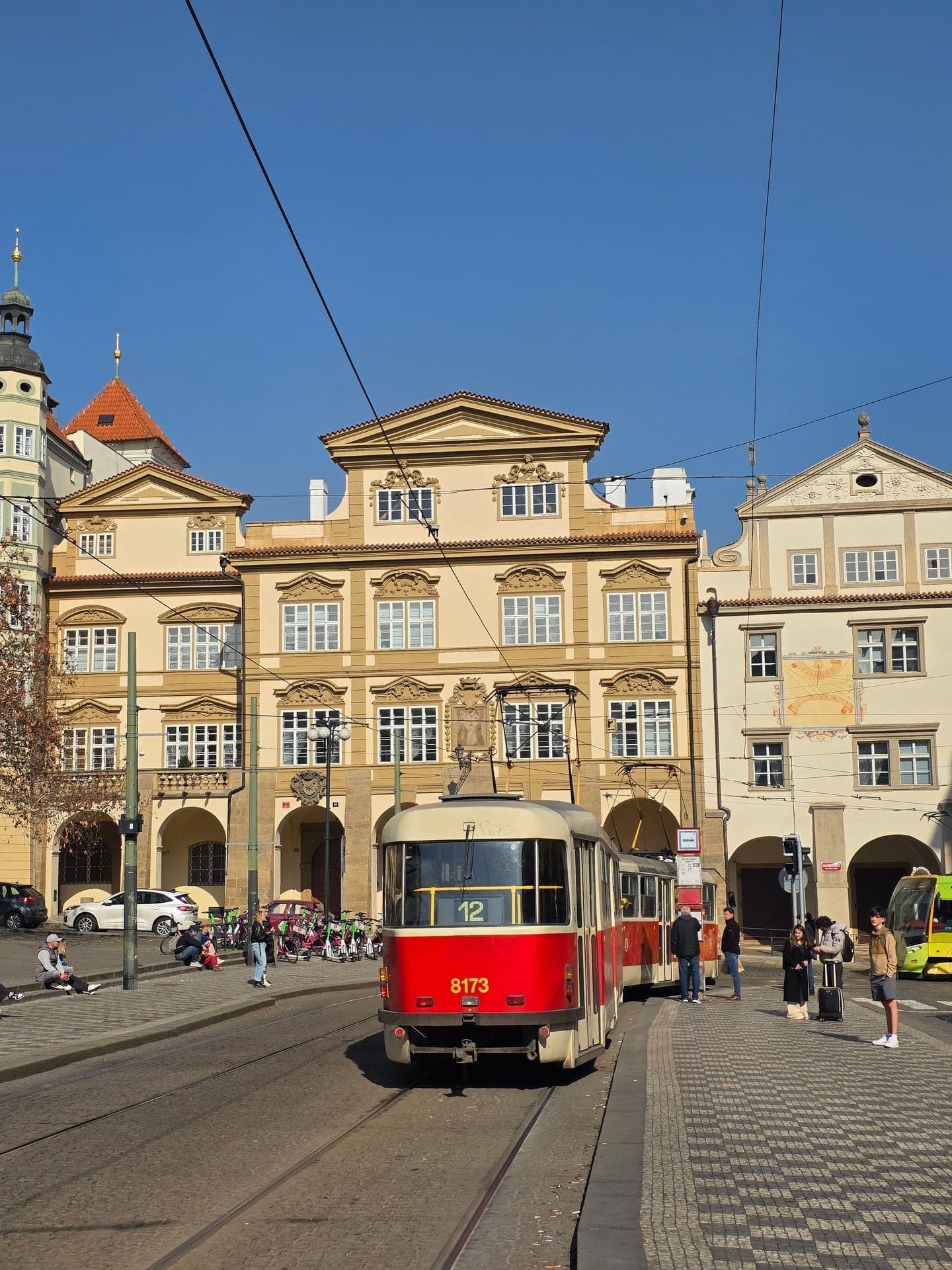
Nerudova: The Two Suns
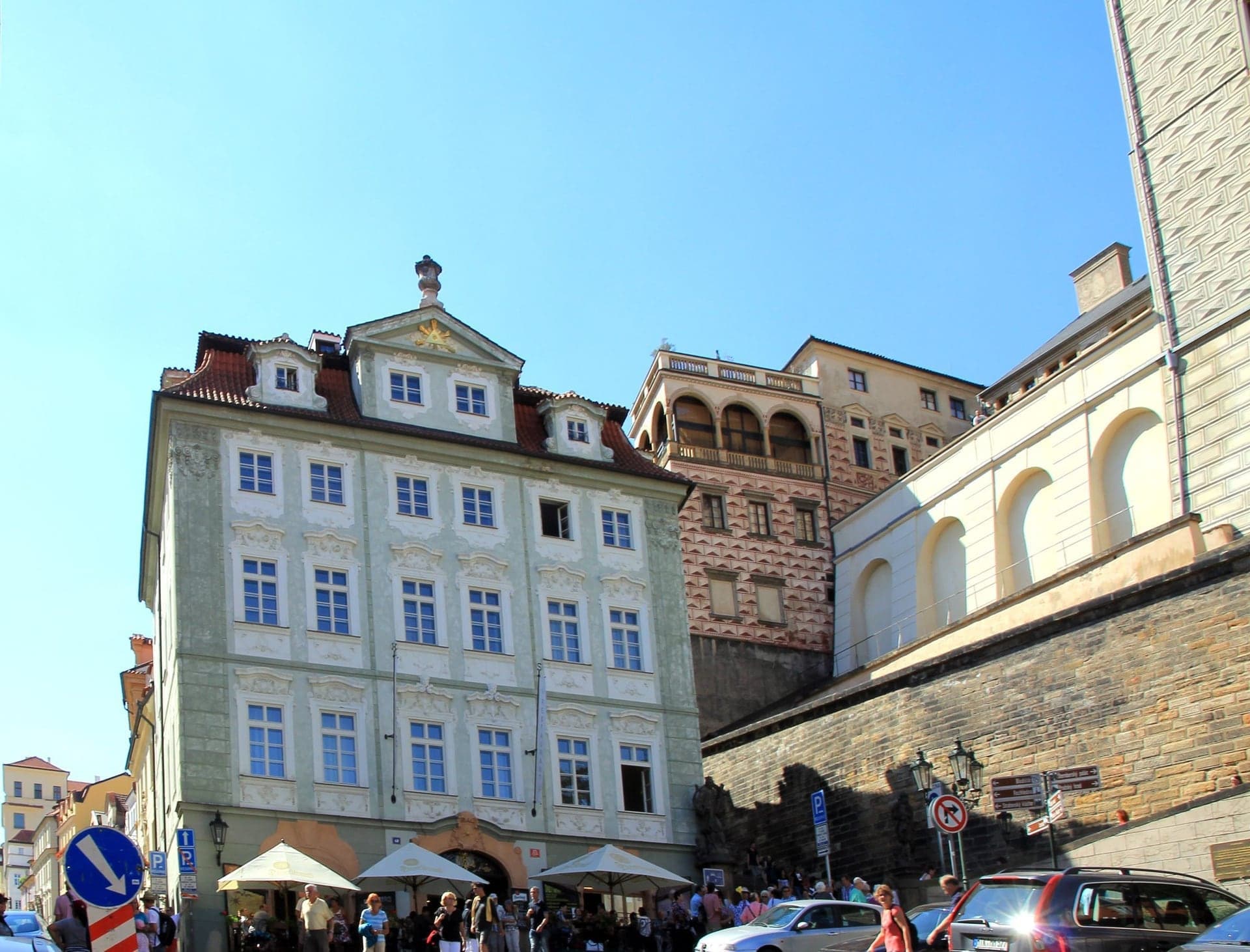
Jan Neruda grew up on this street, facing a house with two suns on its front. A plaque says he began to write here, and the street now has his name.
Details
Best Time to Visit
Before about 9:00, when the deck is another walk, and in daylight, because Kampa's park gate has no published hours and the museum and the church keep daytime hours. Mornings are quiet on Na Kampě. Saint Nicholas opens at 9:00, so a start at about 8:30 reaches it open. Museum Kampa opens at 10:00, so you will pass it shut unless you linger or go back. Checked 3 November 2026.
Pro Tips
- •Getting to the start: Metro line A to Staroměstská, about 350 meters. Cross the Křižovnická tram tracks at the signals by the Staroměstská tram stop, then walk the river-side pavement down past the Knights of the Cross church to the square. Stop listings give trams 2, 17 and 18 on Křižovnická; check pid.cz on the day. Checked 3 November 2026.
- •Coming straight from our Old Town walk: cross at the push-button signal on the line of Karlova, and watch for trams as well as cars.
- •Getting away from the end: the Malostranské náměstí tram stop is about 540 meters back down the hill (stop listings give lines 12, 15, 20, 22 and 23; check pid.cz on the day). Malostranská, Metro line A, is over a kilometer. Or keep climbing: the Castle and Strahov are both uphill from here. Checked 3 November 2026.
- •Vojan Gardens, free, is about 150 meters from the bridge's Lesser Town arch, with its one gate on U Lužického semináře, close to the leg from stop 9 to stop 10. Open daily 8:00 to 16:00 in December and January, 8:00 to 17:00 in February, March, October and November, 8:00 to 19:00 from April to September. Checked 3 November 2026.
- •All three tower climbs are run by Prague City Tourism with the same hours; all three are half price in their first hour each day, except 25 December and 1 January. Prices are on each stop's card. Checked 3 November 2026.
- •Our Lady Under the Chain holds Mass on Sunday at 10:00 and Tuesday at 17:30. By day the church is usually ajar and you can look in through the grille; the forecourt's hours are not published. Checked 3 November 2026.
- •The best view of the bridge's arches is stop 9, Na Kampě, in the morning, before the terraces fill.
Safety & Precautions
- •Pickpockets work the crowded deck of Charles Bridge by day, worst near Saint John of Nepomuk. Keep bags closed and in front of you.
- •On the bridge, stop at the parapet and out of the stream of people. Nobody needs to reach through the queue at the Nepomuk statue.
- •Tram crossing at Karmelitská, between stops 10 and 11: a zebra over two tracks with no signal and no island. Trams come round the corner from the north with little warning and up from the south. Look both ways and cross when it is clear.
- •If you reach stop 1 from Karlova or Staroměstská, you must cross the Křižovnická tram tracks first. Use the signals.
- •Cobbles and setts run the whole way, slippery when wet and hard on wheels. There are no stairs on the route. The last part climbs about thirty meters.
- •Kampa Park's gate on the way to stop 8 has no published hours and we could not check it on the ground. If it is shut, stay on U Sovových mlýnů south to the park. Checked 3 November 2026.
- •A rebuild of Kampa Park was cleared in September 2026 with no timetable published. The park as a whole will not close, but parts may be fenced off. Checked 3 November 2026.
- •Hroznová has no pavement and some residents' cars; Nerudova has thin pavements, parked cars and delivery vans, and no marked crossing on the route. Keep to the side and cross where it is clear.
- •The side passage on the way to stop 10 runs along a café terrace. If tables block it, walk through the bridge's arch instead.
- •A repair of the Old Town Bridge Tower was reported as planned in 2022, and repairs of the Lesser Town towers and the Saint Nicholas belfry were reported as being prepared in 2026. We could not confirm the state of any of them. You may find scaffolding. Checked 3 November 2026.
- •Restorers work through the bridge's statues in turn, and Saint John the Baptist went to tender in May 2026, so a statue may be wrapped or missing. Cleaning of the bridge's outer stone began in July 2026 with pedestrians unrestricted. Checked 3 November 2026.
- •A rebuild of Lesser Town Square was approved in December 2021. We could not confirm its present state, so follow the open pavements and the arcades if hoardings change the way through. Checked 3 November 2026.
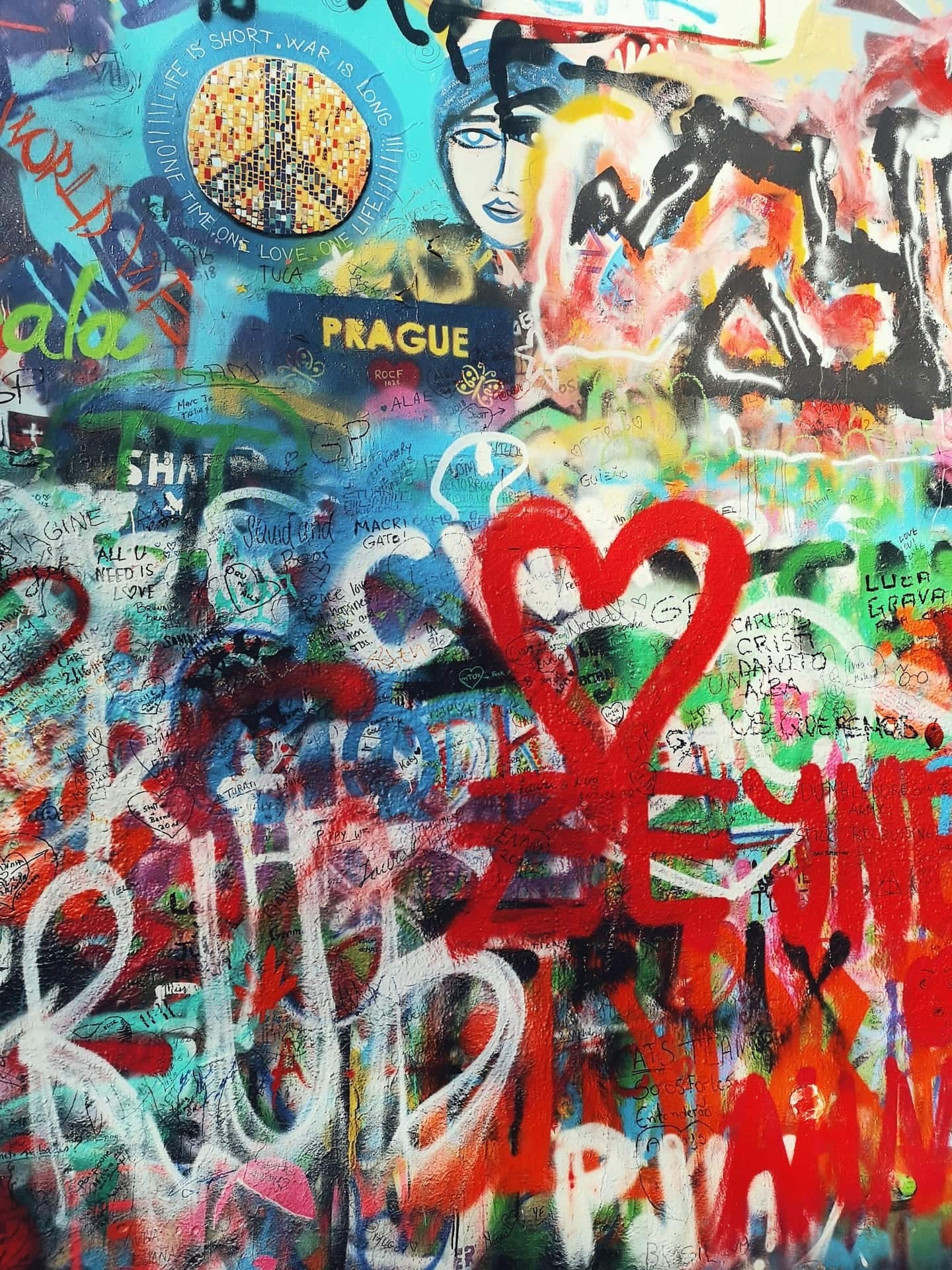
- •The Lennon Wall's rules have changed since 2019: no spray paint. Messages go in the marked places only, in pencil, marker or chalk. Mind vans on the square.
Travel advisory: Exercise Normal Precautions (Level 1).
Gallery
Related Reading
Go deeper on what you'll see, hear, and walk through.
Overview
One Day in Prague: A Walkable Morning-to-Evening Itinerary
8 min
Overview
Prague Travel Guide: Days, Transport, Safety, and Budget
8 min
Thematic
Prague's Layered City: The Coronation Route, Josefov, and a Modern Grammar
9 min
Companion
St. Vitus Cathedral and the Crown at the Top of Prague's Coronation Road
7 min
Deep dive
Charles Bridge: The Crossing Charles the Fourth Built to Last
7 min
Read
What to Eat in Prague
6 min
Read the walk
The full story of Charles Bridge and Malá Strana: What the River Left, in words. Prefer to listen? Play it narrated, from home or on location.
Introduction
Prague, the capital of the Czech Republic, grew up on both banks of the Vltava, and the river has never stopped testing what stands beside it. Charles Bridge was begun in thirteen fifty-seven because a flood had taken the bridge before it. Another flood brought down three of its arches in eighteen ninety. Much of what looks medieval is repair: copied statues, a rebuilt mill wheel, an island raised on rubble.
On the far bank is Malá Strana, the Lesser Town, the quarter under the Castle. Not all of its losses came from water. There is a church that never got its nave, and a wall the authorities kept painting over.
Saint John of Nepomuk, a church official, became a bronze saint nearly three centuries after he died. The Dientzenhofers, father and son, built the church of Saint Nicholas. Jan Neruda, a writer, gave his name to the last street.
The walk is thirteen stops over about two and a half kilometers, a mile and a half, and takes about ninety minutes. It is flat to Kampa Island, then climbs about fifty meters, mostly up Nerudova, with no stairs. Cobbles are slippery when wet and hard on wheels. Towers, museum and church are ticketed; every stop works from outside. It begins at the Old Town Bridge Tower, on the river side of the Křižovnická tram tracks, so cross those at the signals. It ends high on Nerudova, below the Castle.
1. Old Town Bridge Tower
Welcome to Křižovnické náměstí, the small square at the Old Town end of Charles Bridge. Stay on the river side of the tram tracks, walk on to the open paving, and stop facing the great gate. This is the Old Town Bridge Tower. You can climb it on a ticket, and the details are on this stop's card. Walking under it is free.
It was built in the second half of the thirteen hundreds by the workshop that was building Saint Vitus Cathedral, and it did two jobs at once. It was a fortified gate on the bridge, and it was a triumphal arch. Kings passed under it on the way to their coronations.
Look up the front, at the first level above the arch. Two kings sit there with a saint standing between them: Charles the Fourth, who founded the bridge, his son Wenceslas the Fourth, and Saint Vitus, the bridge's patron. Two more saints stand above them. They are all stand-ins. The Gothic figures went indoors to a museum. Keep that in mind, because you are about to meet a lot of it. If scaffolding covers part of the front today, the gate and its story still hold.
The bridge itself exists because of water. A flood in thirteen forty-two took the Judith Bridge, the stone bridge before this one, and Charles founded this one in thirteen fifty-seven.
The far side of this gate has had a rougher time. In sixteen twenty-one the heads of twelve executed rebel leaders were hung on it, and stayed for over ten years. In sixteen forty-eight that face took the worst of the Swedish siege. Even the roof above you, with its four corner turrets, dates from the eighteen seventies.
Follow the route through the arch. Next is your first stand over the Vltava.
2. Charles Bridge: Crucifix and First Arches
Walk on along the deck and stop at the parapet on your left, in a gap between two groups of statues, out of the stream of people. This deck is crowded by day and pickpockets work it, so keep your bag closed and in front of you.
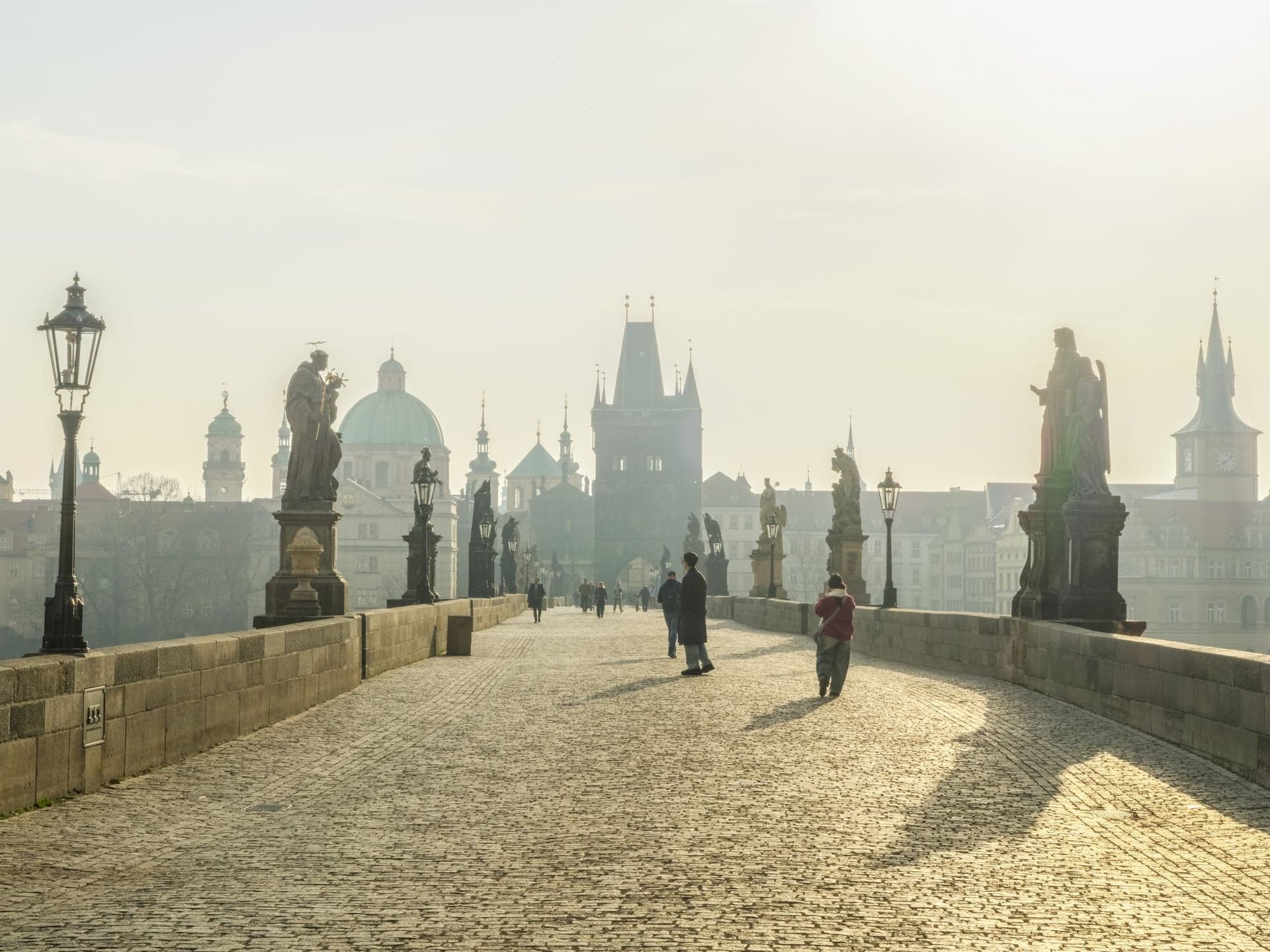
Look over the parapet and down. Those timber structures in the water are ice guards, built of oak. They stand in front of seven of the bridge's fifteen piers, and they catch ice and floating logs so that the sandstone does not have to. These went in during twenty nineteen.
Now look along the deck. It is not straight. Charles Bridge, Karlův most on the signs, runs a little over five hundred meters on sixteen sandstone arches, and it bends on the way across. Until about eighteen seventy it was simply the Stone Bridge, or the Prague Bridge.
It has not always stayed up. In September eighteen ninety, after four days of rain, wrecked rafts and timber jammed against these piers. On the morning of the fourth, just before half past five, the fifth and sixth arches from the Old Town side fell. The eighth followed before ten. Two piers overturned, two groups of statues went into the river, and several people died. You are about to walk over what was put back.
Then look across the deck to the crucifix. The gilded Hebrew letters around the cross say, "Holy, holy, holy is the Lord of Hosts." They were paid for in sixteen ninety-six with a fine imposed on a Jewish man accused of mocking the cross. The city's own account now calls that accusation false, and says the inscription offends Jewish religious conviction. Since the year two thousand, three plaques at the crucifix have explained it.
Follow the route on along the deck. Next is the statue everyone comes for.
3. Charles Bridge: Saint John of Nepomuk
Keep to the left parapet and stop in a gap between two statues. Across the deck, over people's heads, is a figure with a crowd pressed around its base. That is Saint John of Nepomuk. Stay on this side. You can see him well from here, and crossing only puts you in the queue.
He is bronze, in a row that is almost all sandstone, and he dates from sixteen eighty-three, the oldest statue still standing on the bridge.
He was a real man, John of Pomuk, a senior official to the archbishop of Prague. In March thirteen ninety-three he died under torture, and that evening his body went over into the Vltava. So he was dead before he fell.
The legend, shown on the base, says he would not reveal the queen's confession to King Wenceslas. Most historians think it was about an abbey. The king wanted a new bishopric there, to cut the archbishop's power, and John helped block it. Three centuries later the Baroque age needed a martyr and made one.
People touch the reliefs for luck. In this crowd you can skip it.
Now look along your own side. Thirty statues and groups line this bridge, most from just after seventeen hundred, paid for by named clients: university faculties, abbots, a count. Many are copies now. The Saint Ludmila just ahead of you was cut in nineteen ninety-nine. Restorers work through them in turn, so you may find one wrapped.
Follow the route along the deck. On your left, look over the parapet below Saint Vincent's group. A knight with a gilded sword stands on a pier in the water: Bruncvík, for the town's rights. Then comes a blind nun's vision of Christ, Saint Luitgard, which the city calls the bridge's finest work. That is a copy too. Next are the towers at the far end.
4. Lesser Town Bridge Towers
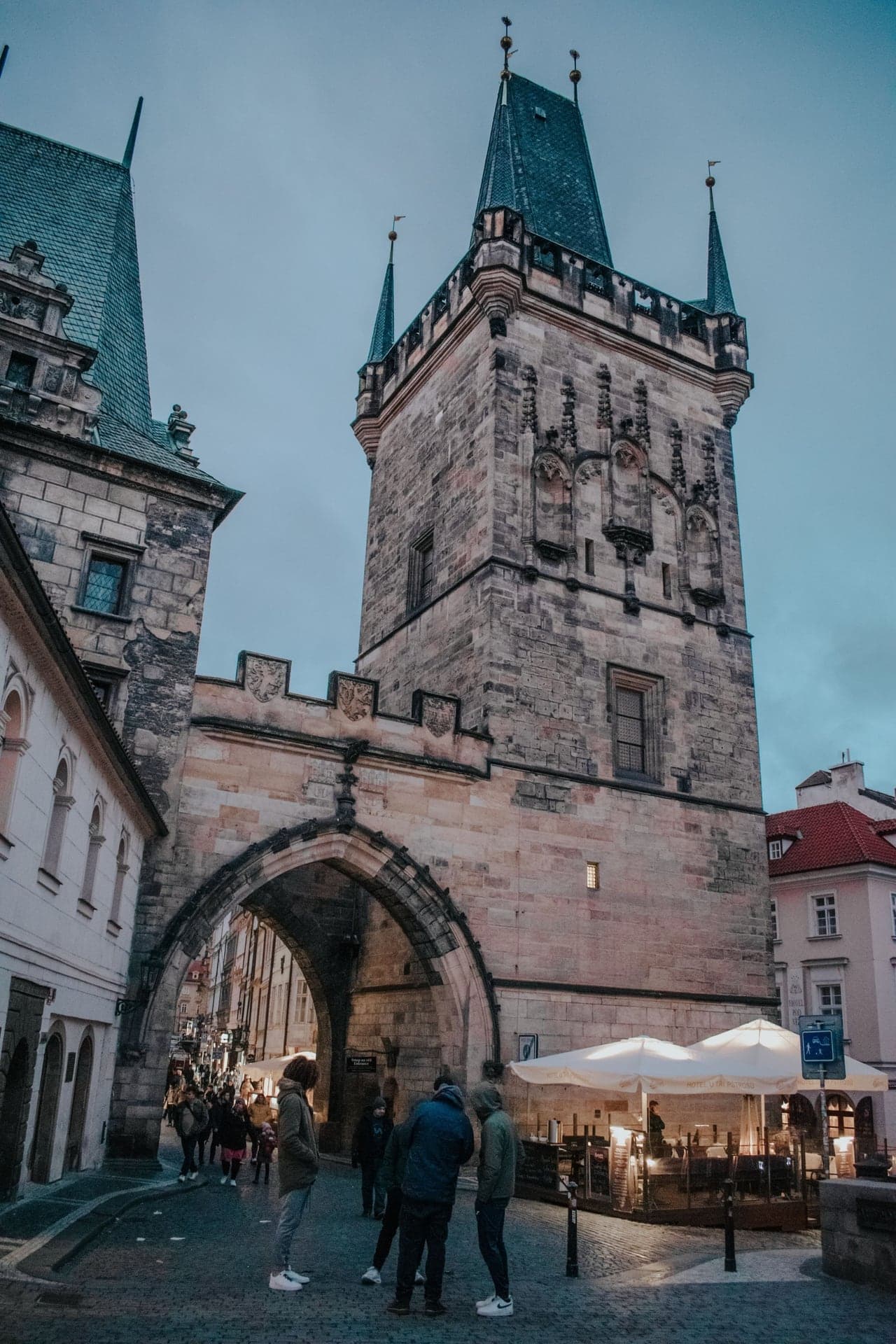
Walk on along the deck and stop near its end, by the parapet on your right, out of the stream. Two towers stand ahead with an arch between them. The taller one is open on a ticket, and the details are on this stop's card. Either may be wrapped in scaffolding when you come, but the difference in height will still show.
Start with the lower tower, on the left. Its core is Romanesque, from around eleven thirty, in a local stone. It belonged to the fortifications of this bank, and the city's account says it is apparently older than the Judith Bridge, which was built about eleven seventy. So the flood of thirteen forty-two took that first stone bridge, and this tower outlasted it.
It has lived several lives. It lost height and gained its Renaissance look after a fire, in fifteen ninety-one. It was a prison from the early fourteen hundreds and a customs house until seventeen eighty-four. Today it is home to the Club for Old Prague, a society founded in nineteen hundred. It is not open to visitors.
Now the taller tower, on the right. It went up after fourteen sixty-four, on a Romanesque predecessor, in big sandstone blocks, and it echoes the gate you started from. It stands about forty-three meters high. Its niches were probably meant for statues, and they never came.
So one gate has two ages side by side, more than three hundred years apart, and the arch between them is younger than one tower and older than the other.
Follow the route through the arch and then down to the side. Next is a church whose middle is missing.
5. Maltese Square and Our Lady Under the Chain
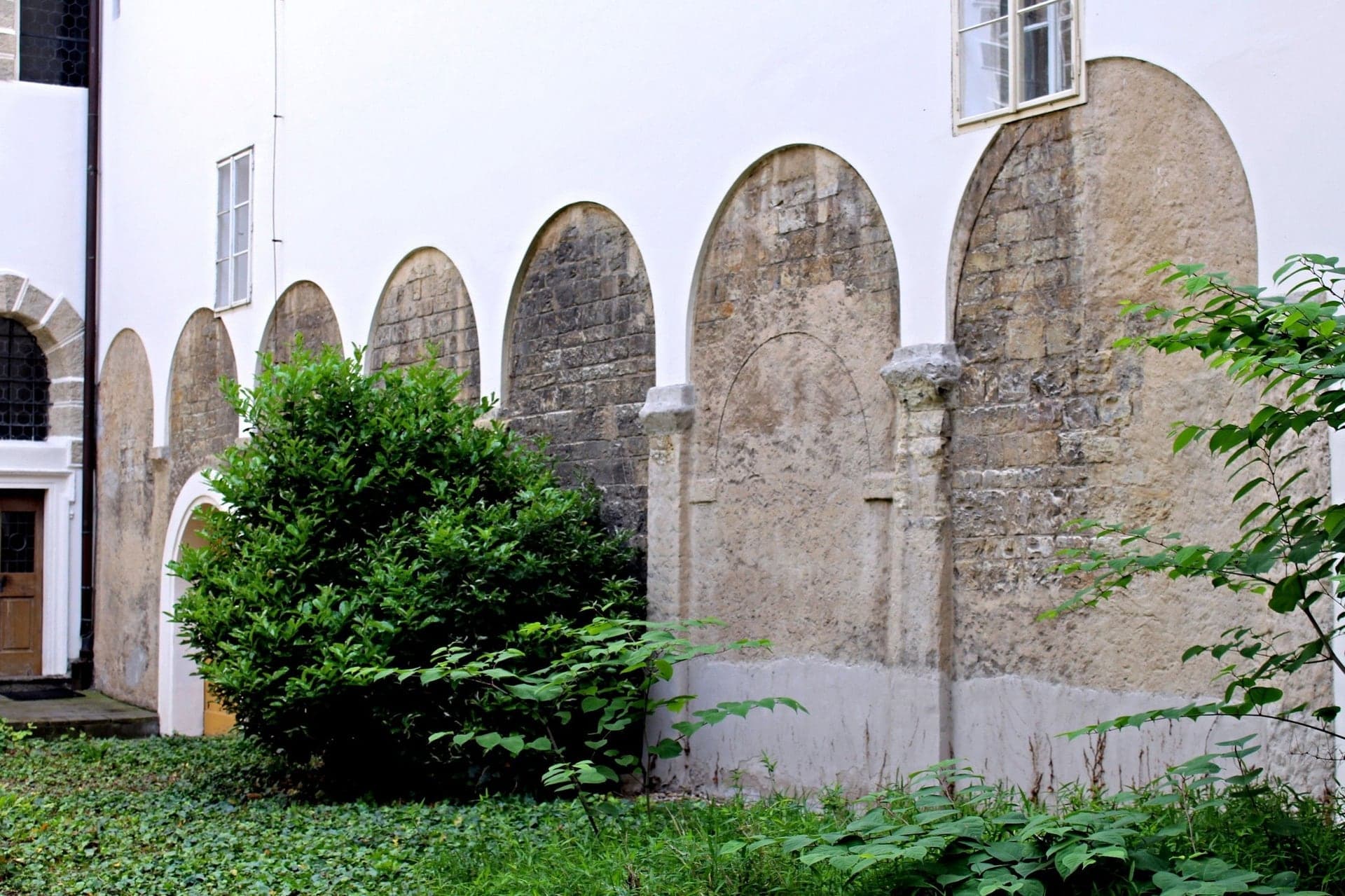
Walk on to the gate between the low fences and stop there, off the roadway. Cars come through at a walking pace. Look through the gate and straight up: two heavy towers stand right over you. They belong to Our Lady Under the Chain, a working church, so keep your voice down. For…
Full narration for this stop unlocks with the tour.
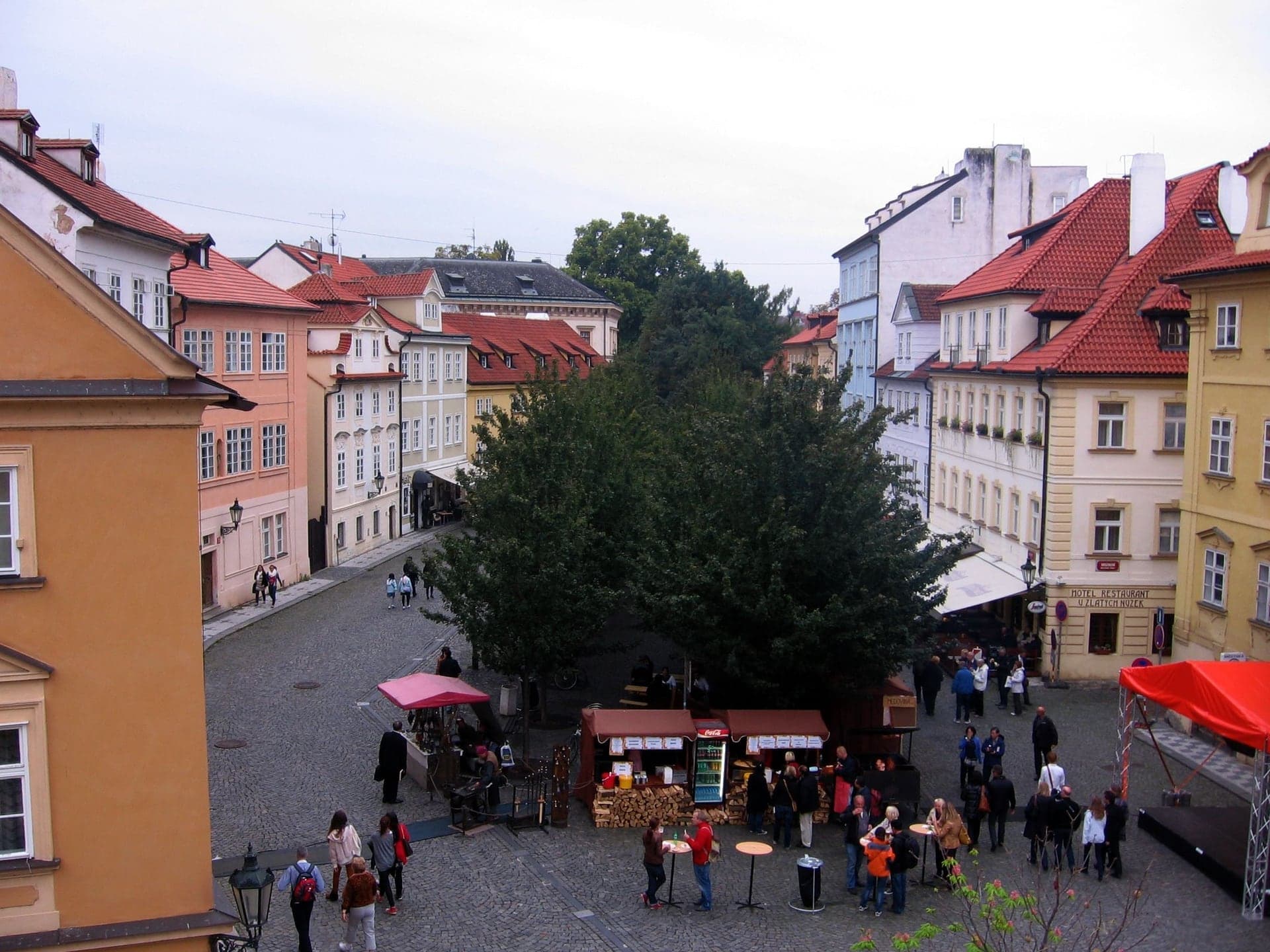
6. Lennon Wall
Walk on across the paving of Velkopřevorské náměstí, the Grand Prior's Square, and stop in the gap between the trees, facing the long wall everyone is photographing. Vans come through at a walk, so step out of their way. This is the Lennon Wall. Whatever is on it today will not…
Full narration for this stop unlocks with the tour.
7. Čertovka and the Grand Prior's Mill
Walk on to the little footbridge and stop at the rail, letting people pass. It is narrow, so for a longer look, step off at the far end. Look along the water for the big mill wheel. This is Čertovka. The locks on the grille may get in the way. You are crossing onto an island…
Full narration for this stop unlocks with the tour.
8. Kampa Park and Sova's Mills
Walk on to the open paved end of the path, where the park meets the river, and stop there. The old mill buildings stand just ahead. They hold Museum Kampa, which is ticketed, and the details are on this stop's card. You do not need to go in for any of this. Find the three big…
Full narration for this stop unlocks with the tour.
9. Na Kampě: The Bridge from Below
Walk on past the block of trees to the open cobbles of Na Kampě and stop there, with the bridge filling the end of the square. Now you see what carried you across. The longest span of the sixteen arches is over this island, more than twenty-three meters. Up on the bridge is…
Full narration for this stop unlocks with the tour.
10. Lesser Town Square: Dome and Belfry
Walk on up Mostecká to where it opens into Lesser Town Square, Malostranské náměstí, and stop on the pavement, back from the zebra. The street points straight at a tower, with a great dome beside it. You can climb the tower on a ticket, and the details are on this stop's card.…
Full narration for this stop unlocks with the tour.
11. Saint Nicholas: West Front
Walk on up the side of the square and stop on the pavement facing the church's great front across the road. This is Saint Nicholas. Inside is ticketed, and the details are on this stop's card. If you do go in, the city calls it the highest interior in Prague. This front is…
Full narration for this stop unlocks with the tour.
12. Nerudova: The Three Little Fiddles
Walk on to the foot of Nerudova and stop on the pavement, facing the narrow house across the street with a sign of three little fiddles. Cars and vans come up here, and the pavement is thin, so keep close to the wall. People live behind these fronts, so keep your voice…
Full narration for this stop unlocks with the tour.
13. Nerudova: The Two Suns
Walk on to the wide checkered paving on this side of the street and stop, facing the house with the curled gables across the road. This is number forty-seven, the Two Suns. Find the sign on the front. Sign makers worked from molds, so suns all over Prague often wear the same…
Full narration for this stop unlocks with the tour.
- Kostel Panny Marie pod řetězem — Mister No, CC BY 3.0 · source
- Praha 1-Malá Strana, kostel Panny Marie pod řetězem — VitVit, CC BY-SA 4.0 · source
- This is a photo of a cultural monument of the Czech Republic,number: — Palickap, CC BY-SA 4.0 · source
- Praga - Dům U Dvou slunců — Josep Renalias Lohen11, CC BY 4.0 · source
Images may be cropped or resized. Other photos via Unsplash and Pexels.