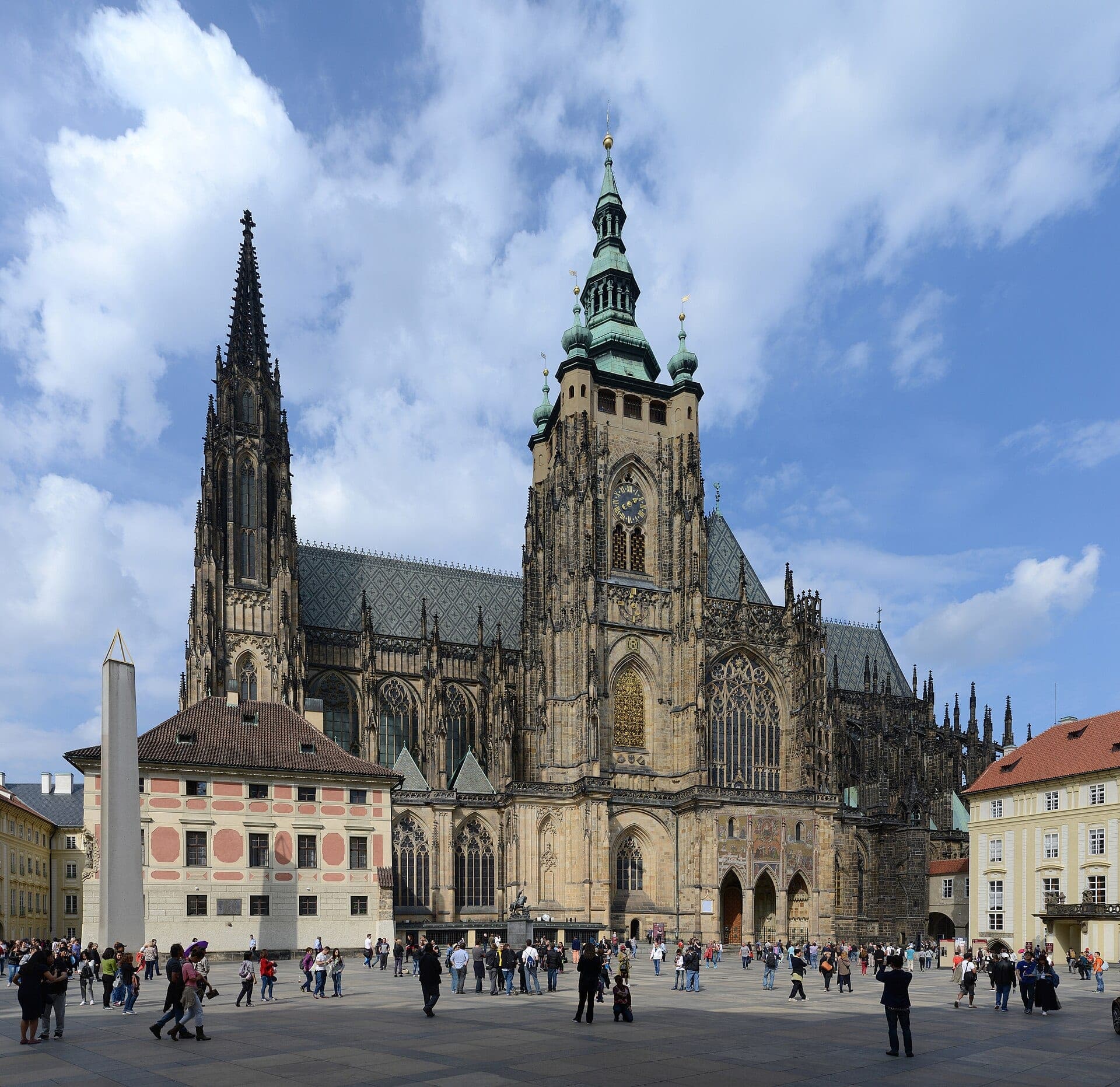
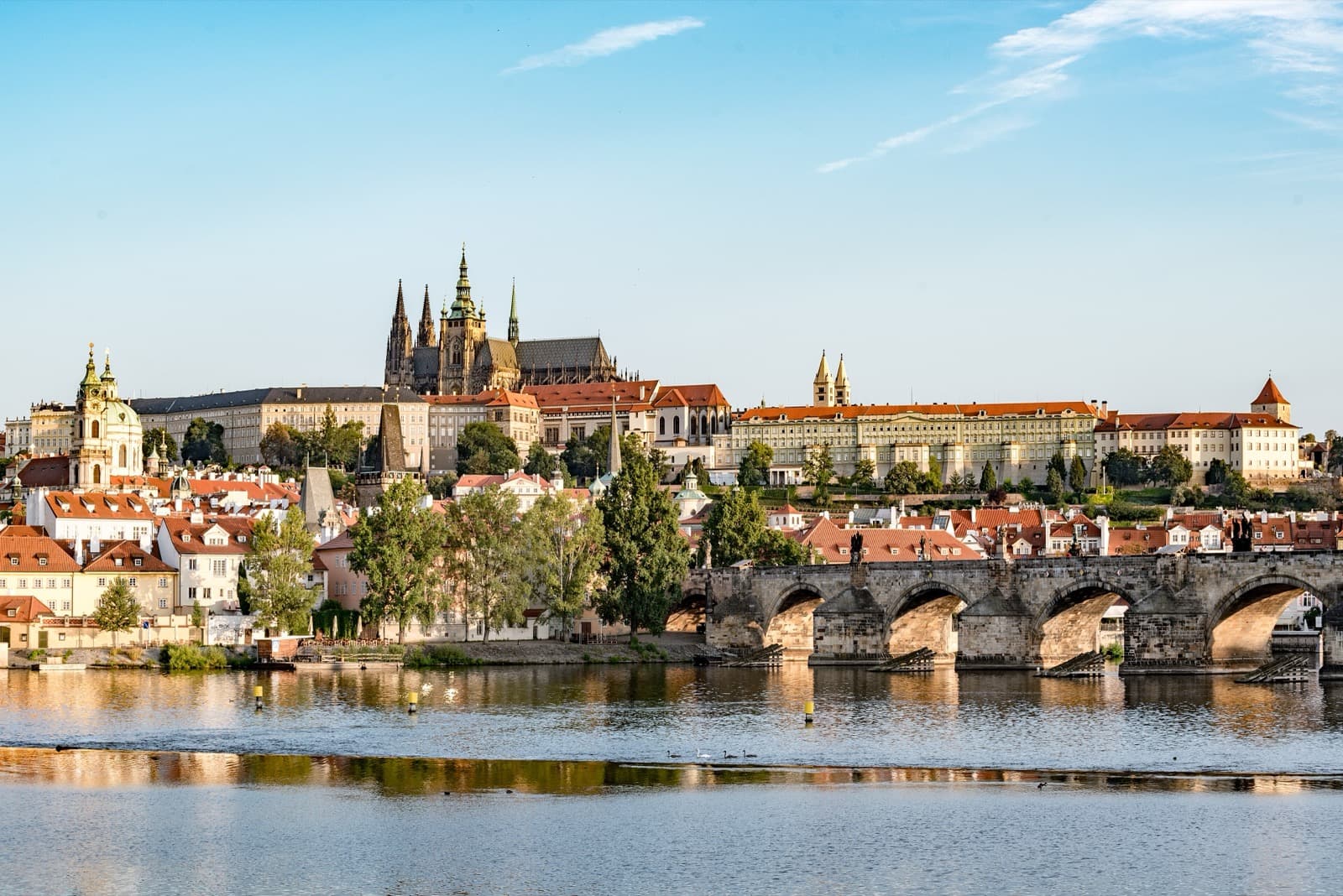
St. Vitus Cathedral is the reason the Royal Route exists. Every stop on the walk up through Prague, from the Gothic gate at the edge of the Old Town, across the market square, over the stone bridge, and up the castle hill, was a step toward this one Gothic front on the summit. The cathedral held the crown of Saint Wenceslas, and that crown waited at the end of every coronation procession the Bohemian kings walked. Read the church backward, from its altar down to that first gate, and the whole route stops being a string of famous sights and becomes what it always was: a single line of ceremony pointed at a single crowning.
The church the whole route was built to reach
The coronation way is one-directional by design. For four hundred years the kings of Bohemia walked it in one direction only, toward their crowning, and the destination was fixed: the cathedral inside Prague Castle where the Bohemian crown jewels and the crown of Saint Wenceslas were kept. When you stand in the courtyard and the Gothic front rears up above you, dense with stone, you are standing where the procession finally stopped. There was nowhere further to go. This was the summit, the crown, the end of the way.
That single fact reorganizes everything below it on the hill. The gate at the bottom of the Old Town was not simply a gate. It was the threshold where the climb began. The bridge over the river was not simply a crossing. It was the span the king had to make on his way up. Each stop earns its place because it sits on the line to this altar.
The cathedral's own timeline is one of the longest in the city. Construction began on the twenty-first of November, thirteen forty-four, the year the seat of Prague was raised to an archbishopric. That elevation was an initiative of Charles the Fourth, King of Bohemia and Holy Roman Emperor, and the foundation stone was laid by his father, King John of Bohemia. The first architect was Matthias of Arras, summoned from the papal palace at Avignon, who died in thirteen fifty-two. After him came Peter Parler, the master builder who also shaped Charles Bridge, and Parler gave the cathedral its extraordinary net vaulting. Then the building simply waited. It was not completed and consecrated until nineteen twenty-nine, nearly six hundred years after it was begun.
What the stone still holds
Hear a stop from this walk
St. Vitus Cathedral: The Crowning Church
The scale is easy to feel and easy to check. The main tower rises about one hundred and two metres, the front towers about eighty-two. Inside lies the tomb of Saint Wenceslas and the Saint Wenceslas Chapel, its walls set with over thirteen hundred semi-precious stones. Among the windows glows one designed in the nineteen twenties by the Art Nouveau artist Alphonse Mucha, so a cathedral begun in the fourteenth century carries glass from the twentieth without any seam showing. That is the character of the place. It absorbs centuries and keeps them all visible at once.
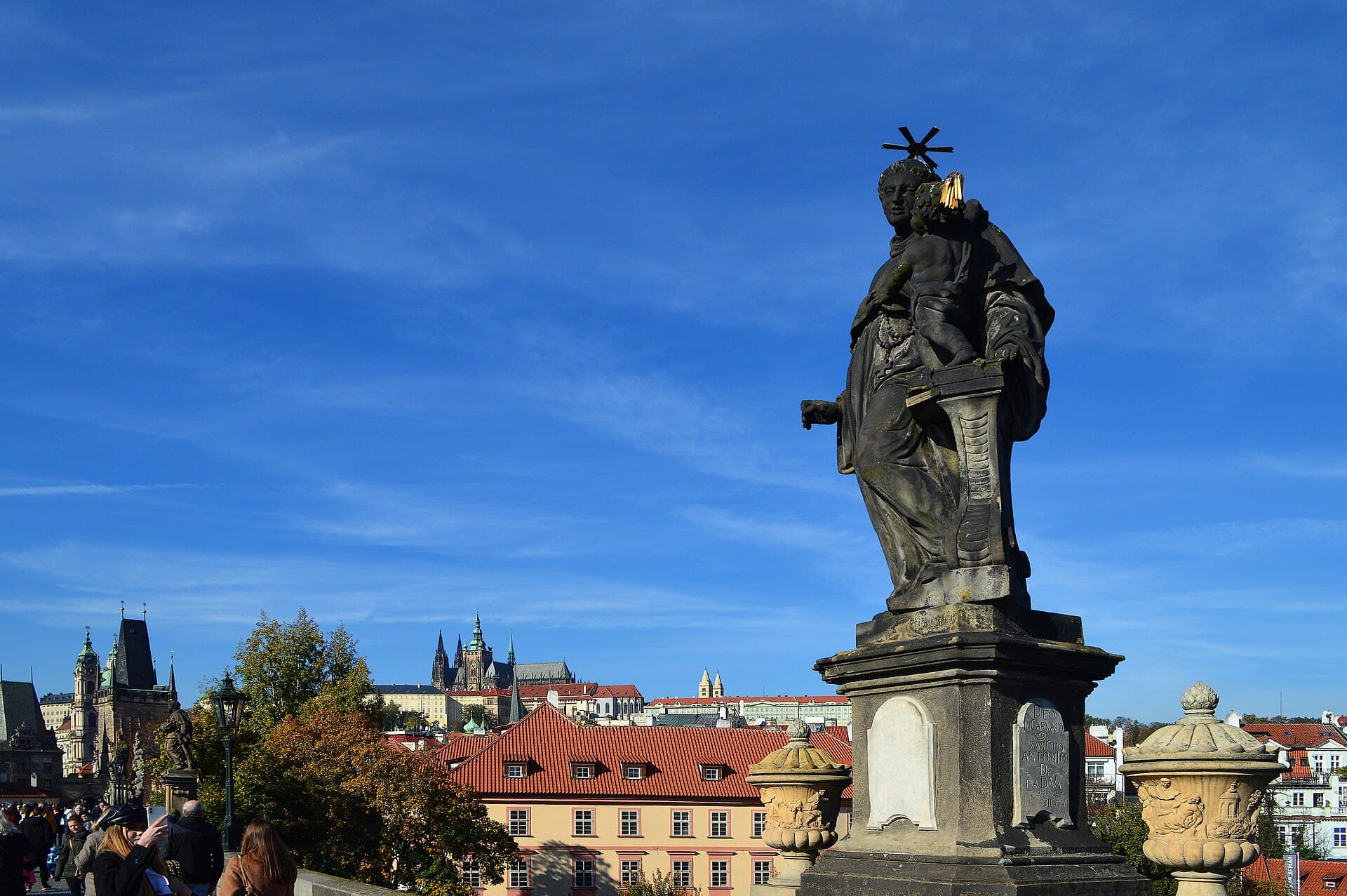
Notice how much of the cathedral's story is already braided into the stops beneath it. Charles the Fourth commissioned this church and also commissioned Charles Bridge, begun in thirteen fifty-seven under his auspices and designed by Peter Parler, the very builder who worked here. Parler's hand is on both the crossing and the crown. So when you walk the bridge earlier in the day, you are already walking a piece of the same commission that produced the cathedral. The route is not a tour of separate monuments. It is one ruler's Prague, laid end to end, built to hold a coronation.
Reading the climb from gate to crown
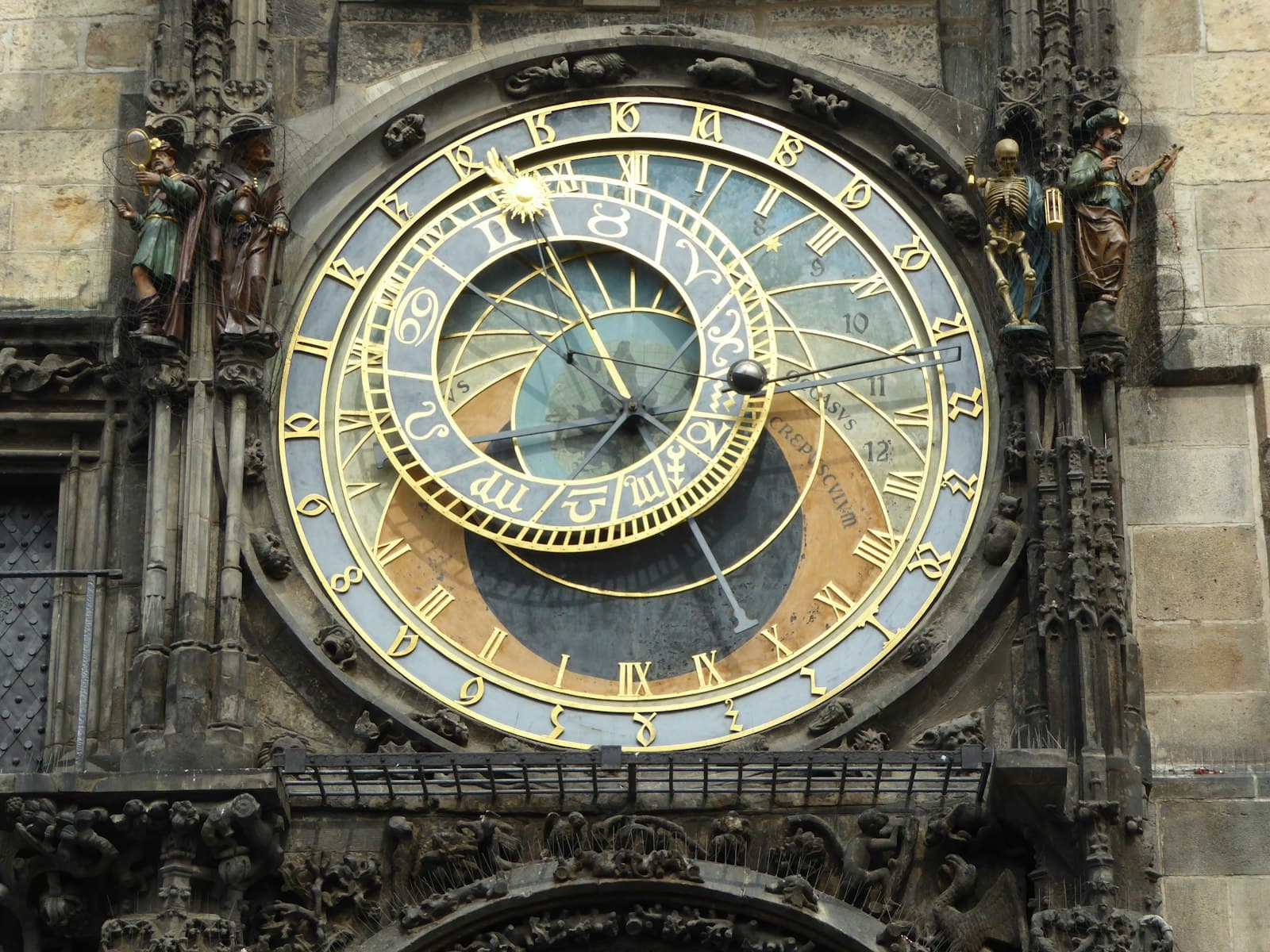
Start at the bottom and the logic of the whole thing opens up. The Powder Tower, in Czech the Prasna brana, marks the very start of the Royal Route. Its foundation stone was laid in the year fourteen seventy-five under King Vladislav the Second, and it fixed the point where the procession stepped off toward the castle. From there the way runs into Old Town Square, the medieval market square, watched over by the Jan Hus Memorial, unveiled on the sixth of July, nineteen fifteen, five hundred years to the year after Hus was burned at the stake in fourteen fifteen. On the town hall wall nearby runs the Astronomical Clock, its dial and mechanism dating to fourteen ten, the oldest astronomical clock still operating anywhere in the world.
The twin Gothic towers of the Church of Our Lady before Tyn rise over the same square, and inside lies the astronomer Tycho Brahe, who died in Prague and was buried here in sixteen oh one. Then the route drops to the river and crosses Charles Bridge, which was the only bridge over the Vltava in Prague until eighteen forty-one, before climbing into the Lesser Town. There St. Nicholas Church lifts its great green dome, the masterpiece of Prague Baroque, where Mozart played the organ in seventeen eighty-seven. Above it all spreads Prague Castle, cited by Guinness World Records as the largest ancient castle in the world at over seventy thousand square metres, and the coronation way ends in its courtyard at the cathedral door.
Every one of those stops sits on the line to the crown. That is why the anchor matters. St. Vitus is not the last item on a list. It is the argument the list was making. See the full sequence of stops and practical notes in our guide to Prague walking tours, and browse everything on offer in Prague.
Walking it your own way
Here is where a modern walker holds something the kings never did. The route was laid out as one ceremony, bound to a single climax and a single moment of crowning, with a court behind and a clock keeping time. You are under no such rule. There is no procession behind you and no ceremony to keep. You can climb at your own pace, linger where a facade holds you, skip a stop that does not, and finish at the altar whenever you arrive.
The practical shape favors one direction. Walk uphill from the Powder Tower to St. Vitus, so gravity works with you and you end at the crowning church the way the kings did. The distance runs roughly five kilometres, much of it a gentle climb, and unhurried, with pauses, it gives you two to three hours, more if you step inside a church or climb a tower. A limited front section of the cathedral is generally open without a ticket; a combined Prague Castle ticket lets you linger inside at the Saint Wenceslas Chapel, the Old Royal Palace, and the Golden Lane. Wear shoes with grip for the cobblestones, start early to reach the bridge and square before the crowds thicken, and keep your bag zipped in the crush. The way was theirs. The pace is yours.
Sources
- St. Vitus Cathedral, Wikipedia. Construction from the twenty-first of November thirteen forty-four, architects Matthias of Arras and Peter Parler, the nineteen twenty-nine consecration, tower heights, and the over thirteen hundred stones of the Saint Wenceslas Chapel.
- St. Vitus Cathedral, Prague Castle for visitors (hrad.cz). Official cathedral pages on access and the Crown Chamber holding the Bohemian crown jewels.
- Charles Bridge, Britannica and Wikipedia. Construction from thirteen fifty-seven under Charles the Fourth, designed by Peter Parler, and the only Vltava bridge until eighteen forty-one.
- Largest ancient castle, Guinness World Records. Prague Castle at over seventy thousand square metres.
- Prague astronomical clock, Wikipedia. Dial and mechanism from fourteen ten and the oldest astronomical clock still in operation.
Ready to experience it?
The Royal Route: The Coronation Way
150 min · 4.8 km · moderate
More from Prague
Explore more at your own pace.
One Day in Prague: A Walkable Morning-to-Evening Itinerary
Prague's Layered City: The Coronation Route, Josefov, and a Modern Grammar
The House of the Black Madonna: How Prague Built Cubism Into a Wall
The Old Jewish Cemetery Reads Prague's Whole Confined Quarter
Charles Bridge: The Crossing Charles the Fourth Built to Last