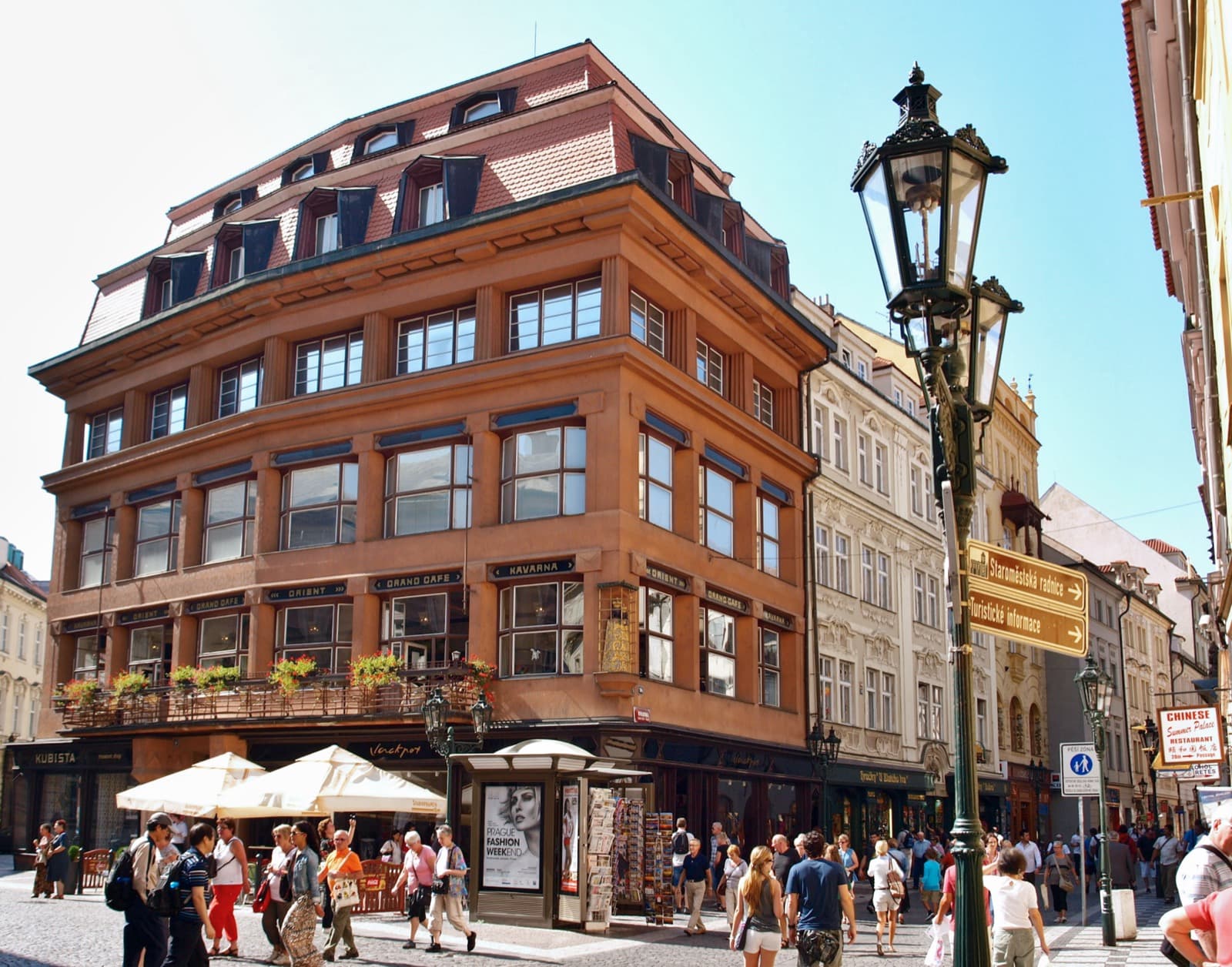
The House of the Black Madonna faceted a reinforced-concrete facade into sharp angled planes, and learning to read that one folded wall unlocks a whole decade when Prague taught itself two brand new ways to shape a surface. Between roughly 1905 and 1915, a city known for Gothic spires and Baroque swirl wrapped its buildings first in the flowing gold of Art Nouveau, then tried something attempted almost nowhere else on earth: building Cubism, the movement painters were working out on canvas, directly into stone and concrete. The House of the Black Madonna is where that second grammar begins, and it is the clearest single lesson on the walk this article prepares you for.
Where the grammar breaks
Stand on the street in front of the House of the Black Madonna, in Czech the Dum U Cerne Matky Bozi, and look at what the architect Josef Gocar did. Completed in 1912, this is the earliest example of Cubist architecture in Prague. After the curved lines and plant-stem ironwork of Art Nouveau, the surface here does the opposite. The facade folds. Bay windows push out in sharp, angled planes. Cornices tilt like cut crystal. The whole wall reads as faceted, as if the building were carved from a solid block rather than assembled.
That is the engineering argument worth pausing on. Cubism on a canvas is a painter's problem: it can break an object into planes without gravity or weather caring. Cubism on a four-story building is a structural problem. Gocar solved the load path with a reinforced-concrete skeleton, an idea associated with the Chicago School of tall American buildings. The concrete frame carries the weight, which meant the interior did not need a forest of supporting walls, and the exterior was freed to do its faceting without holding the structure up. The angled bay windows are cladding and expression, not braces. Once you see that separation of frame and skin, the shock of the new becomes a legible piece of design rather than a mystery.
The old figure and the new wall
Hear a stop from this walk
Prague Main Station: The Gateway Wearing the Grammar
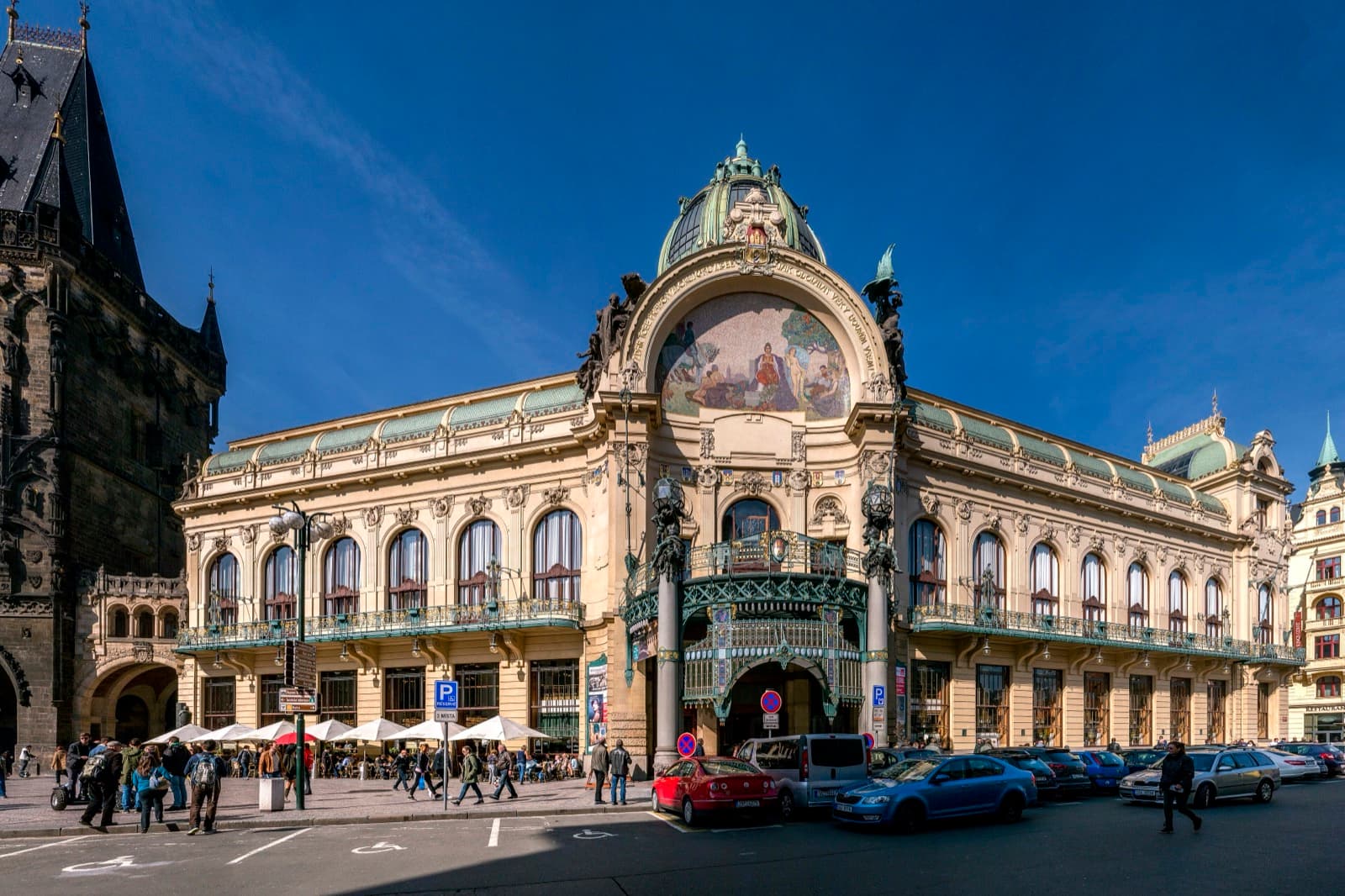
The name comes from the corner. Look up and you will find a small Baroque statue of a black Madonna, kept from an earlier building that once stood on this site. That retained figure is the whole tension of the decade in miniature: an old devotional carving and a radically modern facade sharing the same wall, deliberately. The moderns were not erasing the city. They were folding a new surface over an old one, which is exactly what the Municipal House does a short walk away, where a modern civic palace rose on the site of a former royal court.
Inside, the same faceted logic continues, and the ground floor is free to enter. The Grand Cafe Orient sits on the first floor, presented as the only Cubist cafe, and it was reconstructed in the early 2000s from 1912 photographs, so even the chairs and railings carry the angled forms. The upper floors hold the Museum of Czech Cubism. You do not have to buy anything to read the building: the argument is on the outside, and the free ground floor lets you check the interior detailing against the facade.
One building, the whole route
The reason the House of the Black Madonna makes a good key to the tour is that every other stop is either a source of its grammar or a variation on it. Two decades before Gocar folded his concrete, the National Museum went up at the top of Wenceslas Square, designed by Josef Schulz and completed in 1891 in a heavy Neo-Renaissance style of ramps, columns, and a crowning dome. That is the ornamental language the Cubists were reacting against. Set the museum and the House of the Black Madonna side by side and you understand the entire conversation the walk stages.
Then the tour lets you watch the Cubist idea shrink and travel. On a corner of Jungmann Square stands a Cubist lamppost of faceted reinforced concrete, attributed to the architect Emil Kralicek and dated to around 1913, widely reported to be the only Cubist street lamp in the world. It is the same crystalline language as Gocar's facade, compressed into a single piece of street furniture you can walk right up to and touch. Nearby, the Lucerna Palace shows the engineering side of the decade without the faceting: built roughly between 1907 and 1921, it was one of the first reinforced-concrete buildings in Prague, and its glass-roofed passage cuts straight through the block. It was commissioned by Vacslav Havel, grandfather of the future president Vaclav Havel, and today David Cerny's satirical sculpture of Saint Wenceslas riding an upside-down dead horse hangs in its atrium.
The Art Nouveau bracket around all of this is the other half of the story. The Municipal House, opened in 1912 with a half-dome mosaic titled Homage to Prague and halls painted by Alphonse Mucha, is where the decade opens in gold and glass. It is also where an independent Czechoslovakia was proclaimed on 28 October 1918, which is why the walk asks you to hold beauty and grave history in the same hand. That double reading returns on Wenceslas Square, a boulevard founded by Charles the Fourth in 1348 as the Horse Market, where gilded Art Nouveau figures crown the former Grand Hotel Evropa facade while the paving below remembers 1968, the death of Jan Palach in January 1969, and the Velvet Revolution crowds of 1989. The route closes at Prague Main Station, whose Art Nouveau head building by Josef Fanta, built roughly between 1901 and 1909, wears the same curving grammar as the Municipal House, now with a brutalist 1970s concourse stacked below it.
Reading it on foot
The practical case for walking this rather than reading it is simple: the whole route is free to walk, and most of what matters is on the outside. You can read every facade from the street without a single ticket, and the ground floors of the Municipal House and the House of the Black Madonna are free to enter, so the two grammars are checkable up close. Late morning to mid-afternoon on a weekday is calmest, when the lobbies, cafes, and the Lucerna passage are open and the light rakes across the stone. Watch the fast, quiet trams and the cobbles, and keep bags closed in the crowds around Wenceslas Square.
If you want the full map and the other six stops, browse Prague walking tours or start from the Prague city page. The House of the Black Madonna is stop two, and once its folded wall is in your eye, the faceted logic starts turning up on corners you would otherwise have walked straight past.
Sources
- House of the Black Madonna, Wikipedia: overview of Josef Gocar's 1912 building, its reinforced-concrete frame, and the retained Baroque Madonna statue.
- The House at the Black Madonna, Museum of Decorative Arts (upm.cz): official description of the Grand Cafe Orient and the Museum of Czech Cubism inside the building.
- Municipal House, Prague City Tourism (prague.eu): the Art Nouveau civic palace, its Mucha interiors, and the 1918 proclamation of Czechoslovak independence.
- Wenceslas Square, Wikipedia: the boulevard's founding as the Horse Market and its role in 1918, 1968, 1969, and 1989.
- Prague Main Railway Station, Prague City Tourism (prague.eu): Josef Fanta's Art Nouveau head building and the later concourse below it.
Ready to experience it?
Art Nouveau and Cubist Prague: The City's Modern Grammar
90 min · 3 km · easy
More from Prague
Explore more at your own pace.
One Day in Prague: A Walkable Morning-to-Evening Itinerary
Prague's Layered City: The Coronation Route, Josefov, and a Modern Grammar
St. Vitus Cathedral and the Crown at the End of Prague's Royal Route
The Old Jewish Cemetery Reads Prague's Whole Confined Quarter
Charles Bridge: The Crossing Charles the Fourth Built to Last