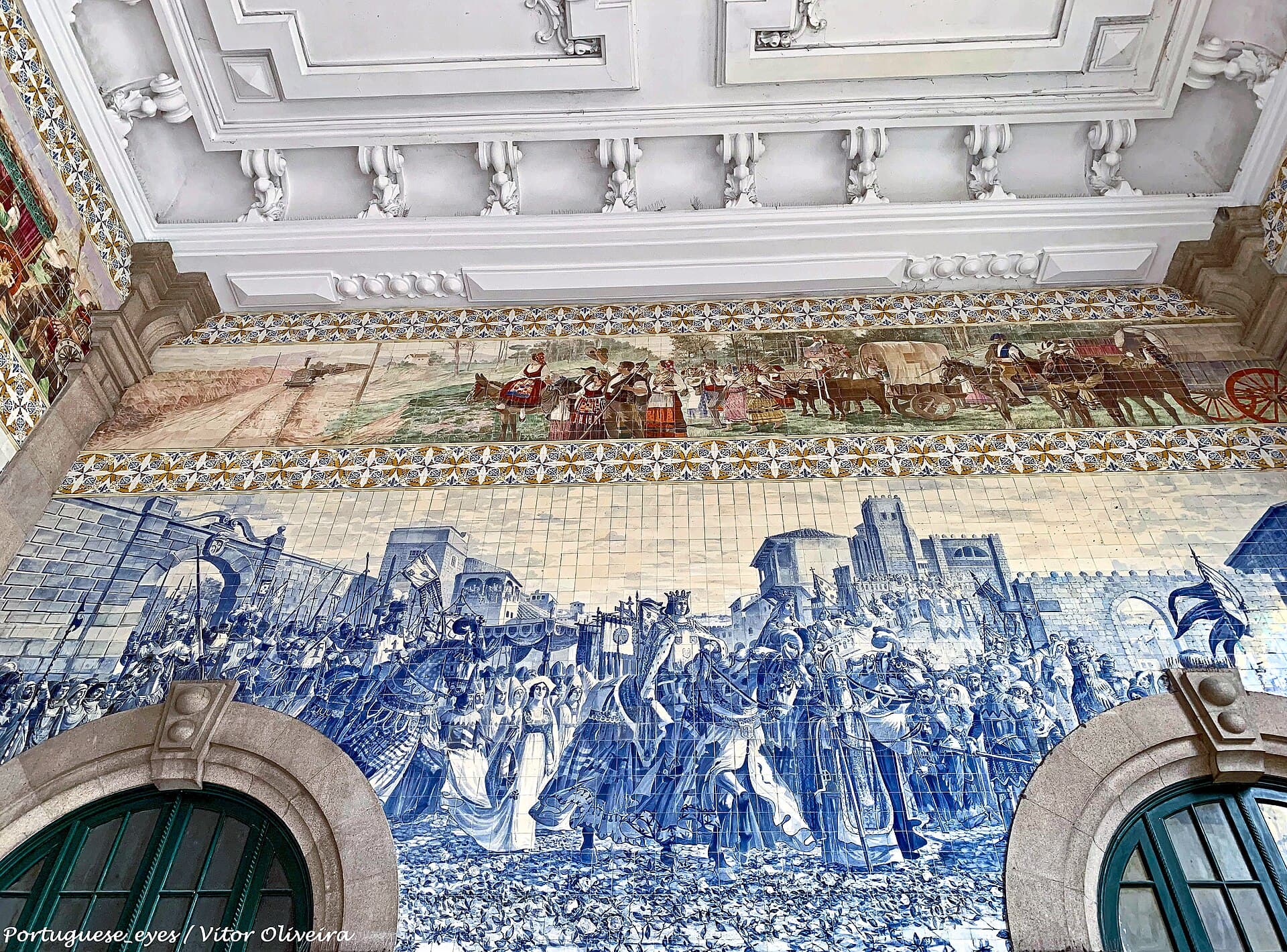
Walk into the entrance hall of São Bento railway station in Porto and you meet the clearest statement of how this city works: a hard granite structure carrying its grandest story not in its bones but on its applied surface, in roughly 20,000 glazed blue-and-white azulejo tiles. The building is a functioning commuter station. People pass through it to buy tickets and catch trains. Yet its outermost skin holds a painted history of Portugal. Understand why the tile is there and not in the stone, and you understand the argument behind an entire walk through the city.
A working building doing monumental work
São Bento opened in 1916 to designs by the architect José Marques da Silva. It stands on the site of the Benedictine convent of São Bento da Ave Maria, which was demolished in 1892 to clear the ground. So the building itself is young by the standards of the churches around it, and that matters, because the tile is younger still in spirit than it looks.
The atrium holds about 20,000 azulejo tiles across 551 square metres, painted by Jorge Colaço. He worked on the panels across roughly eleven years, from about 1905 to 1916. Look at what he chose to depict. High on the walls run grand moments of Portuguese history: the Battle of Arcos de Valdevez, Egas Moniz standing before Alfonso the Seventh, King John the First entering Porto, the Conquest of Ceuta. Below and around those, multicolored panels spread out the ordinary business of the regions, vineyards and harvests, wine being shipped, pilgrims on the road.
The engineering point is the separation of jobs. The station structure does the standing. The tile does the talking. Nothing about a ticket hall requires a mural of national memory. Porto added one anyway, on the surface, where every commuter would walk straight through it. That instinct, to dress a plain function in an extraordinary skin, is the pattern the rest of the walk traces backward.
The paradox of a reserved city
Hear a stop from this walk
Estacao de Sao Bento: Tile as National Narrative
Porto is built of granite, grey stone quarried nearby and stacked into churches, houses, and civic halls that read as reserved and even severe. By material, it should be one of the plainest cities you could walk through. Instead it is one of the most exuberantly dressed. The stone stays quiet; everything applied to it does the work of expression. That is the paradox the full tour reads out loud, and São Bento is its loudest example because the contrast is so total: a strictly utilitarian building, an entire nation's story on its face.
Once you see the separation of structure and surface here, you can read it everywhere. That is what makes São Bento the right way into the route rather than just a nice stop on it. If you want the full map of the city's tours before committing, the Porto walking tours hub lays them out.
Follow one painter and the walk clicks
The most useful thing to carry out of São Bento is a name: Jorge Colaço. He is the hand behind these 20,000 tiles, and he is not confined to the station. A few streets away, the facade of the Igreja de Santo Ildefonso wears about 11,000 blue-and-white tiles showing scenes from the life of Saint Ildefonso, and Colaço placed them there in November 1932. Stand at Santo Ildefonso before you reach São Bento and you are looking at a rehearsal for the climax. Same painter, same medium, smaller canvas, then the full national narrative at the station.
Santo Ildefonso doubles the lesson in a single building. The church was completed and blessed on the eighteenth of July, 1739, in a proto-baroque style. Inside, the main carved altarpiece was designed by Nicolau Nasoni, the Italian architect who came to northern Portugal in the eighteenth century and never left. It was installed by Miguel Francisco da Silva in 1745. So one church holds an eighteenth-century gilded altarpiece by an Italian on the inside and a twentieth-century tile skin by Colaço on the outside, with the granite structure holding still between them. Gold within, glazed blue without, and the stone doing neither.
The honest catch about the tiles
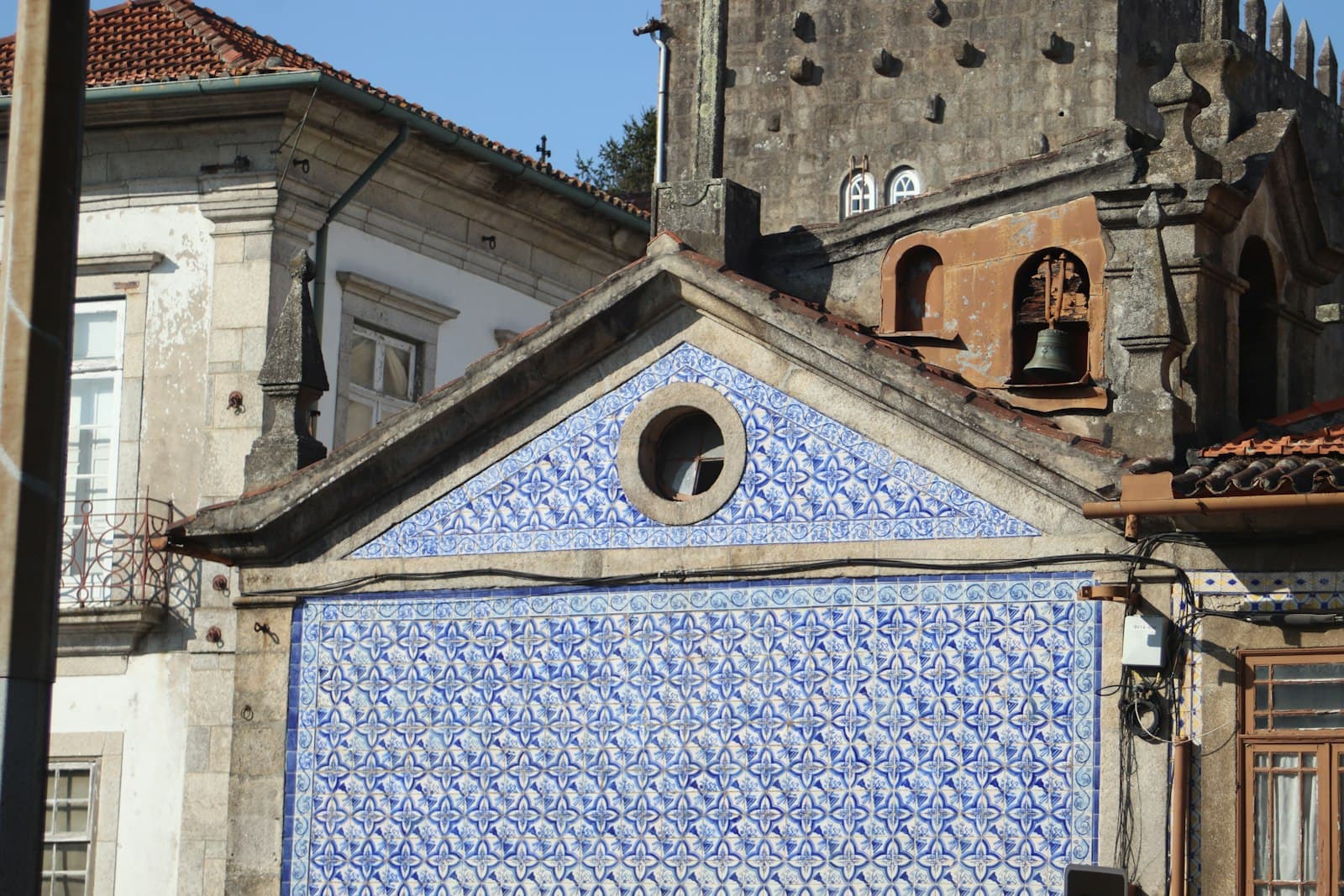
Here is the correction that reorganizes the whole walk. Most of these tiled skins are not old. They look centuries deep, but they belong to an early twentieth-century revival that dressed older stone in an older style. The great azulejo wall of the Igreja do Carmo, sheathing its entire eastern side, was added in 1912, designed by Silvestre Silvestri and painted by Carlos Branco, more than a century after the church was built between 1756 and 1768. The Capela das Almas, whose exterior carries 15,947 tiles across about 360 square metres, only got that skin in 1929, designed by Eduardo Leite and made at the Fábrica de Cerâmica Viúva Lamego in Lisbon. Before that, the chapel stood plastered and painted plain white.
So when you read São Bento's atrium as ancient, correct yourself. Colaço finished it in 1916. The tile revival was a modern city reaching deliberately for an older look, applying narrative to structure that had nothing to say on its own. That is not a knock on the work. It is the whole method made visible.
Where the surfaces come off
The tour opens at the Torre dos Clerigos, where Nasoni carved the city's plainest granite into a baroque tower climbing 75.6 metres. It ends on the Avenida dos Aliados, laid out by the English town planner Barry Parker, where the decoration finally falls away and the bare monumental granite speaks for itself. Between those poles sit the tiled and gilded skins: the Carmo wall, the staged interior of the Livraria Lello, the wrapped chapel of the Almas, and the painted station of São Bento at the climax.
Read São Bento first as a puzzle. Why does a train hall carry a mural of kings and battles? Then walk the route and the answer keeps repeating. Porto built in granite and confessed everything on the outermost layer. When you are ready to walk it stop by stop, start from Porto. The station is free to enter, it is still in daily use, and it is the best single place to learn to read a whole city as decorated pages over quiet stone.
Sources
- São Bento railway station, Wikipedia. Construction date, architect José Marques da Silva, atrium tile count and area, and Jorge Colaço's authorship.
- Church of Saint Ildefonso, Wikipedia. Completion in 1739, Nasoni altarpiece, and the Colaço tile facade of 1932.
- Clérigos Church, Wikipedia. Nasoni's authorship, tower height, and the church's baroque elliptical plan.
- Igreja do Carmo, Wikidata. Construction dates and the 1912 azulejo panel by Silvestri and Branco.
- Capela das Almas, Wikidata. The 1929 tile skin by Eduardo Leite and the Viúva Lamego factory.
Ready to experience it?
Clérigos and São Bento: Granite Dressed in Gold and Tile
100 min · 3.6 km · moderate
More from Porto
Explore more at your own pace.
One Day in Porto: A Walkable Itinerary From Cathedral to River
Porto: The Granite City That Faces Its River
The Porto Market Hall That Never Sold a Thing
Why Port Wine Ages Across the River in Gaia, Not in Porto
Livraria Lello: How Porto Built a Bookshop Like a Cathedral