The Mosteiro da Serra do Pilar is defined by two things that rarely share a building. Its church and its cloister are both circular, a form found nowhere else in Portugal, and its clifftop height turned a house of prayer into a military position more than once. Stand on its esplanade above the south bank of the Douro and you are looking at the single best vantage over Porto, but the building behind you is stranger and more contested than the postcard view suggests. Most visitors come for the panorama and never step through the door. This one place rewards the reader who wants to understand what they are actually standing on.
A round church in a country of naves
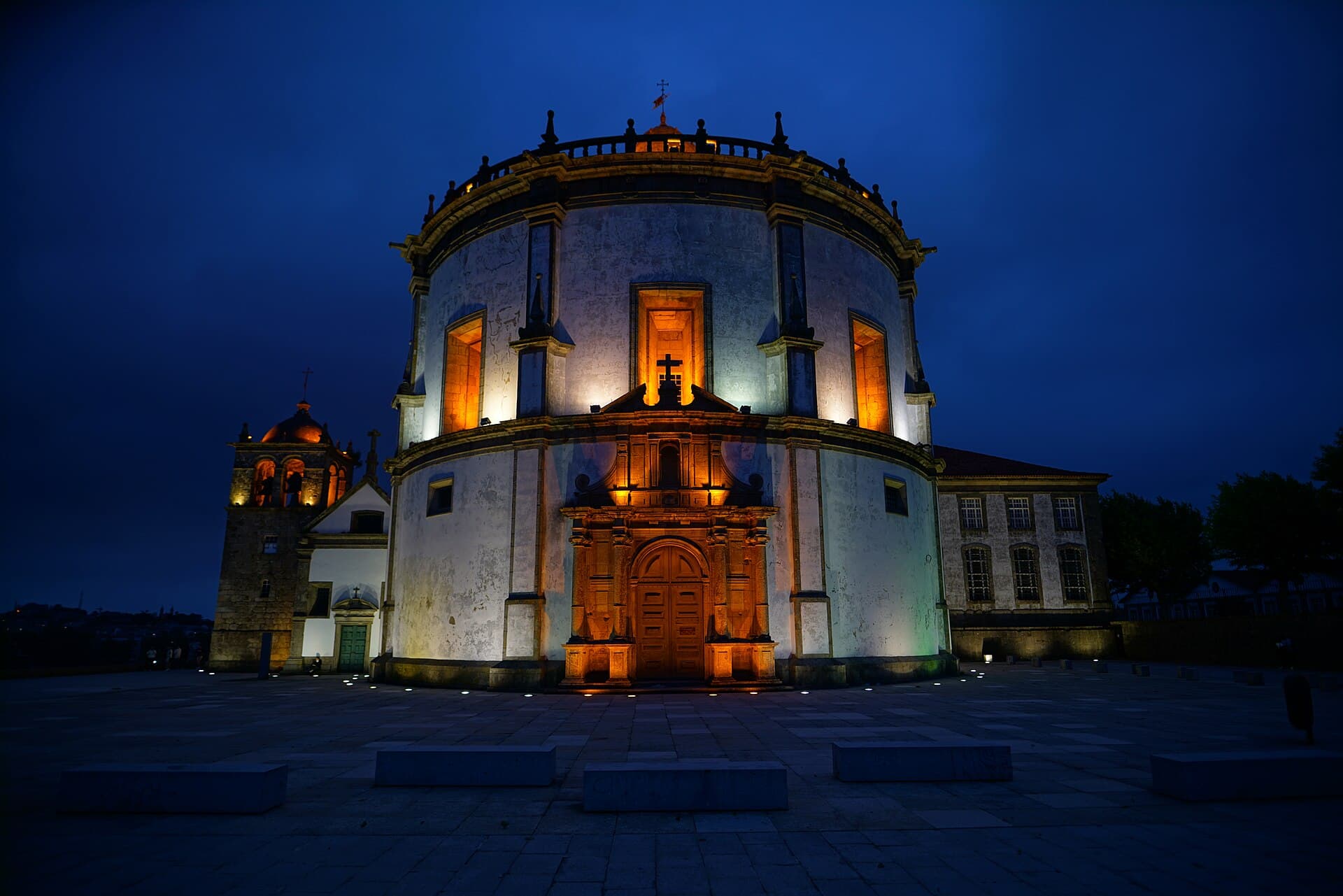
Start with the shape, because it is the thing a trained eye catches first and a casual one misses entirely. Portuguese religious architecture, like most of Western Europe's, is built on the long axis: you enter at one end, you walk a nave toward an altar at the other. Serra do Pilar refuses that logic. Both the church and the adjoining cloister were built as circles, with matching diameters, and that pairing is documented as unique in Portugal and rare across Western Europe. The circular cloister rings the space with Ionic columns, thirty-six of them, a colonnade that curves back on itself instead of framing a square.
Why round? The design belongs to the Renaissance fascination with the perfect form. A circle has no beginning and no end, which architects of the period read as an image of the divine, and Italian theorists of the sixteenth century argued that centrally planned churches came closer to that ideal than the medieval cross. Portugal built very few of them. So when you approach and notice the drum-like body of the church rather than the expected long roofline, you are seeing an idea that arrived from the Italian peninsula and mostly failed to take root here. This is the exception that survived.
The numbers are modest and worth carrying in your head as you look up. The church rises about thirty-six metres. The bell tower reaches roughly twenty. The monastery was begun in the year fifteen thirty-eight as a house of the Order of Saint Augustine, and the round church was inaugurated more than a century later, on the seventeenth of July, sixteen seventy-two. That long gap between founding and completion is its own quiet story: a building this ambitious did not go up in one confident push, but across generations, wars, and shifting fortunes.
The height that made it a weapon
Hear a stop from this walk
The Lodges of Vila Nova de Gaia
Here is where the monastery stops being an architectural curiosity and becomes something harder. Its position, on a cliff directly across from Porto, gave it a field of view over the whole river gorge. That is a gift to a landscape painter and a gift to an artillery officer, and both have used it.
During the Peninsular War, the British general Arthur Wellesley, later the Duke of Wellington, seized on exactly this advantage. In the year eighteen oh nine, with French troops holding Porto across the water, he used the Serra do Pilar height to launch a surprise crossing of the Douro and retake the city. Gun positions on this hill could shell the far bank while men were ferried over. A monastery raised to contemplate the eternal became, for a few days, the platform from which a city was recaptured.
It happened again a generation later. During the Siege of Porto, from eighteen thirty-two to eighteen thirty-three, part of the Liberal Wars that split the country between constitutionalists and absolutists, this hill was the only Liberal stronghold on the entire south side of the river. Everything else on that bank had fallen or turned. The monastery held. If you have ever wondered why a religious house has walls that read almost like a fortress, this is the answer: it kept being asked to behave like one. The circular church and its ring of Ionic columns absorbed cannon smoke as readily as incense.
That double life is the one thing to understand while standing in front of it. This is not a building that history left alone. Its beauty and its usefulness as a gun emplacement came from the same fact, its height, and you cannot separate them.
What the view actually shows you
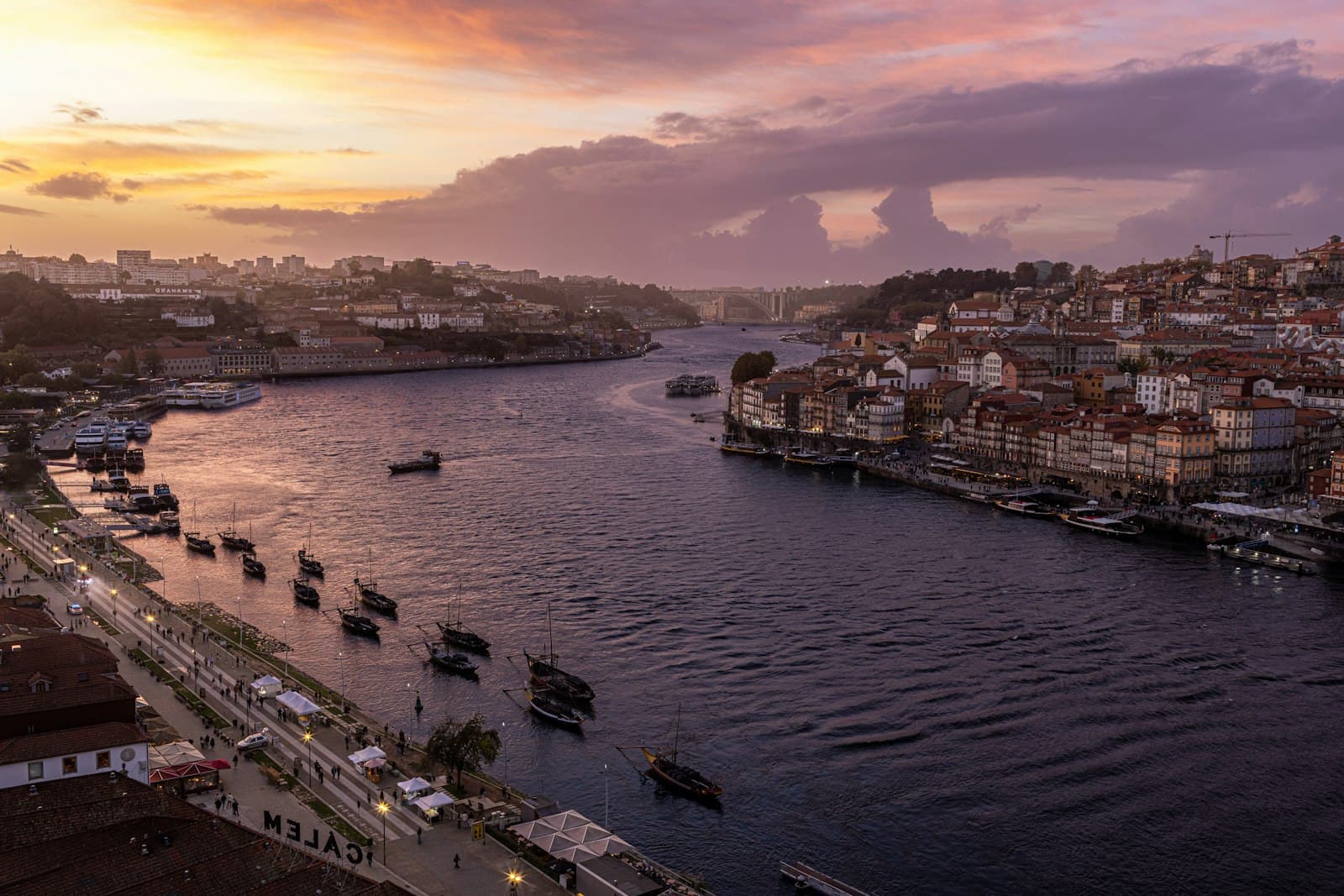
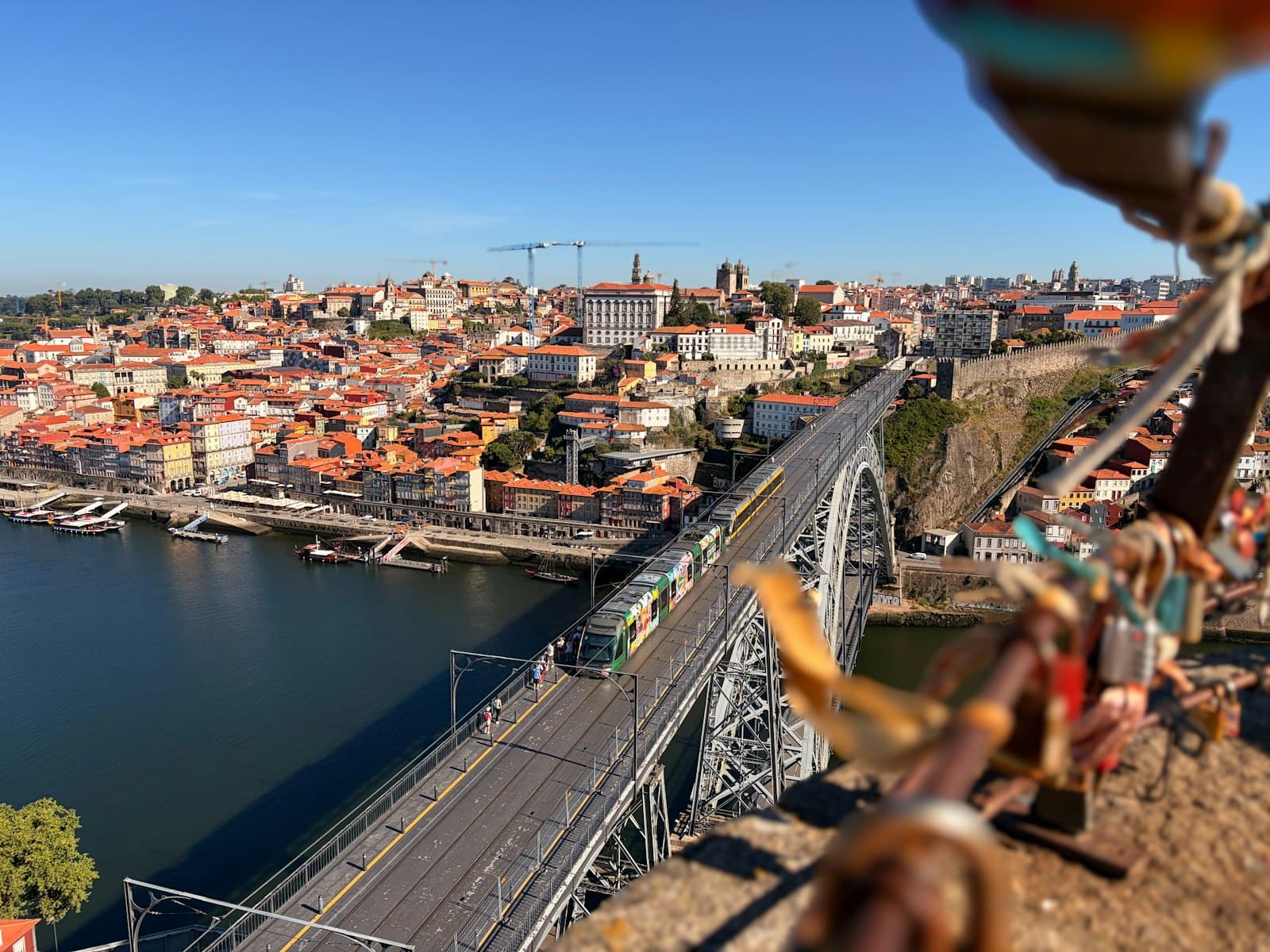
Walk to the edge of the esplanade and the reason this monastery anchors a whole walking route becomes obvious. The geography of northern Portugal's most famous export lays itself out in one glance. Below you on the near bank sit the cellars of Vila Nova de Gaia, where port wine is aged in long dim warehouses. Spanning the river is the iron arch of the Ponte Dom Luis the First. And across the water, stacked up the far cliff, is Porto itself, the city that lent the wine its name without ever growing a grape or aging a barrel of it. The valley where the fruit actually ripens lies out of sight, roughly eighty kilometres upstream, hidden in the hills to the east.
The monastery, together with that bridge and the historic centre across the river, was inscribed by UNESCO in nineteen ninety-six under the title Historic Centre of Porto, Luiz the First Bridge and Monastery of Serra do Pilar. It is not a footnote on that list. It is named in it. The panorama you get here is the same one the recognition was partly built to protect.
A practical note, because it changes how you plan your time. The esplanade viewpoint is free. Stepping inside the round church and the circular cloister costs a modest ticket, so decide at the door based on how much of the interior geometry you want to see up close. Late afternoon into early evening gives you the warmest light on Porto's far-bank skyline, and it is worth timing your climb to arrive about an hour before sunset. The slopes up from the Gaia quay are steep and the granite cobbles turn slick in rain, so proper shoes matter more here than the flat riverfront lets on.
Why it belongs on the walk
The Mosteiro da Serra do Pilar makes most sense not as a standalone stop but as the point where a longer story resolves. It is where the cellars, the bridge, and the city that named the wine all fall into a single frame, and where you can finally see how a valley, a far bank, and an eighteenth-century trade fit together. The self-guided porto-gaia-port-wine route is built to bring you here at the end, on foot and at your own pace, so the panorama lands as an answer rather than a photo stop. If you are mapping out a few days, the wider set of Porto walking tours can help you fit this clifftop into a route through Porto and its river.
Come for the view, by all means. But look up before you look out. The round church behind you is the rarer thing.
Sources
- Monastery of Serra do Pilar, Wikipedia. Founding date, circular church and cloister, Order of Saint Augustine, and military history including Wellesley's 1809 crossing and the 1832 to 1833 siege.
- Serra do Pilar Monastery, Cultural Heritage of Portugal (loja.patrimoniocultural.gov.pt). Confirms the circular church and cloister as a remarkable example of European classical architecture, unique in Portugal.
- Historic Centre of Oporto, Luiz I Bridge and Monastery of Serra do Pilar, UNESCO World Heritage List. The 1996 inscription that names the monastery.
- Second Battle of Porto (1809), Wikipedia. Wellesley setting his headquarters and artillery batteries at Serra do Pilar to shell French-held Porto and enable the Douro crossing on 12 May 1809.
Ready to experience it?
Vila Nova de Gaia: The Wine That Named a Country
110 min · 3.3 km · moderate
More from Porto
Explore more at your own pace.
One Day in Porto: A Walkable Itinerary From Cathedral to River
Porto: The Granite City That Faces Its River
The Porto Market Hall That Never Sold a Thing
Why Port Wine Ages Across the River in Gaia, Not in Porto
Livraria Lello: How Porto Built a Bookshop Like a Cathedral