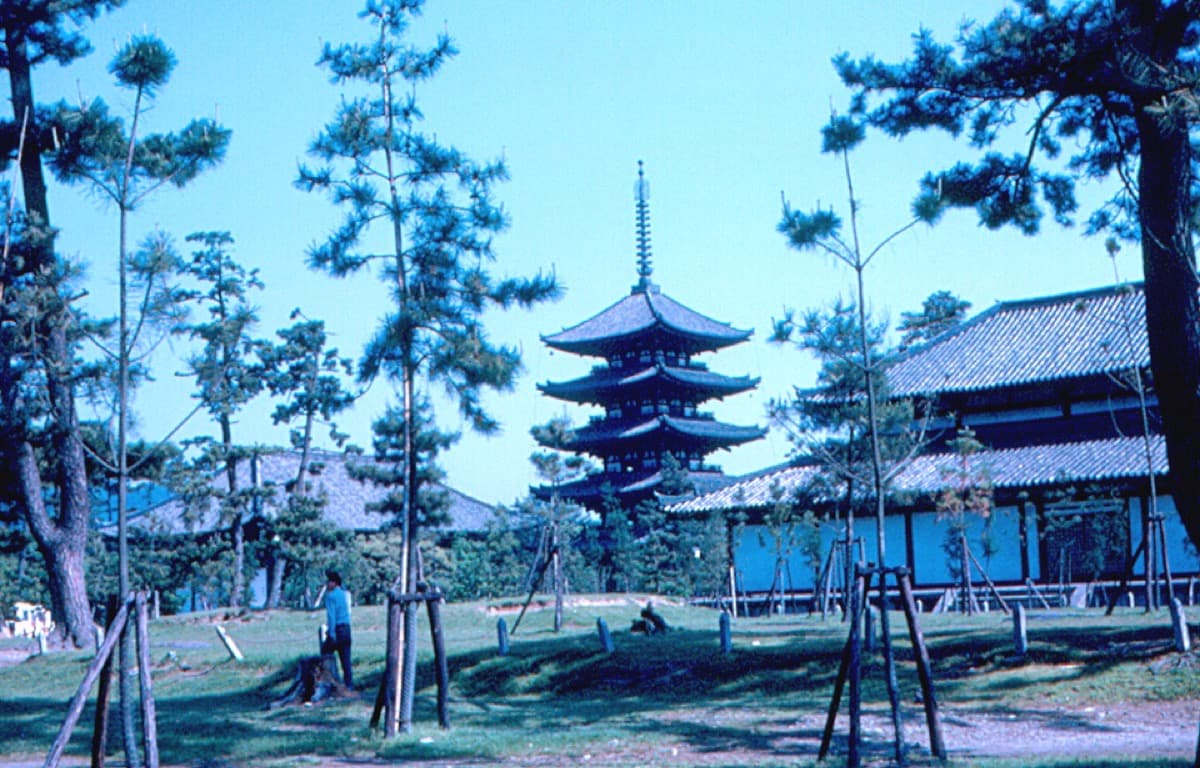
The five-storey pagoda of Kofuku-ji is the tower that defines the Nara skyline, rising dark and severe above the park where the sacred deer roam. It looks eternal, and in a sense it is, but not in the way you would guess. The tower has burned to the ground and been rebuilt many times over its history, and the structure standing today dates from 1426. It is a symbol raised, destroyed, and raised again across nearly thirteen centuries, the persistent emblem of the clan that once ran Japan. Read it as a thing that keeps coming back, and the pagoda becomes a study in endurance.
An empress and the Fujiwara clan
Kofuku-ji was the temple of the Fujiwara, the aristocratic family that dominated the Japanese court for centuries, and the pagoda is bound up with them. The temple traces its origins to 669, founded in connection with the wife of Fujiwara no Kamatari, the clan's founding statesman, and it served as the Fujiwara's tutelary temple, prospering for as long as the family did. The five-storey pagoda itself was commissioned in 730 by Empress Komyo, the wife of Emperor Shomu, as an expression of her devotion to Buddhism. So the tower began as an imperial and aristocratic statement, the spiritual sign of the most powerful family at the most powerful court in the land.
Its fortunes rose and fell with theirs. As the Fujiwara flourished, so did Kofuku-ji, growing into one of the great temple complexes of the ancient capital.
The tower that fire kept taking
Hear a stop from this walk
Nigatsu-do Hall: Twelve Centuries of Unbroken Fire
The pagoda's history is a history of fire. The temple was damaged and destroyed by civil wars and fires many times over the centuries, and each time the pagoda fell, it was rebuilt. This was not a single monument that survived intact from 730, but a form that was renewed again and again on the same spot, generation after generation, refusing to stay gone. The present pagoda dates to 1426, raised centuries after the empress first ordered one, and it is a designated National Treasure. When you look at it, you are looking at a fifteenth-century rebuilding of an eighth-century idea, the latest in a long line of the same tower.
At around fifty meters, it is one of the tallest wooden pagodas in Japan, and for centuries it dominated the low skyline of Nara so completely that it became the city's signature. To see it reflected in the still water of nearby Sarusawa Pond, as generations of travelers have, is to catch one of the oldest picture-postcard views in Japan.
Why it anchors the walk into Nara Park
The pagoda is where a walk through the sacred heart of Nara naturally begins, because it stands at the threshold between the ordinary city and the sacred park. From its foot the ground opens into the world of the sacred deer and leads on toward the colossal Great Buddha of Todai-ji. Roamer's Nara Park and Todai-ji walk uses the pagoda as its opening note for exactly this reason: it sets the register of ancient, repeatedly renewed sacred architecture that the whole route explores. Nara is a city where the oldest things were often rebuilt, from this pagoda to the endlessly reconstructed shrine at Kasuga, and the tower states that theme first.
Reading it in place
Stand at the base of the pagoda and take in its height and its dark, weathered dignity, then hold the fact that this exact tower dates to 1426, the latest of many, and the original idea to 730. Walk to Sarusawa Pond to catch its reflection, one of the classic views of the ancient capital. Then let it point you onward into the deer park and toward the Great Buddha. Early morning gives you the tower with the fewest crowds and the best light.
The pagoda opens Roamer's Nara Park and Todai-ji. To fit Nara into a day, see one day in Nara, and for the full set of routes, browse Nara walking tours.
Sources
- Wikipedia, Kofuku-ji: the temple's origins in 669 connected to the wife of Fujiwara no Kamatari and its role as the Fujiwara tutelary temple, the five-storey pagoda commissioned in 730 by Empress Komyo (wife of Emperor Shomu) out of devotion to Buddhism, the temple damaged and destroyed by civil wars and fires many times and rebuilt as many times, the current pagoda dating to 1426 and holding National Treasure status, and the temple as part of the Historic Monuments of Ancient Nara World Heritage Site.
- Roamer tour transcript, Nara Park and Todai-ji (nara-todaiji), fact-audited: the Kofuku-ji five-storey pagoda as the clan that rebuilt the sky, at the threshold of the sacred park.
Ready to experience it?
Nara Park and Todai-ji: The Great Buddha
95 min · 3 km · moderate
More from Nara
Explore more at your own pace.
Nara Travel Guide: Day Trip from Kyoto or Osaka, the Deer, How Long You Need (2026)
One Day in Nara: The Perfect Walkable Day Trip (2026)

What to Eat in Nara: A Food Guide (2026)
Gango-ji: The Temple Older Than Nara That Naramachi Grew Around
The Great Buddha of Nara Was Cast to Hold a Country Together