Gango-ji is Japan's oldest full-scale Buddhist temple, and the Naramachi merchant quarter grew up inside the footprint of its shrinking precincts. That is the fact most visitors to Nara never learn, because they arrive for the giant bronze Buddha and the sacred deer and leave before they ever walk ten minutes south. Yet the reason the old merchant streets exist at all, the reason the lattice houses and red charms cluster where they do, is that a temple older than the capital once stood over the whole neighborhood and then slowly gave up its ground.
A temple that predates the city
Start with the dates, because they are the point. Gango-ji does not begin in Nara. Its lineage reaches back to Hoko-ji, also called Asuka-dera, founded in the year 588 by the powerful nobleman Soga no Umako in Asuka, a region south of present-day Nara. Soga no Umako built it as his clan's temple, and it is widely counted among the very first Buddhist temples in Japan. The official temple describes Asuka-dera as the first authentic temple in the country, the place where Buddhist temple building began.
When the Japanese court moved its capital to Heijo-kyo, the grid city we now call Nara, the temple came with it. In the year 718 Hoko-ji was relocated to its present site and renamed Gango-ji. So the institution standing before you was already more than a century old when Nara itself was laid out. That is what makes the phrase "older than the capital" literal rather than decorative. The town formed around a temple that had already outlived one imperial seat.
Reading the oldest roof in Japan
Hear a stop from this walk
Gango-ji Temple: The Root Older Than the Capital
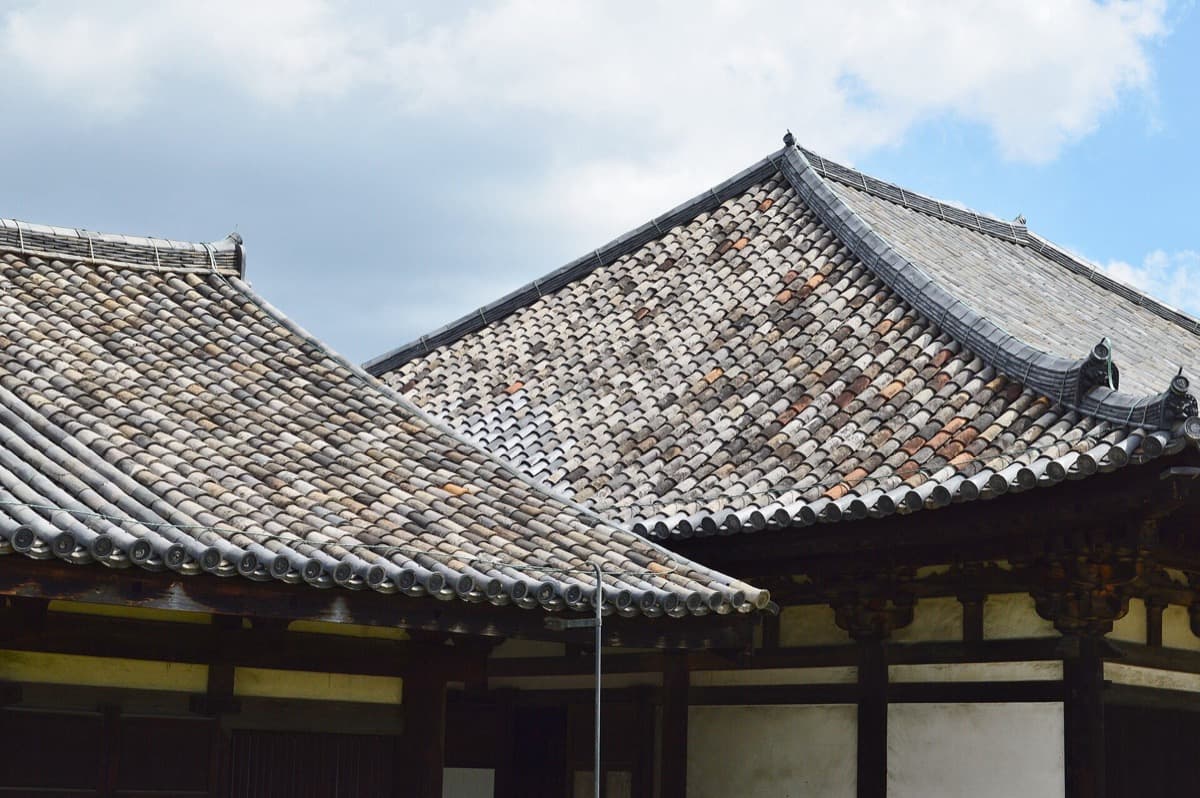
The clearest thing to look at is the roof. Raise your eyes to the Gokurakubo, the main hall, and its adjoining Zen room. Some of the tiles up there have been in continuous use since the Asuka period, roughly 1,400 years, and they are considered the oldest roof tiles in Japan. They were not laid flat and uniform. They follow an overlapping method, and the surface reads as a patchwork of red, brown, black, and gray. That mottling is not decay or neglect. It is a visible record of age, the most ancient tiles set among later replacements, so the roof itself becomes a timeline you can read from the ground.
This is the kind of detail that rewards slowing down. A monument can announce itself with scale, the way the Todai-ji Buddha does to the north. Gango-ji asks you to look closely instead. The surviving Gokurakubo hall and Zen room are designated National Treasures, and inside the hall is the Chiko Mandala, a depiction of the Pure Land paradise tied to a Nara-period scholar-monk named Chiko. In the year 1998 the temple was inscribed on the World Heritage list as one of the component sites of the Historic Monuments of Ancient Nara.
How a temple became a neighborhood
Here is the turn that makes Gango-ji matter beyond its own walls. In the Nara period it was one of the great state-supported temples, ranking among the powerful institutions of the ancient capital, holding vast precincts. That power did not last. Court patronage shifted over the centuries, fire reduced the buildings, and the temple's land steadily shrank. What filled the vacated ground was not another temple. It was ordinary people.
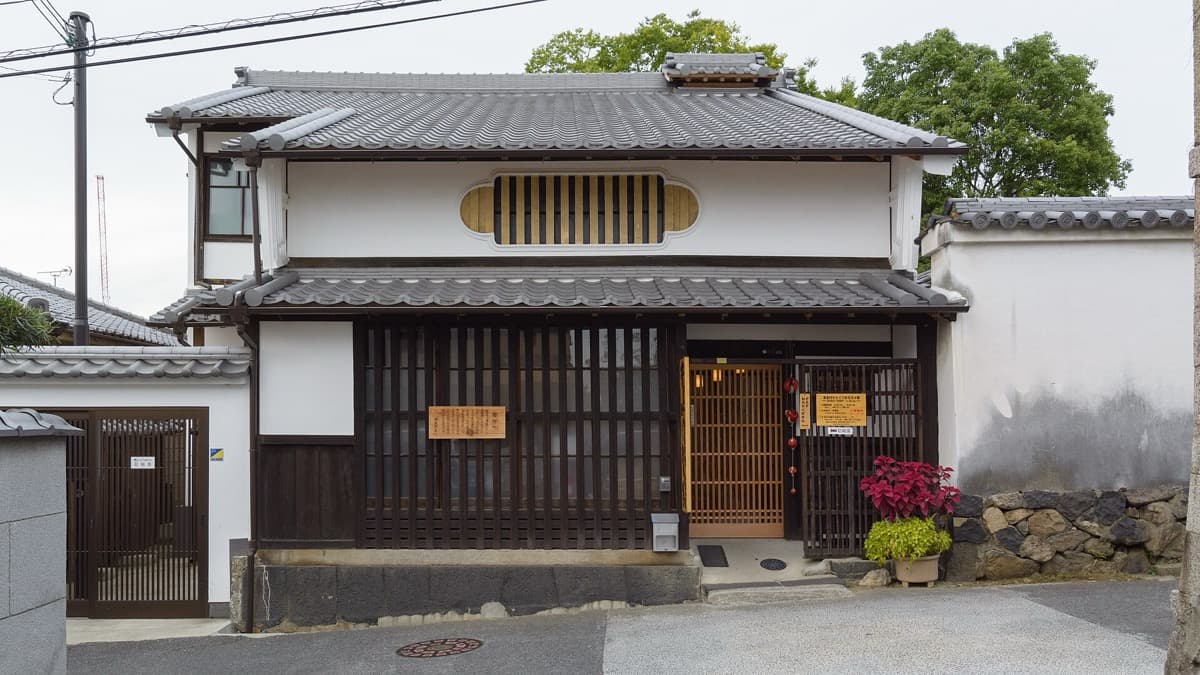
The townspeople who settled on and around the former precincts became the merchants of Naramachi. The narrow lanes you can walk today, the deep wooden townhouses, the workshops for ink and brush and sake, all of it sits inside the outline of a temple that once covered far more. By the Edo period, when a folk faith called Koshin took hold in these streets and families began hanging little red substitute-monkey charms under their eaves, Gango-ji had already been reduced and its grounds were giving way to the merchant town. The domestic city grew directly out of the monumental one. That single fact organizes the whole quarter.
What to notice on the ground
If you go inside, admission is 700 yen for adults, and the temple is open from nine in the morning to five in the afternoon, with last entry at four thirty. That cutoff is worth planning around. It is easy to spend the early part of a Naramachi visit wandering the lattice streets and then find Gango-ji closing just as you reach it, so it pays to visit the temple earlier in a loop rather than saving it for last.
Once inside, three things repay attention. First the roof, for the reasons above, since nowhere else can you look at 1,400-year-old material still doing its job. Second the proportions of the Gokurakubo and Zen room, quieter and more intimate than the vast halls to the north, built for a monastic community rather than crowds. Third the relationship between the temple and everything outside its gate. Step back onto the street and the logic reverses: instead of a temple surrounded by a town, you are standing in a town that was carved out of a temple.
That reversal is the heart of it. Nara's headline sights, the Buddha and the deer, present the ancient capital as monument. Gango-ji lets you read it as a living settlement that changed hands over 1,400 years, from a clan temple in Asuka, to a state institution in the new capital, to the seed of a merchant quarter that ordinary families called home. The temple is the root, and Naramachi is what grew from it.
If you want to walk this ground in order, from the pond that marks the boundary down through the merchant lanes, Roamer's Naramachi audio tour begins just north of here. You can find it and the rest of the city on the Nara page.
Sources
- Gango-ji official site (gangoji-tera.or.jp): confirms the temple's origin as Hoko-ji / Asuka-dera, the Soga family founding, the move to Heijo-kyo and renaming, and its status as a National Treasure and World Heritage site.
- "A Travel Guide to Gango-ji, Japan's Oldest Full-Scale Buddhist Temple" (GOOD LUCK TRIP, gltjp.com): source for the oldest-full-scale claim, the Asuka-period roof tiles laid in an overlapping method, the 588 founding by Soga no Umako, the 718 relocation, the 1998 World Heritage inscription, and the Chiko Mandala.
- Historic Monuments of Ancient Nara (UNESCO World Heritage inscription, 1998): the listing under which Gango-ji is protected as a component site.
- Nara City Tourism Association travelers guide (narashikanko.or.jp): general context on Gango-ji and the surrounding Naramachi quarter.
Ready to experience it?
Naramachi: The Merchant Town Beneath the Temples
70 min · 2.5 km · easy
More from Nara
Explore more at your own pace.
Nara Travel Guide: Day Trip from Kyoto or Osaka, the Deer, How Long You Need (2026)
One Day in Nara: The Perfect Walkable Day Trip (2026)
What to Eat in Nara: A Food Guide (2026)
Kofuku-ji's Five-Storey Pagoda: The Tower an Empress Ordered and Fire Kept Remaking
The Great Buddha of Nara Was Cast to Hold a Country Together