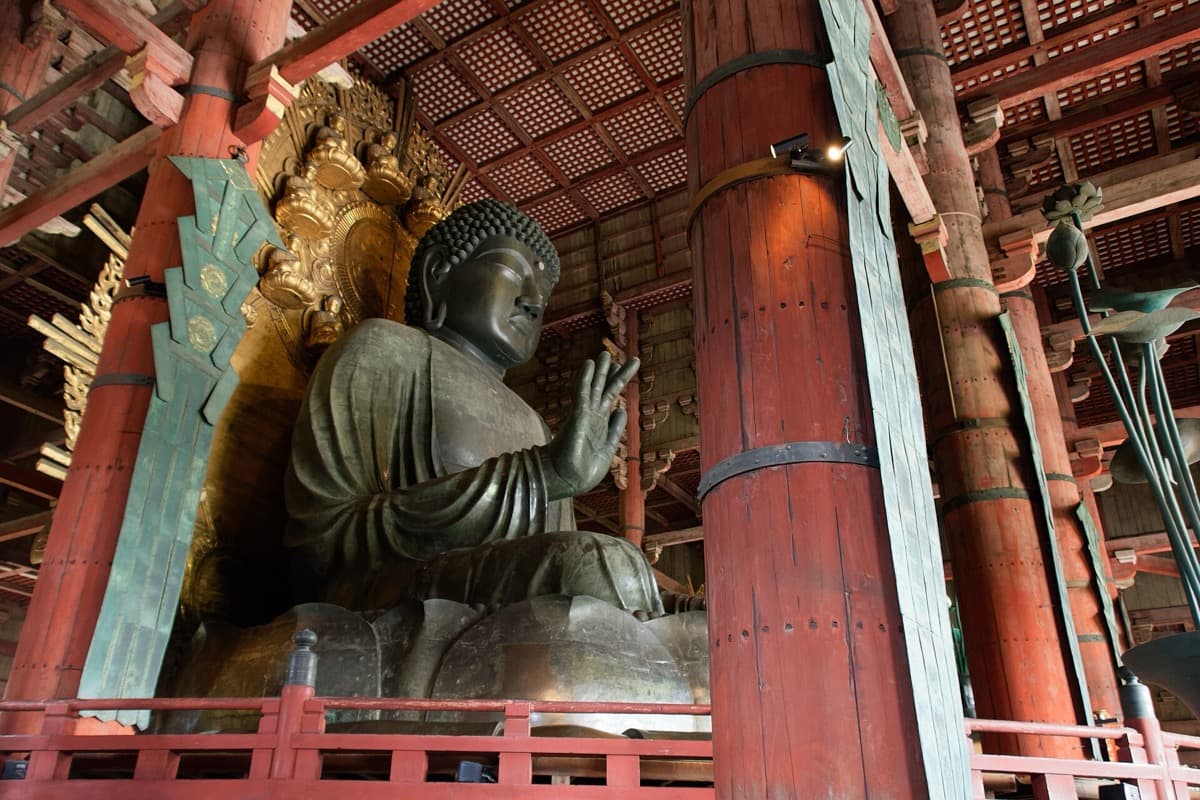
The Great Buddha of Todai-ji is not a gentle religious ornament. It is an instrument of raw statecraft. The colossal bronze Vairocana seated inside the Great Buddha Hall in Nara was cast by order of Emperor Shomu to bind a young Japan together under a single power, and its calm face has been overawing visitors ever since. The scale you feel when you walk in is the point. Shomu did not commission a work of quiet devotion. He commissioned an argument about who ruled, made in two hundred and fifty tons of metal.
A statue with a job to do
The figure is known in Japanese as the Daibutsu, the Great Buddha, and it is an image of Vairocana, the cosmic Buddha, called Rushana in Japanese. It rises roughly fifteen metres and weighs an estimated two hundred and fifty tons. It is the largest bronze Buddha in the world. That much is easy to read off a plaque. What the plaque tends to leave out is why anyone in the eighth century would pour that much bronze, gilding, and labor into a single seated figure.
The answer is politics. Emperor Shomu issued the founding edict for the Great Buddha in the year seven hundred and forty three. Japan at that point was a country still assembling itself, a court trying to hold provinces together under a central authority and a shared imperial religion. Vairocana was a shrewd choice for that project. He was understood as the cosmic Buddha whose light reached every corner of the realm, a single radiant source from which everything else derived. Building him at overwhelming scale was a way of making an abstract claim physical. One Buddha, one light, one country, one throne.
The casting was carried out here in Nara, in what was then the capital of Heijo-kyo, over roughly three years and many separate pourings. Bronze of that quantity could not be cast in one go. Molten metal was poured in stages, layer building on layer, the figure rising out of the ground in sections. The project strained the resources of the state. That strain was not a side effect. A monument that costs the whole country something is a monument the whole country has invested in, and that was exactly the binding effect Shomu wanted.
The day the eyes opened
Hear a stop from this walk
Nigatsu-do Hall: Twelve Centuries of Unbroken Fire
A Buddhist image is not considered alive until its eyes are painted in. That final act, the kaigen, the eye-opening, is what animates the figure. For the Great Buddha of Nara the ceremony came in seven hundred and fifty two, and it was staged as a state spectacle. Thousands of monks and dancers gathered. The court attended. The most striking detail is who held the brush. The eye-opening itself was performed not by a local abbot but by Bodhisena, a priest who had traveled to Japan from India. He drew in the pupils and, with that stroke, the colossus was brought to life before the assembled realm.
Think about what that choreography signaled. An Indian monk consecrating a Japanese state Buddha placed the new capital on a map that ran all the way back to the origins of the faith. It told everyone watching that Nara was not a provincial outpost but a legitimate node in a Buddhist world that stretched across Asia. The eye-opening was as much diplomacy as it was ritual.
The face is younger than you think
Stand in front of the Daibutsu today and it is tempting to assume you are looking at one continuous eighth-century object. You are not. The statue has been damaged repeatedly across more than twelve centuries. War and fire took the halls around it more than once, and the figure itself did not escape. The most important consequence is right in front of your eyes: the serene head is not original. It was recast in the Edo period, the era of the Tokugawa shoguns, so the calm, symmetrical face you meet is younger than the body it sits on.
This is worth holding onto, because it changes how you read the whole thing. The Great Buddha is not a frozen relic of the year seven hundred and fifty two. It is a composite, repaired and rebuilt by later centuries that needed it to keep standing. Each generation that restored it was making its own version of Shomu's original bet, that this figure was too important to the idea of the nation to let it fall.
Why the calm is deceptive
Everything about the presentation encourages serenity. The lowered eyes, the still hands, the vast quiet hall. And that serenity is real. People sit in front of the Daibutsu and feel something settle. But the calm and the statecraft are not in tension. They are the same gesture. A figure built to project the reach of a unifying power works best when it looks utterly untroubled by the effort. The composure is the message. It says the order it represents is natural, permanent, beyond argument.
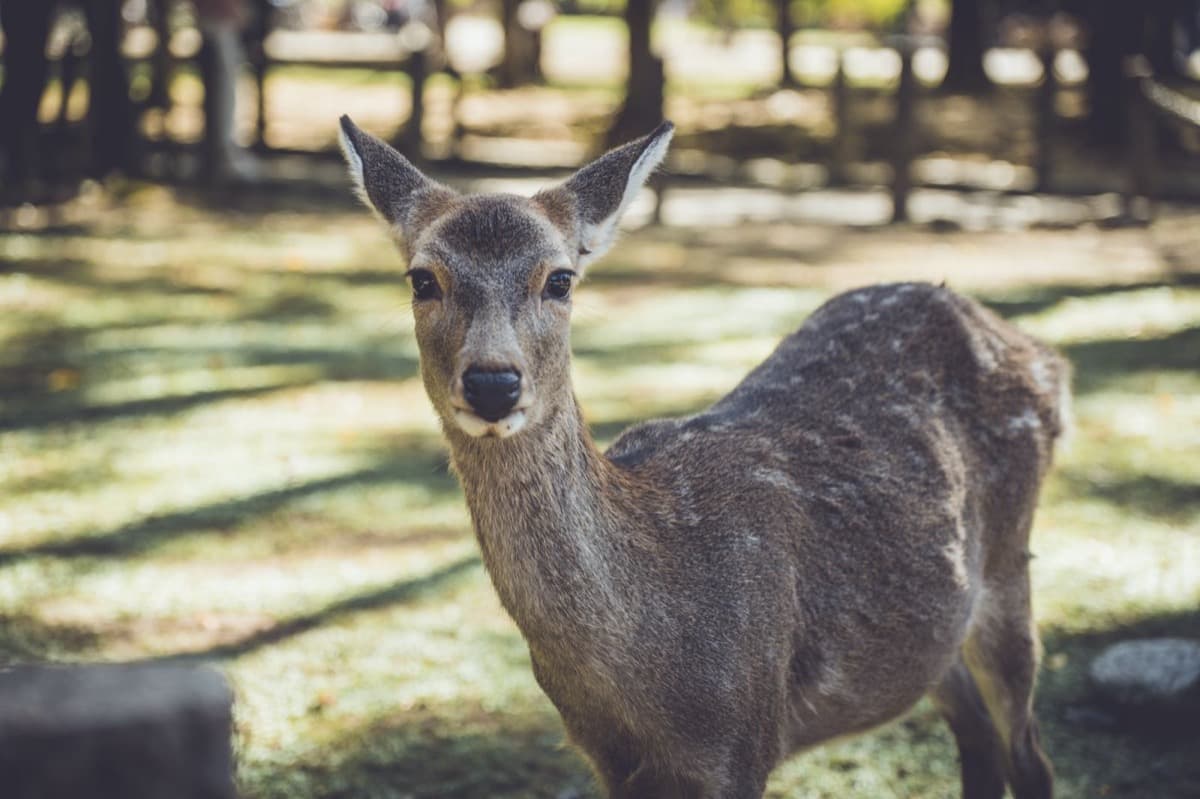
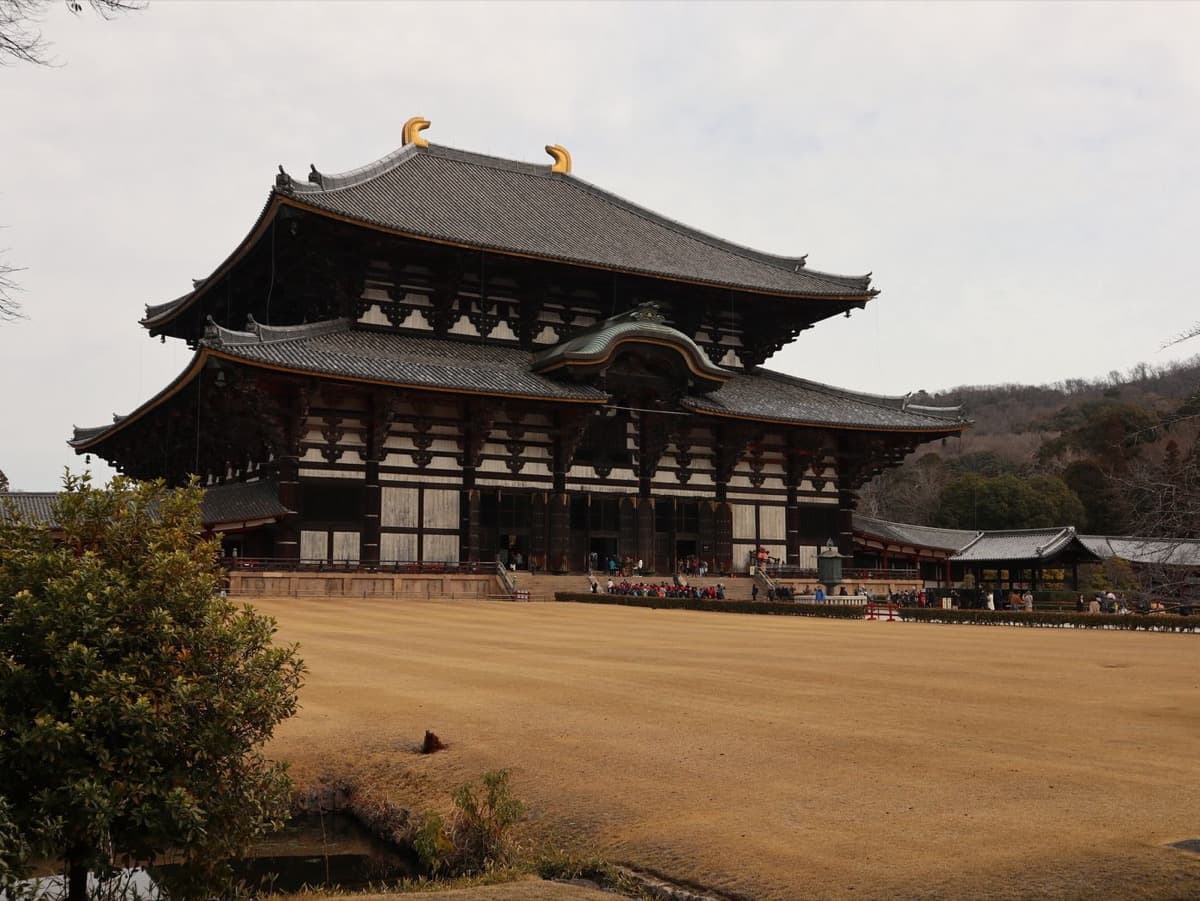
That is the paradox at the center of Nara Park, and the Great Buddha is where it lands hardest. The tame bowing deer outside, protected because a god once made harming them unthinkable. The guardian kings at the gate, carved fierce and colossal to make you feel small before you ever reached the temple. The shrunken rebuilt hall that still counts among the largest wooden buildings on earth. And at the heart of it, a Buddha whose gentleness was engineered to overawe. Everything charming here has a hard root, and the softest face in the park was the hardest political instrument of all.
To stand in front of it, and to walk the ascending west-to-east loop that leads up to it and beyond it to the oldest surviving hall on the hillside, follow the Nara Park and Todai-ji walk in Nara. Arrive soon after the Great Buddha Hall opens, around seven thirty in the morning in warmer months, and you can meet the colossus in near silence, before the day fills the hall.
Sources
- Vairocana, the Great Buddha of Todaiji (Nippon.com). Confirms the bronze Vairocana (Rushana) identity, the roughly fifteen-metre height and estimated two hundred and fifty ton weight, its standing as the largest bronze Buddhist statue in the world, the seven hundred and fifty two eye-opening, Bodhisena as the Indian monk who drew in the eyes, and the Edo-period recasting of the head.
- All About the Great Buddha (Nara Travelers Guide, narashikanko.or.jp). Official tourism source documenting Emperor Shomu's decrees and the seven hundred and fifty two eye-opening ceremony officiated by the Indian priest Bodhisena.
- Todai-ji official temple site, Daibutsuden information (todaiji.or.jp). Primary source on the Great Buddha Hall and the figure it houses.
- Todai-ji, Wikipedia. Encyclopedic overview of the temple's casting (eight castings over roughly three years), destructions, rebuilds, and World Heritage status within the Historic Monuments of Ancient Nara.
Ready to experience it?
Nara Park and Todai-ji: The Great Buddha
95 min · 3 km · moderate
More from Nara
Explore more at your own pace.
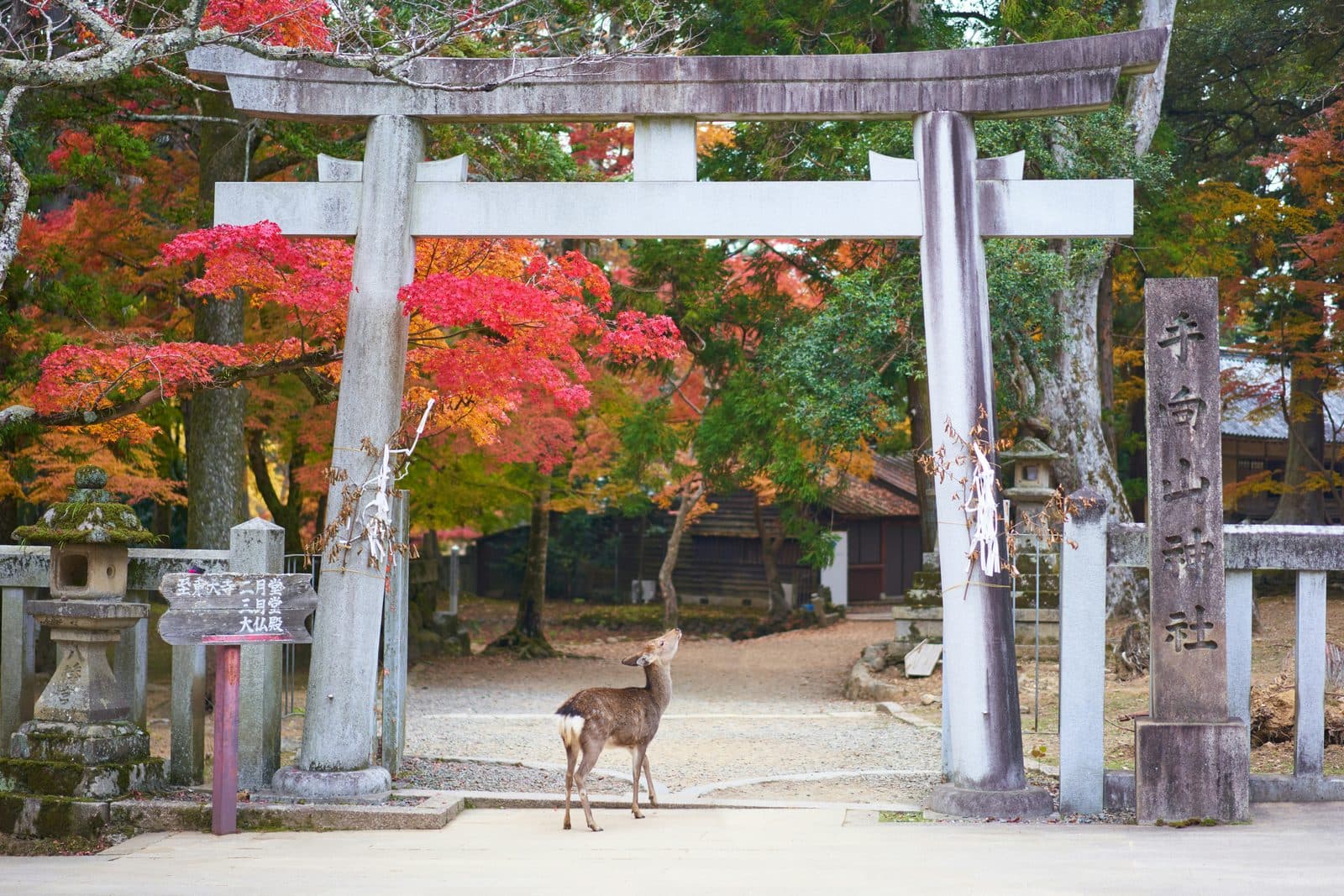
Nara Travel Guide: Day Trip from Kyoto or Osaka, the Deer, How Long You Need (2026)
One Day in Nara: The Perfect Walkable Day Trip (2026)
What to Eat in Nara: A Food Guide (2026)
Gango-ji: The Temple Older Than Nara That Naramachi Grew Around
Kofuku-ji's Five-Storey Pagoda: The Tower an Empress Ordered and Fire Kept Remaking