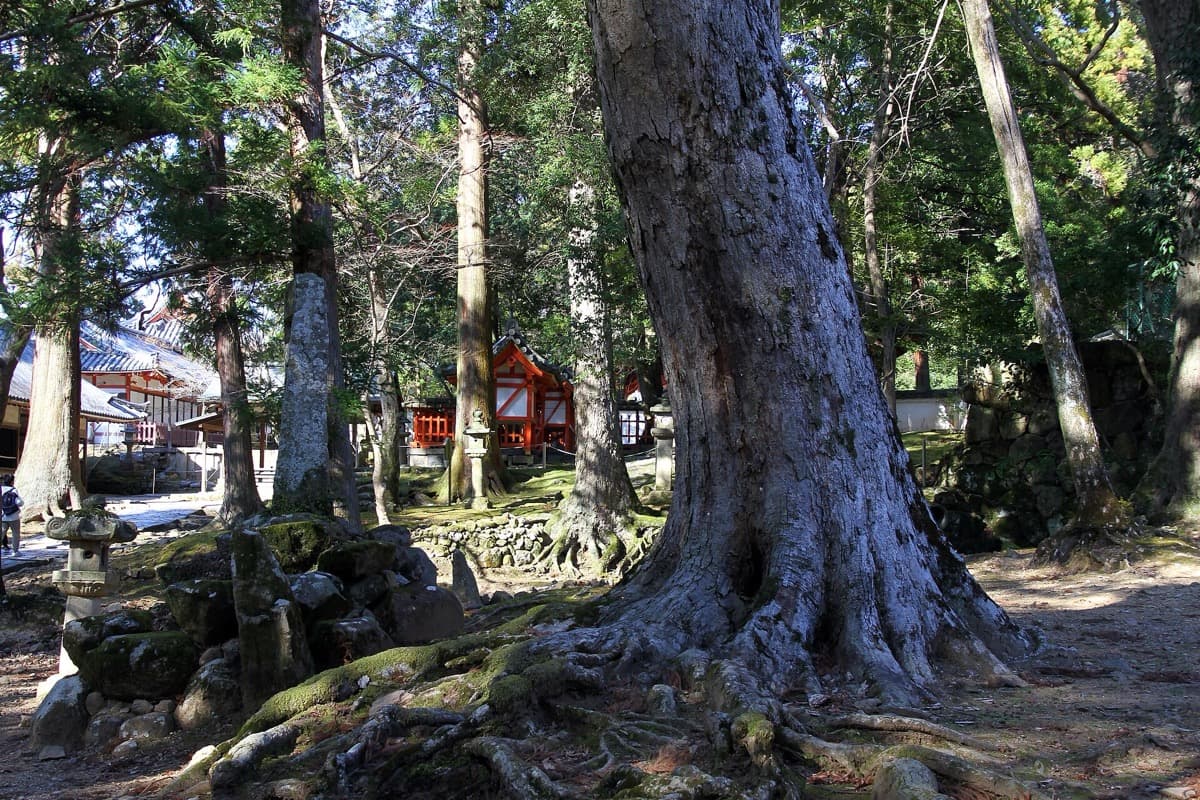
Above the vermilion halls of Kasuga Taisha in Nara, on the slope of Mount Kasuga, the Kasugayama Primeval Forest has survived as genuine primary woodland that no one has been allowed to cut since the year 841. That single fact rearranges everything you think you know about old places in Japan. We assume the temple or the shrine is the ancient thing and the trees around it are decoration. On this hillside the order is reversed. The buildings below have been torn down and remade to the same design roughly every twenty years for more than a thousand years, while the wood above them has simply been left alone for twelve centuries. The forbidden forest is the real antiquity. The wilderness is what was preserved by an imperial order that forbade anyone to touch it.
An imperial order that actually held
The ban is precise and datable. In the year 841, during the reign of Emperor Ninmyo, an imperial order prohibited hunting and logging on Mount Kasuga because the mountain was sacred ground attached to the shrine. Plenty of medieval decrees were issued and then quietly ignored. This one was not. For roughly twelve hundred years, while the surrounding capital grew, burned, and was rebuilt again and again, not a single tree on this protected slope was felled. What survives is the Kasugayama Primeval Forest: about 298.6 hectares of primary woodland, meaning forest that has never been logged and never cleared, only allowed to grow according to its own logic.
Primary forest of this kind is rare anywhere. It is close to miraculous this near an old and continuously inhabited city. Most of Japan's lowland woodland was cut for fuel, timber, and farmland many times over across the centuries. Here, a legal wall held the axes back generation after generation, and the result is a living archive of what the hills around Nara looked like before people reshaped them.
What twelve centuries of not-cutting produces
Hear a stop from this walk
Kasugayama Primeval Forest: The Deliberate Wild
Left to itself for that long, the forest became genuinely wild rather than managed. Surveys count around 175 species of trees inside it, evergreen oaks and beech among the dominant kinds, layered into a dense canopy that stays green through the year. The undisturbed structure supports animal and insect life that has thinned out or vanished elsewhere in the region: local counts record roughly sixty kinds of birds and well over a thousand species of insects living within the protected boundary. None of that richness was designed. It is simply what accumulates when you stop interfering and wait long enough.
Japan recognized the forest's importance in stages. In 1955 the government designated it a Special Natural Monument, its highest tier of natural protection. In 1998 it was inscribed as part of the World Heritage listing for the Historic Monuments of Ancient Nara, sharing that status with the shrine below and the temples nearby. The listing is worth pausing on. A patch of untouched trees earned the same international recognition as centuries of human architecture, because the deliberate refusal to build here is itself a monument.
The shrine that renews, the forest that endures
To feel why this hillside is strange, hold it against the shrine directly below it. Kasuga Taisha was founded in the year 768 as the tutelary shrine of the Fujiwara clan, the family that governed Japan for centuries from behind the throne. According to the shrine's own records, its sanctuary has been rebuilt to the same specifications roughly every twenty years for over a thousand years. Not patched or restored. Rebuilt from new timber. The most recent was the sixtieth rebuilding, completed in 2016. The building style even carries the shrine's name, Kasuga-zukuri. So the shrine is ancient as an institution and young as an object. Its permanence lives in the pattern, not in any single plank.
The forest is the exact opposite argument. It has lasted precisely because nobody rebuilt it, repaired it, or improved it. Its permanence lives entirely in the material, in the actual trees that have stood there across twelve hundred years. Two neighboring philosophies of endurance sit within a few hundred metres of each other. One keeps a thing alive by remaking it. The other keeps a thing alive by refusing to touch it. Both are answers to the same question, and Nara built both into the same hillside.
How to stand at the edge of it
The forest is not a park you wander through freely, and that restraint is the point. Visitors may walk only the marked paths at the forest's edge. Stepping off them is forbidden, because the entire value of the place depends on it never having been disturbed. That rule can feel frustrating if you came expecting a hike deep into old-growth trees, but it is the same principle that saved the forest in the first place, extended to you. You are being asked to look, not to enter.
Standing at the boundary, the dense dark wall of the canopy rises directly behind the bright shrine, and the contrast is immediate. Below, the freshly renewed vermilion. Above, the deep, unbroken green that predates every version of the buildings you just passed. If you visit in autumn the edges glow with color, and in summer the shade off the slope is a physical relief from Nara's heat. Either way, the thing to do is simple: stand still and register that you are looking at twelve hundred years of a decision being kept.
Roamer's self-guided walking tour of Kasuga Taisha and the sacred forest climbs in order from the deer-lined approach up to this edge, then on to Mount Wakakusa, the grass hill next door that is deliberately burned to the ground every January. Set against the never-cut forest, that yearly fire completes the argument the whole walk is making about how people choose to keep a place alive. You can find the full route, and the rest of Nara, on the Nara city page.
Sources
- Kasugayama Primeval Forest, Wikipedia. Area of 298.6 hectares, the 841 ban under Emperor Ninmyo, and the monument and World Heritage status.
- Kasuga-taisha, Wikipedia. Founding in 768, the twenty-year rebuilding cycle continued for over a thousand years, the sixtieth rebuilding in 2016, and Kasuga-zukuri architecture.
- Historic Monuments of Ancient Nara, Wikipedia. The 1998 World Heritage inscription and its inclusion of both the shrine and the forest.
- Kasugayama Primeval Forest, Nara Travel Guide (japan365days). The 175 tree species including oaks and beech, roughly 60 bird types, and about 1,180 insect species.
Ready to experience it?
Kasuga Taisha: The Sacred Forest
120 min · 6.5 km · moderate
More from Nara
Explore more at your own pace.
Nara Travel Guide: Day Trip from Kyoto or Osaka, the Deer, How Long You Need (2026)
One Day in Nara: The Perfect Walkable Day Trip (2026)

What to Eat in Nara: A Food Guide (2026)
Gango-ji: The Temple Older Than Nara That Naramachi Grew Around
Kofuku-ji's Five-Storey Pagoda: The Tower an Empress Ordered and Fire Kept Remaking