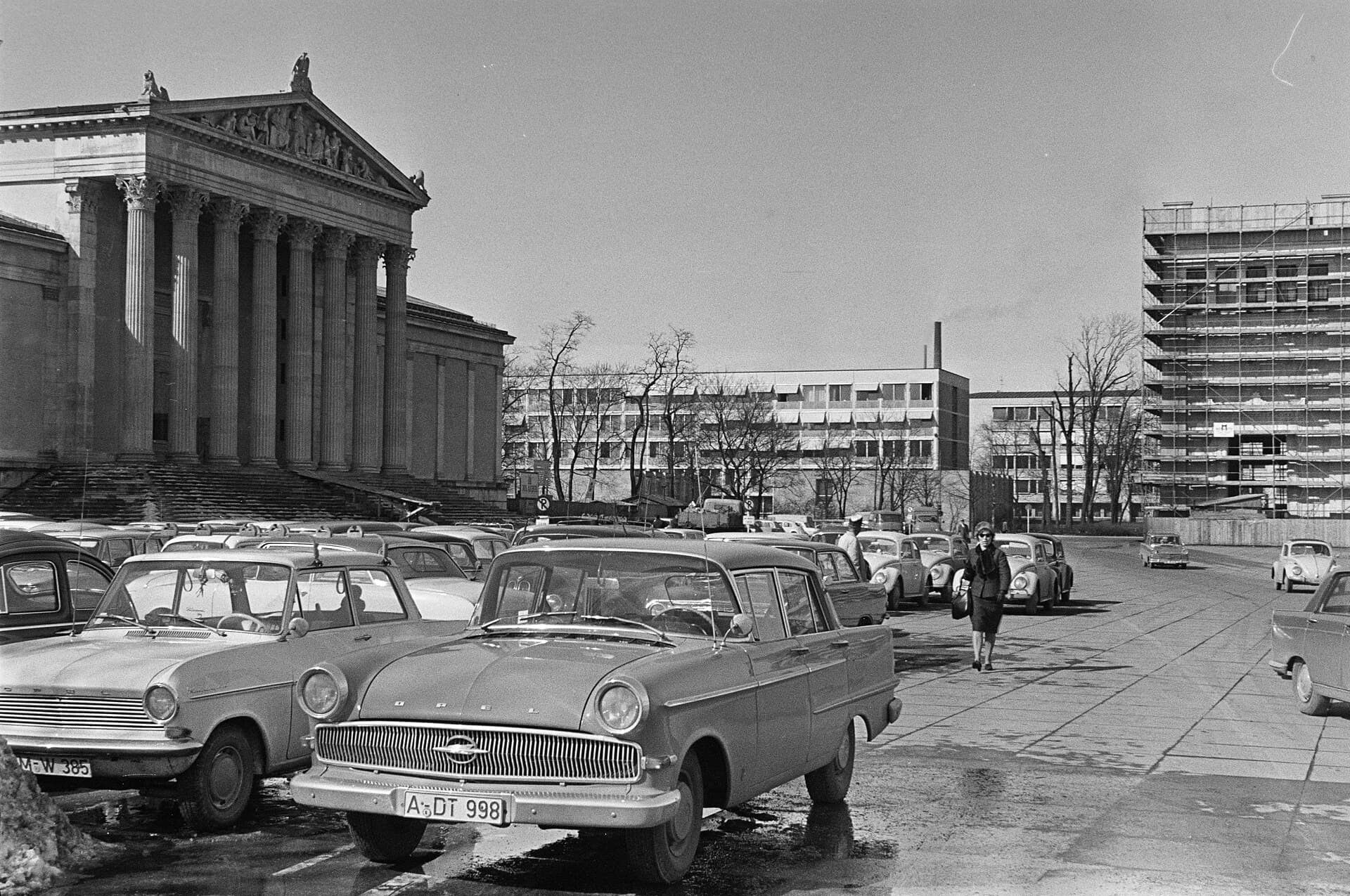
Königsplatz in Munich is a square built to make a Bavarian city look like classical Athens, then seized by the Nazis who paved its grass in granite and raised shrines to their coup dead on its eastern edge. Understanding this one square means holding both facts at once: a nineteenth-century forum of temples and museums, and a twentieth-century parade ground with a political cult grafted onto it. The most important thing to grasp standing here is that Munich, after the war, chose neither to erase this history nor to rebuild it. The city left the scars in place on purpose.
A classical capital by design
The square was laid out in the early nineteenth century under King Ludwig the First, with design work by Karl von Fischer, Friedrich Ludwig von Sckell, and Leo von Klenze. Ludwig wanted Munich to be a classical capital, an ambition that earned this quarter a descriptive nickname: Athens on the Isar, after the river that runs through the city. The buildings that frame the square carry that ambition in stone. There is the Doric gate called the Propyläen, modelled on the entrance to the Athenian Acropolis. There is the Glyptothek, which opened in 1830 as Munich's first public museum. And there is the Staatliche Antikensammlungen, the state collection of antiquities.
This was, in other words, a place of temples and sculpture from the start. The open square at its center was ceremonial ground, the most formal public space in the city. That formality is exactly what made it useful to a later regime. A dictatorship that wanted grandeur did not have to build it. Munich had already built it a century earlier.
The granite and the temples
Hear a stop from this walk
The Georg Elser Memorial
After 1933, the regime chose Königsplatz as a stage. Hitler had his architect Paul Ludwig Troost pave the grass of this square with roughly twenty thousand granite slabs, hard and grey, and turned it into a forum for mass rallies and marches. The lawns that had softened Ludwig's classical vision were gone. In their place was a flat, unbroken parade surface, built to hold crowds and to be seen from a podium.
Then came the shrines. On the east side, in 1935, Troost built two Ehrentempel, two Temples of Honour. These were open colonnades, and they held the bronze coffins of the sixteen men who died in the Beer Hall Putsch, Hitler's failed coup of 1923. That coup had ended a short walk away, at the Feldherrnhalle on the Odeonsplatz, where Bavarian State Police fired on the marchers and sixteen of the coup's followers and four policemen were killed. The regime took those coup dead and enshrined them here, in open temples on a square that had been designed to evoke ancient Athens.
The transformation was complete. A museum forum had become a political stage, and a place of sculpture had become a place of ceremonial death worship. This is the register the walk asks you to hold. The classical shell did not disappear. It was repurposed, which is often how the regime worked: it seized existing symbols rather than only inventing new ones.
The choice to leave the scars
After the war, the American army destroyed both Temples of Honour on the ninth of January, 1947. The rubble was cleared away. But here is the detail that matters most, and the one to look for when you stand on the square: the concrete platform foundations of the two temples were deliberately left in place. They are still there today, grassed over at the eastern edge of the square. They are easy to miss, low rectangular platforms rather than a marked monument.
That decision was not an accident of neglect. It was a choice. Munich could have poured new grass over everything, restored Ludwig's lawns, and let the parade ground vanish from memory. Instead the city left the foundations visible, so that the shape of the shrines would remain readable in the ground. The lawns returned. The scars stayed on purpose.
This is an early sign of the reckoning that defines the whole quarter. Look toward the north-eastern edge of the square and you will see a plain white cube, the NS-Dokumentationszentrum, the Documentation Centre for the History of National Socialism. It opened in the spring of 2015 on the footprint of the former Braunes Haus, the Brown House, which from 1931 was the national headquarters of the Nazi party. The party was run from a spot on this square, and on that same ground Munich now examines what it meant for a city to be given the official title Hauptstadt der Bewegung, the Capital of the Movement, in 1935. Admission is free, a deliberate choice so that anyone can come and look.
What to understand standing here
If you take one idea away from Königsplatz, let it be this. The square you are looking at is layered. Underneath the calm neoclassical frame is a period when this was a parade ground, and underneath the grass at the edge are the foundations of two shrines. The city did not tidy this away. It documented it.
Today the square anchors the Kunstareal, Munich's museum quarter, where some eighteen museums are grouped around and near it, including the three Pinakotheken and the Glyptothek. You can walk from ancient sculpture to modern painting within a few hundred metres. And in the middle of it, deliberately, the past is left legible: temple foundations in the lawn, a documentation centre on the Brown House ground, a refusal to either erase or celebrate.
Königsplatz is the third stop on the The Movement and the Rose walk, which moves from the Feldherrnhalle where the coup was enshrined, through the alley where ordinary Munichers avoided the forced salute, to the university where the White Rose students were killed and the memorial to the carpenter Georg Elser who acted alone. The tour lets you stand on this granite at your own pace, read the ground for what it holds, and take the moment of silence it asks for. For the full route and the other stops, browse Munich walking tours and the wider Munich city guide.
Sources
- Königsplatz, Munich (Wikipedia): overview of the square's neoclassical design under Ludwig the First, the granite paving, and the Temples of Honour.
- Ehrentempel (Wikipedia): the two Temples of Honour built by Paul Ludwig Troost in 1935, their 1947 demolition, and the surviving foundations.
- NS-Dokumentationszentrum München (official site, nsdoku.de): the documentation centre on the Brown House site, its 2015 opening, and its free admission.
- Roamer tour "The Movement and the Rose": the fact-audited walking-tour transcript for Königsplatz and the surrounding quarter, the primary source for this article.
Ready to experience it?
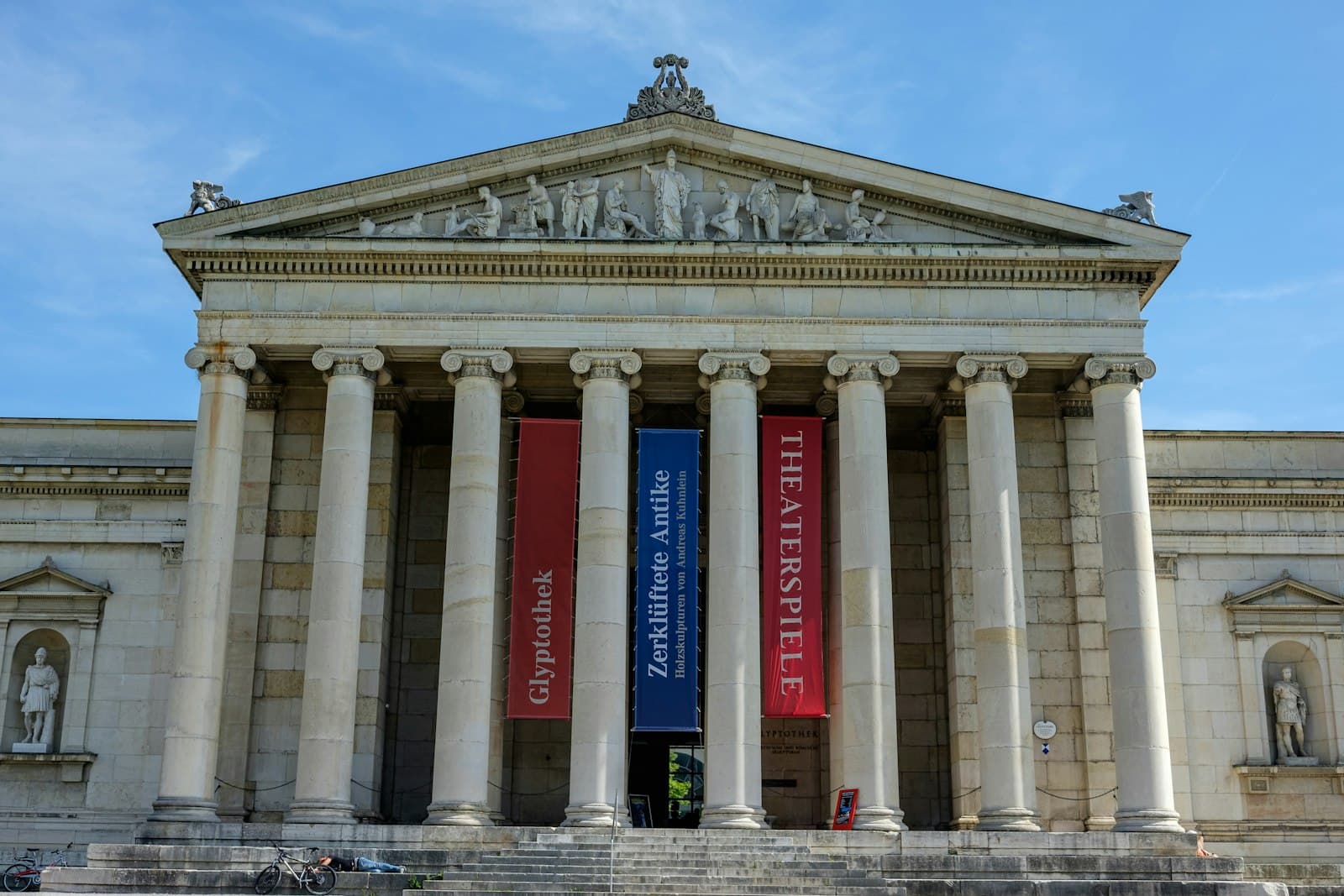
Königsplatz: The Movement and the Rose
120 min · 4.9 km · moderate
More from Munich
Explore more at your own pace.
Munich Travel Guide: Days, Transport, Timing, Safety, and Budget
The City the Monks Named: How Munich Turns Privilege Into Public Life
Alter Hof: Where a Burned Bridge Founded Munich
The Chinese Tower Beer Garden: Munich's Whole Idea in One Clearing
Hofbräuhaus am Platzl: How a Duke's Private Brewery Became Munich's Public Beer Hall