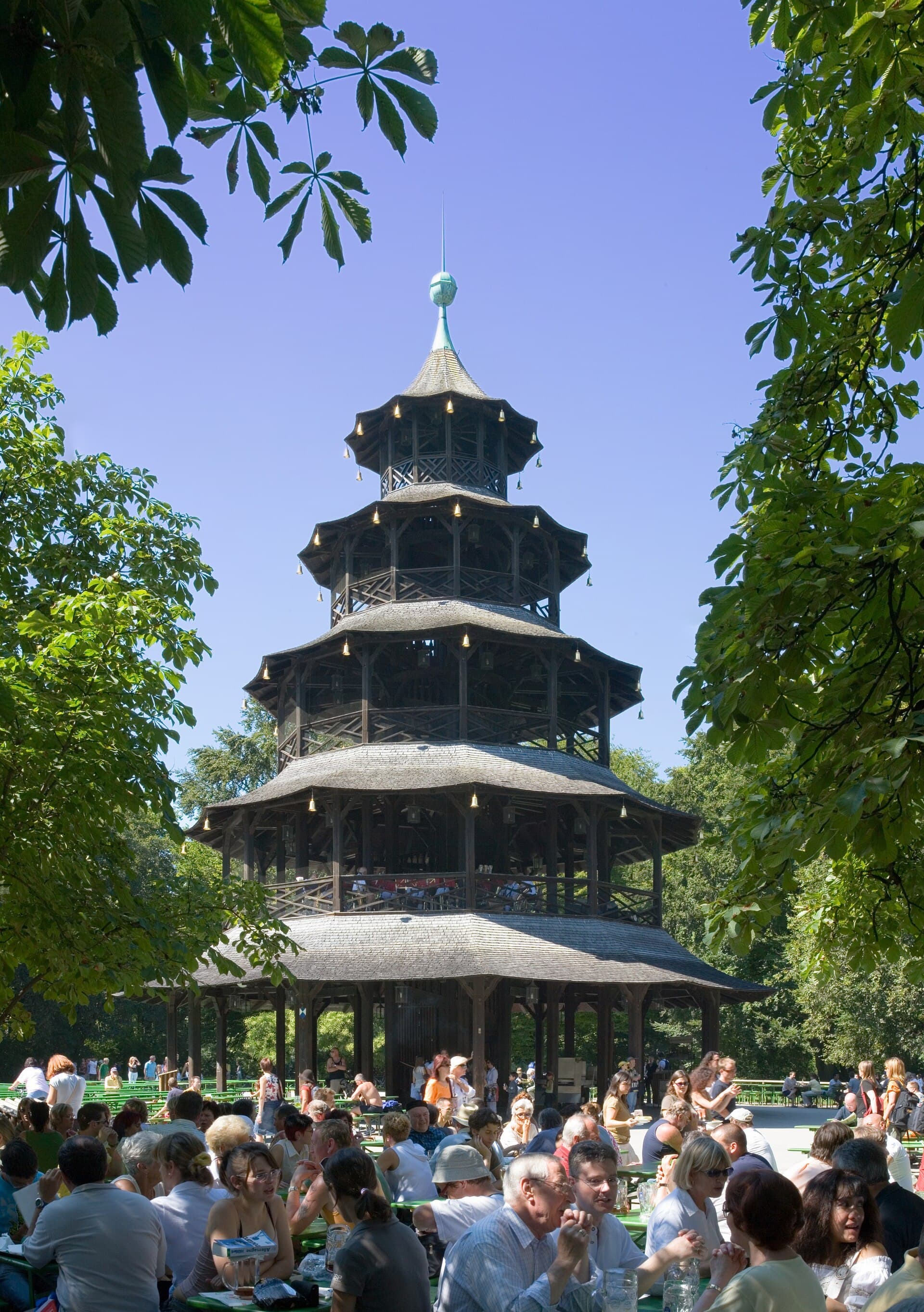
The beer garden at the Chinese Tower sits in a clearing of the Englischer Garten, and it is where Munich's oldest civic habit turns physical. Rulers here kept opening their private ground to everyone, again and again, until a stranger's bench under chestnut shade became something ordinary. You can still spread your own bread and cheese on the table and buy only the beer. That single arrangement, a royal compromise made permanent, is the reason this clearing explains the whole city better than any monument could.
A hunting ground handed over
Start with the ground itself. The Englischer Garten was not always a park. It was laid out from 1789 on the initiative of Sir Benjamin Thompson, later Count Rumford, who advised the Bavarian court and proposed putting soldiers to useful civilian work on the gardens during peacetime. The enabling decree came from the Elector, Charles Theodore, published on the thirteenth of August, 1789, dedicating a former hunting reserve to public amusement. Turm means tower and Garten means garden, and the naming is plain, but the gesture underneath it is not. A prince's private hunting land became a place where anyone could walk, sit, and stay as long as they liked.
That gesture is the spine of the entire walk this article belongs to. It happens over and over in Munich. A ducal brewery is opened to the public. A court market is moved by decree so the whole city can trade. A pair of dukes set a purity standard for the beer everyone drinks. A wedding field becomes an annual festival. The Chinese Tower beer garden is the moment where the pattern stops being history you read and becomes a bench you sit on.
The tower and the seven thousand seats
Hear a stop from this walk
The Munich breweries and the cellar-and-chestnut origin
In front of you, if you make the walk, stands the Chinesischer Turm, a five-storey wooden pagoda about twenty-five metres tall. It was built in 1789 and 1790 and modeled on a pagoda at Kew Gardens in England. The original burned in 1944 and was rebuilt in its original style by 1952, which is its own quiet lesson about a city that keeps restoring what it loses. Around its base spreads a beer garden with roughly seven thousand self-service seats, the second largest in Munich.
Numbers that big can feel abstract, so here is the part that matters at the table. You may still bring your own food to these benches. Pack bread, cheese, radishes, or fruit, spread it out, and buy only the beer. This is not a loophole. It is the tradition working exactly as designed, and its origin is a royal decree you can trace precisely. In the nineteenth century Munich's breweries dug cooling cellars into the banks of the Isar and planted horse-chestnut trees above them, because the dense canopy cooled the beer and the shallow roots would not break into the cellars below. That is why a proper Munich beer garden means chestnut shade to this day. Then King Maximilian the First Joseph, the same ruler who moved the city market, issued a decree on the fourth of January, 1812, letting brewers serve beer straight from their cellars but restricting the food they could sell, after smaller breweries complained. The workaround became the custom: if the brewery could not sell you much food, you brought your own. Two centuries later that compromise is why the grand and the humble literally share a table.
Gemütlichkeit is a design, not a mood
Bavarians have a word for the feeling that settles in once you sit down: Gemütlichkeit, that warm, unhurried, communal ease of sitting shoulder to shoulder with strangers. It sounds like atmosphere, but under the Chinese Tower you can see it is actually a set of decisions. The self-service counter flattens the hierarchy that a waited table creates. The bring-your-own-food rule means the person beside you might have a picnic basket while you have a paper bag, and neither looks out of place. The long communal benches leave no private tables to claim. Shade, water, and space are held in common. The clearing was engineered, deliberately and by decree, to make sitting together the point.
That is what makes this a good stop to reach on foot rather than by taxi. The walk out from the old town of Munich earns the bench. You move from the enclosed, vaulted world of the historic beer halls, where the idea began indoors and ducal, into open lawn where the same idea finally breathes. By the time you reach the pagoda, the shared bench does not feel like a novelty. It feels like the destination the whole city has been building toward.
Why the anchor works for the whole route
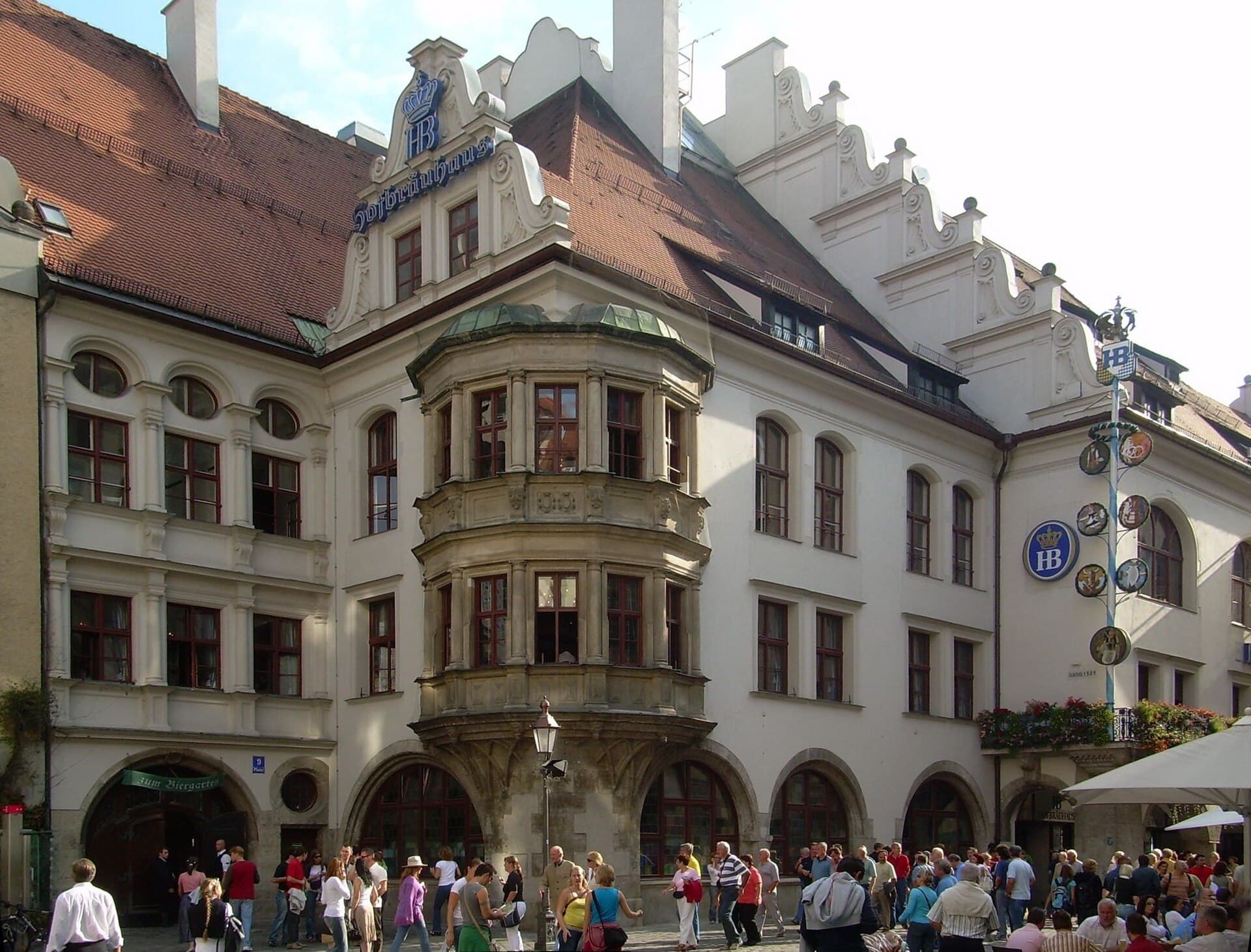
If you only see the Chinese Tower, you get a lovely afternoon. If you walk the route it anchors, you get the argument. The full walk runs roughly eight and a half kilometres over about three hours of gentle, level walking, and every stop is a variation on the same civic move. The Hofbräuhaus shows the beer-hall idea enclosed and communal, a court brewery founded in 1589 that only admitted the general public in 1828. The Viktualienmarkt shows a court market opened to the city by decree. The Reinheitsgebot, the beer purity law of 1516, shows two dukes setting a standard for an everyday drink. Just south of the park, the Eisbach standing wave shows a public feature of the city thrown open to anyone bold enough to ride it. And the Theresienwiese shows a royal wedding field of 1810 that became a festival the city has repeated almost every year since.
The Chinese Tower is the hinge. It is the moment the walk breaks fully into the open, and the moment the abstract pattern becomes a physical seat you can take. That is why it is worth reaching on your own schedule, lingering as long as the shade holds, and letting the rest of the route frame it. This is a solo walk at your own pace, every stop short and skippable, and the beer garden is the one you will want to sit in longest.
You can see how the anchor connects to the rest of the day in the full set of Munich walking tours, or browse everything the city offers on the Munich page. Either way, the bench under the Chinese Tower is waiting, and it has been public for well over two centuries.
Sources
- Englischer Garten, Wikipedia. Founding in 1789, Count Rumford's initiative, Charles Theodore's decree, and park scale.
- Chinese Tower, Wikipedia. Pagoda dimensions, 1789 to 1790 construction, Kew Gardens model, 1944 fire and 1952 rebuild, and beer-garden seating.
- Beer garden, Wikipedia. Isar cellars, horse-chestnut planting, and the 1812 decree of Maximilian the First Joseph on food and beer service.
- Reinheitsgebot, Wikipedia. The 1516 purity law and its later loosening, for context on the wider route.
- Hofbräuhaus am Platzl, Wikipedia. 1589 founding and 1828 public admission, for context on the walk's opening stop.
Ready to experience it?
Englischer Garten: The Art of the Beer Garden
150 min · 8.5 km · moderate
More from Munich
Explore more at your own pace.
Munich Travel Guide: Days, Transport, Timing, Safety, and Budget
The City the Monks Named: How Munich Turns Privilege Into Public Life
Alter Hof: Where a Burned Bridge Founded Munich
Hofbräuhaus am Platzl: How a Duke's Private Brewery Became Munich's Public Beer Hall
Königsplatz, Munich: The Athens on the Isar the Nazis Paved in Granite