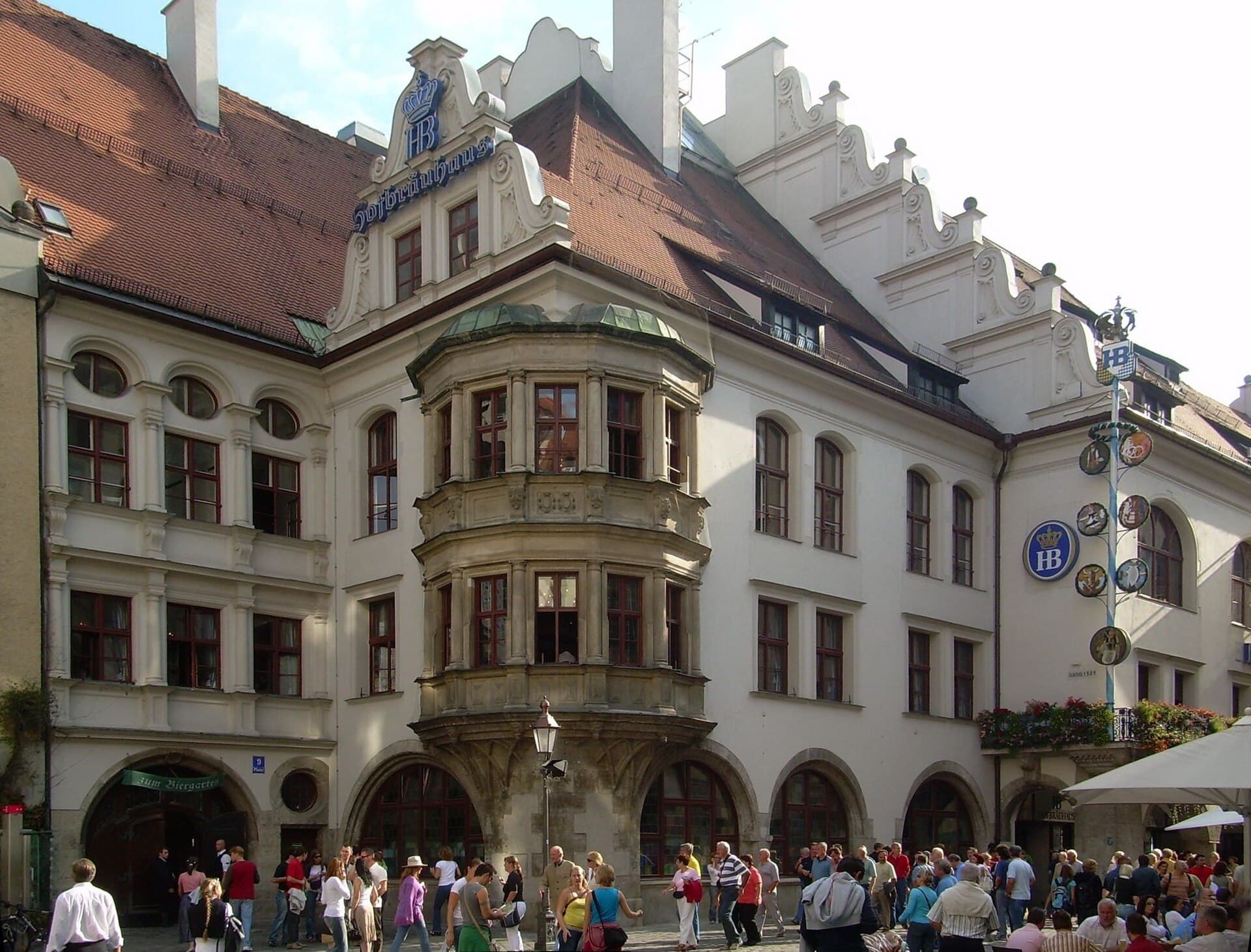
The Hofbräuhaus am Platzl records one civic gesture in vaulted brick: a court brewery, founded as royal privilege in 1589, handed to the public in 1828. Standing on the small square the locals call the Platzl, you are looking at the place where drinking beer stopped being a court's private habit and became a Munich institution shared shoulder to shoulder. If you understand only one thing while you stand in front of it, understand that timeline. The building is not old because it has always belonged to the people. It became the beer hall we picture precisely because a ruler opened a door he had every right to keep shut.
The name tells the whole story
Start with the word on the facade. Hof means court. Brauhaus means beer hall. Put them together and you have the court beer hall, which is exactly what this was. The brewery was founded in 1589 by Duke Wilhelm the Fifth of Bavaria as the brewery attached to the ducal court residence. For its first decades the beer it made belonged to the court and to the court alone. Ordinary Munich did not drink here. This was not a tavern that happened to have noble patrons. It was a private supply line for a ducal household, and the general public had no standing to walk in and order a mug.
That closed arrangement held for well over two centuries. The change arrived in 1828, under King Ludwig the First, when the general public was finally admitted. Roughly two hundred and forty years passed between the founding pour and the moment an ordinary Münchner could sit down inside. Hold that gap in your mind, because it is the reason this stop opens a longer story about Munich. The city's genius, the thing that runs through its markets, its royal park, and the meadow where Oktoberfest began, is a repeated pattern of rulers reaching down to hand their own privileges to the city. The Hofbräuhaus is the first and clearest example. A duke's brewery became a king's gift became everyone's beer hall.
What survived, and what you are actually seeing
Hear a stop from this walk
The Munich breweries and the cellar-and-chestnut origin
Step inside if you like, into the vaulted ground floor. That great arched room has a name: the Schwemme. It is worth knowing that this room carries a heavier history than the cheerful noise suggests. The Schwemme was the only part of the building to survive the bombing of the Second World War. The rest of the building was rebuilt in the postwar years, with the restoration finished by the late 1950s. So when you run your hand along the low brick vaults, you are touching the one surviving fragment of the original interior, rebuilt around and above by the postwar city. The Hofbräuhaus you see is both very old and, in large part, carefully restored, and that layering is honest to how Munich itself came through the twentieth century.
Look along some of the walls and you will notice small lockers. These are not coat storage. Regulars keep their personal mugs in them, a tradition that goes back to the days when the old grey Keferloher ceramic mugs were treasured enough that patrons wanted their own kept safe. It is the mark of the Stammgast, the regular who returns to the same corner week after week, in the spirit Bavarians call the Stammtisch: the regulars' standing table. The locker is the physical proof that this room is not only for visitors passing through. It is somebody's second living room, and has been for generations.
When your beer arrives it comes in a one-litre mug called a Mass. That single measure tells you the register of the place. This is not a spot for a delicate half-pour. The Mass is built for a long sit, for conversation that outlasts the first glass, for the unhurried communal ease Bavarians call Gemütlichkeit. That word is hard to translate cleanly. It sits somewhere between coziness, contentment, and the specific warmth of being packed in among strangers who have, for the length of an afternoon, become companionable.
Why this is the enclosed version of a bigger idea
Here is the thing to carry away as you leave. The Hofbräuhaus is beer culture indoors: vaulted, communal, and ducal in origin. It is the enclosed, roofed ancestor of something that Munich would later push out into the open air. The whole tradition of the Bavarian beer garden, the shared bench under chestnut trees where you bring your own bread and cheese and buy only the beer, grows out of this same instinct for communal drinking. The Hofbräuhaus shows you that instinct in its first, walled form. The rest of Munich's beer story is about taking this vaulted room and lifting the roof off it, spreading the benches under the sky, and opening the privilege wider and wider until the shared bench becomes the entire point.
That is why the Platzl is the right place to begin a walk through Munich's leisure history rather than to end it. Every stop that follows repeats the gesture you can see here. A court market opened to the city by royal decree. A hunting reserve thrown open as a public park. A wedding field that became a fairground. The Hofbräuhaus is the pattern in miniature, small enough to grasp in a single vaulted room, and the whole city unpacks outward from it.
Practically, the visit is easy. The Hofbräuhaus is free to enter; you pay only for what you eat and drink. Go early on a weekday if you want the Schwemme calm, before the tour groups and the evening singing fill it. Then let the crowds build behind you as you walk out toward the market and the park.
Walk it in order
The best way to feel why the Hofbräuhaus matters is to keep walking after it, because the argument the building starts only completes itself out in the open air. The self-guided route "The Art of the Beer Garden" begins right here at the Platzl and traces the idea outward across seven stops and about eight and a half kilometres, from this ducal hall to the open meadow. You can browse the full set of Munich walking tours or start from the Munich city page, then set your own pace under the chestnut shade.
Sources
- Hofbräuhaus am Platzl, Wikipedia: the Schwemme as the only room to survive Second World War bombing, the postwar restoration completed in the 1950s, the one-litre Maß mug, and the personal-mug lockers introduced for regulars.
- Staatliches Hofbräuhaus in München official history (hofbraeuhaus.de): the brewery founded in 1589 by Duke Wilhelm the Fifth of Bavaria to supply the ducal court, and public admission granted in 1828 by King Ludwig the First.
- Roamer tour "The Art of the Beer Garden" (munich-beer-gardens), fact-audited stop transcripts: the Mass mug, the mug lockers and Stammtisch tradition, and the Gemütlichkeit through-line connecting hall to beer garden.
- muenchen.de, the City of Munich's official visitor portal: general context on the Platzl and Munich's beer-hall traditions.
Ready to experience it?
Englischer Garten: The Art of the Beer Garden
150 min · 8.5 km · moderate
More from Munich
Explore more at your own pace.
Munich Travel Guide: Days, Transport, Timing, Safety, and Budget
The City the Monks Named: How Munich Turns Privilege Into Public Life
Alter Hof: Where a Burned Bridge Founded Munich
The Chinese Tower Beer Garden: Munich's Whole Idea in One Clearing
Königsplatz, Munich: The Athens on the Isar the Nazis Paved in Granite