Last Supper and Sant'Ambrogio: Leonardo and Roman Milan
80 min · 1.9 km · easy
Milan built its holiest places outside its walls, and the walls kept moving out to take them in. Last Supper and Sant'Ambrogio: Leonardo and Roman Milan walks that idea in twelve stops, about 1.9 km and 80 minutes: from Santa Maria delle Grazie east along Corso Magenta, into the Roman city at Via Brisa, and south to the basilica of Sant'Ambrogio and the gate on the old canal. Three people carry it: Leonardo, his patron Ludovico il Moro, and Saint Ambrose.
The duke's church in the suburb
Stop 1 is the piazza in front of Santa Maria delle Grazie. In 1460 a commander of the Sforza troops gave the Dominicans land outside the city, building began in 1463, and the church was finished by 1482. Il Moro then made it his court church and planned it as his family's mausoleum. In the refectory to the left of the church is the Last Supper, painted in the mid-1490s and finished by 1498. The walk never takes you in: booking is compulsory, in 15-minute slots of up to 40 people, and nothing is sold at the door. Our piece on why the Last Supper survives covers the painting, the bombs of 1943 and the booking rules.
From across the street, stop 2, you see the new east end il Moro ordered: its first stone was laid on 29 March 1492 to his architect's design, and the works stopped around 1498 with the tomb of his wife Beatrice d'Este, who had died in childbirth. On the same pavement stands the Casa degli Atellani, behind which grows the vineyard tradition says il Moro gave Leonardo. Replanted in 2015, it has been closed to visitors since October 2023.
A bridge where the city began
Hear a stop from this walk
Piazza Santa Maria delle Grazie
The suburb was where Milan kept what it held at arm's length. Palazzo delle Stelline, stop 3, stands on a nunnery the archbishop suppressed after the plague of 1576 to make a hospital for the poor; it became, for centuries, an orphanage for girls. At Largo d'Ancona, stop 4, the street crossed water. Via Carducci, opening south, was the Naviglio di San Gerolamo, and a bridge, the Porta Vercellina bridge, carried Corso Magenta over it. The heritage register says that canal was buried between 1892 and 1895, a generation before the rest of the ring. Nothing of it shows.
Inside the line, the walk passes Palazzo Litta, stop 5, a house of the 1640s that got a new Rococo front in the 1750s, and San Maurizio, stop 6, the church of a Benedictine nunnery begun in 1503, its plain front hiding a hall divided in two, one half for the public and one for the nuns, every wall painted.
Roman Milan
A few steps on, the walk crosses the crossroads where the Roman Porta Vercellina opened; remains of it and of the Roman walls were found in the basement of a building on Via Brisa. At Via Brisa, stop 7, low brick foundations with curved rooms sit in a sunken plot: part of the imperial palace. Modern scholarship dates the palace, the circus beside it and the walls round both to the age of the emperor Maximian, the late third century. Milan was an imperial seat for about a century, until the court left for Ravenna in 402, and it is the city of the agreement of 313 usually called the Edict of Milan.
Up Via Luini, stop 8, a square brick tower over San Maurizio's end belonged to the circus's starting gates and became the nuns' bell tower. Chariot races and convent bells in one tower.
The cemetery basilica
The Università Cattolica, stop 9, occupies the monastery beside Sant'Ambrogio, rebuilt in the 1490s to designs by the same architect il Moro used at the Grazie; under the Napoleonic republic it became a barracks and then a military hospital before it was a university. The Tempio della Vittoria, stop 10, built from 1927 to 1930, puts Milan's war dead beside the saint.
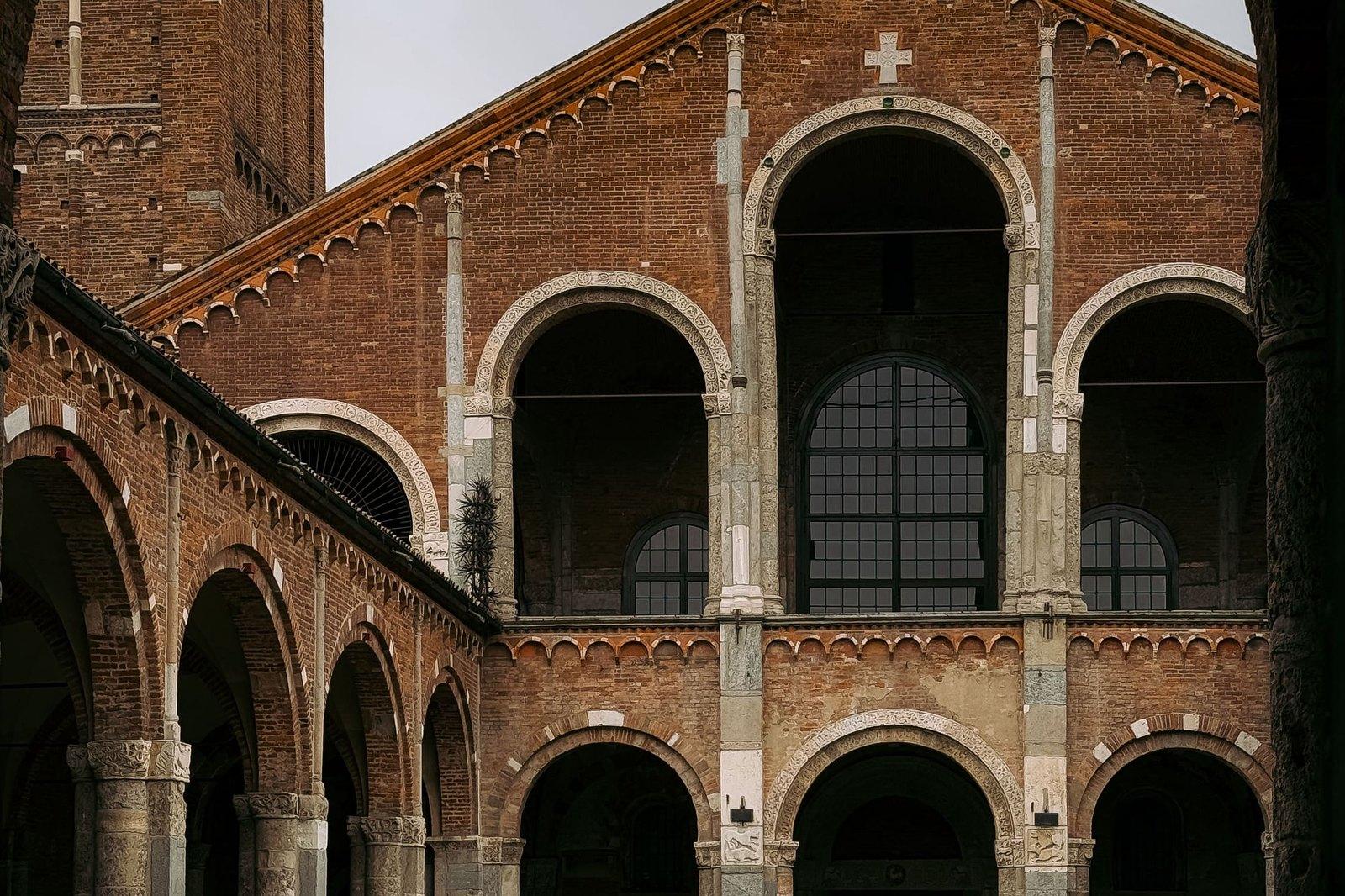
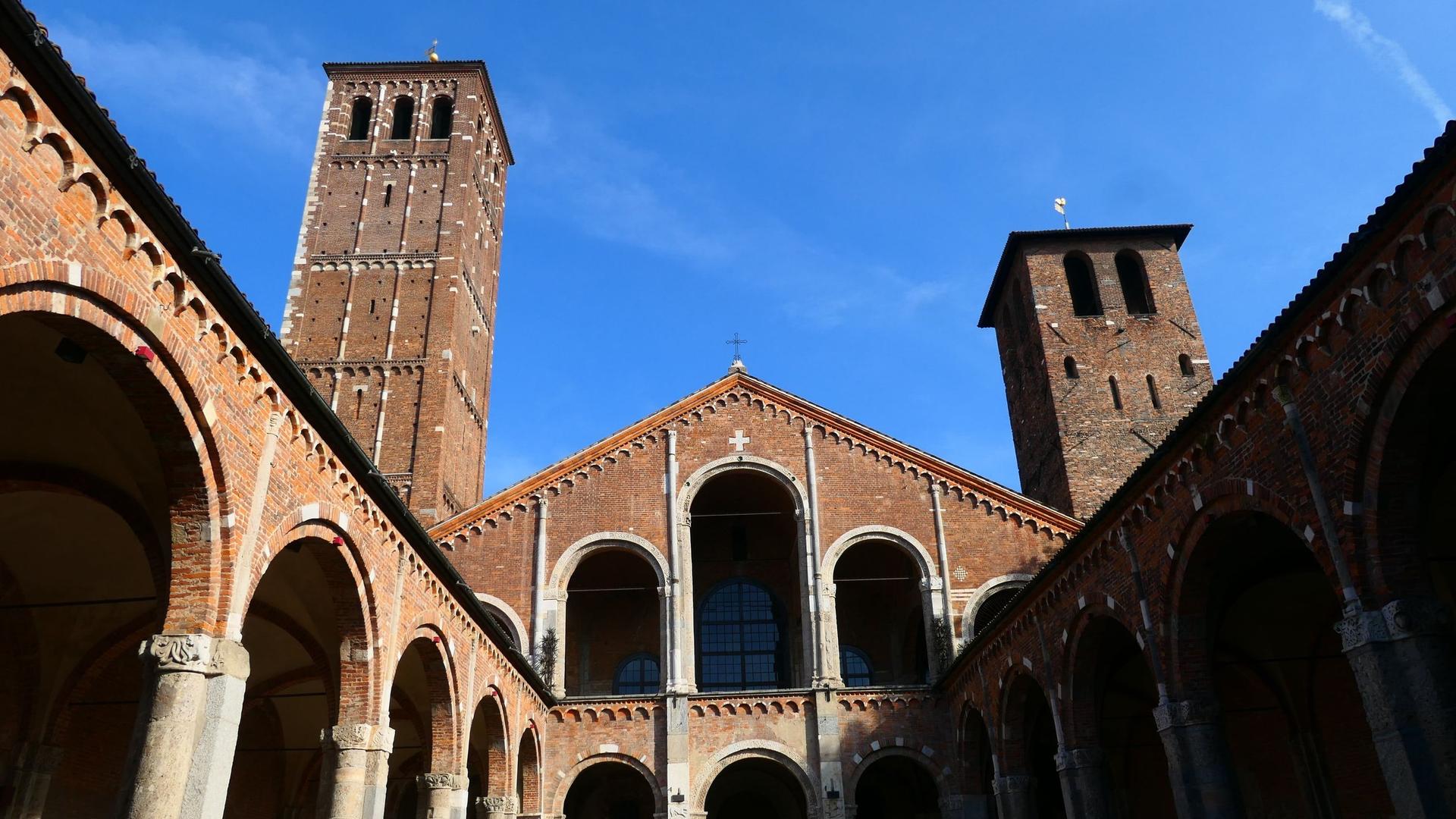
Sant'Ambrogio, stop 11, was begun in 379, the basilica says, on the great cemetery outside the city walls. Ambrose, an imperial official, was elected bishop by the people in 374 and consecrated on 7 December, the date Milan still keeps as its holiday; in 386 he found the bodies of the martyrs Protasius and Gervasius and moved them here, and he was buried beside them in 397. The atrium in front was first built in the 800s and rebuilt in the 1100s, once a market, a meeting place and a burial ground. Its two towers are a quarrel in brick: the monks' tower of the ninth and tenth centuries, and the canons' tower of 1128, topped only in 1889.
The medieval gate, mostly from 1939
The walk ends at stop 12, the Pusterla di Sant'Ambrogio on Via De Amicis. The register says the first passage opened in the twelfth century, when the walls along the canal ring finally took the basilica in; in 1549 the fortress was pulled down and a stone bridge built over the canal. The honest twist: what you see is for the most part a reconstruction of 1937 to 1939.
Walking it
The walk starts in Piazza Santa Maria delle Grazie (tram 16; M1 Conciliazione and M1/M2 Cadorna are close) and ends 40 meters from M2/M4 Sant'Ambrogio. Sant'Ambrogio is free, with visiting hours Monday to Saturday 10:00 to 12:00 and 14:30 to 18:00, Sunday 15:00 to 17:00, outside services. On Monday 7 December 2026, Saint Ambrose's day, expect crowds and services at the basilica. Corso Magenta's tram rails are slippery in the wet, and the crossing at the Grazie has no lights.
The tour is free to start in the Roamer app: the introduction and first stop play in full, every later stop plays a short preview. From the Pusterla, the Navigli walk starts at San Lorenzo's columns, about ten minutes down Via De Amicis. More routes are on the Milan page.
Ready to experience it?
Last Supper and Sant'Ambrogio: Leonardo and Roman Milan
80 min · 1.9 km · easy
More from Milan
Explore more at your own pace.
Castello Sforzesco and Parco Sempione: A Companion to the Walk From Castle to Arch
Milan's Historic Center: A Companion to the City That Keeps Facing Its Cathedral
Arena Civica: Napoleon's Amphitheater Built From the Castle's Walls
Conca dell'Incoronata: The Dry Lock and the Canals Milan Buried
Galleria Vittorio Emanuele II: The Glass Salon of Milan