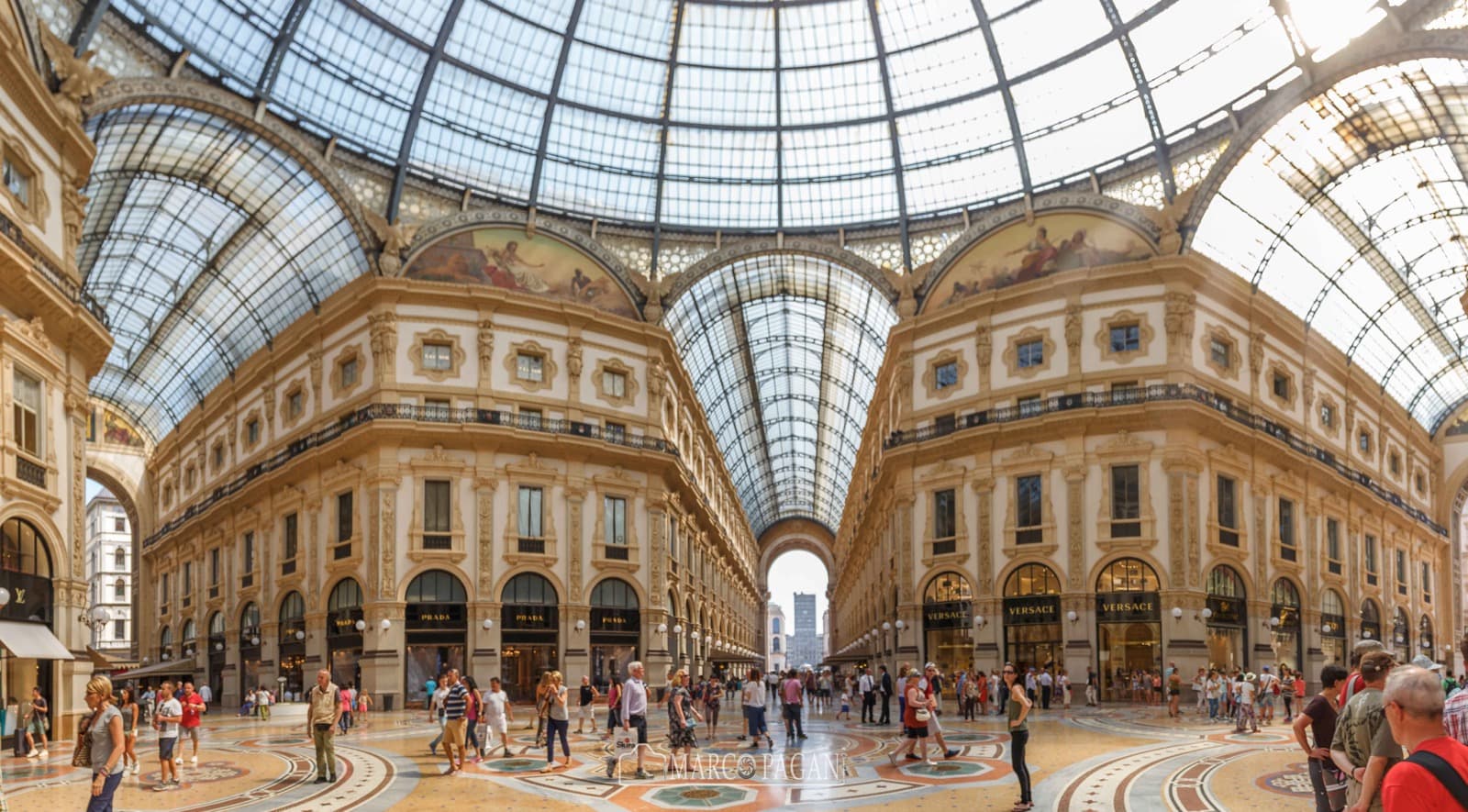
Step out of the Piazza del Duomo and into the Galleria Vittorio Emanuele II, and the noise of the square gives way to a hush that belongs to a different kind of building. Light falls from a glass dome high overhead onto a marble floor. Four storeys of arcade rise on either side. This is a covered street that behaves like a cathedral, and it is no accident that it stands next to the actual cathedral. Built between 1865 and 1877 to the design of the architect Giuseppe Mengoni, the Galleria is regarded as Italy's oldest active shopping arcade and a prototype for the modern enclosed mall. Everything you have ever walked through with a glass roof and shops on both sides has an ancestor here.
A salon named for a king
The Galleria carries the name of Victor Emmanuel II, the first king of the unified Kingdom of Italy. That dedication tells you what the building was really for. It was raised in the years just after Italian unification, when a young nation needed places that felt like statements, and Milan wanted a public room grand enough to say that the city belonged to the new country's future. The Galleria answered that need with iron, glass, and marble rather than with a palace or a monument, and in doing so it invented a new kind of civic space.
The plan is simple and brilliant. The arcade connects two of the most important squares in Milan, running from the Piazza del Duomo at one end to the Piazza della Scala at the other, so that the walk from cathedral to opera house passes through a sheltered corridor of shops, cafes, and light. The building is not a detour between two destinations. It is a destination in its own right, a room the size of a street where the city could gather in any weather. Milanese have long called it the salotto, the drawing room of the city, and the name fits. It was designed to be inhabited, not merely passed through.
Iron, glass, and a dome
Hear a stop from this walk
Duomo di Milano: The Marble Forest Six Centuries in the Making
What makes the Galleria feel modern, even now, is its structure. It is a four-storey double arcade built on a cast-iron frame with glass-vaulted ceilings, and where the two arms cross at an octagonal center, the roof lifts into a great glass dome. In the 1860s and 1870s this was engineering as spectacle. Iron and glass let the builders roof a public space without the heavy walls and small windows of older architecture, so that the interior could be flooded with daylight while remaining sheltered from rain and sun. The result reads as both a street and an interior at once, which is precisely the trick that every shopping mall since has tried to repeat.
It is worth remembering that the man who shaped the Galleria also shaped the square it opens onto. Giuseppe Mengoni was responsible for the redesign of the Piazza del Duomo carried out between 1865 and 1873, so the arcade and its front square were conceived together, as a single gesture of urban ambition. The Galleria was never meant to sit apart from the cathedral. It was meant to extend the great public space of the Duomo indoors, to give the city a covered continuation of its most important square. Standing under the dome, you are standing inside a deliberate answer to the piazza outside.
The architect who never saw it open
The Galleria carries a shadow that most of its visitors never notice. Giuseppe Mengoni fell from scaffolding and died on 30 December 1877, only days before the arcade was to be inaugurated. He built the ancestor of a building type that would spread across the world, and he did not live to walk through it finished. It is one of those facts that changes the mood of a place once you know it. The lightest, most celebratory interior in Milan is also the last work of a man who died just short of seeing it complete.
There is a lighter ritual underfoot as well. Set into the mosaic floor is the coat of arms of Turin, which includes a bull. A local superstition holds that spinning your heel on the bull brings good luck, and generations of visitors have obliged, grinding a small hollow into the stone. The custom is so persistent that the mosaic has had to be restored again and again to repair the wear. It is a small, human counterpoint to the grandeur overhead: a monument to national unity, a masterpiece of iron and glass, and a spot on the floor worn smooth by people hoping for a little fortune.
Read together, the cathedral and the Galleria tell the two halves of Milan's civic story, the medieval one raised in marble and the modern one built in iron and glass. To follow the first half, see the companion piece Milan Cathedral: A Marble Forest Six Centuries in the Making, explore the rest of the city at Milan, and find every route through its historic center at the best walking tours of Milan.
Give the Galleria a slow crossing rather than a quick cut-through. Look up at the dome, find the bull, and remember the architect. A covered street this deliberate is not a passage between places. It is one of the places.
Sources
- Galleria Vittorio Emanuele II, en.wikipedia.org
- Galleria Vittorio Emanuele II, visitmilano.org
- Roamer tour transcript, milan-duomo
Ready to experience it?
Duomo di Milano: The Marble Forest at the City's Heart
90 min · 1.4 km · easy
More from Milan
Explore more at your own pace.
Brera and the Pinacoteca: Where Milan Chooses to Be Soft
Piazza Gae Aulenti and the District Milan Built on Air
Vicolo dei Lavandai: The Washermen's Alley That Explains Milan's Buried Port
Bosco Verticale: The Vertical Forest You Can Weigh
Milan Cathedral: A Marble Forest Six Centuries in the Making