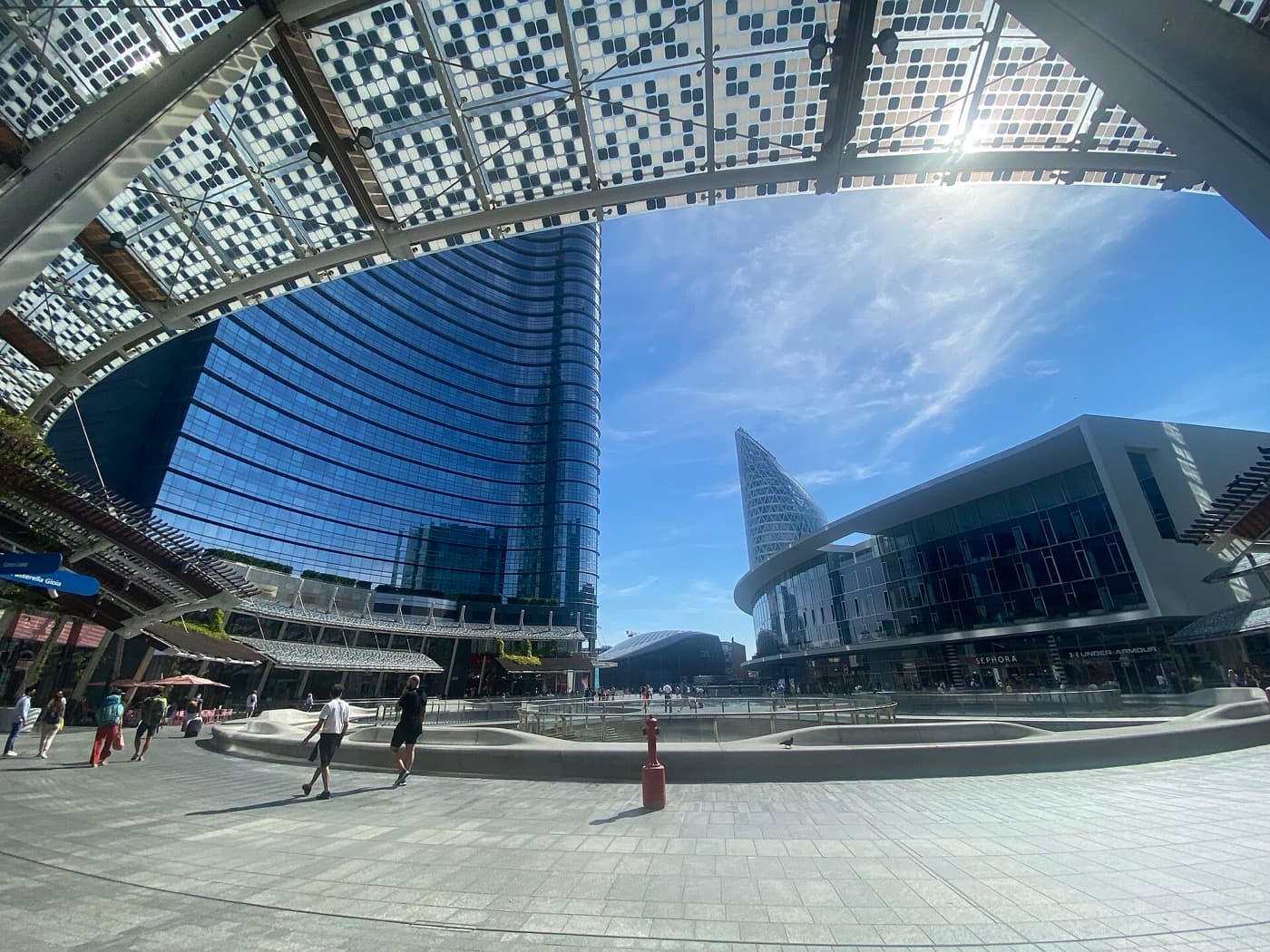
Piazza Gae Aulenti is a raised public deck, a new ground plane lifted about six metres above the street so that people and cars occupy separate layers, and standing on it is the clearest way to read Porta Nuova as a district Milan engineered upward on abandoned railway land. The square is not a monument or a church. It is a circle one hundred metres across, opened on the eighth of December, twenty twelve, and it works as a roof over the traffic beneath it. You walk in the calm; the road runs below. That single structural decision, the choice to build a second surface in the air, is the whole district in miniature, and it is why this square is the right place to begin a walk through Milan's newest skyline.
A square that is also a structure
Most of Italy guards its past. Milan made a different bet. On a stretch of former railway wasteland just north of the historic center, over the course of the twenty tens, the city grew a new district upward, and Piazza Gae Aulenti is its hinge. Look at the paving and you will notice water features and shallow pools set into a surface that is engineered as a roof over what lies below. Nothing here sits on natural ground. The square is a deck, and the towers ring it on almost every side because the deck was laid to gather them into one composition. The rise is not even on all sides: it is about six metres above the road that enters from the south and closer to fifteen metres above the street to the west.
There is a quiet poignancy in the name. The square honors Gae Aulenti, a well known Italian designer and architect, who died on the thirty first of October, twenty twelve. That is just weeks before the square carrying her name was inaugurated. She never saw it full of people. Standing in the center, you are standing at the pedestrian core of the whole Porta Nuova redevelopment, directly in front of Milano Porta Garibaldi station, which makes it one of the most transit connected new squares in the city. Arrive by train or metro and you step out at stop one without a single street crossing.
Reading the skyline as loads, not pictures
Hear a stop from this walk
UniCredit Tower: The Tallest, With an Asterisk
From the square, pick out the tallest thing on the horizon, the tower topped by a slender illuminated spire. That is the UniCredit Tower, completed in twenty eleven and designed by the Argentine American architect Cesar Pelli. Here the walk teaches you to be precise. Measured to the tip of that spire, the tower reaches about two hundred and thirty eight metres, which makes it the tallest building in Italy by total height. Yet the roof itself, the last occupied floor, sits at roughly one hundred and fifty eight metres, and the Allianz Tower across town in CityLife reaches a roof height of about two hundred and ten metres. So the spire is not decoration. It carries no floors, it is light, and it is exactly what earns the superlative. Take the steel away and the ranking changes. That is the kind of distinction Porta Nuova rewards: look past the picture and ask what is doing the work.
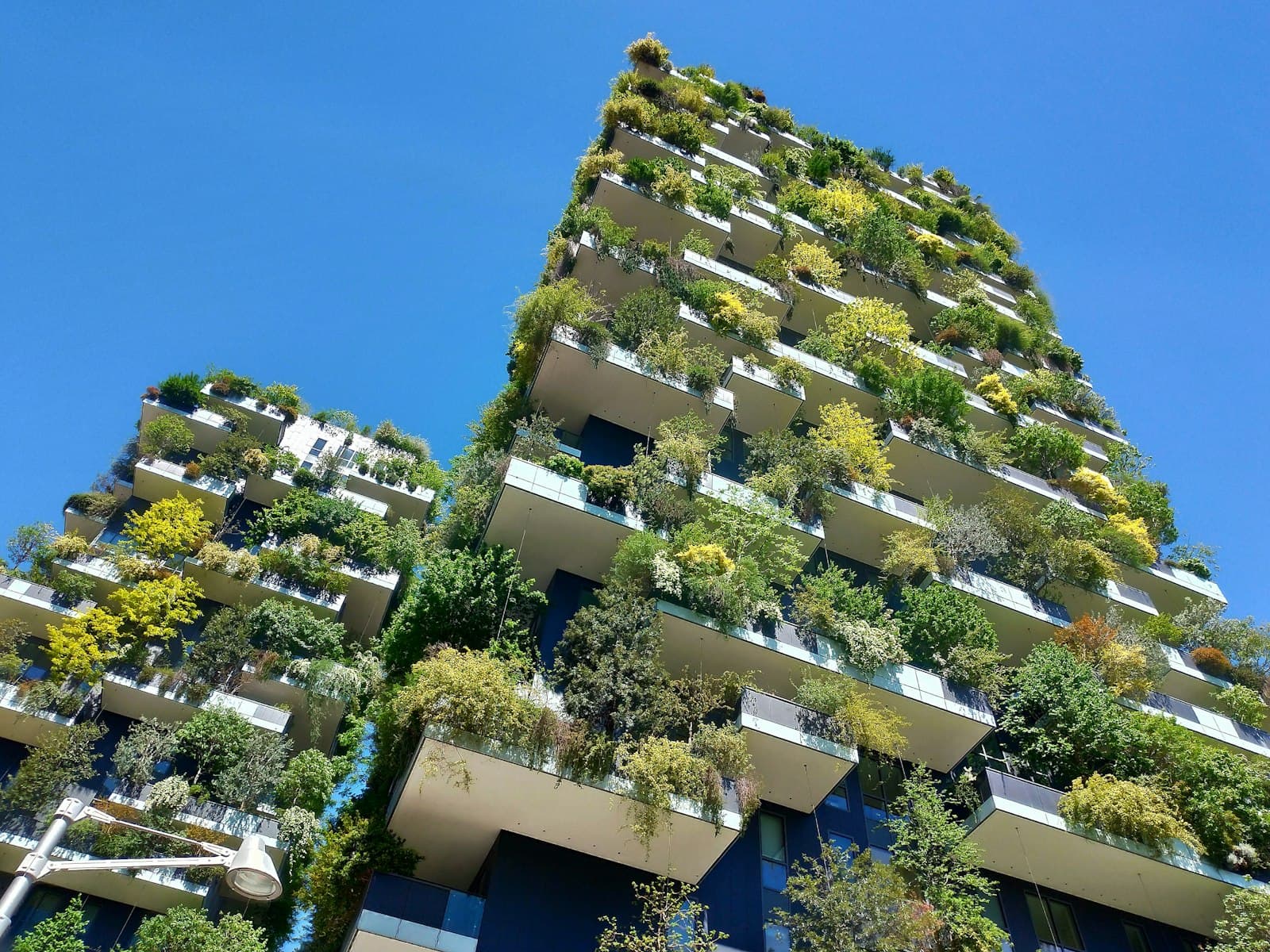
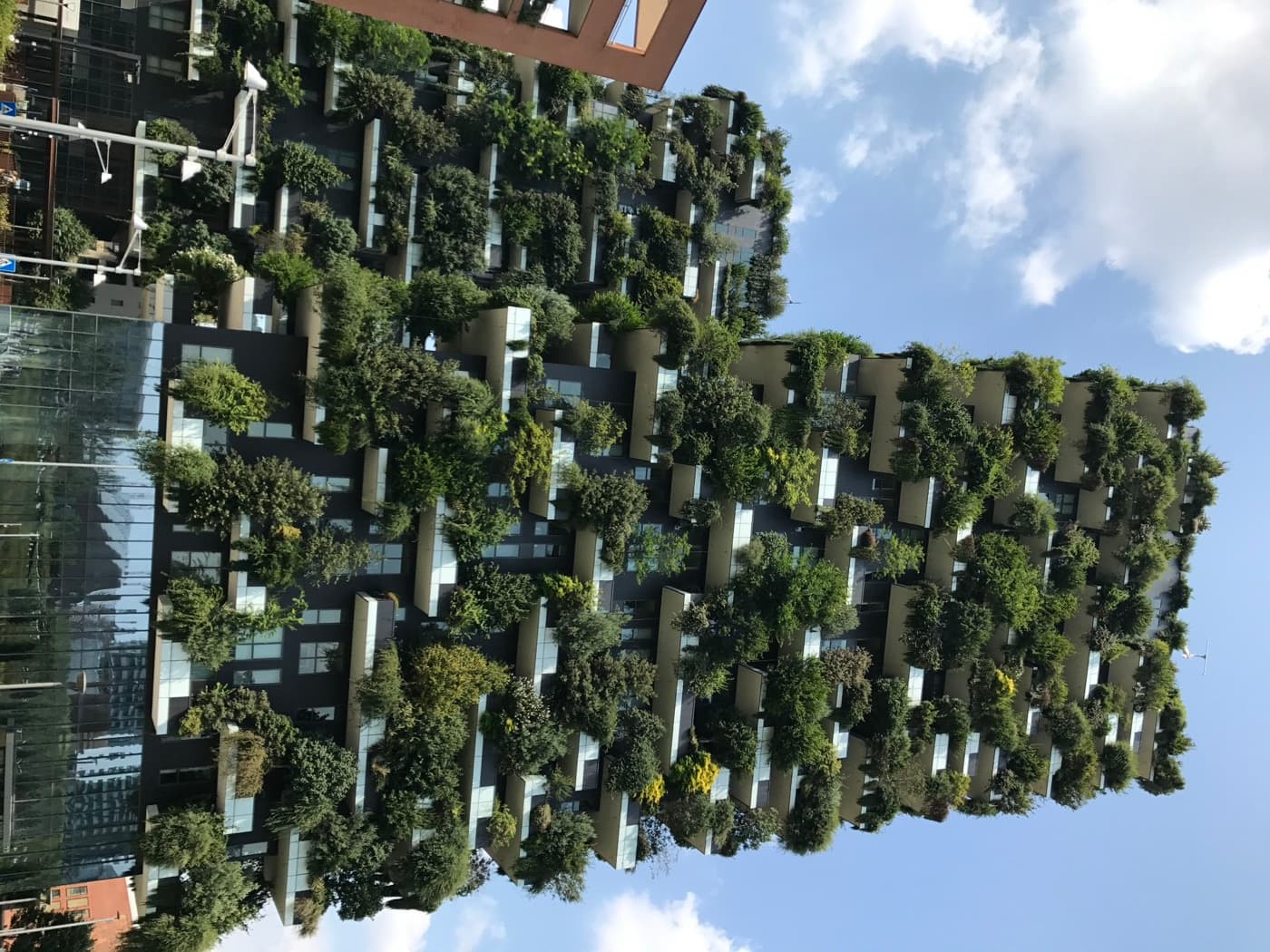
The lesson sharpens at the Bosco Verticale, the Vertical Forest, a pair of residential towers whose balconies carry real trees. The design counts seven hundred and thirty of them, four hundred and eighty large and two hundred and fifty small, plus roughly five thousand shrubs and eleven thousand perennials across ninety four plant species. The taller tower rises one hundred and sixteen metres, the shorter eighty four, and both were inaugurated on the seventeenth of October, twenty fourteen, designed by Stefano Boeri with Gianandrea Barreca and Giovanni La Varra. You can let the wonder land, and you should. Then see it the engineer's way, which makes the wonder deeper. A tree on a balcony is a load. Wet soil is heavy, and a grown tree a hundred metres up catches the wind like a sail, so the cantilevered balconies had to be designed to hold that weight against the wind. A forest does not maintain itself, either. Specialist gardeners, sometimes called flying gardeners, are lowered down the facade on ropes to prune and check the plants. The greenery is a permanent maintenance contract written into the building. The project won the International Highrise Award in twenty fourteen and the Council on Tall Buildings prize for best tall building worldwide in twenty fifteen.
The ground answers the towers
Where the towers concentrate nature and lift it into the air, the Biblioteca degli Alberi, the Library of Trees, spreads it flat and sorts it. This public park runs about nine and a half hectares, opened in phases between twenty seventeen and twenty eighteen, and was designed by the Dutch studio Inside Outside with Petra Blaisse, who won an international competition for it in two thousand and four, with Piet Oudolf contributing to the planting. The name is the organizing idea. The park is arranged as about twenty two circular forests, each dedicated to a single tree species, so you walk from one round grove to the next as you might walk the shelves of a library. There is a harder history under your feet: the site was a contaminated brownfield left from the twentieth century, and the soil had to be cleaned before anything could be planted. The green calm was reclaimed, not inherited.
The surprise that closes the loop
The walk then leaves the new district entirely, and this is where its argument turns over. Stand beneath the Grattacielo Pirelli, the slender modernist tower Milanese call the Pirellone. Its first stone was laid in nineteen fifty six, it topped out in nineteen fifty eight, and it was inaugurated in nineteen sixty, rising one hundred and twenty seven metres. Its unusually thin, tapered form was made possible by the structural engineers Pier Luigi Nervi and Arturo Danusso, who designed its reinforced concrete structure so architect Gio Ponti could abandon the usual bulky block. This tower already made Milan's case decades ago: that the city builds forward and reaches upward. It became a symbol of Italy's postwar economic recovery, the era Italians called the economic miracle, and its design is credited with influencing the New York tower now known as the MetLife Building. The shining new district is not a clean break. It is a sequel.
The last stop is the origin. Stazione Centrale, inaugurated on the first of July, nineteen thirty one, from a competition the architect Ulisse Stacchini won in nineteen twelve, is where the land itself began. Its steel train shed vault arches about seventy two metres over twenty four tracks. The disused rail yards north of this station are the exact ground that became Porta Nuova. The railway made the land industrial, then abandoned it, and the raised square, the tallest tower, the forest, and the park all rose on what the railways let go.
That is the full arc, and Piazza Gae Aulenti is where it opens. Six stops, about two kilometres, ninety minutes at an unhurried pace, every stop free and open or read from the street. Browse more Milan walking tours or see everything the city offers on the Milan page, then walk the route and read the district backward from the deck you are standing on.
Sources
- Piazza Gae Aulenti, Wikipedia: dimensions, opening date, its stepped height above the surrounding streets, and its position in front of Milano Porta Garibaldi station.
- UniCredit Tower, Wikipedia and CTBUH Skyscraper Center: total height including spire versus roof height, and Cesar Pelli's authorship.
- Bosco Verticale, Stefano Boeri Architetti and Wikipedia: plant counts, tower heights, inauguration date, and awards.
- Parco Biblioteca degli Alberi, Wikipedia and Inside Outside: park area, competition year, designers, and the circular-forest layout.
- Pirelli Tower, Fondazione Pirelli and Wikipedia: construction timeline, structural engineers, and postwar significance.
Ready to experience it?
Porta Nuova: The Vertical Forest
90 min · 2.1 km · easy
More from Milan
Explore more at your own pace.
Brera and the Pinacoteca: Where Milan Chooses to Be Soft
Vicolo dei Lavandai: The Washermen's Alley That Explains Milan's Buried Port
Bosco Verticale: The Vertical Forest You Can Weigh
Galleria Vittorio Emanuele II: The Glass Salon of Milan
Milan Cathedral: A Marble Forest Six Centuries in the Making